Santa Maria della Vittoria: A Roman Catholic Church of the Counter-Reformation
Site at a Glance
- Popularity
- Very High
- Country
- Italy
- Primary era
- Early Modern
- Eras represented
- Early Modern, Modern
- Civilizations
- Italian, Papal States
- Site type
- Religious
- Remains
- Church
On this page21 sections
History
Santa Maria della Vittoria is a Catholic church in Rome, Italy, built for the Discalced Carmelites between 1608 and 1620 during the Counter-Reformation. The Counter-Reformation was the Catholic Church’s response to Protestant reform; the Discalced Carmelites were a reformed branch of the Carmelite order whose members adopted a practice of going barefoot or wearing simple sandals. The church became associated with a Catholic victory in Bohemia and was rededicated to the Virgin Mary.
Foundation and Marian dedication
The Carmelites purchased the land on 20 April 1607. The church was first built as a chapel dedicated to Saint Paul, and the order initially paid for the work. Its dedication changed after the Catholic victory at the Battle of White Mountain, near Prague, on 8 November 1620. The victory reversed the Reformation in Bohemia, and the church was rededicated to the Virgin Mary. It was consecrated under that dedication in 1622.
An image of the Madonna of Victory was brought from Prague and placed at the altar. A legend connected the battle’s outcome with P. Domenico, a Carmelite monk serving as an army chaplain. He was said to have carried an image of the Virgin into the fighting, blinding Protestant troops and causing them to flee. This story helped spread devotion to the Madonna of Victory. Images of the subject often show Mary above troops or ships, or among military commanders.
Patronage and later associations
Excavation for the church’s foundations in 1608 uncovered the ancient Sleeping Hermaphroditus, a sculpture of a Greek mythological figure associated with both male and female characteristics. Scipione Borghese, a cardinal and nephew of Pope Paul V, took possession of the sculpture. In 1624, he assumed the cost of the unfinished façade work and made his architect, Giovanni Battista Soria, available to the Carmelites. The change in patronage followed the order’s initial financing of the church.
Standards captured from Ottoman forces at the Battle of Vienna in 1683 were later hung in the church. Their display strengthened its association with the Virgin’s aid to Catholic armies.
Ecclesiastical status and restoration
Santa Maria della Vittoria has been a titular church since Pope Pius VII assigned it that status in 1801. In Rome, a titular church is associated with a cardinal-priest’s title. The church is also a minor basilica, an honorific status within the Catholic Church. It is served by the Discalced Carmelites and belongs to the parish of San Camillo de Lellis in the Diocese of Rome.
A fire damaged the interior in 1833 and led to restoration. The main altar and its Marian image were reconstructed after the fire.
Remains
Plan and architectural form
Setting and façade
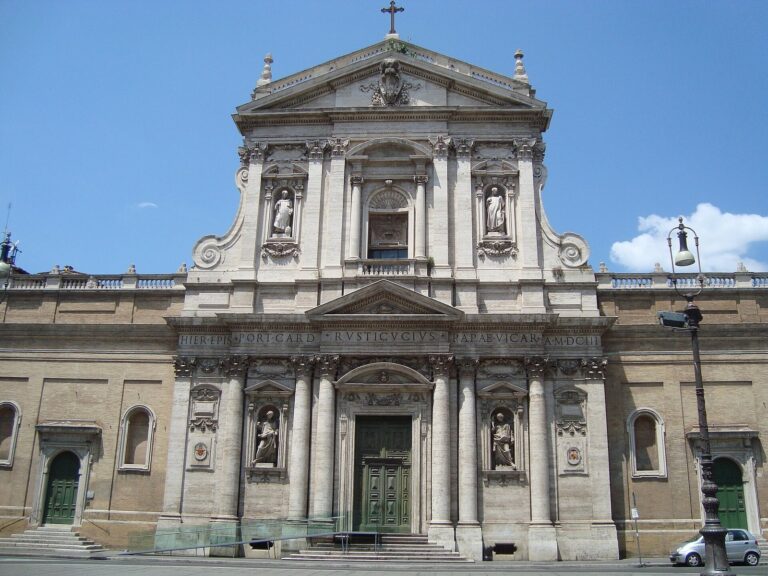
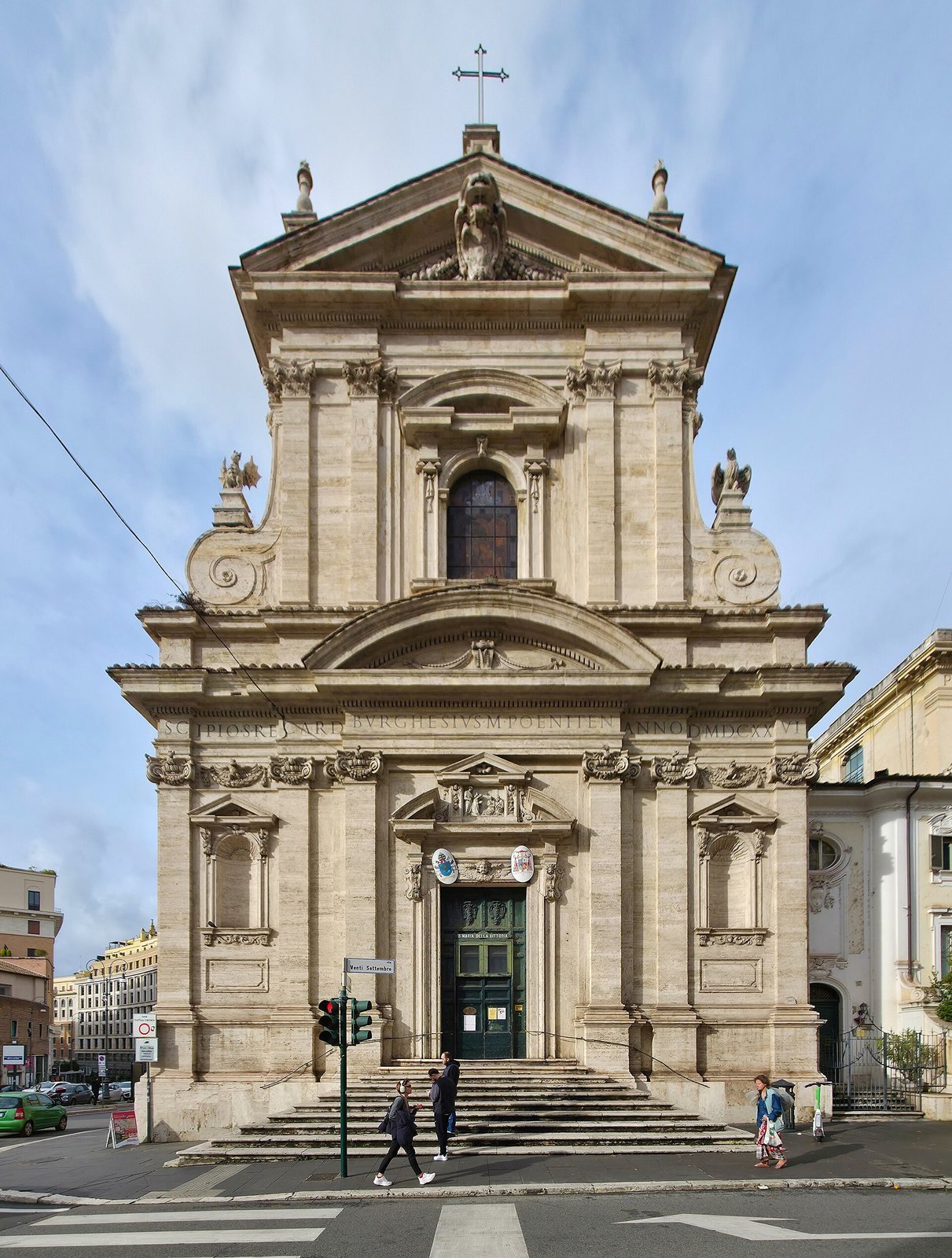
The church stands on Via Venti Settembre, at its junction with Largo Santa Susanna, in Rome’s Sallustiano district. It is beside the Fountain of Moses and faces Santa Susanna across the square. Its plan measures about 35 by 19 metres. Carlo Maderno designed the church, while Soria designed and built its principal façade between 1624 and 1626, drawing on the nearby church of Santa Susanna.
The façade follows a type associated with Counter-Reformation churches. It has two balanced tiers, paired pilasters, scroll-shaped volutes, and a horizontal entablature, the structure above the supports. Projecting sections of the entablature draw attention toward the centre. A triangular pediment is combined with a curved one, giving the upper part of the façade a varied outline.
Nave and crossing
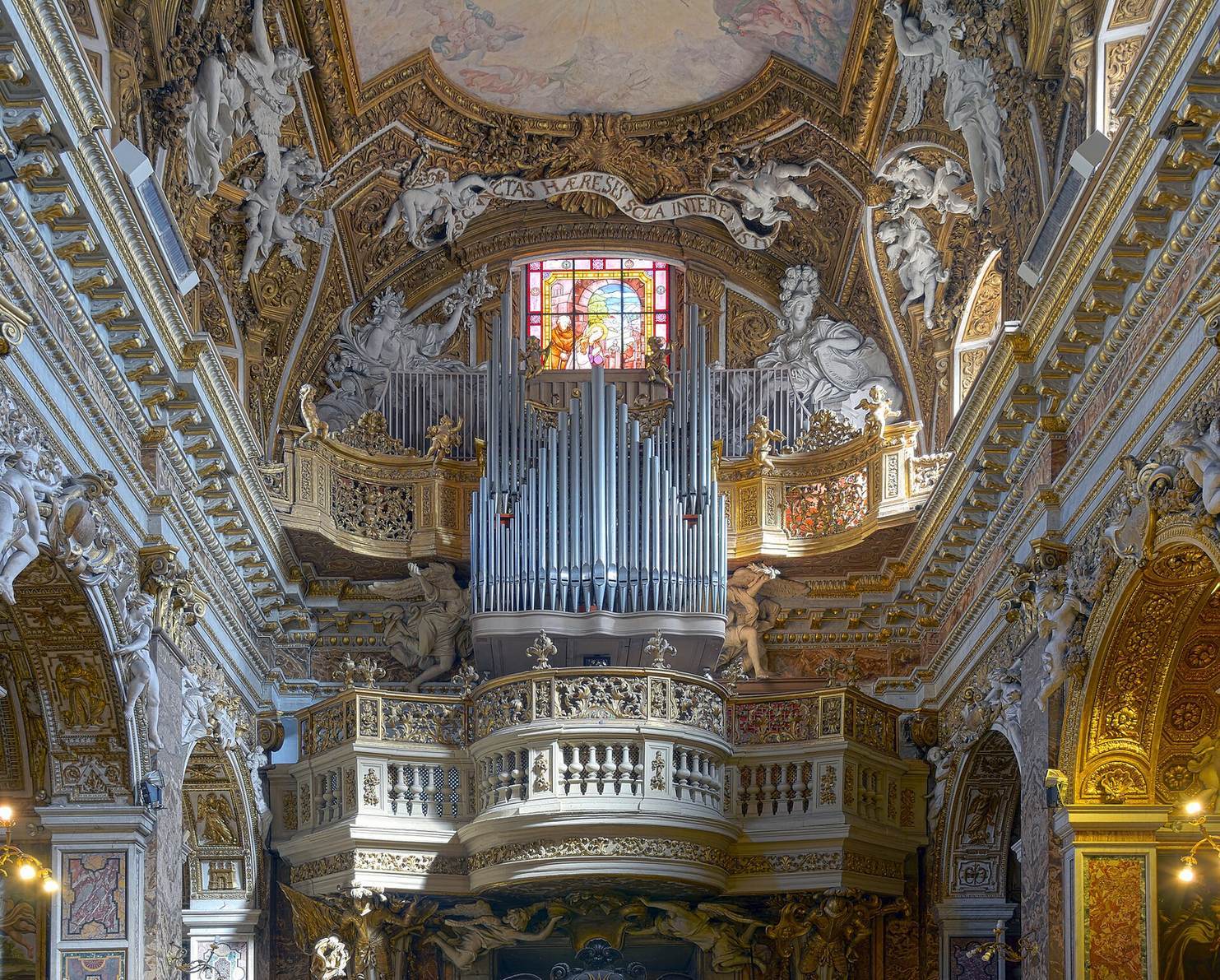
Inside, a broad single nave is covered by a low, shallow barrel vault, a continuous arched ceiling. Side chapels open behind arches. A crosswise transept remains within the nave’s width, and a dome rises over the crossing, where the transept meets the nave. Large Corinthian pilasters, shallow supports attached to the walls, carry gilded capitals and an enriched entablature. Contrasting marble cladding is complemented by molded plaster decoration, including white and gilded angels and decorative child figures in full relief. Mattia de Rossi designed the choir loft.
Paintings and high altar
Vault and dome decoration
A ceiling work titled Triumph of the Madonna over Heretics is attributed to Giuseppe and Andrea Orazzi. Giovanni Domenico Cerrini’s frescoes, painted in 1675, show the Virgin triumphing over heresy and the Fall of the Rebel Angels. Cerrini also painted Saint Paul’s ascent to heaven in the dome. In the half-dome above the curved end of the church, Luigi Serra depicted the miraculous image’s appearance at Prague.
High altar
The main altar is set within rays of gilded bronze and holds a copy of the Virgin’s image brought from Prague. Both the altar and image were reconstructed after the 1833 fire.
Chapels beside the nave
Chapel of Thérèse of the Child Jesus
The first chapel on the right was once dedicated to Mary Magdalene and was later rededicated to Thérèse of the Child Jesus, the French Carmelite nun also known as Thérèse of Lisieux. Silvano Giustiniani received the chapel in 1623 and arranged its decoration. Giorgio Szoldatics painted the altarpiece of Thérèse, while the altar has red breccia columns, made from stone containing angular fragments, with bronze details. Gilded plaster scenes on the ceiling show Mary Magdalene in penitence, her reception into heaven, and the meeting with Jesus traditionally called Noli me tangere, or “Do not touch me.” Giustiniani and Henri I de Montmorency are buried here.
Chapel of Saint Francis of Assisi
The next chapel on the right is dedicated to Saint Francis of Assisi, founder of the Franciscan order. It was granted to Ippolito Merenda in 1627, and Mario Arconio designed its architecture and decoration. Domenichino’s altarpiece shows the Virgin and Child with Francis. Side paintings by Domenichino’s pupil Antonino Alberti depict Francis in religious ecstasy and bearing wounds resembling those of Christ’s crucifixion. Gilded ceiling reliefs show Francis preaching to birds, his glorification, and his temptation by the devil.
Chapel of Our Lady of Mount Carmel
The third chapel on the right was first dedicated to the Assumption of Mary, the Catholic belief that she was taken body and soul into heaven. Cardinal Girolamo Vidoni received its patronage in 1626; it was later rededicated to Our Lady of Mount Carmel. Alfonso Balzico’s 1895 sculpture shows the Virgin giving a scapular, a devotional garment worn over the shoulders, to Saint Simon Stock, a medieval Carmelite associated with the devotion. The sculpture replaced Pompeo Ferrucci’s low relief of the Assumption with Saints Jerome and John. Ferrucci also made the tombs of Cardinal Girolamo Vidoni and Marquis Giovanni Vidoni. Other gilded reliefs depict Jerome’s penitence, Mary’s coronation, and John the Evangelist, Mary Magdalene, and Carlo Borromeo.
Chapel of Saint Andrew
The first chapel on the left is dedicated to Saint Andrew, one of Jesus’s apostles. Marco Aurelio Maraldi commissioned its decoration, completed in 1635–1636. Pietro Camuccini’s 1801 altarpiece copies Guido Reni’s Saint Andrew before Martyrdom. Gilded ceiling reliefs show Andrew being bound to his cross, his crucifixion, and the calling of Andrew and Peter. The chapel contains memorials to Luca Angelo Maraldi, who died in 1636, Blanchia Verzaglia, who died in 1862, and Marco Aurelio Maraldi, who died in 1635. Cavalier d’Arpino painted portraits of Luca Angelo and Marco Aurelio.
Chapel of Saint John of the Cross
The next chapel on the left is dedicated to Saint John of the Cross, a Spanish Carmelite mystic and poet associated with the order’s reform. Monsignor Luigi Bevilacqua commissioned Nicolas de Bar, known in Rome as Niccolò Lorense, to paint scenes of Christ appearing to John, the Virgin rescuing him from a fall into a well, and his death. The altar is flanked by two columns of red and white Sicilian jasper. Two marble angels by Giuseppe Mazzuoli, dated 1695, sit on the pediment and adore the Cross of Christ.
Chapel of the Holy Trinity
The left-side chapel of the Holy Trinity, the Christian belief in one God in three persons, was granted to Cardinal Berlinghiero Gessi in 1629, and he commissioned its decoration. Guercino painted the altarpiece, while Guido Reni made a portrait of Gessi. Above the entrance, Alessandro Algardi’s allegorical figures represent Wisdom and Justice. Giovanni Francesco Grimaldi painted ceiling scenes of the Adoration of the Shepherds, the Transfiguration, and the Baptism of Christ; Algardi made four decorative child figures supporting the oval painting of the Transfiguration. The chapel also contains Gessi’s funeral monument.
Transept chapels
Cornaro Chapel
The private Cornaro Chapel occupies the left transept, opposite the Chapel of Saint Joseph. Cardinal Federico Cornaro commissioned Gian Lorenzo Bernini, a leading Italian Baroque sculptor and architect, to create its central work. The commission came after Bernini lost papal patronage following the death of Pope Urban VIII and the succession of Innocent X, who disliked his style. Bernini’s Ecstasy of Saint Teresa, made between 1647 and 1652, depicts a vision experienced by Saint Teresa of Ávila, a Spanish Carmelite nun and religious writer who led a sixteenth-century reform of the order. She described the experience as both painful and joyful, and the sculpture shows an angel directing a golden arrow toward her heart.
The Carrara-marble figures occupy an altar niche between columns of colored marble, against rays of gilded bronze representing divine light. Bernini arranged concealed light from a window above, with additional illumination from below, now provided electrically. Hidden metal brackets support the figures, which appear suspended within the lighting. Bernini described the work as his finest carving, saying that he had made marble as pliable as wax and brought sculpture and painting together. Critics in his lifetime and in later centuries considered the treatment of Teresa’s mystical experience indecorously sexualized.
The chapel’s later decoration involved Mattia de Rossi, Francesco Ferrucci, Domenico Guidi, Giovanni Barberi, and Nicolas Lorrain; Guido Ubaldo Abbatini painted the vault. Its side walls contain illusionistic, box-like viewing spaces with eight strongly projecting figures from the Cornaro family, including a doge and seven cardinals, shown watching the vision. Giacomo Antonio Fancelli, Baldassare Mari, Giovanni Antonio Mari, Lazzaro Morelli, and Antonio Raggi assisted with the figures. A gilded-silver Last Supper relief at the altar is attributed to Giovanni Pietro del Duca and Francuccio Francucci. Gabriele Renzi made the inlaid praying skeletons in the floor.
Chapel of Saint Joseph
The Chapel of Saint Joseph occupies the right transept. Giovanni Battista Contini designed the chapel and its altarpiece. Domenico Guidi’s sculptural group, The Dream of Saint Joseph, dates to 1695–1699. On the side walls, Pierre-Étienne Monnot made reliefs of the Flight into Egypt and the Adoration of the Shepherds. Bonaventura Lamberti painted the ceiling, where angels raise Joseph to heaven. Four plaster reliefs show Joseph and Jesus in the carpenter’s workshop, Joseph with Jesus, Joseph chosen as Mary’s husband, and Joseph’s death.
The church also contains the burial of Cardinal Pietro Vidoni (1610–1681) and displays the preserved remains of Saint Victoria, venerated as a Christian martyr.