Church of Santa María la Blanca: A Baroque Parish Church in Seville
Site at a Glance
- Popularity
- High
- Country
- Spain
- Primary era
- Early Modern
- Eras represented
- Medieval, Early Modern, Modern
- Civilizations
- Crown of Castile, Spanish
- Site type
- Religious
- Remains
- Church
On this page21 sections
History
The Church of Santa María la Blanca is a Catholic parish church in the San Bartolomé neighborhood of Seville, Spain. Its present character largely reflects seventeenth-century Baroque remodelling in a Borrominesque style, with forms associated with the architect Francesco Borromini. The church also serves as the headquarters of the Brotherhood of the Rosary of Our Lady of the Snows and belongs to the Diocese of Seville.
Synagogue and conversion to a church
A building from the Visigothic period, when the Visigoths ruled much of the Iberian Peninsula, is associated with the site. After King Ferdinand III captured Seville in 1248, he transferred the city’s mosques to the Archdiocese of Seville, while granting three mosques in the Jewish quarter to the Jewish community for use as synagogues. His son and successor, Alfonso X, confirmed the arrangement in 1252. One of those synagogues stood on this site. The synagogue dates to the thirteenth century, and archaeological evidence places a synagogue here after the earthquake of 1356.
Following the anti-Jewish uprising in Seville in 1391, the synagogue became a Christian church. Its medieval form had a Gothic-Mudéjar character, a Christian style that incorporated Islamic-derived forms and techniques. Adaptation for Catholic worship included a new Gothic façade and the removal of the women’s gallery and the first tier of the bell gable.
Seventeenth-century remodelling
Work on the church’s chapels preceded the major remodelling. A baptismal chapel was built in 1642. From 1642 to 1646, Diego Gómez constructed the sacramental chapel above an adjoining house that had been used as a tavern. The main chapel followed in 1660. In 1657, Justino de Neve, a Seville canon and ecclesiastical inspector, raised alms for a new main altarpiece. Martín Moreno, a specialist in assembling altarpieces who had also made the church’s choir stalls, received the commission on 31 August. Pedro and Miguel de Borja also undertook decoration that year.
Between 1662 and 1665, builders renewed the nave and vaults while retaining the earlier Mudéjar structure rather than replacing it wholesale. De Neve was the principal patron and financed the work through a collection; the parish priest was Domingo Velázquez Soriano. In July 1662, De Neve contracted Juan González to build the vaults, including a central vault with lunettes and a dome supported on pendentives, curved sections that carry a dome over a differently shaped space. The earlier stone columns were replaced by jasper columns made by Gabriel de Mena from stone quarried at Antequera. Borja and Pedro Roldán produced plasterwork for the central vault and dome.
The renovated church was inaugurated in 1665. Miguel Mañara, a prominent Sevillian religious and charitable figure, organized a procession for the occasion that also celebrated the Immaculate Conception, the Catholic belief that Mary was conceived without original sin.
Confraternities and later history
The Brotherhood of the Lavatory, Christ of the Mandate, and Mother of God of the Pópulo began at the Church of San Esteban in 1598 and moved to Santa María la Blanca in 1610. It joined the Brotherhood of the Quinta Angustia during the 1623 reduction of confraternities, then separated from it in 1624. Its last recorded penitential procession took place in 1662. The procession included three floats: one depicting Christ washing the disciples’ feet, another carrying Christ of the Mandate on a carved rocky outcrop, and a third bearing the Virgin of the Pópulo beneath a blue velvet canopy supported by ten rods.
The church also served as the seat of the former Confraternity of the Holy Trinity. The confraternity replaced an earlier altarpiece because its images did not fit. It planned to obtain the house behind the present altarpiece of Saint Peter for a dedicated chapel, but financial difficulties and decline brought the plan to an end. The Brotherhood of the Rosary of Our Lady of the Snows, a Catholic lay association focused on devotional and celebratory observances, had its first rules in 1732. It became associated with Our Lady of the Snows in 1864; Leoncio Baglietto made the brotherhood’s image in 1882.
During the French invasion, French forces under Marshal Soult, a military commander of the Napoleonic era, plundered several paintings. Two paintings depicting the origins of devotion to Our Lady of the Snows were returned to Spain and later entered the Prado Museum. Restoration and archaeological study took place from 2010 to 2015, with excavations in 2012 revealing remains of the earlier mosque and synagogue. Spain declared the church an Asset of Cultural Interest, a statutory protected-heritage designation, on 15 November 1995.
Remains
The church has a rectangular plan, an extended chancel, and two additional rectangular sections attached to the Epistle side, the side traditionally associated with the reading of the Epistle during Mass. Its interior combines the retained medieval structure with Baroque alterations, including a richly decorated central nave, side aisles, chapels, and a tower-façade.
Exterior
Main façade
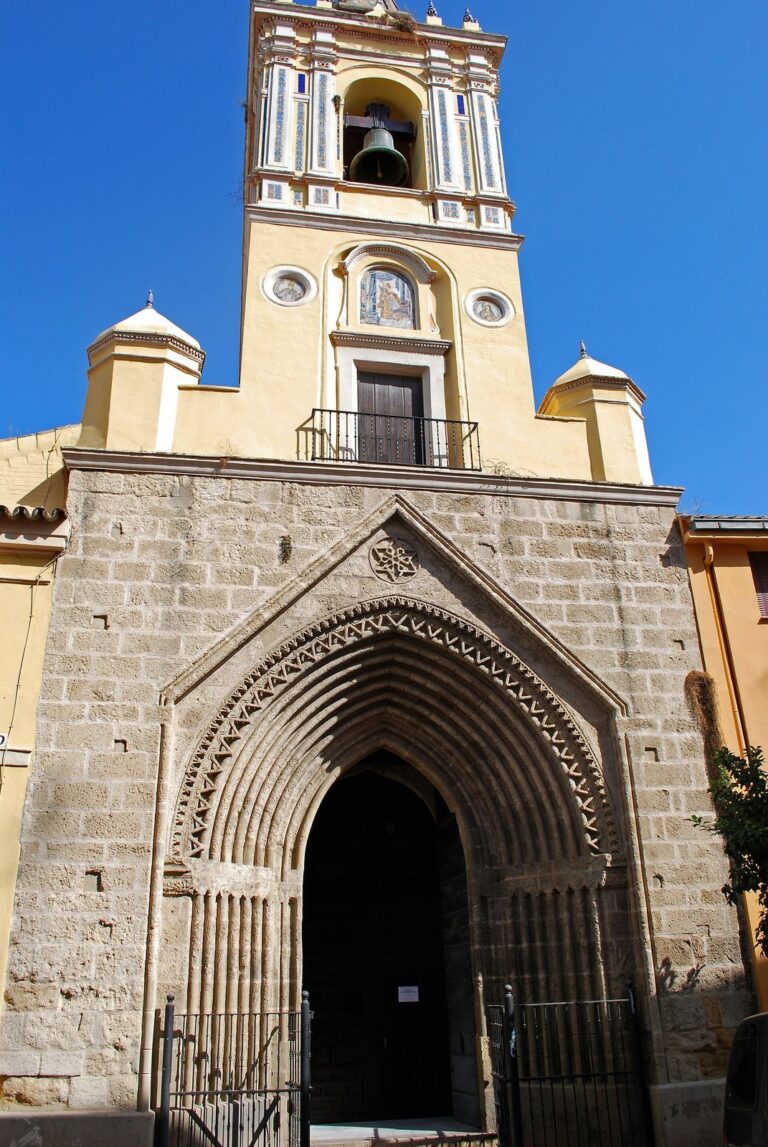
The main façade faces Santa María la Blanca Street and combines the entrance with a tower rising in three stages. A flared pointed arch forms the lower entrance; diamond-shaped carving decorates the stone band around it. Above, the first level has two plain openings with semicircular heads. The next level is a bell chamber with two similar openings framed by pilasters and topped by a broken pediment. A smaller chamber above has one opening between pilasters, ceramic finials, and a cross-shaped weather vane. A tiled image of the Virgin of the Snows, painted by Antonio Morilla in 1957, stands to the right of the entrance between lanterns.
Archeros Street portal
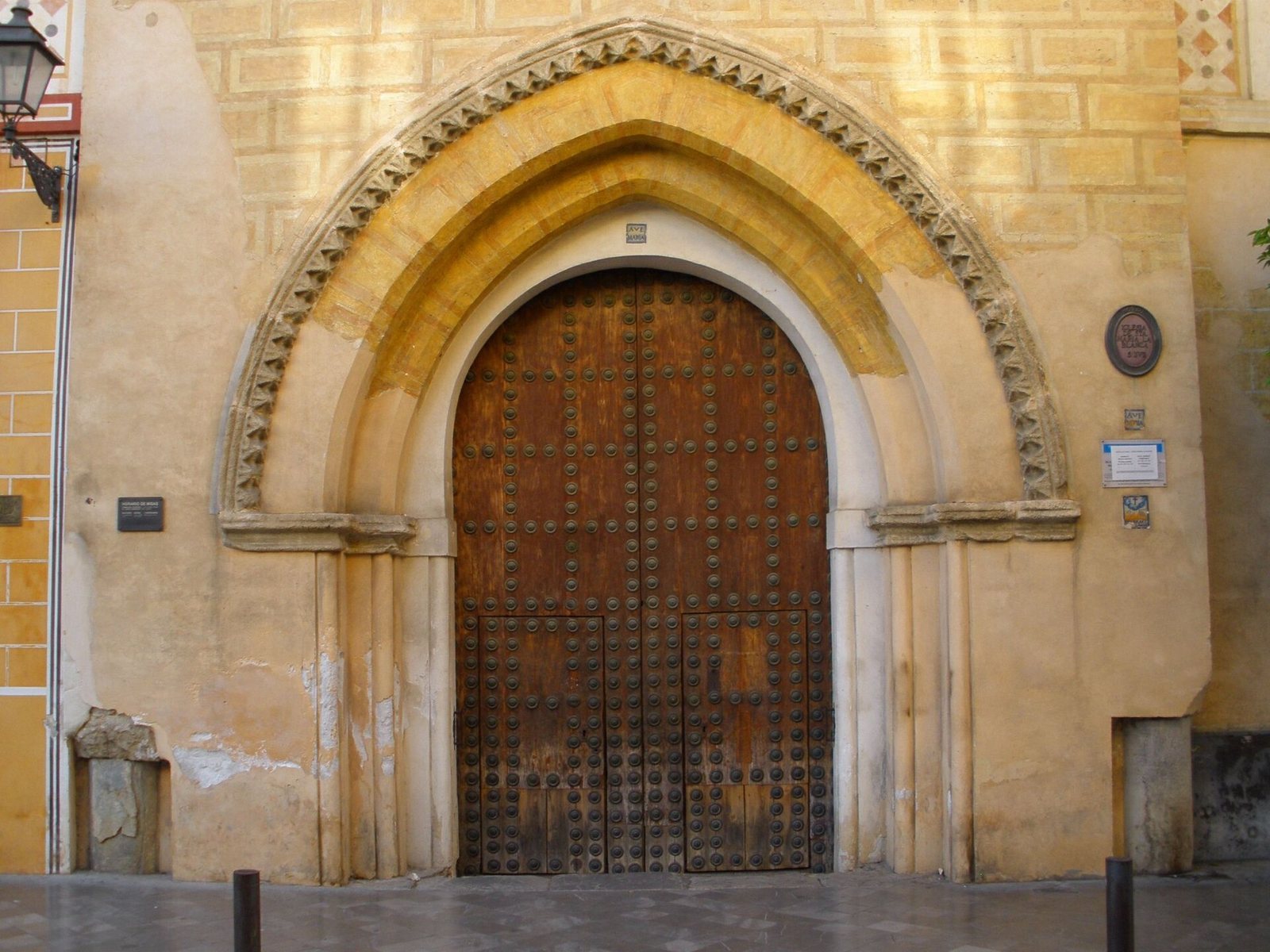
A disused portal on the side facing Archeros Street dates to the alterations of 1642–1646. Its raised arch has a blocked decorative field above it and stands between two reused columns topped with Corinthian capitals, ornate column tops whose style may be late Roman or Visigothic.
Earlier worship buildings
Mosque
The earlier mosque occupied a smaller area than the present church. It extended across four structural divisions from the western end and faced south-southeast. A mihrab, a niche indicating the direction of prayer, lay in the area immediately before the sacramental chapel. The mosque’s entrance was in the parish courtyard, which survives.
Synagogue
The synagogue occupied the same plot as the church. Parts of its wall structure remain beneath the later Baroque decoration, including a Torah ark, the cabinet that held Torah scrolls, in the present presbytery. During restoration of the main altarpiece in 2024, attention was drawn to the surviving remains of the ark in this area.
Interior structure and chapels
Nave and presbytery
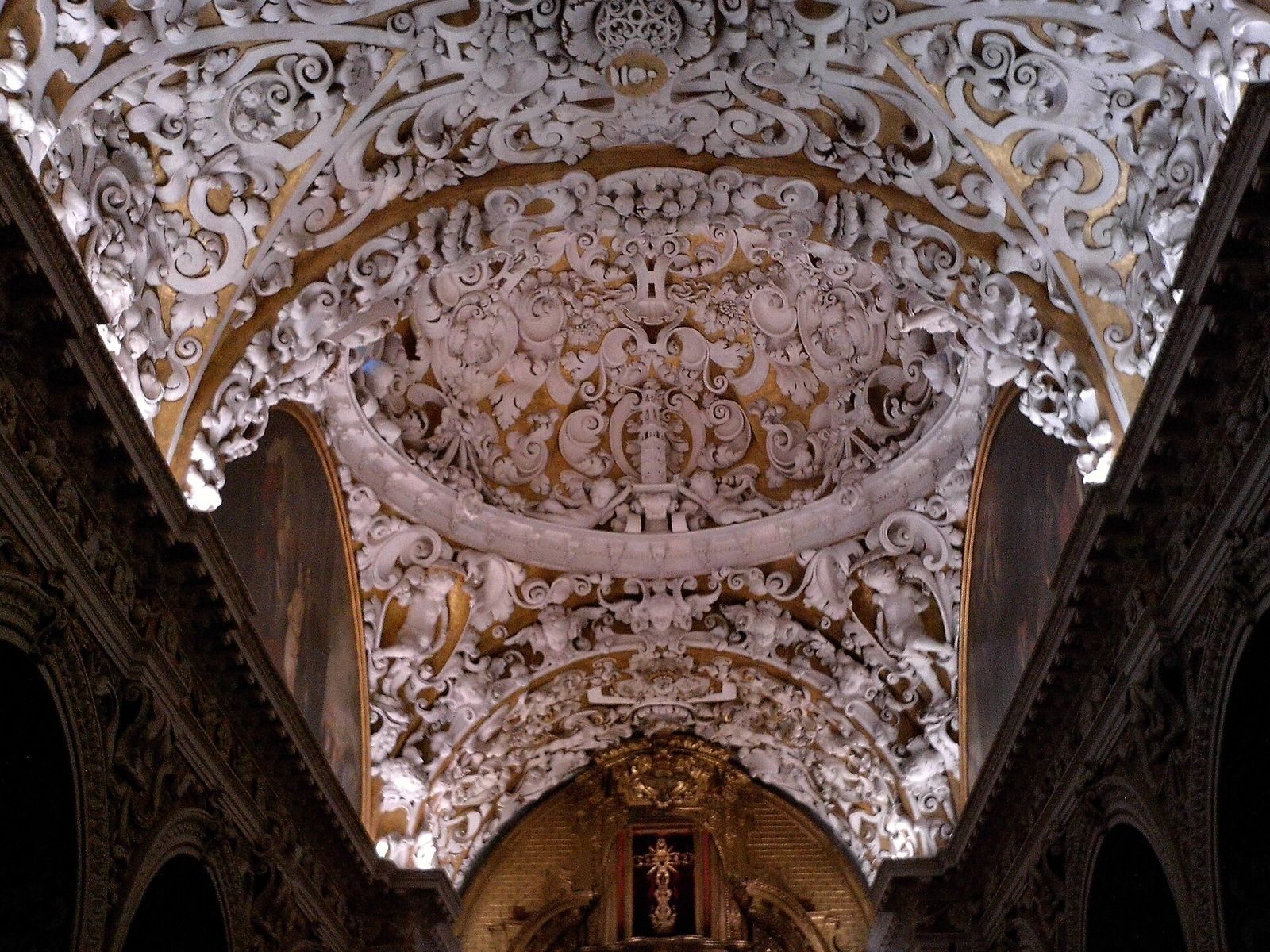
Ten red-marble Tuscan columns, a plain classical type, divide the interior into three aisles and six bays. Semicircular arches support barrel-shaped vaults. The central nave has false lunettes, curved sections formed where a vault meets another surface, while the side aisles have groin vaults formed by the intersection of two barrel vaults. Over the final two central bays, just before the presbytery, the area around the main altar, a dome rests on pendentives and receives light through two circular openings at its sides. A barrel-shaped vault with lunettes covers the presbytery.
Plasterwork with geometric, plant, and human or other figure motifs covers the vaults, dome, and undersides of the arches. The mural paintings follow the same decorative sequence across these surfaces.
Chapels and sacristy
At the western end of the Epistle aisle, the baptismal chapel contains a stairway leading to the tower and choir. The rectangular sacramental chapel stands beside it, while the sacristy lies farther along the same aisle. A portrait in the sacramental chapel depicts Florencio Delgado, founder of the Confraternity of the Holy Trinity; he was a physician, not a priest.
Altarpieces and devotional sculpture
Main altarpiece
The main altarpiece has a carved predella, its lower base section, decorated with floral patterns echoed in the side sections. A silver Eucharistic tabernacle stands between figures of Saints Peter and Paul. Paired Doric columns frame the figures, while two spiralling Solomonic columns with moulded Attic bases frame the upper section, which ends in carvings of seraphim. A crucifix attributed to Juan de Mesa and dated to around 1620 has also been placed on the altarpiece.
Sacramental chapel altarpiece
The chapel’s 1722 altarpiece contains a varied Calvary group, a representation of Christ’s crucifixion, with images associated with the Brotherhood of the Lavatory. Christ of the Mandate, made by Diego García de Santa Ana in 1559 from a composite of wood and paste, forms part of the group. The dressed Virgin of the Pópulo, an image of Our Lady of Sorrows, has been in the church since 1610. Its eighteenth-century silver crown was chased by Blas Amat, and the figure was restored in 2021. The Saint John figure was linked to the work of Cristóbal Ramos after its restoration in 2017.
Altarpiece of the Holy Trinity
Beyond the Archeros Street portal in the same aisle stands the altarpiece of the Holy Trinity. Its eighteenth-century sculptural group is attributed to Blas Molner, and a Pietà by Cristóbal Ramos occupies the lower niche. Relics associated with Saints Victor, Aurelius, Prosper, Cornelius, and Concordia are placed on either side. Small figures of Saint John the Baptist as a child and the Christ Child, belonging to the former confraternity, are usually kept in the presbytery.
Paintings and devotional images
Works in the church
The church retains Bartolomé Esteban Murillo’s The Last Supper, painted in 1650. It escaped French plunder because the dramatic contrast between darkness and strongly lit areas, a style known as tenebrism, led the French to doubt its attribution to Murillo. Other paintings include works by Luis de Vargas in the 1564 altarpiece of the Pietà and a panel of the Ecce Homo, showing Christ presented for judgment, by a follower of Luis de Morales at the altar of Saint John Nepomuk.
Paintings in other collections
The Dream of the Patrician and The Patrician John and His Wife before Pope Liberius depict the origins of devotion to Our Lady of the Snows. Formerly positioned beneath the dome before the presbytery, they are now in the Prado Museum. An Immaculate Conception formerly on an end wall of a side aisle is now in the Louvre, while The Triumph of Faith, also formerly on a side-aisle end wall, belongs to the Faringdon collection.