Church of San Isidoro: A Gothic-Mudéjar Parish Church in Seville
Site at a Glance
- Popularity
- Medium
- Country
- Spain
- Primary era
- Medieval
- Eras represented
- Medieval, Early Modern
- Civilizations
- Crown of Castile, Spanish
- Site type
- Religious
- Remains
- Church
On this page16 sections
History
Medieval foundations
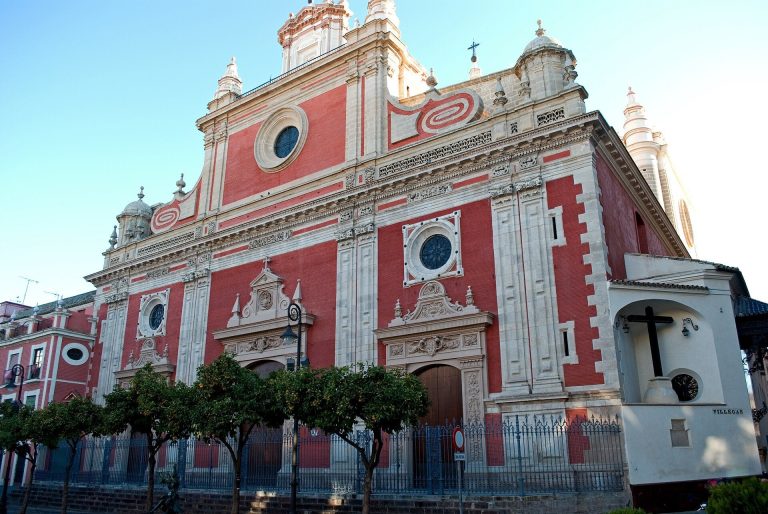
The Church of San Isidoro is a Catholic parish church in Seville, Spain, built in the mid-14th century in the Gothic-Mudéjar tradition, which combines Gothic features with Islamic-derived forms and techniques. Excavations at its elevated site have identified some of Seville’s earliest settlements. The parish was established soon after the Crown of Castile captured the city in 1248, during Christian expansion into al-Andalus. The church is dedicated to Isidore of Seville, a sixth- and seventh-century archbishop and Christian scholar later venerated as a saint.
Rebuilding and parish growth
In the late 16th or early 17th century, the church’s sanctuary end was rebuilt, enlarging the area around the altar and adding two side chapels. One was first dedicated to John of Nepomuk, a 14th-century Bohemian cleric later venerated as a saint, and later became associated with the Villalpando family. The other, the Chapel of the Maestres, takes its name from a title historically used for the head of a military order.
Further changes in the 18th century added chapels along the Gospel side, the left-hand side when facing the altar. The parish’s central urban position supported a large and active congregation, whose members helped establish chapels and made numerous donations. The tower was erected in 1752 and extensively redesigned in the Baroque style during the mid-18th century.
Brotherhoods and later history
Two historic religious brotherhoods are based at the church. The Sacramental Archconfraternity of the Three Falls, a lay religious association with special ecclesiastical privileges, takes part in a Good Friday penitential procession during Holy Week. The Brotherhood of Our Lady of Health and Saint Ignatius of Loyola, named for the 16th-century Spanish cleric who founded the Society of Jesus, also holds a procession.
The Alfalfa Cross marked a common grave associated with Seville’s 1649 plague. Devotion to the cross gave rise to a brotherhood that had disappeared by the 19th century. After 1840, residents successfully requested that the monument be moved beside the church from its original position in the former Plaza de la Alfalfa, where rubbish had accumulated and caused local problems. The church was declared a Spanish Asset of Cultural Interest on July 25, 1995, and remains a Catholic parish served by diocesan clergy in the Archdiocese of Seville.
Remains
Plan and structural form
The church has a rectangular plan, with a central aisle, two side aisles, a crosswise transept, and chapels along the sides. Ten square-section pillars support semicircular arches that rise slightly above their supports. Baroque alterations replaced the original pointed arches and cross-shaped pillars. A trough-shaped timber ceiling with geometric patterns of interwoven bands covers the central aisle, while the side aisles have sloping roofs. A hemispherical dome over the transept crossing rests on pendentives (curved supports that carry a dome above a square space). Tunnel-shaped barrel vaults cover the transept arms and the main chapel.
Entrances and tower
Portals
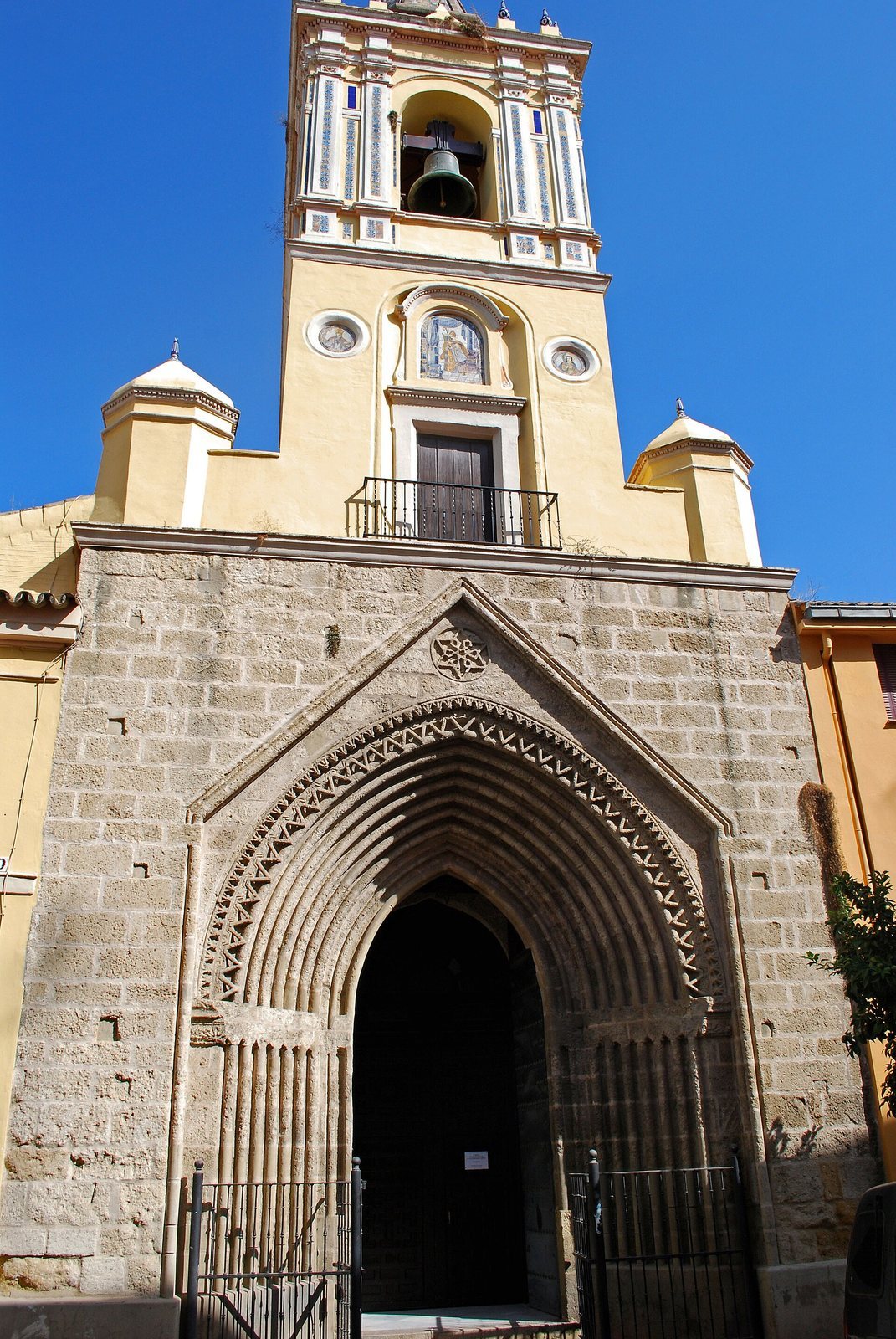
The church has three portals. The distinctive portal on the Epistle side, the right-hand side when facing the altar, is reached through an elongated vestibule between the nave wall and the doorway. The vestibule’s far end forms the tower’s first stage. This arrangement has no known parallel among Gothic-Mudéjar buildings in lower Andalusia. The portal has a deeply recessed pointed arch edged with archivolts (bands that follow an arch’s curve) and sawtooth ornament. A triangular, pediment-like molding frames the arch, with a Star of Solomon at its apex, a Jewish symbol also used in late medieval architecture.
The portal at the church’s foot is built of dressed stone and has been substantially altered. Its present pointed arch is framed by an alfiz (a rectangular frame around an arch); the original opening was probably horseshoe-shaped. At the foot of the Gospel-side nave, the left-hand side when facing the altar, a late-18th-century doorway has a flat-topped opening framed by flat wall-attached columns. These support a horizontal band decorated with alternating grooved blocks and recessed panels.
Tower
The tower stands on the Epistle side and is predominantly Baroque in appearance. Its spiral staircase, covered by a vault with intersecting curved surfaces, may be its only surviving Mudéjar feature. Tilework on the tower depicts Saint Isidore and his older brother, Saint Leander, who also preceded him as archbishop of Seville.
Chapels and interior decoration
Decorative iron screens are fitted to the side chapels and to the chapels flanking the main chapel.
Sacramental and Three Falls chapels
The Sacramental Chapel and the Chapel of the Brotherhood of the Three Falls open off the Gospel-side nave and date to the third quarter of the 18th century. Mid-17th-century plasterwork decorates the Sacramental Chapel.
Baptismal and La Milagrosa chapels
The Baptismal Chapel stands at the foot of the Gospel-side nave. The Chapel of La Milagrosa, a devotional title for the Virgin Mary, is the only chapel opening off the Epistle-side nave. Both chapels have vaults supported on squinches (corner supports that carry a vault).
Chapel of the Maestres
Also known as the Chapel of the Blood of Christ, this chapel stands at the head of the Gospel-side nave. It contains the 14th-century Gothic crucifix called the Christ of the Blood, one of three Gothic crucifixes noted in Seville province. The other two are the Christ of the Million in the main altarpiece of Seville Cathedral and the Christ of Saint Peter in Sanlúcar la Mayor. A tiled dado, the lower part of a wall, decorates the chapel. The tiles are attributed to Hernando de Valladares and date to 1609.
Villalpando Chapel
The Villalpando Chapel has a tiled dado of the same attribution as the tiles in the Chapel of the Maestres, also dated to 1609.
Main chapel and altar
The main altar was designed in 1752. Its large painting, made by Juan de Roelas in 1613, depicts the death of Saint Isidore. An elaborate frame made by Benito de Hita y Castillo in 1752 surrounds the painting. The main chapel’s vault features painted architectural forms framing Saint Ferdinand, generally identified with Ferdinand III of Castile, the king associated with Seville’s 1248 conquest, and Saint Hermenegild, a Visigothic prince later venerated as a martyr. In 1752, Pedro Tortolero was commissioned to paint the vault and gild and decorate the altarpiece (a decorated structure behind or above an altar).
Alfalfa Cross
The Alfalfa Cross is a cross monument now beside the church. Its original site was the former Plaza de la Alfalfa, now Alfalfa Street.