St. Jakob in Friedberg: A Neo-Romanesque Catholic Parish Church
Site at a Glance
- Popularity
- Low
- Country
- Germany
- Primary era
- Modern
- Eras represented
- Medieval, Modern
- Civilizations
- Duchy of Bavaria, German, Holy Roman Empire, Kingdom of Bavaria
- Site type
- Religious
- Remains
- Church
On this page11 sections
History
St. Jakob in Friedberg is a Catholic parish church in Germany, rebuilt in 1871–1873 in the Neo-Romanesque style after its predecessor collapsed. A church dedicated to James the Greater, one of Jesus’ apostles, stood in Friedberg by the late 13th century.
The medieval church and its altars
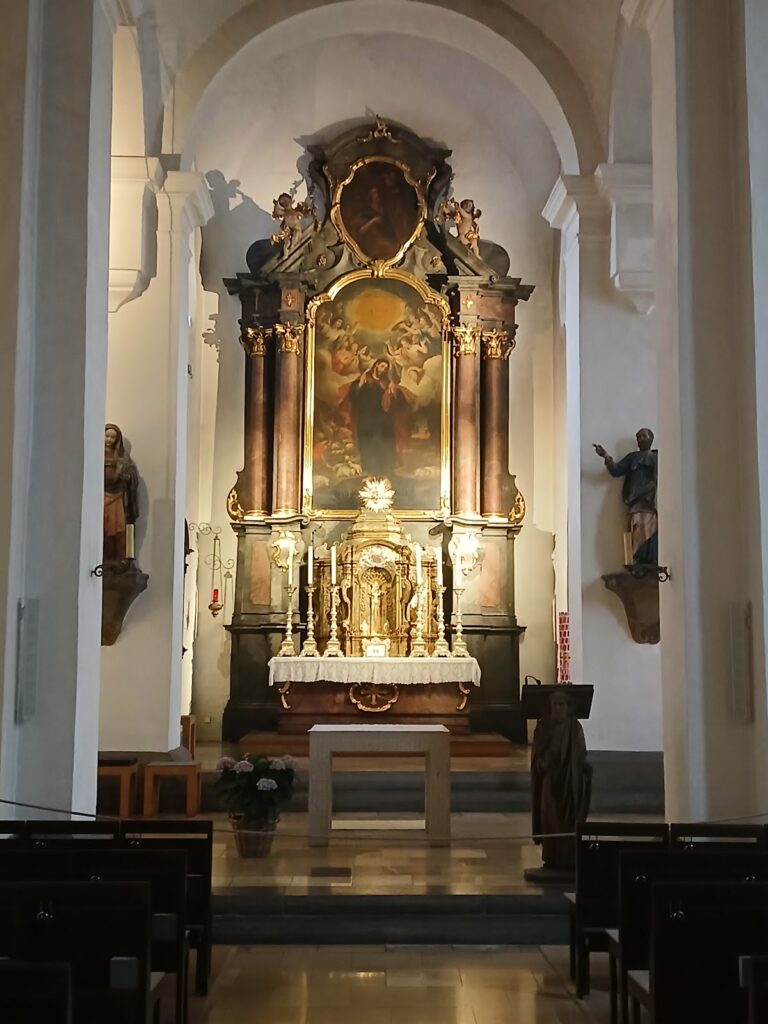
The earlier building was a three-aisled Gothic hall church. Its altars accumulated over several centuries: one honoring the Virgin Mary was present by 1408, an altar to St. John by 1444, a Holy Cross altar by 1471, and one to St. Sebastian by the late 16th century. By 1610, the church had seven altars, dedicated to St. James, the Holy Cross, the Virgin Mary, St. Anne, St. Nicholas, St. Sebastian, and All Saints.
The Thirty Years’ War caused extensive damage, and repairs proceeded gradually. The choir’s restoration was complete by 1713, by which time a tower about 75 metres high had also been built.
Baroque renewal and the tower collapse
An altar dedicated to St. John of Nepomuk was erected in 1737. From about 1740 to 1745, the church was remodeled in the Baroque style. Johann Baptist Anwander painted a ceiling fresco of St. James, and the Bavarian stucco artist Franz Xaver Feichtmayr carried out the plasterwork.
On 2 March 1868, the church’s tower collapsed. The fall destroyed the central nave and the presbytery, leaving the building to be replaced.
The present church and later changes
The replacement church was built in 1871–1873. It began hosting worship on 18 October 1873, while construction continued until 1881, when Bishop Pankratius von Dinkel of Augsburg consecrated it.
A renovation from 1956 to 1958 severely damaged the church’s frescoes. After an earlier Baroque-era organ, further instruments were made by the builders Bohl and Weise. Metzler Orgelbau built the present organ in 2001.
Remains
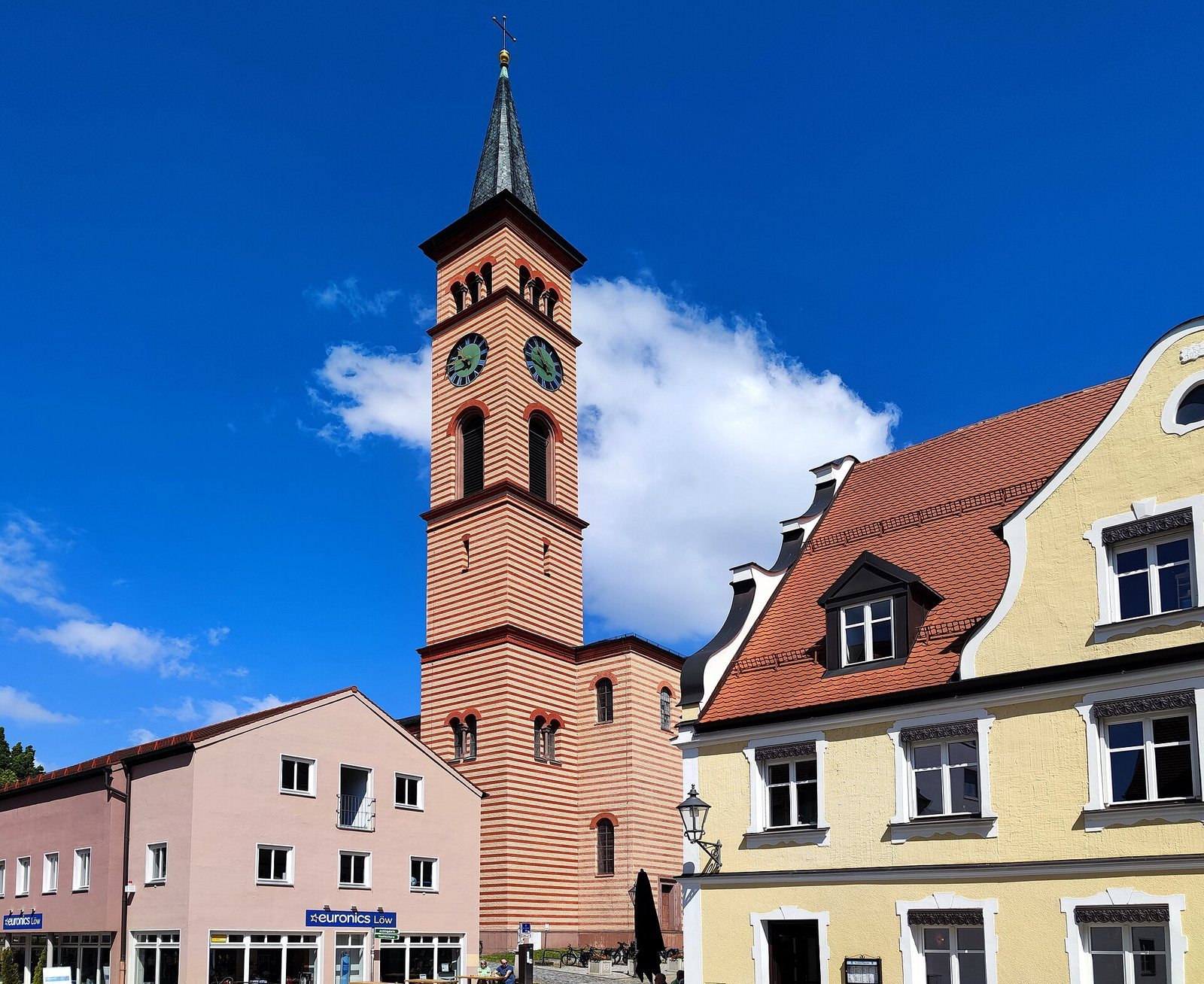
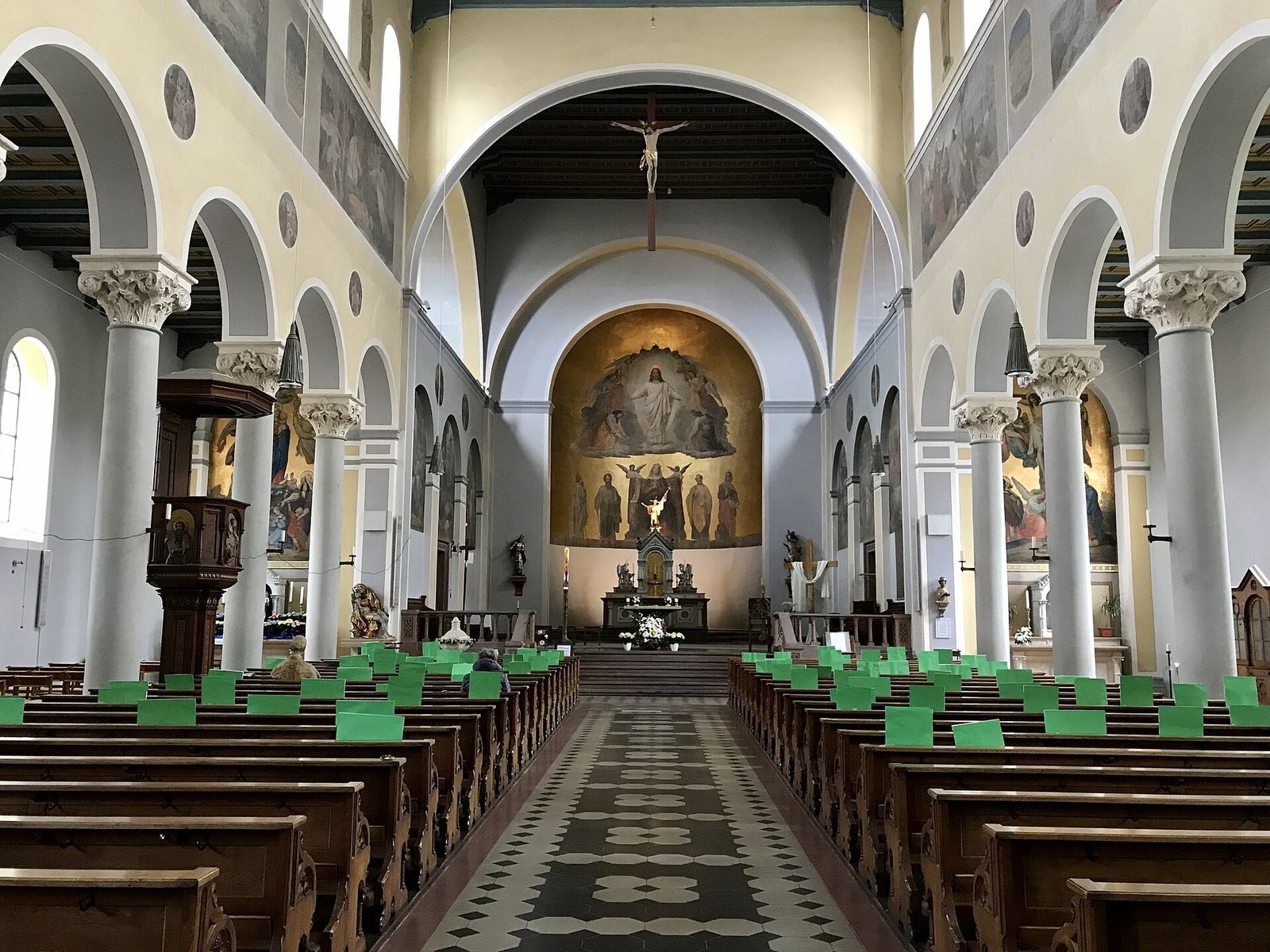
The present church rises 56.6 metres. Its exterior takes San Zeno in Verona as a model, while the interior refers to Sant’Apollinare in Classe in Ravenna. Bricks fired to different degrees create bands inspired by the Italian model. Four bells came from the Johann Hermann bell foundry in Memmingen.
Painted decoration and altars
Frescoes
Ferdinand Wagner’s frescoes express creation by God the Father, redemption through the Son, and sanctification through the Holy Spirit. These paintings were brought from the All Saints Court Church in Munich. In the apse, the rounded end of the church, surviving frescoes show the Second Coming of Jesus and Mary enthroned in heaven, accompanied by the apostles Peter, Paul, John, and James. The chancel, the area around the main altar, contains scenes from the life of Jesus, while four circular panels depict episodes from Mary’s life.
Side altars and saints
The left side altar recalls the earlier church’s altar to the Virgin Mary. The right one brings together associations with its former altars to the Holy Cross, St. Sebastian, and St. John of Nepomuk. A painting depicts St. Lidwina and St. Elizabeth. Wagner used local people as models: Johanna, the niece of city parish priest Schneider, posed for Lidwina, while the wife and children of district-office assessor Schlichtegroll posed for Elizabeth.
Images of James and the apostles
A broad band around the nave depicts the life of St. James, and images of the twelve apostles appear above its twelve columns. Beside the organ, David with a harp and St. Cecilia represent patrons of church music.
The 1409 memorial stone
Set into the west wall of the right aisle, a memorial stone dated 1409 commemorates fortification works begun in Friedberg that year by Duke Ludwig the Bearded. Its inscription refers to the town wall and building work in both the town and the castle. The carving includes the Bavarian ducal arms, two small lions, and a larger lion as a helmet crest. It also shows the princess and raven from the legend of King Oswald, together with a broken chain. A sun disk refers to Ludwig’s admission by Charles VI of France to the Sun Knights, a chivalric group. The stone is regarded as a masterpiece of Gothic stone carving.
The organ
The present organ has a slider-chest, a type of pipe-organ windchest mechanism, and 40 sounding registers, or selectable sets of pipes. It includes three transmissions, which let pipe ranks serve more than one keyboard group. The instrument is arranged across three manuals, or keyboards, and a pedal, or foot keyboard. Its key and stop actions are mechanical. Six couplers link the manuals or connect them to the pedal: II/I, III/I, III/II, I/P, II/P, and III/P.