St. Peter am Perlach: Augsburg’s Civic and Pilgrimage Church


Site at a Glance
- Rating
- 4.7
- Popularity
- Low
- Country
- Germany
- Primary era
- Medieval
- External website
- Open
- Eras represented
- Medieval, Early Modern, Modern
- Civilizations
- Holy Roman Empire
- Site type
- Religious
- Remains
- Church
On this page19 sections
History
St. Peter am Perlach is a Roman Catholic filial church and former collegiate church in Augsburg, Germany, built in the Romanesque period and traditionally associated with Bishop Embrico around 1060. Written evidence records the creation of a collegiate foundation at an existing church in 1067. Located beside Augsburg Town Hall and the Perlachturm, it developed as a religious institution with an enduring civic and pilgrimage role.
Foundation and Medieval Development
The church community expanded quickly through donations from Schwigger von Balzhausen and wealthy Augsburg patrician families. Its leaders were sometimes appointed directly by the pope, an indication of the institution’s position in medieval Augsburg. Because the church originally stood outside the city walls, it was repeatedly destroyed. When the earlier building collapsed during a service in 1182, the present church was erected on its site.
A chapel was added in 1248. It was first dedicated to Saint Catherine and, from 1273, also to Saint Felicitas. The church’s grounds had a public and judicial role as well as a religious one. From 1260, a fish market operated in front of the church on land belonging to St. Peter, while the square was also used by the church as an execution site.
Civic and Religious Roles
St. Peter acquired a formal connection with Augsburg’s municipal government. In 1385 and again in 1622, regulations required a service at the church before the election of the mayor. This tradition underlies its continuing description as Augsburg’s “civic church.” Each year after the summer recess, the city council and lord mayor traditionally attend an ecumenical service there.
The Reformation affected St. Peter less severely than several other Augsburg churches. Nuns from the Maria Stern convent continued to attend Mass there until 1576, and changes to the church’s appearance continued during the eighteenth century. These alterations included the extensive Baroque remodelling of the choir, which gave the medieval building much of its later interior character.
Suppression, Damage, and Renewal
After Augsburg was incorporated into Bavaria, the Bavarian state dissolved the collegiate foundation of St. Peter. Demolition threatened the church, but citizens secured its reopening for worship in 1811. An agreement with the Bavarian state in 1913 provided more secure protection for its continued existence.
A renovation in 1893 revealed medieval and eighteenth-century frescoes. It also uncovered the founder’s tomb in the nave, identifying the founder as Count Schwigger von Balzhausen. British air attacks on the night of 24 to 25 February 1944 severely damaged the church. The building became accessible again in 1954, after which Jesuits provided pastoral care there until 2010. A complete renovation was finished in 2006.
Mary Untier of Knots and the Perlachturm
St. Peter am Perlach is now a filial church of St. Moritz and remains a pilgrimage church dedicated to Mary Untier of Knots. This Marian devotion presents Mary as a patient helper in resolving human difficulties and troubled relationships. The image was commissioned in 1700 by the canon Hieronymus Ambrosius Langenmantel, who served at St. Peter from 1666 to 1709. Its commissioning is traditionally linked to a family story in which Langenmantel’s grandfather Wolfgang sought the prayers of the Jesuit Jakob Rem during a marital separation, after which peace was restored between the couple.
The devotion later spread to South America after Pope Francis encountered the image during a stay in Germany, took a copy to Argentina, and helped establish its veneration there. A copy made by Marta Beti has stood in the San Jose del Talar church in Buenos Aires since 8 December 1996, where it attracts regular pilgrims. St. Peter am Perlach is protected as a listed monument in Bavaria.
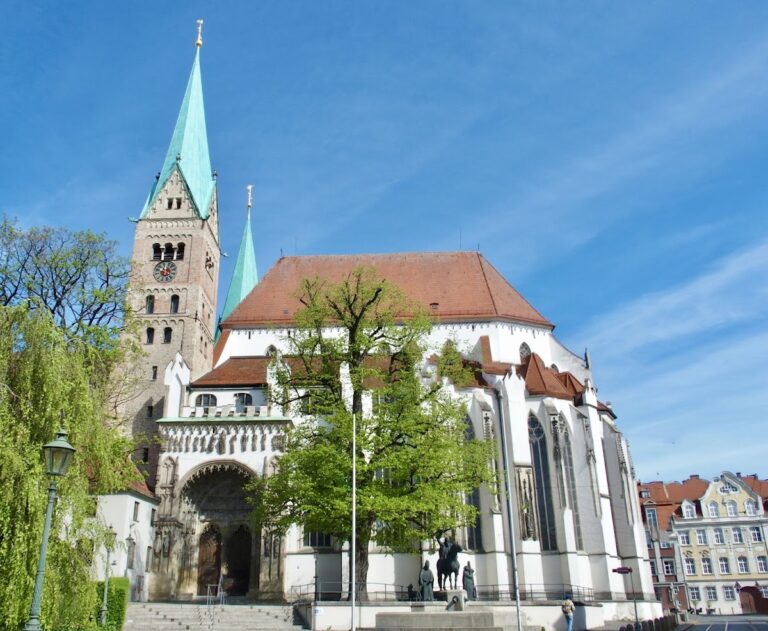
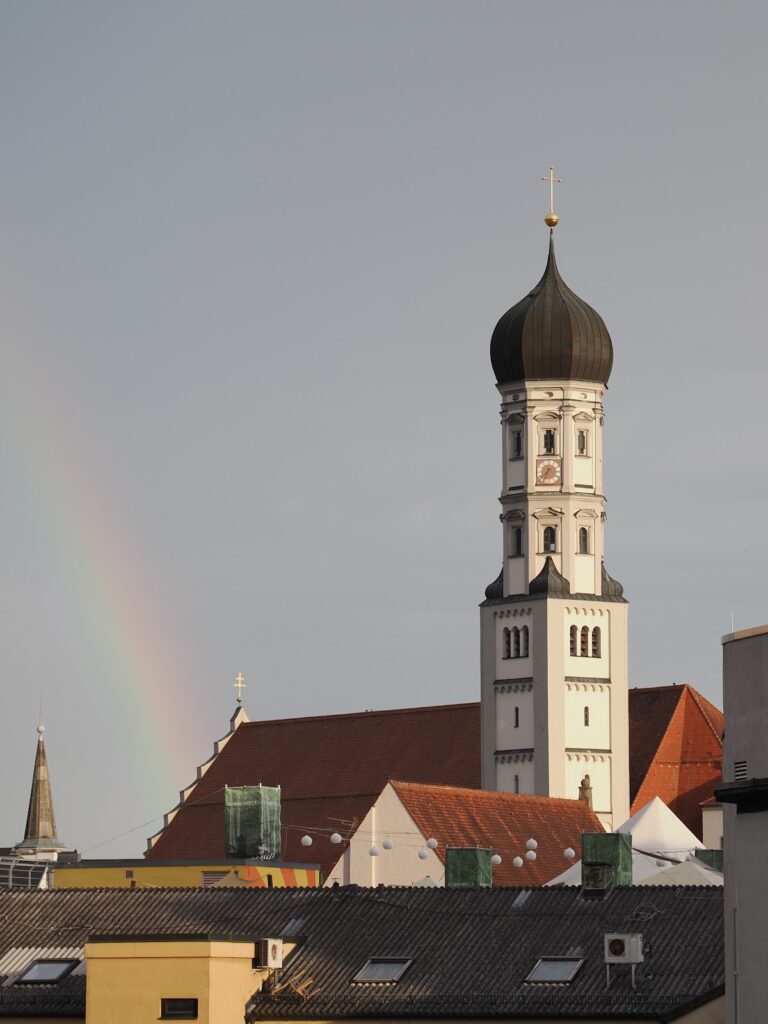
The Perlachturm began as a 30-metre watchtower built in 989 and was later incorporated into the church’s functions as its bell tower. Although connected to the church, it remains structurally and institutionally independent. The tower is now 70 metres high, and together with Augsburg Town Hall it forms a landmark ensemble in the city. On Michaelmas, the Christian feast of Saint Michael observed on 29 September, the Turamichele appears hourly in the lowest west-facing tower window and symbolically spears the devil at its feet with a lance. Flowers decorate the window for the occasion.
Remains
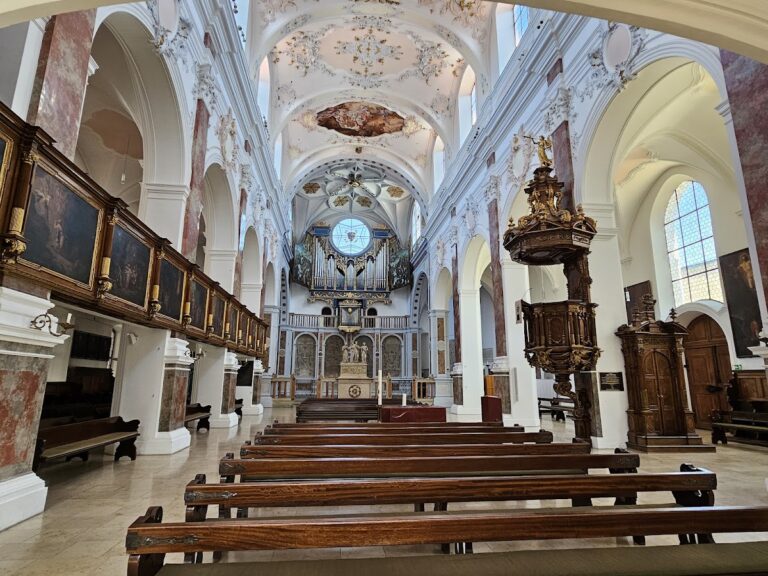
St. Peter am Perlach is a three-aisled Romanesque hall church built in brick. In a hall church, the nave and side aisles are approximately equal in height, and here the three aisles rise to nearly the same level. The interior measures about 27.50 metres in length, almost 15 metres in width, and approximately 10.60 metres in height in the central aisle. Four bays are covered by cross vaults, and the building has no transept. The central aisle ends in a rectangular main choir, the southern aisle in a semicircular apse, and the shorter northern aisle in an altar area.
Structure and Western Bay
Interior Supports
The piers stand on simple plinths and carry Baroque impost blocks. The western bay is formed by the structure beneath the organ gallery, whose piers have half-columns set on Attic bases. The large sacristy, formerly the Chapel of Saint Catherine and Saint Felicitas, forms a separately owned part of the complex. Its exterior walls belong to the Free State of Bavaria, its interior to the St. Peter am Perlach Citizens’ Association, and the Perlachturm to the City of Augsburg.
Organ Gallery
The organ gallery has three sections. The central section, which now houses the organ, may formerly have served as a chapel. The two side rooms open toward the main interior through arcades supported by Romanesque columns. Their capitals carry foliage and palmette ornament, while Baroque angels holding scrolls by Christian Erhardt decorate the space above. The organ dates from 1688 and is the oldest surviving organ in Augsburg.
Western Bay Furnishings
The central chapel of the western bay contains the so-called Fugger Christ, a cross associated with a donation by Georg Fugger in 1522. Its maker is uncertain. A 1707 tabernacle, a fixed architectural receptacle for the reserved Eucharist, originally stood on the Sacred Heart altar in Augsburg Cathedral. The citizens’ association acquired it in 1864 and transferred it to St. Peter am Perlach. Its decoration includes fruit, flowers, and acanthus.
The former eastern-choir grille of Augsburg Cathedral was purchased by St. Peter after the pope’s visit to Augsburg in 1782 and installed in the church in 1785 to screen the second bay. Made in 1656, it was renewed around 1700 and repaired again in 1785. The nave also contains four reliquaries acquired from the cathedral parish in 1864, reliefs of Saints Peter and Paul from the second half of the seventeenth century, and a 1520 sculpture of Saint Felicitas with her sons in a niche above the entrance to the Felicitas Chapel.
Nave and Main Choir
Nave Furnishings
A painting of Saint Joseph by Georg Johann Knappich probably entered the church as a donation from Ignaz von Schellenberg for the Joseph altar in 1696. The side-aisle seating dates from around 1700, while the choir stalls in front of the side-aisle apses belong to the late sixteenth century. Baroque wrought-iron apostle lamps and holy-water basins remain among the interior furnishings.
Baroque Choir
The choir was extensively altered during the Baroque period. Its marbled high altar was built between 1760 and 1770 and carries two putti on a broken entablature. The altarpiece, donated by Anton Fugger in 1625, combines a depiction of the Good Shepherd by Johann Matthias Kager with Saint Peter by Johann Georg Bergmüller.
A terracotta Madonna in the choir area probably dates from around 1420 to 1430. The figure originally held the Christ Child, which has been lost. It was reworked in 1620 and 1670, then restored to its original state in 1934. Beside the choir stands a sculpture of Saint Peter donated by Octavianus Secundus Fugger in 1581. A second, fifteenth-century wooden figure of the apostle is used today as an ambo, a stand from which readings are proclaimed.
Medieval Memorials
The church also contains a terracotta Pantocrator, an image of Christ as universal ruler, from the period of the church’s construction. The enthroned and blessing figure originally stood at the apex of the eastern gable. On the south wall of the altar area, the founder’s grave slab probably dates from the second half of the fourteenth century. Before the Baroque changes, it formed part of a high tomb positioned in the centre of the church.
Fugger Sacrament House
Set into the north wall of the altar area is a sacrament house, a fixed receptacle for the Eucharist, bearing the Fugger arms and the date 1522. This early Renaissance work is framed in Solnhofen limestone and was donated by Marcus Fugger the Younger, who also served as provost of St. Peter am Perlach.
Side Apses and Pilgrimage Images
Northern Apse
The northern apse contains a relic of Saint Crescentia of Kaufbeuren, installed in a medieval altar in 1997. Above it hangs a late-seventeenth-century Crucifixion with the Virgin Mary and Saint John. Beneath the altar is a 1997 medallion of Crescentia by Gernot Hausner, based on older engravings. Restoration work revealed an Adoration of the Magi from around 1420, together with remnants of a miracle and bishop’s legend in the curved inner surface of the arch.
Southern Apse
The southern apse holds the pilgrimage image of Mary Untier of Knots. Mary is shown untying a tangled knot while crushing a serpent’s head. She is clothed with the sun, stands above the moon, and wears a crown of stars. The painting has been attributed by the Augsburg art historian Bruno Bushart to Johann Georg Melchior Schmittner.
The apse is flanked by a 1520 sculpture of Saint Ulrich and an early-eighteenth-century sculpture of Saint Afra. A Good Friday sacrament house by Martin Ziegelmayr was inserted into the wall in 1995. Medieval frescoes found during restoration include two women from the late thirteenth century, probably Mary Magdalene with an ointment vessel and either Saint Helena or Saint Elizabeth with a crown.
Perlachturm Connection
The Perlachturm rises to 70 metres beside the church, but its structural and institutional independence from St. Peter remains clear despite their connection. The ground floor of the tower contains the southern and central chapels of the church’s western bay, linking the tower to the building’s surviving architectural arrangement while preserving its separate identity.