Fountain of the Idol: A Roman Sacred Fountain in Braga, Portugal
Site at a Glance
- Popularity
- Medium
- Country
- Portugal
- Primary era
- Classical
- Eras represented
- Classical, Modern
- Civilizations
- Portuguese, Roman
- Site type
- Religious
- Remains
- Sanctuary
On this page11 sections
History
The Fountain of the Idol, also known as Fonte do Ídolo, is a Roman sacred fountain in Braga, northern Portugal, probably created in the first century AD during the reign of Augustus. Bracara Augusta, founded around 16 BCE under Augustus, Rome’s first emperor, became the capital of Gallaecia, a Roman province in the northwest of the Iberian Peninsula. The fountain stood in the former territory of the Callaici Bracari, an ancient people of the region. It is the sole Roman monument from Bracara Augusta to survive in substantially intact condition and provides evidence of indigenous worship under Roman rule, when devotion to local deities was generally permitted alongside worship of Roman gods.
Roman origins
Celicus Fronto commissioned the fountain for a water cult centered on Tongoenabiagus, a local deity associated with watercourses. The deity was linked with Nabia, a goddess of the Lusitanian people. The work therefore reflects religious practice in which local traditions continued under Roman authority.
Early records and ownership
Georg Braun marked the spring on a map of Braga in 1594. By 1695, the property belonged to Father Santos Rodrigues, vicar of São João de Castelões. After his death, it passed to his niece, Angélica de Barros, who later left it to her brother-in-law, Vicente Gomes do Couto. In the eighteenth century, historian Jerónimo Contador de Argote described a deep spring in a garden known as the Idol, behind the church of São João Marcos. His account included a drawing of the fountain first made by Bishop Alves de Figueire. In 1816, Domingos Fernandes da Silva pursued a legal claim to the land, asserting that it belonged to him.
Nineteenth-century study
Emílio Hübner visited in 1861 and attempted to clarify lettering obscured by lime, using Argote’s notes. The following year, King Pedro V and the Marquess of Sousa examined the fountain after its owner, João de Abreu Guedes do Couto, offered it to the king. Pedro considered relocating it to Quinta dos Falcões as the basis for a museum of carved and inscribed stones, but the proposal was dropped. The property changed hands again: it was sold to Luís do Amaral Ferreira around the 1870s, passed to his wife, Maria do Carmo Sousa, in 1875, and belonged to José Joaquim de Oliveira by the 1890s.
José Leite de Vasconcelos studied the monument in 1894 and returned the next year to examine lettering hidden by lime. He revisited it in 1903 and 1905, proposing that one carved figure represented a religious practitioner and the other a deity. In 1910 the fountain received National Monument status. In 1980–1981, Alain Tranoy proposed the reverse identification, treating the left-hand figure as the deity and the figure in the niche as a worshipper. António Rodríguez Colmenero later suggested a sanctuary serving multiple deities, with the figures representing Nabia and Tongoenabiagus. Other interpretations have identified the left-hand figure as Asclepius, a Roman god associated with healing. Francisco Sande Lemos proposed a possible connection with the sanctuary at Fragas de Panóias in Vila Real.
Protection and conservation
Braga’s municipal government acquired the land around the fountain in 1936 and transferred it, the monument, and adjoining land to the State in 1937, including access from Rua do Raio. The Directorate-General for National Buildings and Monuments then removed the public tank and water pipes. Repairs followed in 1952, and access to the site was developed in 1967. A conservation study in 1995 and an archaeological investigation in 1999 preceded a preservation and interpretation project designed in 2000–2001 and completed in 2004. Excavation and cleaning work in 2003 formed part of that project.
Remains
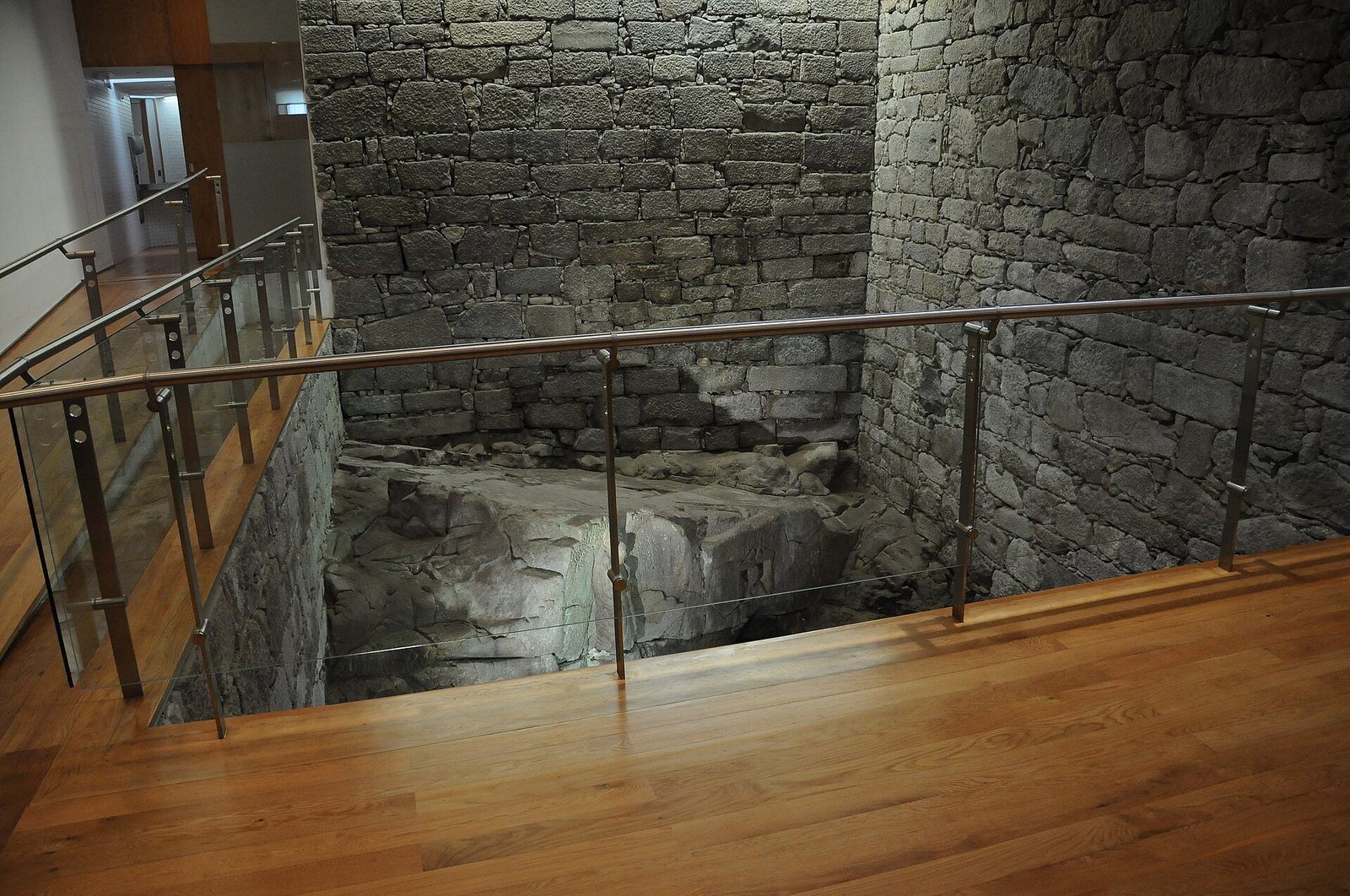
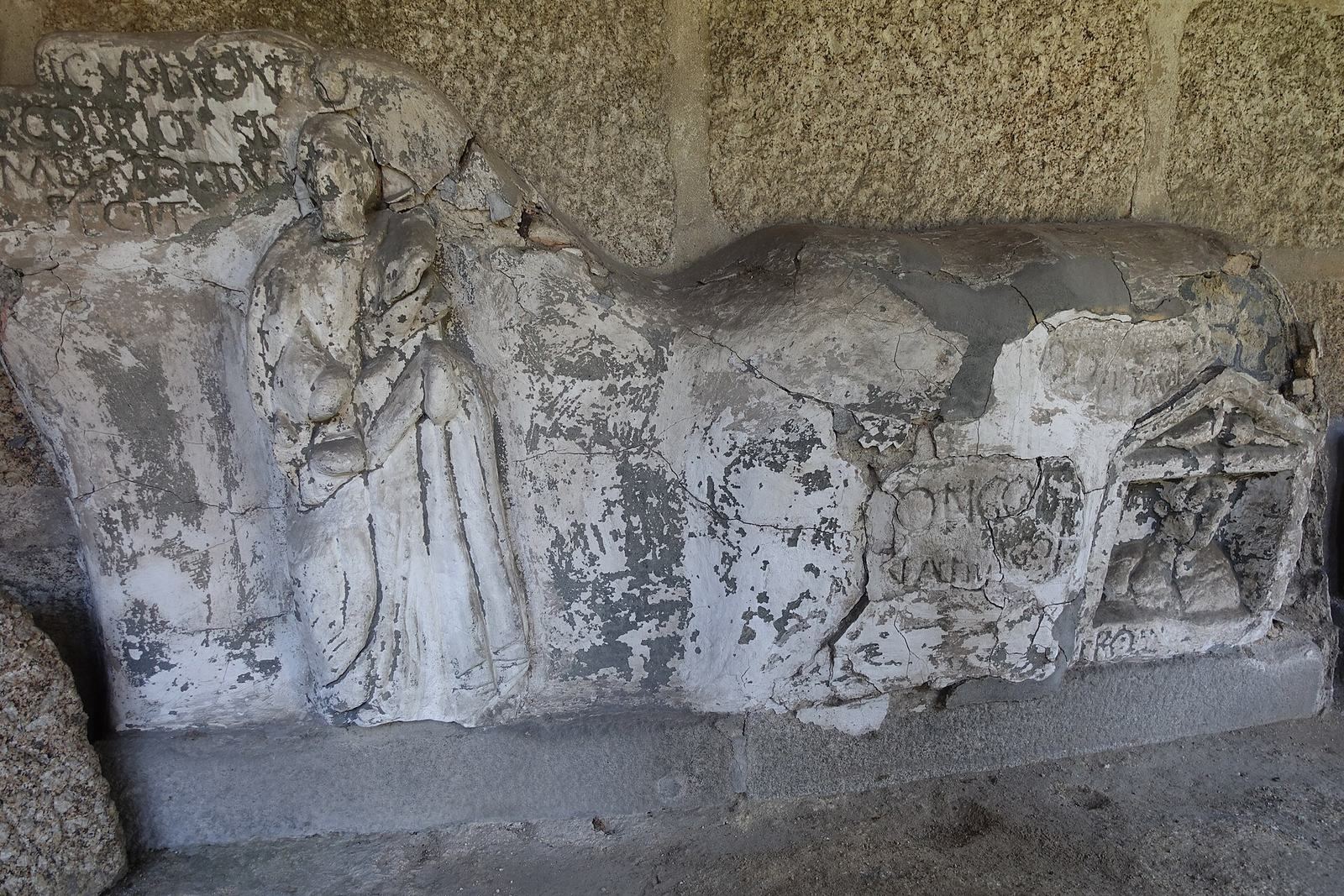
The fountain is carved into a natural granite outcrop in Braga’s historic centre, outside the former boundary of Bracara Augusta and near the Palace of Raio and the Hospital of São Marcos. Its long carved surface measures about 3 metres across and 1.20 metres high, forming a backrest above water that flows from the base. A protective enclosure built in a modern style also serves as an interpretive centre.
Rock-cut carvings
Carved figure
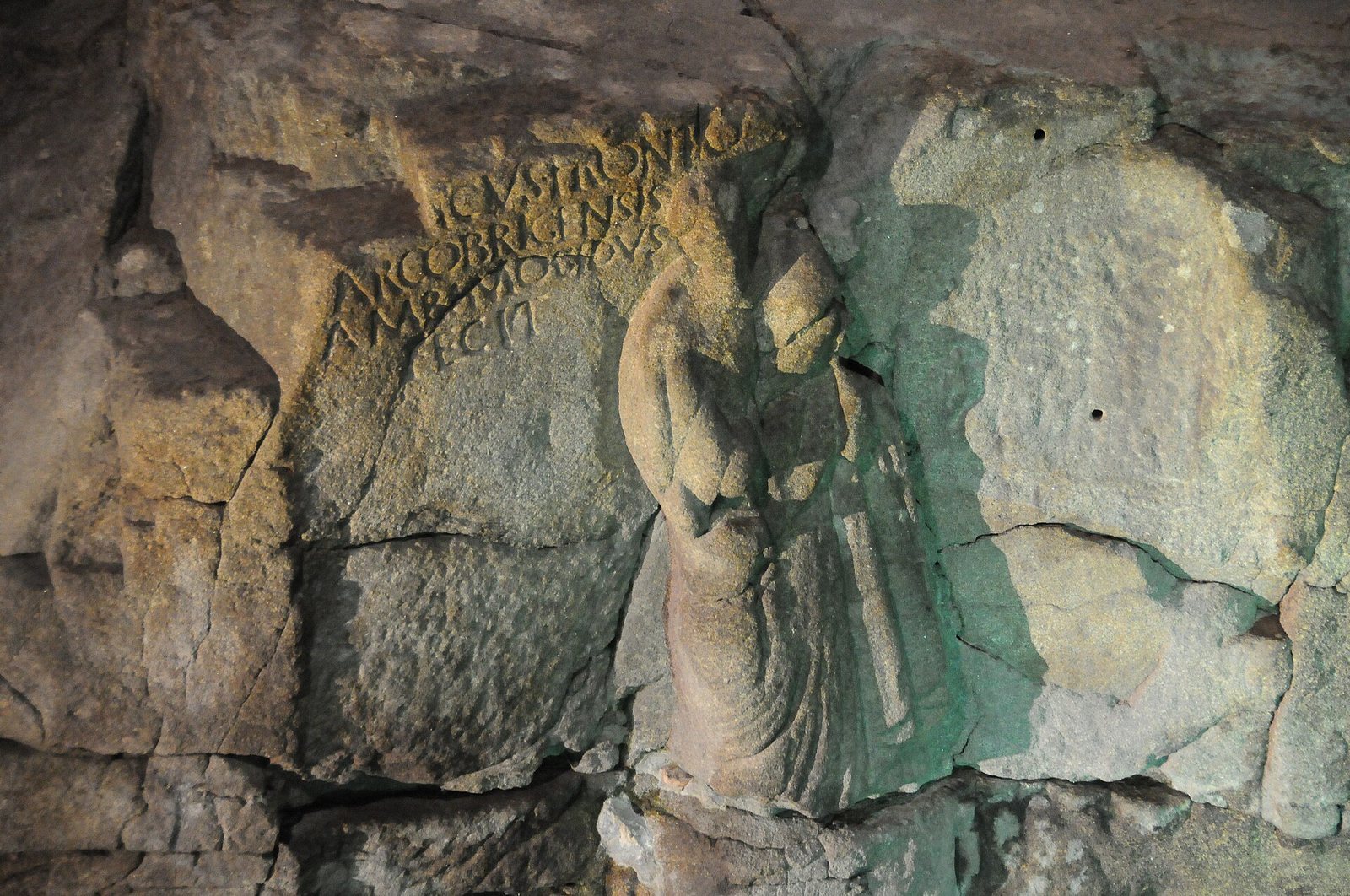
An upright human figure, about 1.10 metres tall, occupies the left side of the rock face. Its worn features may represent a bearded man, and the figure wears a toga. Its left arm holds a bulky object. The carving is damaged; an eighteenth-century description noted that part of the body and the right hand had broken away.
Niche and inscriptions
At a slightly lower level to the right, a rectangular feature cut into the granite measures about 0.7 metres high, 0.6 metres wide, and 0.12 metres deep. A worn human head appears in a niche beneath a triangular pediment, the gabled top of the structure, which bears an engraved bird. Latin lettering runs along the sides and down to the base. The partly cut-away text above the main figure names Celicus Fronto of Arcobriga, Ambimogido, as the maker. Another inscription, CELICVS FECIT, also names Celicus as its creator. TONGOE NABIAGOI gives a form of the deity’s name, while ABAVIS AMOR, above the carving, is translated as “with affection from the great-grandparents.”
Related inscribed stone
A stone associated with the spring came from the former nearby Chapel of Santana, now within the archbishops’ palace. Its inscription describes restoration of the structure by T. Caelicus Fronto and his descendants Mark, Titus, and Lucius, identified as grandchildren and great-grandchildren.
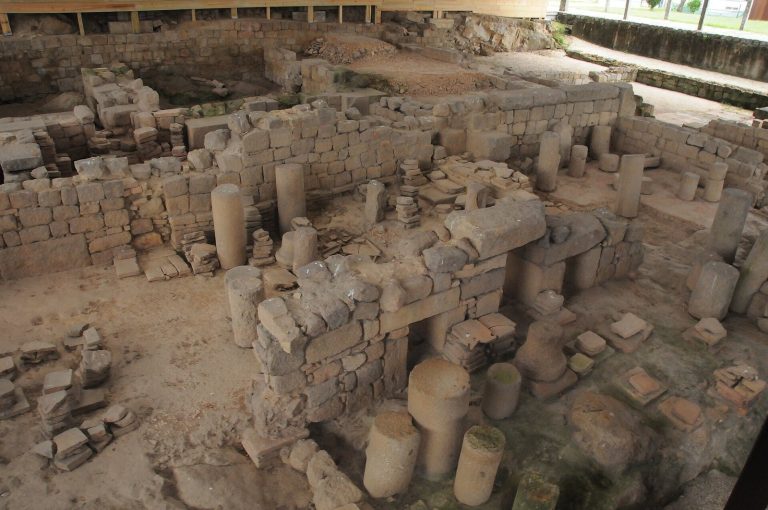
Surrounding archaeological remains
Excavation in 2003 uncovered drainage channels and remains of Roman walls. Demolition work had also exposed curved and flat Roman roof tiles and a votive inscription. Evidence from the area points to a wider sanctuary and a possible additional structure, perhaps a temple dedicated to Nabia. The archaeological remains also suggest that the spring sanctuary may have formed part of a temple.