Museum of Archaeology D. Diogo de Sousa: Archaeological Museum in Braga, Portugal



Site at a Glance
- Rating
- 4.5
- Popularity
- Medium
- Country
- Portugal
- Primary era
- Classical
- External website
- Open
- Eras represented
- Stone Age, Classical, Medieval
- Civilizations
- Ancient Greek, Egyptian, Etruscan, Roman
- Site type
- Museum
On this page16 sections
History
The Museum of Archaeology D. Diogo de Sousa is an archaeological museum in Braga, Portugal, whose collections span the Paleolithic to the Middle Ages and focus especially on the ancient Roman city of Bracara Augusta. Its name honours D. Diogo de Sousa, Archbishop of Braga from 1505 to 1532, who was among the first people to preserve the city’s Roman archaeological heritage.
Early efforts to preserve Bracara Augusta
D. Diogo de Sousa created an open-air display of Roman milestones at Campo de Sant’Ana, now Avenida Central. Roman milestones were inscribed roadside markers that recorded distances and often commemorated the authority responsible for building or repairing a road. In 1769, D. Gaspar de Bragança moved the milestones to Alameda das Carvalheiras.
Braga’s municipal authorities proposed gathering the city’s archaeological material at Alameda das Carvalheiras in 1886. They decided in 1892 to establish a museum there, but the plan was not implemented. Francisco Manuel de Oliveira Carvalho, Viscount of Fraião, submitted another proposal for a municipal archaeological museum in 1897. Although it was unanimously approved, this initiative also failed to take effect.
From private collection to municipal museum
Albano Belino, a Portuguese archaeologist and antiquarian, opened an archaeological museum in the Bracarense Episcopal Palace in September 1899. The museum was small and poorly lit, and it was not open to the general public. When Braga Castle was threatened with demolition in 1905, Belino proposed converting it into a museum. This would have preserved the castle while providing a more suitable home for his collection. The proposal was rejected, the castle was demolished, and Belino later donated his collection to the Archaeological Museum of the Sociedade Martins Sarmento in Guimarães.
The municipal museum was formally founded on 28 March 1918 and was also installed in the Bracarense Episcopal Palace. It did not enter regular operation until the revitalization process that began in 1980. A commission was appointed that year to prepare a revitalization project under Decree-Law 409/80 of 27 December.
Purpose-built museum
Teresa Patrício Gouveia, Secretary of State for Culture in the eleventh constitutional government, later launched construction of a purpose-built museum. A concrete structural frame was erected before the project was suspended. In 1989, Pedro Santana Lopes replaced Patrício Gouveia as Secretary of State and reorganized the services under his authority. The Portuguese Institute of Cultural Heritage was abolished, and the Portuguese Institute of Architectural Heritage and the Portuguese Institute of Museums were created in 1992.
The presidents of the two new institutions, Nuno dos Santos Pinheiro and Simonetta Luz Afonso, froze the museum project because they regarded it as a white elephant in museology. Construction resumed in 2001, and the museum opened to the public in its new building on 29 June 2007. It is administered by Museus e Monumentos de Portugal, E.P.E. The milestones in the Capela Inventory were classified as National Monuments in 1910.
Collections and later additions
The museum’s holdings come mainly from excavations in Braga and elsewhere in northern Portugal. They include material from the Paleolithic through the medieval period, with particular emphasis on Bracara Augusta. The collections include what is regarded as Europe’s finest collection of Roman milestones, thousands of coins from the Early Empire, and tens of thousands from the Late Empire, many of the latter still uncatalogued.
In 2018 and 2019, nearly 300 objects were donated by the Buehler-Brockhaus Foundation and by Hans-Peter Bühler and Marion Bühler-Brockhaus during the centenary commemorations of the museum’s foundation. The objects came from Egyptian, Greek, Etruscan, and Roman contexts. A catalogue of the complete donation, Greco-Roman World Ancient Mediterranean Art, was published in 2020 by Hans-Peter Bühler and others and donated to the museum.
On 1 July 2022, the museum received a Roman votive altar dedicated to Ocaere, an indigenous deity, for permanent exhibition. The altar had been found in 1724 during rebuilding work on the sacristy of the parish church of São João do Campo at Campo do Gerês, in the municipality of Terras de Bouro. The museum conserved and inventoried the altar, and its donation was made through the brother of Ana Maria Braga da Cruz Ferrão, its deceased owner, in accordance with her wishes.
In 2021, Hans-Peter Bühler and Marion Bühler-Brockhaus supported improvement and requalification work that included cleaning and painting the building and improving its security and lighting systems. In 2023, they entered into a loan-for-use agreement involving fifteen objects, including a marble head of the Roman emperor Antoninus Pius, who reigned from 138 to 161, a marble sculpture of a Laconian greyhound, and a marble fragment of a Roman relief showing a quadriga, a vehicle drawn by four horses.
Remains
Building and archaeological displays
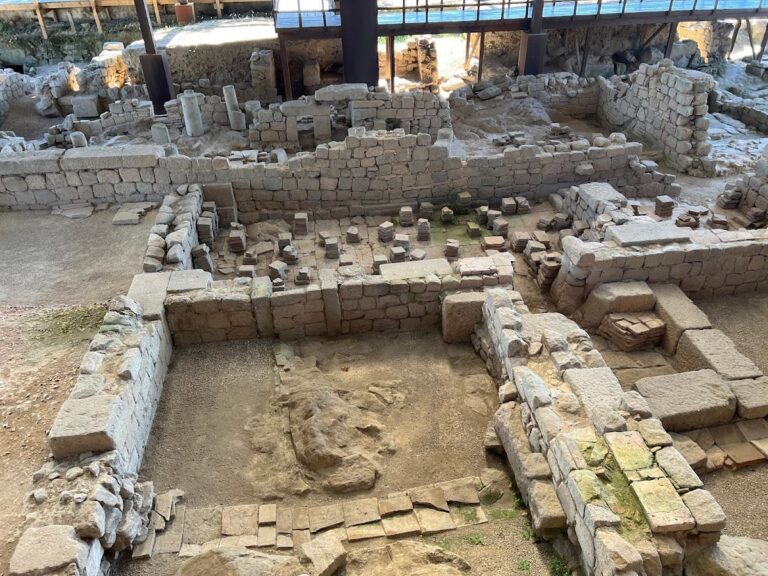
The museum occupies a specially designed building in the centre of the former Roman city of Bracara Augusta. Its construction was marked by the erection of a concrete structural frame, followed by a lengthy suspension before work resumed and the building opened in 2007. A Roman mosaic is displayed in the precise location where it was discovered, keeping the surviving artwork connected to its archaeological setting.
Roman milestones and coins
Milestone collection
The museum’s Roman milestones form a collection regarded as the best in Europe. These inscribed markers represent the road system of the Roman world and preserve information connected with distances and official responsibility for road construction or repair. Their early display and later classification as National Monuments also link the physical objects to Braga’s long history of archaeological preservation.
Numismatic holdings
The numismatic collections contain thousands of coins from the Early Empire, the first centuries of Roman imperial rule, together with tens of thousands from the Late Empire, the later imperial period before the end of Roman rule in the western empire. Many of the Late Imperial coins remain uncatalogued.
Buehler-Brockhaus collection
Sculpture and vessels
The Buehler-Brockhaus donation contains almost 300 objects made from marble, gold, silver, bronze, and terracotta. Greek and Etruscan ceramic vessels are represented alongside Roman glass unguentaria, small containers for perfumes, oils, or other scented substances, as well as utensils, equipment, and ornaments made from precious materials.
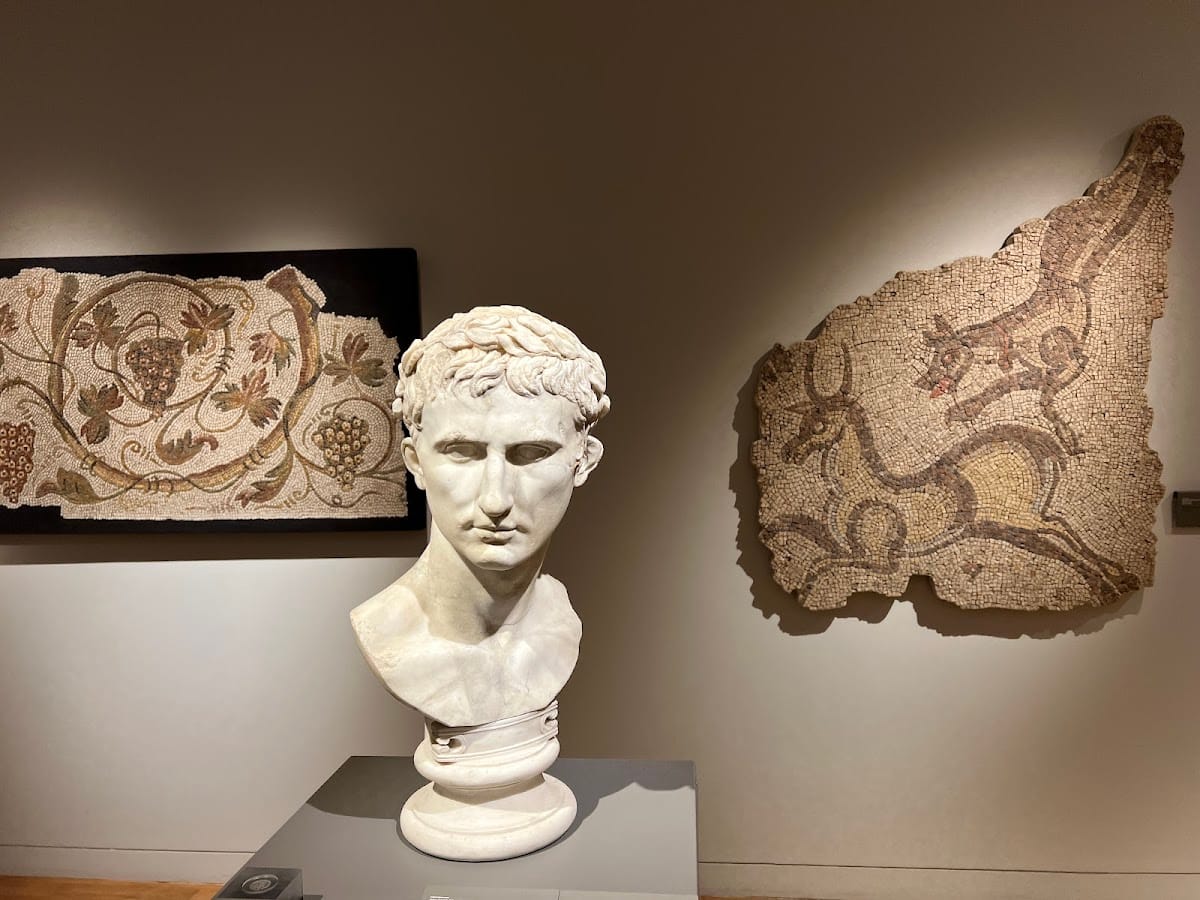
Among the sculptures are a period bust of the emperor Augustus, described as the only example of its kind in Portugal, and a bust of the emperor Trajan. Large-scale works include a marble torso of the goddess Artemis, a marble torso of a military figure, and a large sculpture of a Roman figure wearing a toga. Other notable objects are a cup with a rare Etruscan inscription, a large Apulian volute krater, a vessel used for mixing wine with water, and three large Roman mosaics.
Archive and religious artefacts
Photographic archive
The museum’s photographic archive contains images of architectural and archaeological monuments that no longer exist. It preserves visual evidence for elements of Braga’s heritage that have disappeared and complements the museum’s material collections.
Altar dedicated to Ocaere
The Roman votive altar dedicated to Ocaere is part of the permanent exhibition. Found at São João do Campo in 1724, the altar underwent conservation before being registered in the museum inventory. As a religious monument offered to a deity, it provides a physical example of the indigenous religious traditions represented within the museum’s Roman-period collections.
Objects on loan
The fifteen objects included in the 2023 loan-for-use agreement add further Roman material to the displays. They include the marble head of Antoninus Pius, a marble Laconian greyhound, and a marble fragment from a relief depicting a quadriga.
Nearby sites