Schottenstift: A Benedictine Abbey in Vienna
Site at a Glance
- Popularity
- High
- Country
- Austria
- Primary era
- Early Modern
- Eras represented
- Medieval, Early Modern, Modern
- Civilizations
- Austria-Hungary, Austrian Empire, Duchy of Austria, Habsburg, Holy Roman Empire
- Site type
- Religious
- Remains
- Monastery
On this page17 sections
History
Foundation and medieval development
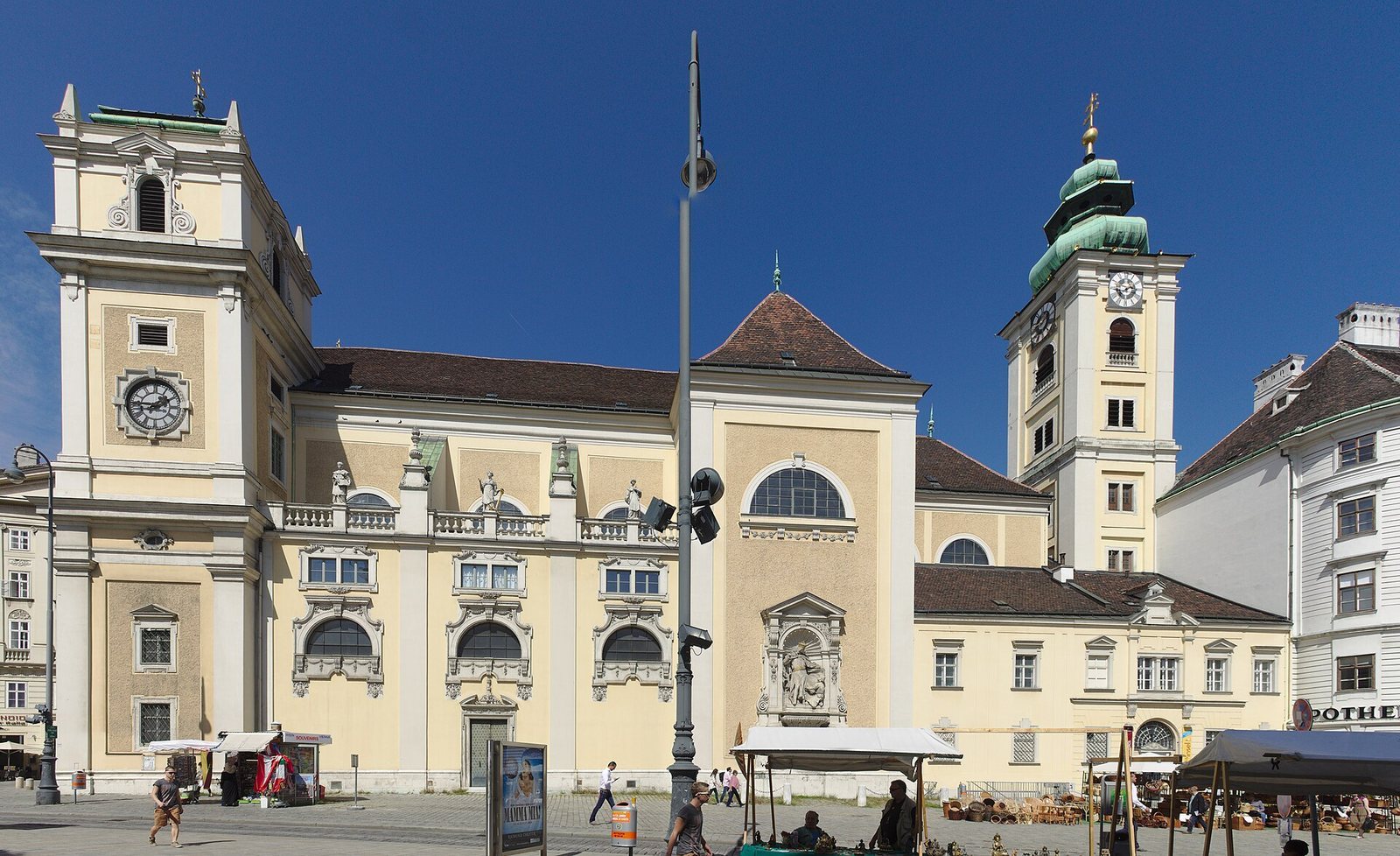
The Schottenstift is a Benedictine abbey in Vienna, Austria, founded in 1155 by Henry II Jasomirgott. Its church began as a Romanesque building and was later rebuilt in Baroque form. Henry was a Babenberg ruler who moved his residence from Klosterneuburg to Vienna and established the monastery to serve his new seat with religious services and resources for administration, education, learning, and care.
The founding community came from the monastery of St James in Regensburg, not directly from Ireland. The name Schotten means Scots, but in this monastic context it referred to Irish monks. Ireland was known in Latin as Scotia Maior, which helps explain the name. Henry granted the monks extensive privileges and property and stipulated that only Iro-Scottish monks could join the community. Its endowment included chapels dedicated to St Ruprecht, St Peter, and Maria am Gestade in Vienna, St Stephen in Krems, the Holy Cross in Tulln, and St Koloman in Laab, as well as the parish churches of Pulkau and Eggendorf. The monks also established a hospice for pilgrims and crusaders travelling through Vienna toward Jerusalem.
Work on the first church began in 1155, the first monastic building was constructed in 1160, and the church was consecrated in 1200. Henry died in 1177 and was buried in the church. A fire destroyed the monastery and many other buildings in Vienna in 1276. By 1310, the abbey maintained a writing school, and its abbots regularly witnessed ducal charters. They appear to have used liturgical insignia associated with bishops by the mid-13th century, although the formal right to do so came in 1287.
The monks also took part in the University of Vienna, founded in 1365. Abbot Donaldus, who held office from 1380 to 1392, became the university’s eighth rector. In 1418, Duke Albert V transferred the abbey from the Iro-Scottish monks to German-speaking Benedictines as part of the Melk Reform, a movement to renew Benedictine discipline and practice. The monastery became a reform centre, while retaining the name Schotten.
Reform, conflict, and early modern change
During the First Ottoman Siege of Vienna, mercenaries lodged at the abbey and plundered its church, library, and archive. The community continued through the Reformation and maintained its school. In the second half of the 16th century, some monks became abbots of other monasteries, while lay religious associations attached to the church grew in prominence. The association devoted to St Sebastian was particularly influential.
The abbey joined the Austrian Benedictine Congregation in 1625; that congregation became part of the Benedictine Confederation in 1893. In 1638, lightning struck the church tower, which fell and damaged the roof. The church was rebuilt in stages. The Second Ottoman Siege of Vienna damaged the abbey’s properties, and the rebuilding work added to its financial strain. The monks responded in part by returning the abbey’s Breitenlee estate, held since the 12th century, to agricultural production. It remains an important part of the abbey’s agricultural base.
In 1702, the abbey incorporated the Hungarian Abbey of Telki, which had been destroyed by the Ottomans, along with the villages of Telki, Jenö, now Budajenö, and Páty. Until Telki Abbey was ceded in 1881, Schotten abbots displayed two ceremonial mitres in their coats of arms. Abbot Karl Fetzer, in office from 1705 to 1750, helped ease the abbey’s financial difficulties and supported scholarship and the arts. In 1715, he founded a gymnasium, an academically oriented secondary school where lay students could take philosophy courses. It closed in 1741.
Abbot Benno Pointner, who led the abbey from 1765 to 1807, prevented its suppression during the Josephinian reforms associated with Emperor Joseph II and affecting religious institutions. This period also brought the incorporation of numerous parishes. In 1773–1774, a new school and priory house were built on the site of a disused cemetery. An imperial decree established the Schottengymnasium in 1807 under Abbot Andreas Wenzel.
Rebuilding and institutional change
During the early 19th century, the abbey sold substantial property in the areas now known as Neubau and Josefstadt as Vienna’s suburbs expanded, particularly around Schottenfeld and Breitenfeld. From 1826 to 1832, Joseph Kornhäusel redesigned the Schottenhöfe, the courtyard buildings around the abbey. The dilapidated convent was demolished and rebuilt, and the medieval cloister was lost in the process.
Abbot Ernest Hauswirth, in office from 1881 to 1901, oversaw the church’s restoration and partial alteration. He commissioned a monument to Henry II on the church façade and arranged for the founder’s remains to be moved to a new sarcophagus in the crypt. The church received the Catholic Church’s honorary title of minor basilica in 1958.
The abbey in the twentieth century
A monastic reform ordered in 1924 was not properly implemented. After a visit in 1930, Abbot Amand Oppitz was pressed to resign, and Hermann Peichl was appointed coadjutor abbot, an assistant to the serving abbot. Peichl became abbot in 1938. During the Second World War, most of the younger monks were conscripted, and the community suffered severe losses. From 1949 to 1966, Schotten monks also cared for the Mariazell priory.
Peichl had the church crypt remodelled in 1960. Under his successor, Bonifaz Sellinger, parts of the old Romanesque church were uncovered, and the abbey opened its Benediktushaus guesthouse. Abbot Heinrich Ferenczy, in office from 1988 to 2006, oversaw extensive building and alteration work in the church, crypt, and gymnasium. The Schottenstift remains a Roman Catholic Benedictine community in the Archdiocese of Vienna, using the Roman rite, the liturgical tradition of the Latin Church, with German and Latin in its liturgy.
Remains
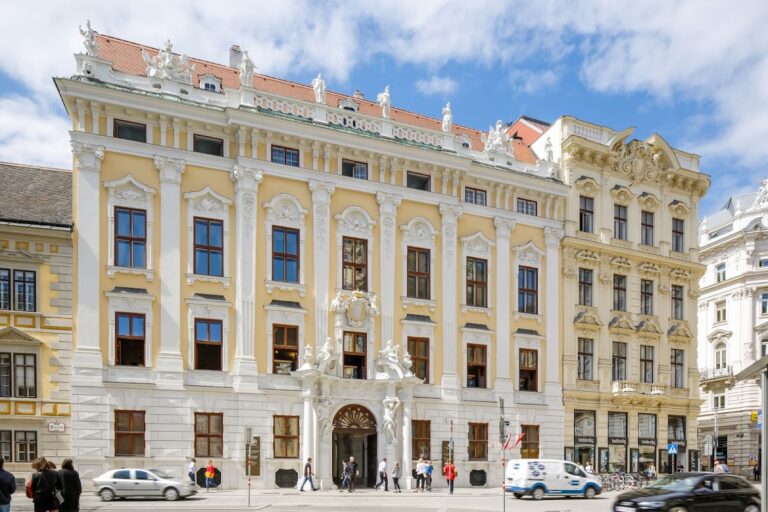
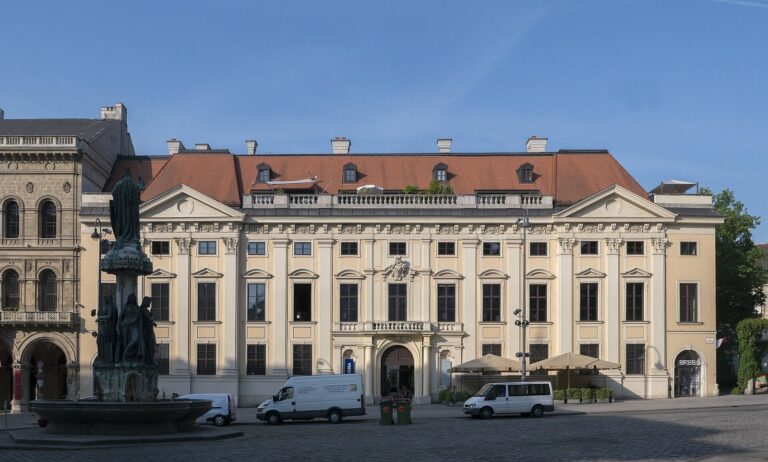
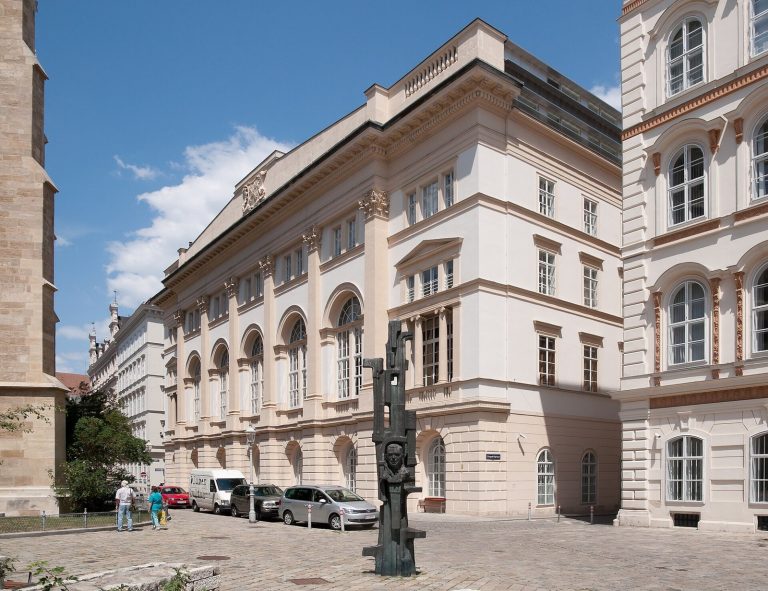
The complex lies between Freyung and Schottengasse. Its principal parts include the abbey church, convent, school, library, courtyards, and the former abbot’s residence and administrative quarters. The church combines the plan of its Romanesque predecessor with the form produced by later rebuilding, while the surrounding buildings reflect successive changes to the monastic complex.
The abbey church
Original plan and rebuilt tower
The first church was a three-aisled Romanesque pier church, with arcades supported by masonry piers rather than columns, a single rounded end, or apse, and a crypt, a chamber beneath the church. Later rebuilding shortened the church and left its tower separate from the nave. The Baroque western tower projects from the façade and rises only slightly above it; a proposed extension was never completed. Peter Concorz carried out the church’s stonework, and Abbot Michael II Schnabel obtained stone from the imperial quarry for a cross. Bartolomäus Khöll carved the main portal in the tower façade in 1651, and Adam Tobias Kracker placed a statue of the Virgin and Child in its niche.
Altars, paintings, and memorials
The church’s 17th-century altarpieces include works by Joachim von Sandrart for the Apostles’ altar in 1652, the Holy Cross altar in 1654, and the high altar in 1671. Tobias Pock painted works for the St Sebastian altar in 1649–1650, the Marian altar in 1651–1655, and the St Benedict altar in 1654. Georg Bachmann painted the St Gregory the Great altarpiece in 1651–1652; the St Anne and St Barbara paintings, dated 1656–1659, are attributed to Jeronimo Joachim. Pock’s fresco of St Wolfgang, painted around 1655, was uncovered again in the late 20th century. A fresco beneath the choir vault depicts the abbey’s foundation and the granting of its privileges.
After the Second Ottoman Siege of Vienna, the church was restored, and memorials were added to the nave pillars for people buried in the crypt. One is a bust of Ernst Rüdiger von Starhemberg, designed by Johann Bernhard Fischer von Erlach in 1701–1702. Another commemorates Ludwig Andreas von Khevenhüller, buried in 1744; other memorial slabs are set into the pillar bases between the nave arcades. The 19th-century restoration added ceiling paintings by Julius Schmid and a new high altar whose design followed sketches by Heinrich von Ferstel. Its mosaic, designed by Michael Rieser, shows the Virgin and Child with St Gregory the Great, St Benedict, John the Baptist, and Henry II.
Crypt and vestibule
A new staircase from the church vestibule made the originally Romanesque crypt accessible in the 19th century. It was adapted with an altar, burial niches, and a neo-Romanesque tomb monument for Henry II. The founder’s remains were transferred to a new sarcophagus there under Abbot Ernest Hauswirth. In the vestibule, an image of St Teresa of Ávila was venerated as miraculous and surrounded by votive tablets.
Convent, school, and courtyards
Convent and school buildings
The rebuilt convent forms part of the Schottenhöfe. Its entrance steps and two large staircases use polished Kaiserstein, a stone quarried near Kaisersteinbruch and marked by translucent colour inclusions. The school and priory house built on the former cemetery became popularly known as the Chest-of-Drawers House because of its shape. The Schottengymnasium forms part of the abbey’s school complex, which was remodelled and partly rebuilt with marble decoration.
Library
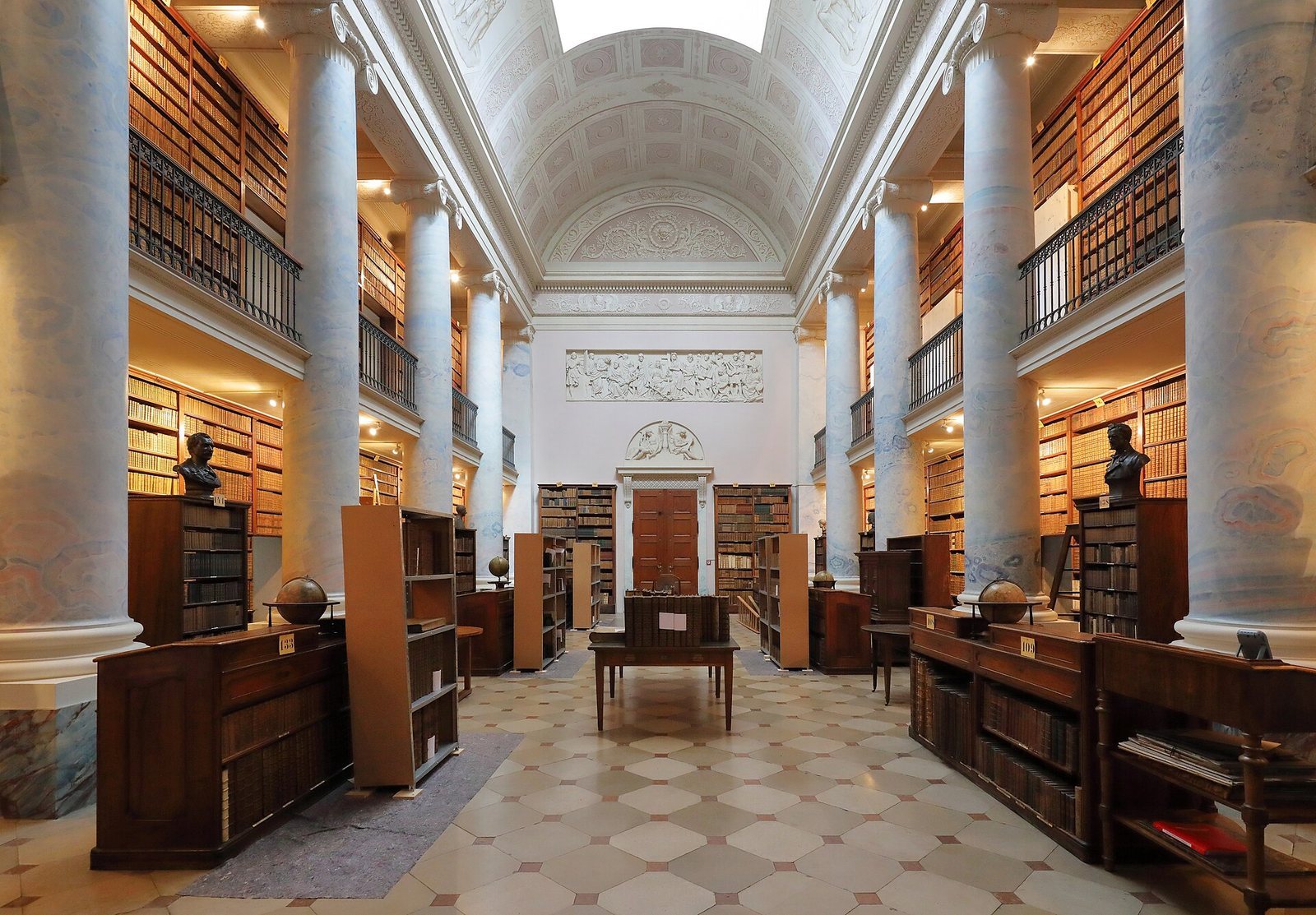
The convent library is a Classicist building constructed from 1828 to 1838 as part of the new convent. Joseph Kornhäusel prepared its plans, and Josef Klieber made its reliefs.
Courtyard and garden features
The Heinrich Jasomirgott Fountain, made by Sebastian Wagner in 1652, stands in the first courtyard and includes a statue of the founder. A dolphin fountain was installed in the second courtyard in 1874. Peter Nobile designed the Black Madonna statue in 1825; it was placed in the convent garden in 1858.
Museum and collections
Vienna Schotten Altar
The Vienna Schotten Altar is a winged altarpiece, with hinged side panels that open or close, made from 1469 onward by the artist known as the Master of the Vienna Schotten Altar. It probably served as the church’s high altar until the 17th century and is now a principal work in the abbey museum. Its panels include detailed, topographically accurate views of Vienna and Krems, making the altarpiece a historical visual record of both cities.
Former prelature and museum holdings
The abbey museum occupies the former abbot’s residence and administrative quarters. Installed in 1994–1996 and renewed in 2004–2005, it contains paintings, furniture, tapestries, vestments, liturgical objects, manuscripts, printed books, material on the abbey’s history and incorporated parishes, and a natural-history cabinet. Its painting collection includes religious subjects, portraits, landscapes, still lifes, and genre scenes, with particular strengths in Flemish, Dutch, and Austrian works from the 16th to 18th centuries and in Viennese Biedermeier painting. The former Baroque high altarpiece, Sandrart’s Heavenly Glory of 1671, is displayed in the prelature hall. Measuring 7 by 4 metres, it depicts the Assumption of the Virgin and the homage of the saints led by John the Baptist; it is described as Sandrart’s largest work.