Ering Castle: A Bavarian Noble Estate and Administrative Seat
Site at a Glance
- Popularity
- Medium
- Country
- Germany
- Primary era
- Early Modern
- Eras represented
- Medieval, Early Modern
- Civilizations
- Duchy of Bavaria, Holy Roman Empire
- Site type
- Domestic
- Remains
- Castle
On this page11 sections
History
Ering Castle is a historic castle in Ering, Bavaria, Germany. Records for the surrounding settlement begin in 788, and the estate later served successive ecclesiastical and noble rulers as a centre of local administration.
Early estates and the Counts of Hals
In 788, Fricho, Ratolf, and Ratolf’s brothers gave eight farmsteads at Ering to Niederaltaich Abbey, a Benedictine monastery in Bavaria, with the approval of Duke Tassilo of the Agilolfing dynasty, an early ruling house of Bavaria. In the early eleventh century, Holy Roman Emperor Henry II transferred royal property around Ering to the Prince-Bishopric of Bamberg, an ecclesiastical territory whose bishop also held secular power. Count Ulrich of Formbach served as bailiff, an official exercising authority delegated by a lord, until the end of the eleventh century. From the early twelfth century, the office passed to the Kamm family and later to the Counts of Hals.
On 8 June 1296, Bishop Arnold of Bamberg pledged Ering to Count Albert of Hals. The Counts of Hals brought the lordship under a more unified administration based at Erneck Castle. Officials named in records include Eberhardt the Puchlär in 1314, Tannberger in 1321, Chunrad the Amann in 1337, and Degenhart the Oetlinger in 1353. On 6 July 1377, Johann of Leuchtenberg, Landgrave of Leuchtenberg and Count of Hals, sold the strongholds of Ering-Erneck and Ratzelberg to the Bavarian dukes Otto, Friedrich, Johann, and Stephan.
Bavarian rule and the destruction of 1504
Ering’s role as an administrative seat is recorded from the fifteenth century, when territorial rulers appointed its officials. A separate administrative and revenue office served the ducal court district of Ering-Erneck. In 1414, Hans Closer held the posts of administrator and treasurer, although his seat was at Erneck Castle.
Ering suffered destruction during the War of the Landshut Succession, a conflict over the inheritance of the Duchy of Bavaria-Landshut after Duke George the Rich died. Duke Albrecht IV of Bavaria-Munich formed a provisional government, while his rival, Count Palatine Philipp, sent troops from Schärding to seize and devastate the Inn and Rott valleys. On 29 May 1504, Albrecht entered the Rott valley from Munich with 14,000 men. The fighting destroyed Ering, Erneck, and Frauenstein; Ering and Frauenstein were later rebuilt.
The Paumgarten lordship
In 1508, Albrecht IV sold Ering Castle and the Ering-Frauenstein lordship to brothers Peter and Wolfgang von Paumgarten. In 1523, Alban Gogkendorfer’s daughter sold the Paumgartens at Frauenstein a walled residence beside Ering’s parish church and cemetery wall, with its associated property. This residence lay within the Frauenstein lordship and the Braunau court district. Also in 1523, the Frauenstein-Ering lordship passed to cousins Georg and Hans von Paumgarten; their successors included their sons Hans Wolf I and Hans Christoph I.
The Paumgarten family held Frauenstein-Ering until 1845. Its members became barons in 1629 and counts in 1745, and their authority grew from lower jurisdiction to high justice, the power to try serious crimes, including capital cases. From 1764, this jurisdiction covered Ering, Frauenstein, and Stubenberg. Executions for theft took place in 1779 and 1788. The 1779 Peace of Teschen ended the War of the Bavarian Succession and transferred the Innviertel to Austria, ending the family’s high jurisdiction in that region. At Ering, a court operated under the landholders’ authority from 1830 to 1848. On 16 April 1848, Countess Maria von Baumgarten declared its transfer to the Bavarian state.
Later owners and the divided estate
In 1845, ownership passed through Countess Elisabeth von Paumgarten’s marriage to Baron Maximilian von Lerchenfeld. In 1887, Baroness Anna zu Lerchenfeld married Baron Ferdinand von Sedlnitzky von Choltitz. Ivo, Baron von Sedlnitzky-Odrowons von Choltitz, and his wife Sophie, née Hoenning-O’Carroll, lived at the estate in the early 1940s. Their eldest daughter, Marie-Gabrielle, took over the castle in 1946 after her brothers Udo and Hans died in the Second World War. She had married Count Kasimir Esterházy de Galántha in 1941. Most owners of the castle in the nineteenth and twentieth centuries were buried at the pilgrimage church of St. Anna.
In 1991, Marie-Gabrielle gave the castle and its associated properties to her third son, Paul Daniel, Count Esterházy de Galántha. In 2006, he sold the inner connecting Venningen Wing to his youngest brother as an unrestored ruin. The agreement included shared use of surrounding open areas and reciprocal family pre-emption rights for the castle as a whole, excluding fields and forests. In 2015, the brother transferred the wing into equal shares among himself and his family. Paul Daniel transferred the rest of the castle to his son Nikolaus in 2022. The estate has been divided among private owners since 2006 and is protected as both a built monument and an archaeological monument.
Remains
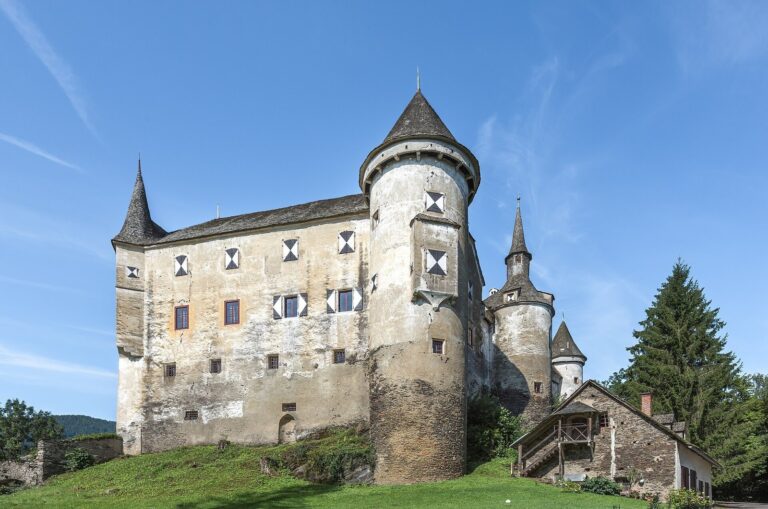
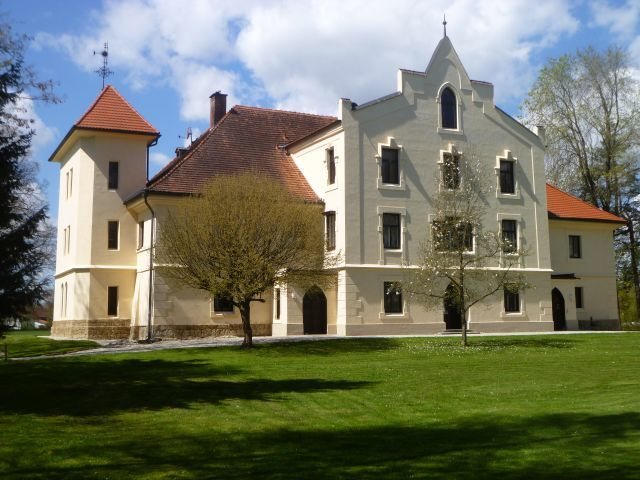
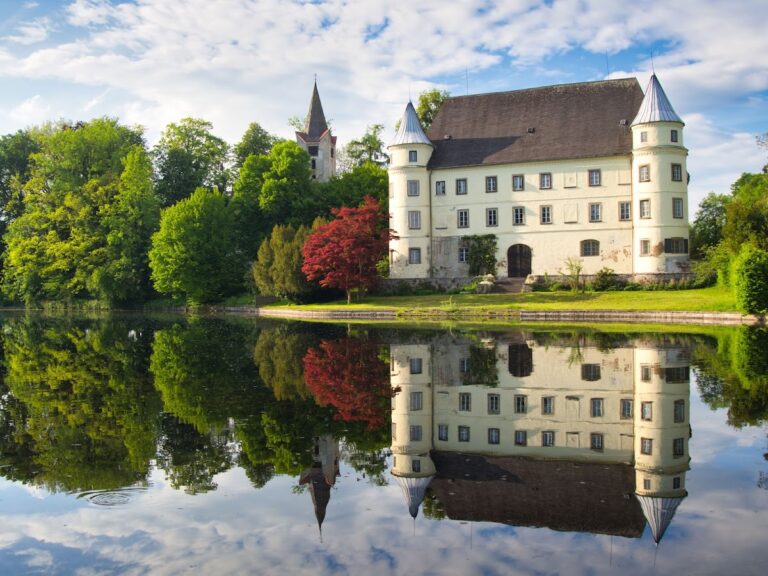
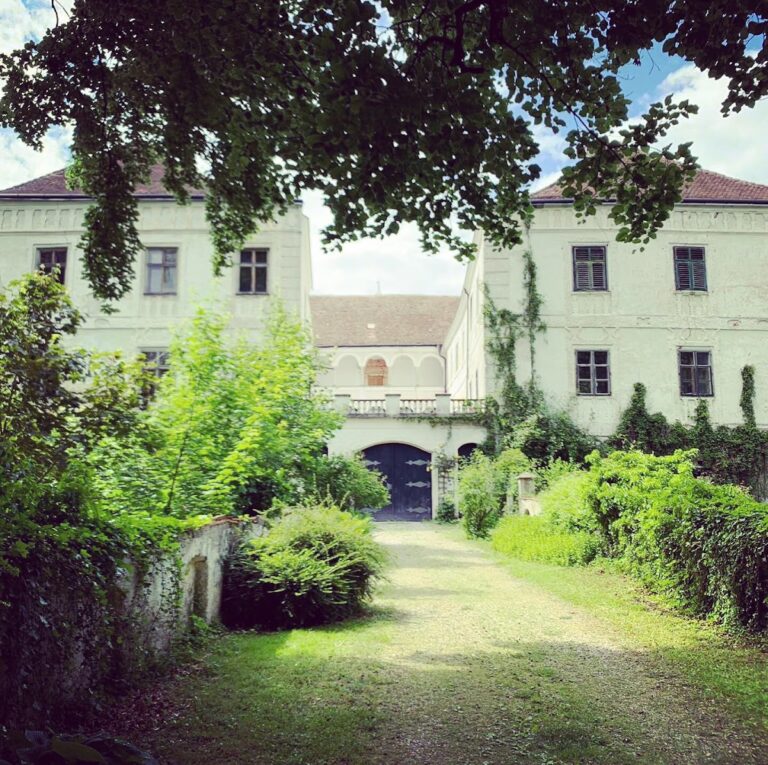
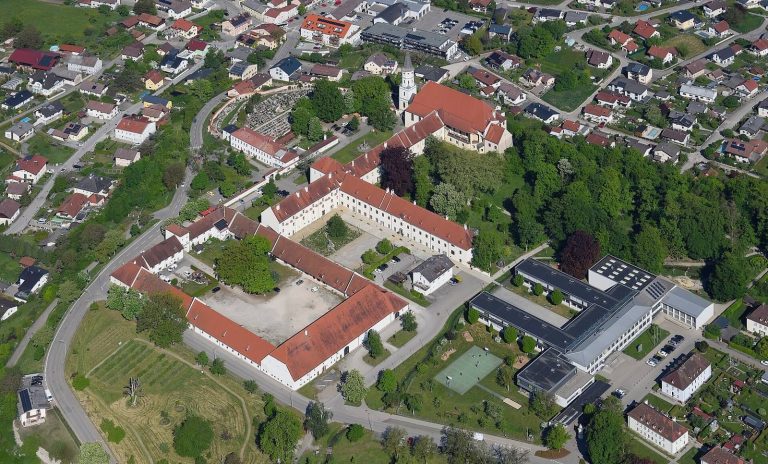
The surviving complex has an irregular plan of wings around two principal courtyards, with stables attached to the castle buildings. Its present arrangement has five wings around the main courtyard and four around the service courtyard; a crosswise wing creates an additional court. The main building comprises four wings and three storeys, with a roof sloping on all sides and a central section projecting from the principal front. Secondary buildings are two storeys high.
Wings and courtyards
A doorway framed by flat decorative strips is set in the north wing. An engraving made around 1726 by Bavarian artist Michael Wening depicts an extensive, uneven complex. Its apparent entrance passes through a two-storey service wing with more than 25 window openings. A two-storey side wing adjoins it, followed by an open arrangement of three three-storey wings around a fountain. Two further service wings enclose a courtyard. The engraving also shows the Church of the Assumption of Mary beside the castle. A connecting passage between the church and castle may have existed, but its presence is uncertain.
Fountains and gardens
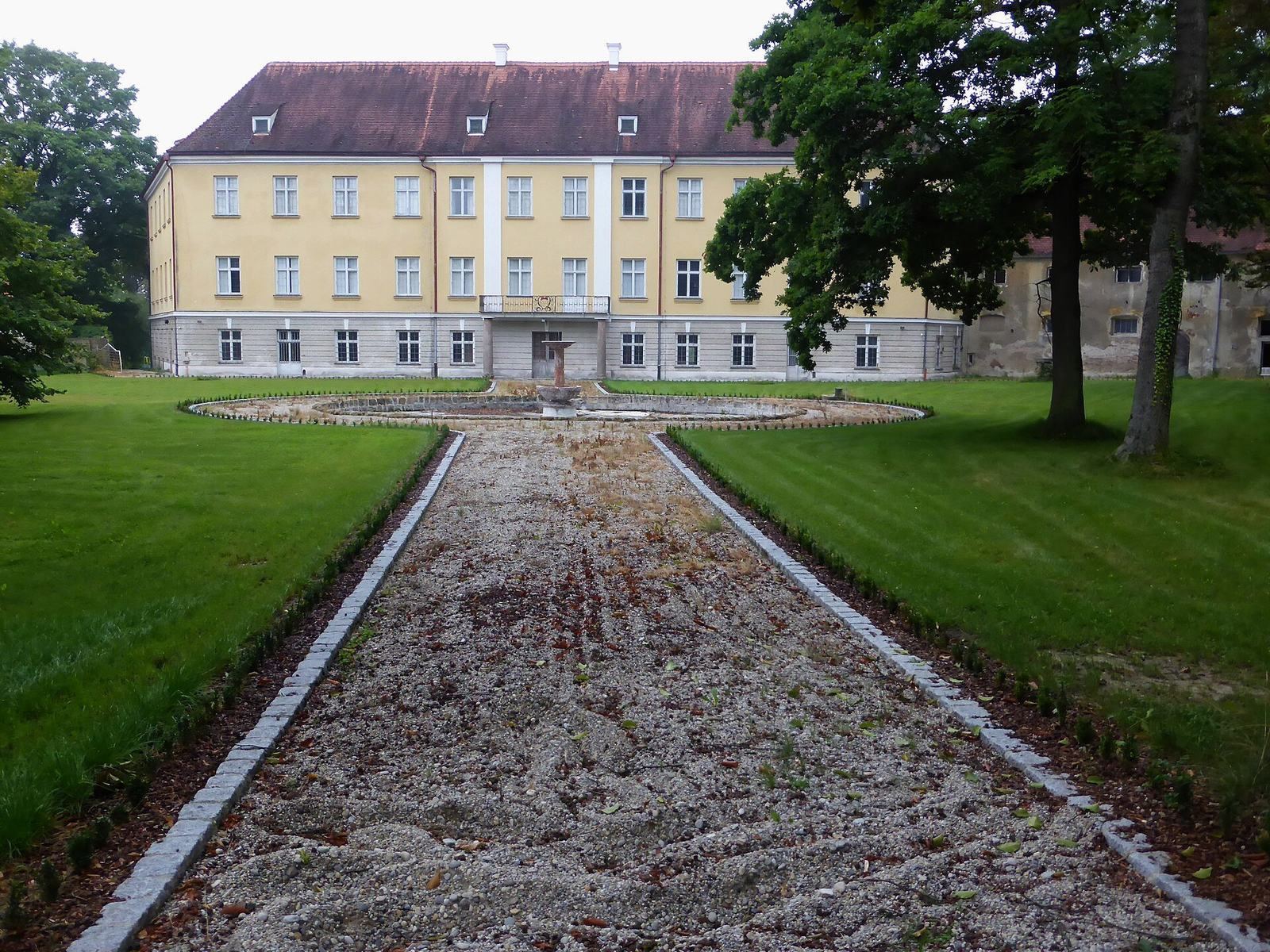
A fountain in the main courtyard bears the date 1787. The enclosed castle park and its fountain also date to the eighteenth century. Wening’s engraving shows three walled gardens, including a large park, giving a view of the estate’s grounds as they appeared in the early eighteenth century.
Present condition and archaeological evidence
Castle buildings
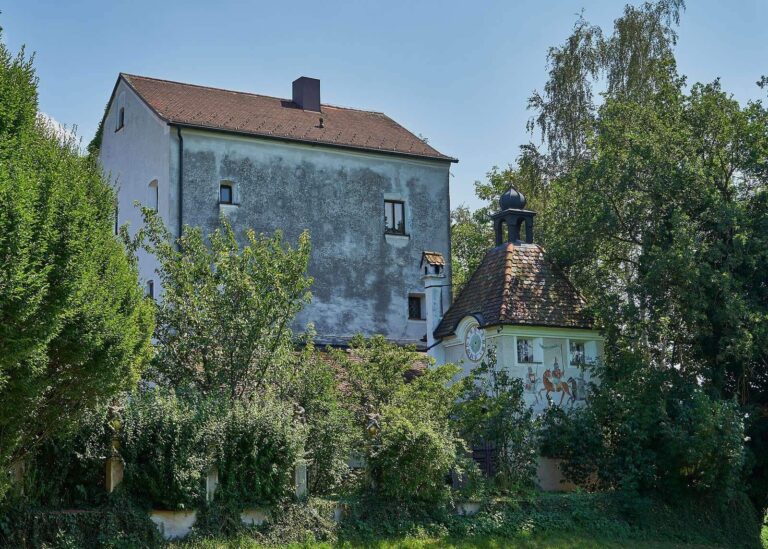
The Venningen Wing was restored between 2006 and 2019 under heritage-preservation requirements. The upper castle, Lerchenfeld Wing, and stables remain largely unrestored.
Buried remains
Archaeological remains include buried early-modern parts of the castle and garden installations, as well as evidence and finds connected with medieval and early-modern buildings that preceded the present complex.