Stageira: An Ancient Greek City and Aristotle’s Birthplace
Site at a Glance
- Popularity
- Very High
- Country
- Greece
- Primary era
- Classical
- Eras represented
- Iron Age, Classical, Medieval
- Civilizations
- Ancient Greek, Byzantine, Kingdom of Macedon
- Site type
- City
On this page15 sections
History
Foundation and growth
Stageira was an ancient Greek city on the Liotopi peninsula near Olympiada, Greece, founded around 655 BCE by Ionian settlers from Andros. Settlers from Chalkis on Euboea arrived later. Its harbors and position near mineral resources, including gold mines, supported prosperity and trade in the northern Aegean. By the sixth century BCE, the city issued silver coins, including staters, a type of ancient Greek coin. A boar served as its civic emblem.
War and political change
Xerxes I, king of the Achaemenid Persian Empire, occupied Stageira in 480 BCE. The city later joined the Delian League, an alliance led by Athens, and paid tribute to it. During the Peloponnesian War, fought by Athens and Sparta and their allies from 431 to 404 BCE, Stageira left the Athenian alliance in 424 BCE and joined the Spartan commander Brasidas.
In 422 BCE, the Athenian general Cleon unsuccessfully besieged Stageira. He died later that year at the Battle of Amphipolis, fighting Spartan forces led by Brasidas. The Peace of Nicias, a treaty that temporarily ended hostilities between Athens and Sparta, listed Stageira among the Delian League cities declared autonomous in 421 BCE. Stageira also joined the Chalcidian League, a federation of cities on the Chalkidike peninsula, though the date is uncertain.
Aristotle, destruction, and rebuilding
Stageira was the birthplace of Aristotle, born in 384 BCE. In 348 BCE, Philip II of Macedon captured and destroyed the city. Its inhabitants were said to have been killed or enslaved. The city was rebuilt and former residents resettled around 343–340 BCE. The rebuilding is generally attributed to Philip II, traditionally at Aristotle’s urging: Aristotle had tutored Philip’s son Alexander, who later became king of Macedon. Another attribution credits Alexander with the reconstruction.
Later history and rediscovery
A local tradition held that after Aristotle died at Chalcis in 322 BCE, the people of Stageira brought his body or ashes back and buried them in the city. They were said to have named him its founder and placed an altar over his grave. The burial site, called the Aristoteleion, reportedly served as a meeting place for the city council. A month was named in Aristotle’s honor, and an annual festival commemorated him.
Stageira declined during the Hellenistic period, which followed Alexander’s conquests, and the Roman period. By the time of Strabo, a Greek geographer, it had lost its status as a city. A fortress was built over the ancient acropolis around the tenth century, during the Byzantine period, the era of the medieval Eastern Roman Empire. The surrounding area was associated with iron smelting, and in the sixteenth century it reportedly contained a mint belonging to an Ottoman sultan.
The location of ancient Stageira was debated, with suggestions including Stavros, the modern village of Stagira, and Olympiada. A passage from Strabo’s Geography helped identify the site at Liotopi; Danish archaeologist Karl Frederik Kinch identified it in 1886. Archaeological investigations began in the late 1960s under Greek archaeologist F. Petsas. Systematic excavations and restoration followed from 1990 to 2000 under Greek archaeologist Kostas Sismanidis.
Remains
Settlement and defenses
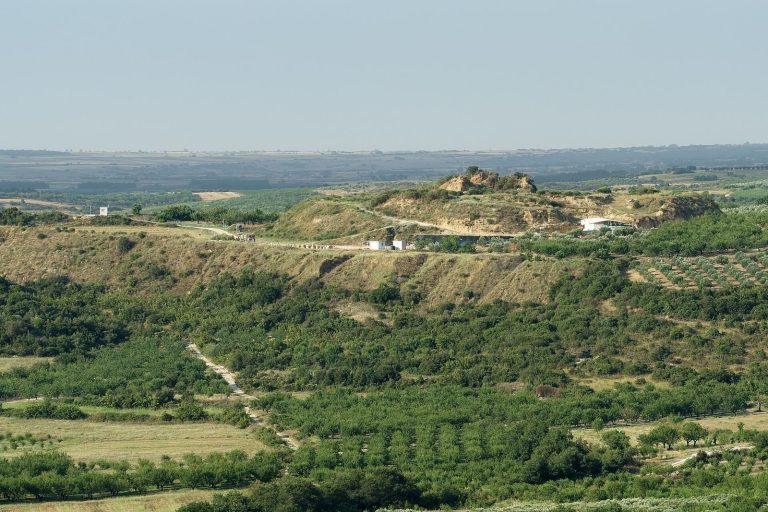
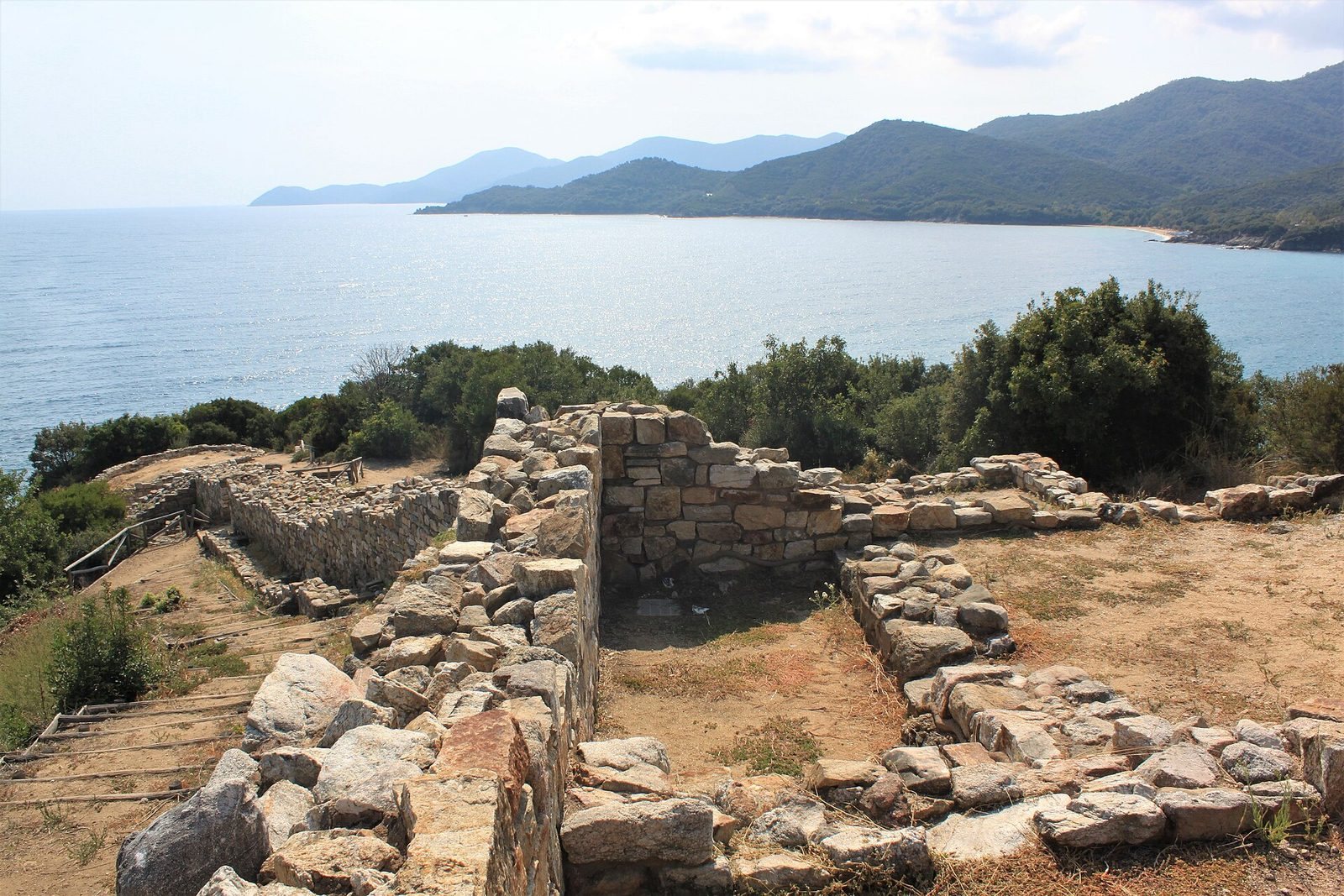
The archaeological site occupies a promontory on the Liotopi peninsula and extends across two hills divided by a low depression. The smaller northern hill lies closer to the sea, while the southern hill is larger. The harbor and a small island opposite the city shared the name Kapros, meaning “boar.”
City walls and western gate
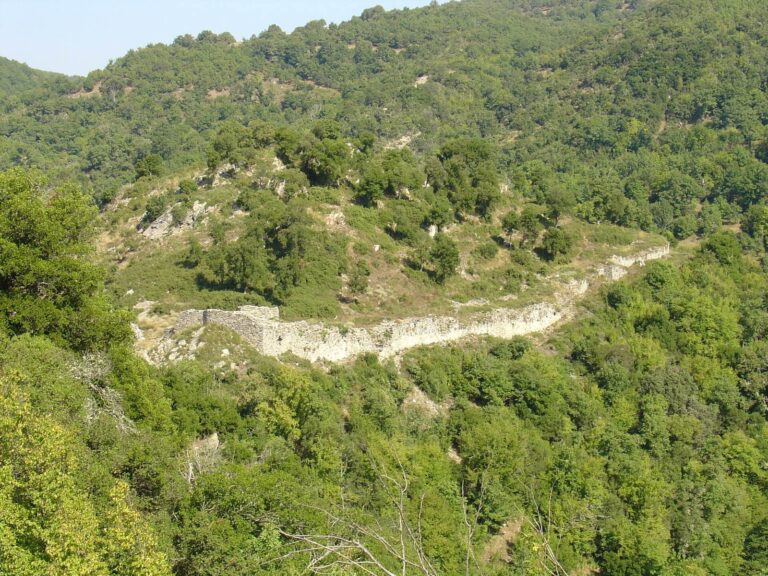
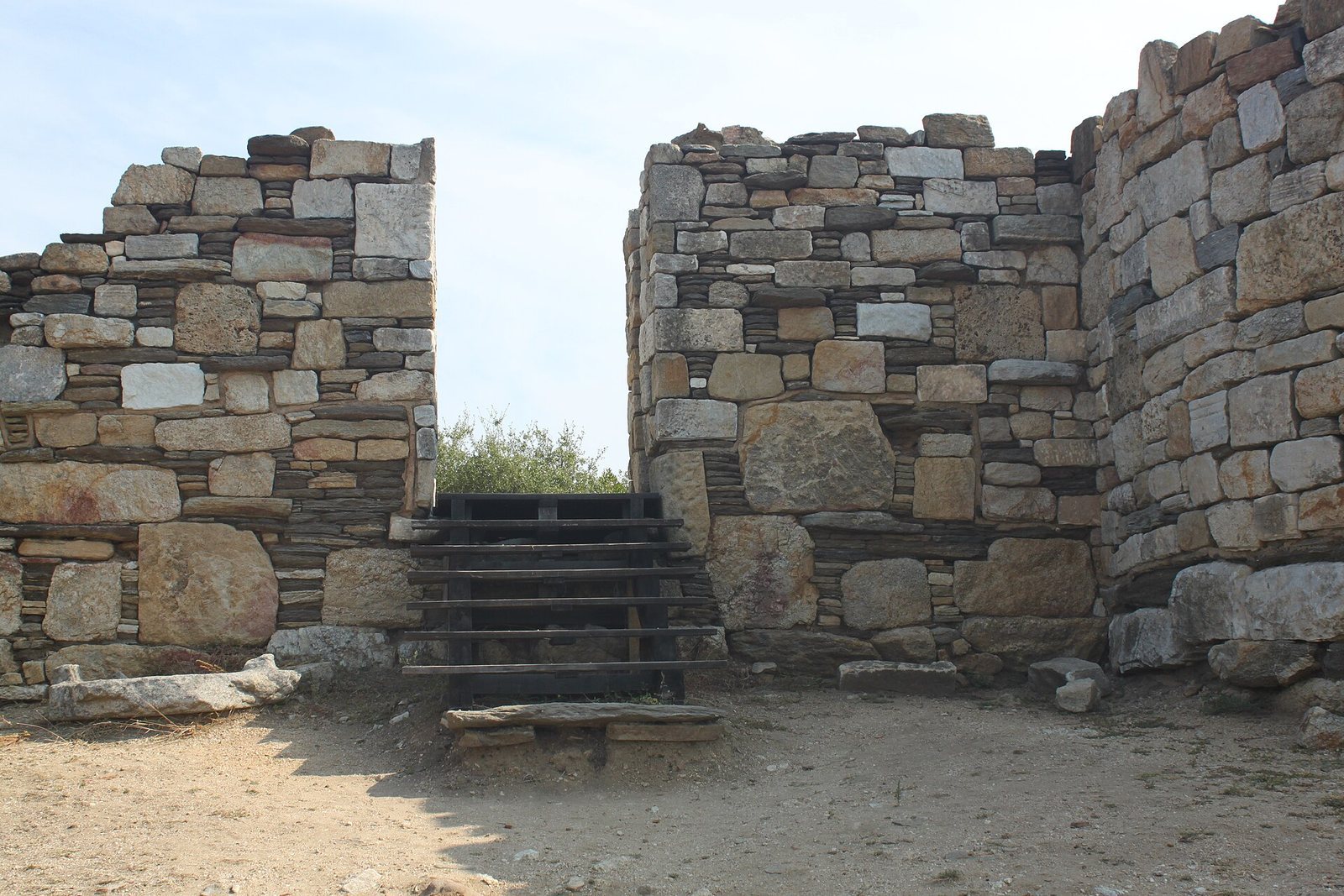
Construction of the city wall began around 500 BCE. Built in several types of masonry, it was about two metres thick and extended roughly 1.5–2 kilometres. Surviving stretches include towers and projecting defensive works. At the western gate, a relief of a lion and a boar decorates the main lintel. A separate lintel, dated to the sixth century BCE, was found with remains of an early wall in a Byzantine complex; it bears an inscription dated to the fourth century BCE.
Southern citadel
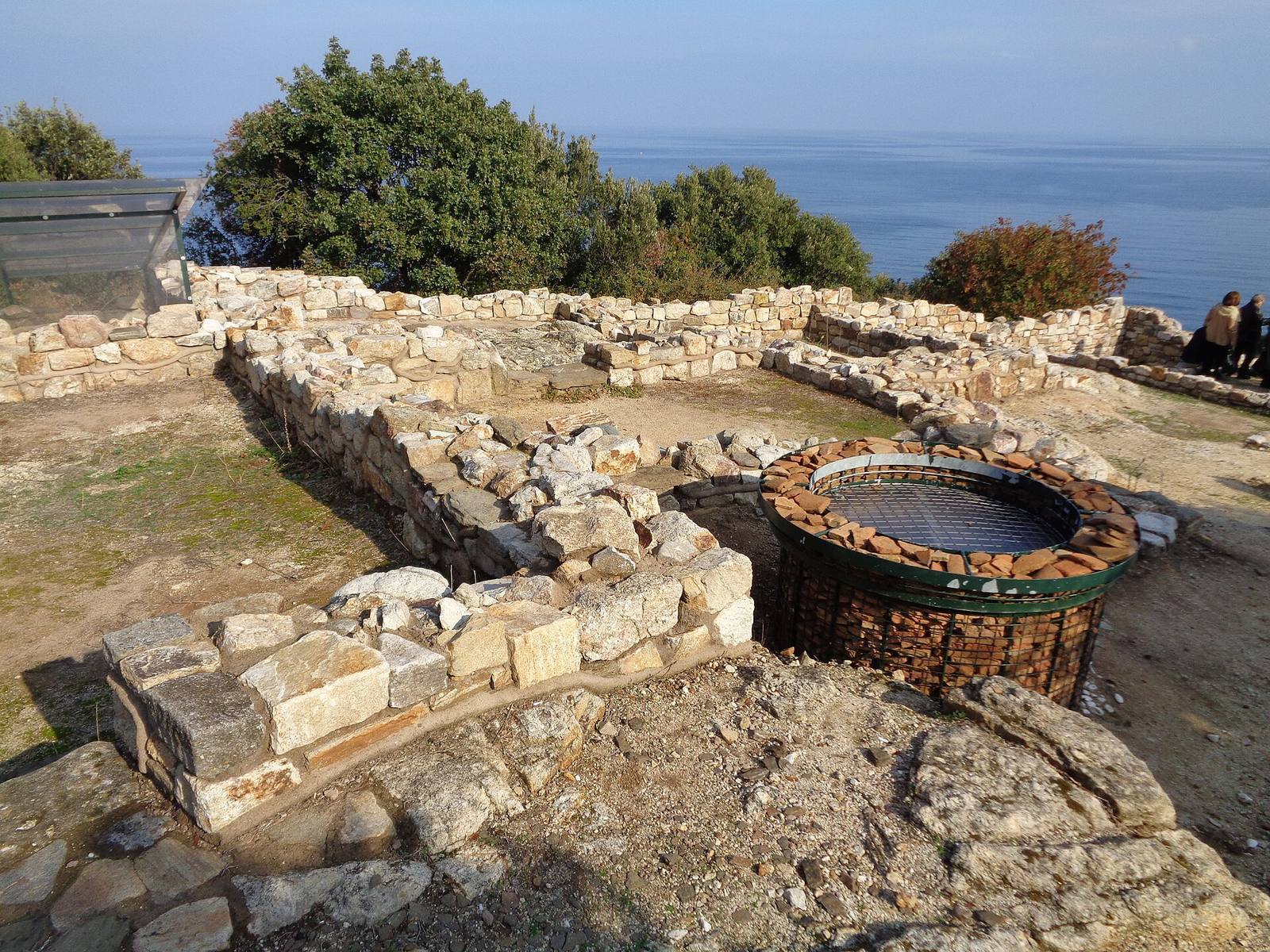
The acropolis, the fortified high point of a settlement, occupies the summit of the southern hill. Its triangular upper plateau forms a right angle, and its 40-metre southern side follows the city’s southern wall. A small gate, 1.5 metres wide, allowed soldiers to pass through that side. Nearby, a seven-step staircase abuts the inner face of the wall and served military purposes. The other two sides were protected by an enclosure made of two stone walls, each about 0.8 metres thick. Buttresses created small rectangular spaces that were probably roofed. The eastern wall bends near its base to meet a large circular tower.
Trapezoidal channels along all three sides of the citadel drained rainwater. Opposite the gate, a circular cistern cut into the natural rock lies between two supports of the enclosure. It measures about two metres across and four metres deep; its carefully built walls are coated with dense white mortar. A large square space at the citadel’s highest corner served as a military observation post and overlooked the surrounding area.
Civic, religious, and residential areas
Agora and stoa
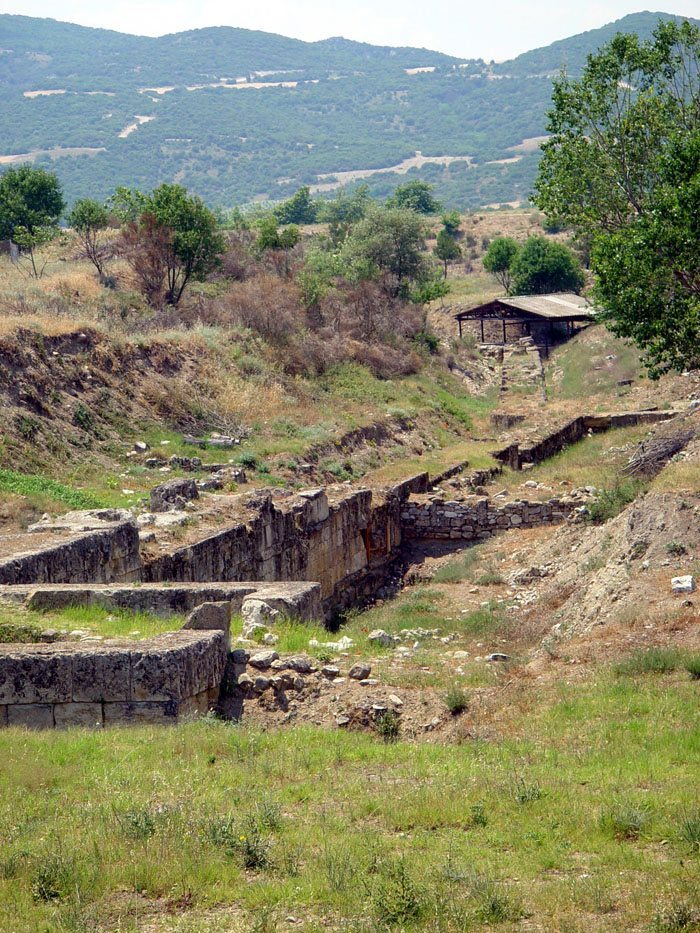
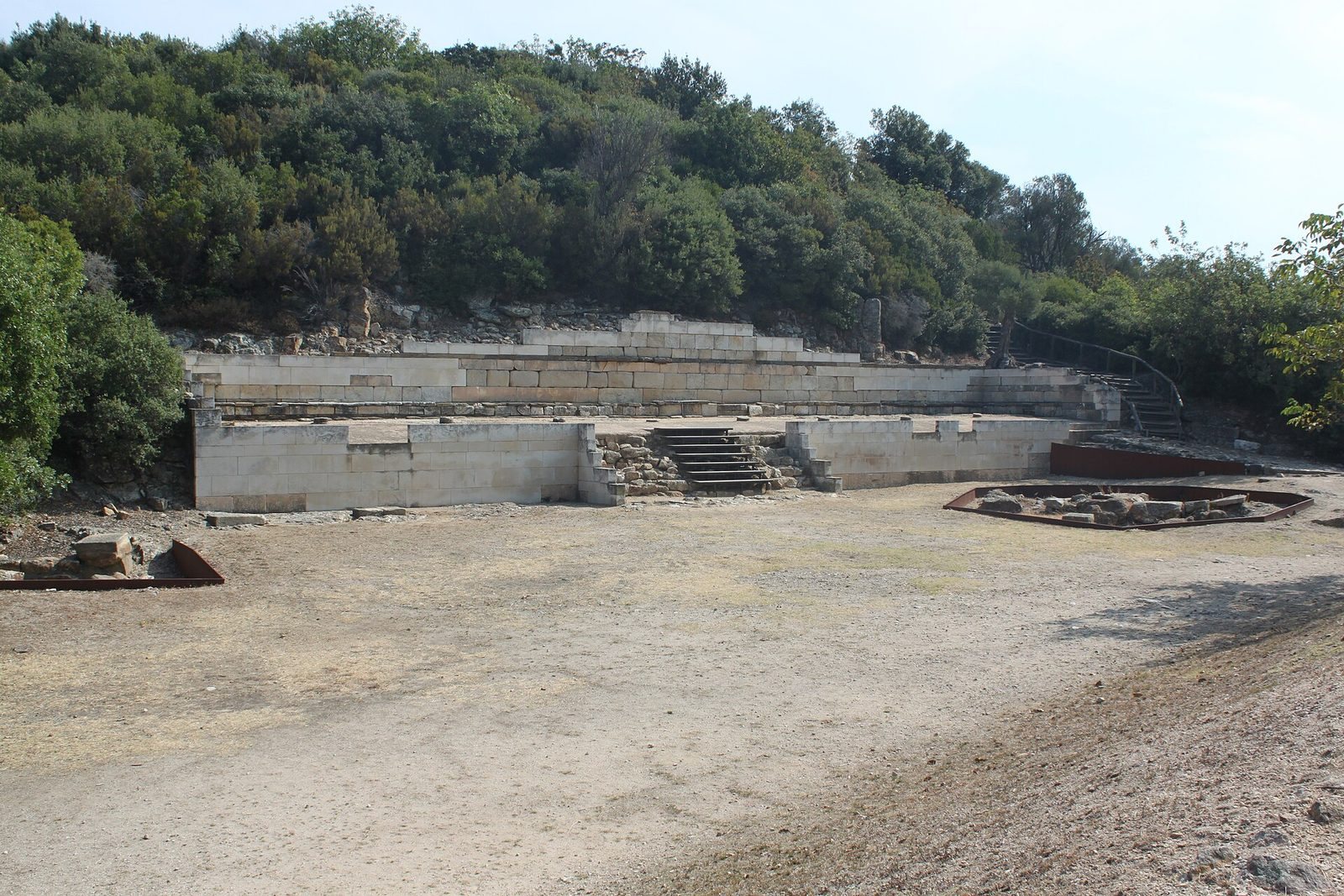
The agora, a public square for civic gatherings and commerce, lies in the depression between the hills. Its fourth-century-BCE stoa, a covered public colonnade, was built in regular horizontal courses of stone blocks whose heights vary. A paved road about three metres wide runs near the agora.
Sanctuaries
Three early Greek sanctuaries have been identified on the northern hill. The one nearest the sea may have been dedicated to Demeter, the goddess of agriculture and fertility. Another was probably a Thesmophorion, a sanctuary connected with a festival in her honor. The sanctuary near the summit was dedicated to an unidentified deity. The city’s rebuilding around 343–340 BCE also included an aqueduct and two sanctuaries to Demeter, distinct from these three northern-hill sanctuaries.
Houses and workshops
Remains of houses occur on both hills. Excavations have also uncovered terraced houses, workshops, an early temple building, and residential and public structures associated with the city’s rebuilding.
Byzantine construction
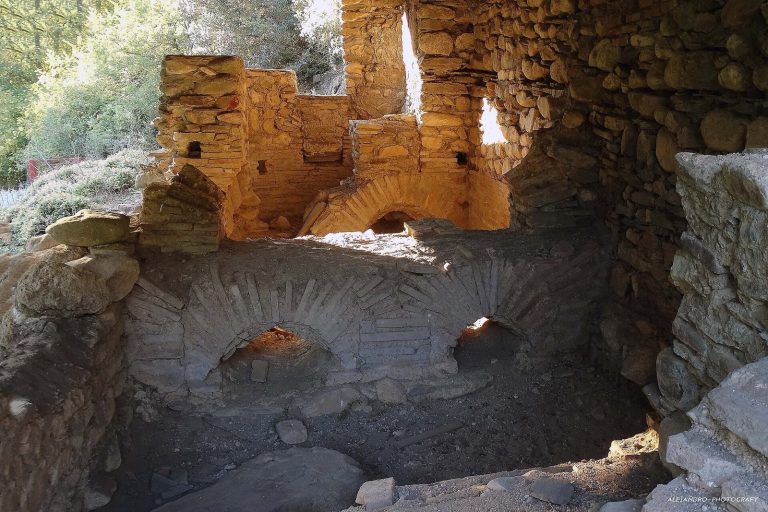
A Byzantine complex occupies part of the northern hill above ancient remains. The fortress, built around the tenth century, stands on the site of the ancient acropolis.
Building proposed as Aristotle’s tomb
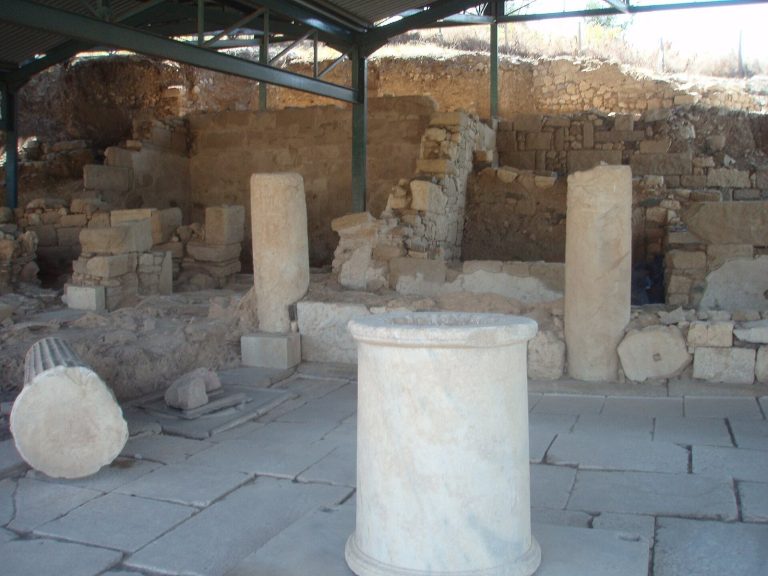
Near the agora, a domed building with a marble floor has been dated to the early Hellenistic period. Excavations found an altar, about 50 bronze coins from Alexander’s time, and pottery from royal workshops at Pella, the ancient capital of Macedon. In 2016, Sismanidis proposed that the building might be Aristotle’s tomb. Its monumental form and central position have also supported interpretations of it as a heroon, a shrine honoring someone regarded as a hero, and as the Aristoteleion. The identification remains unconfirmed, and other interpretations are possible. Finds from Stageira are exhibited at the Archaeological Museum of Polygyros.