Dolmen de Unsac: A Neolithic Covered Passage Grave in France
Site at a Glance
- Popularity
- Very Low
- Country
- France
- Primary era
- Stone Age
- Eras represented
- Stone Age
- Civilizations
- Unclassified
- Site type
- Burial
- Remains
- Tomb
On this page6 sections
History
Dolmen de Unsac is a covered passage grave in Puy-de-Dôme, France, dating to the Neolithic, the later Stone Age associated with farming and settled communities. This megalithic tomb has an elongated, roofed chamber. It belongs to the Atlantic type, an archaeological classification for monuments associated with Atlantic Europe. The site is the only monument of this type in the department and represents the classification’s southeastern limit.
Origins and Local Tradition
Local folklore linked the monument with wolves and fairies. In this tradition, fairies embodied the devil and malevolent spirits. The dolmen’s traditional names included the Wolf’s House, the Fairies’ Cabin or Cave, and the Covered Passage of Unsac.
Antiquarian Record and Excavation
A plan drawn by Jean-Baptiste Bouillet in 1846 showed the large covering stone already overturned on the ground. The monument was designated a historic monument in 1896.
Archaeologist Louis Gilbert excavated the site in 1964, after clandestine digging had taken place earlier. Finds from the excavation included pottery, flint, and later material, providing evidence of activity at the site beyond its Neolithic origins.
Remains
Setting and Chamber
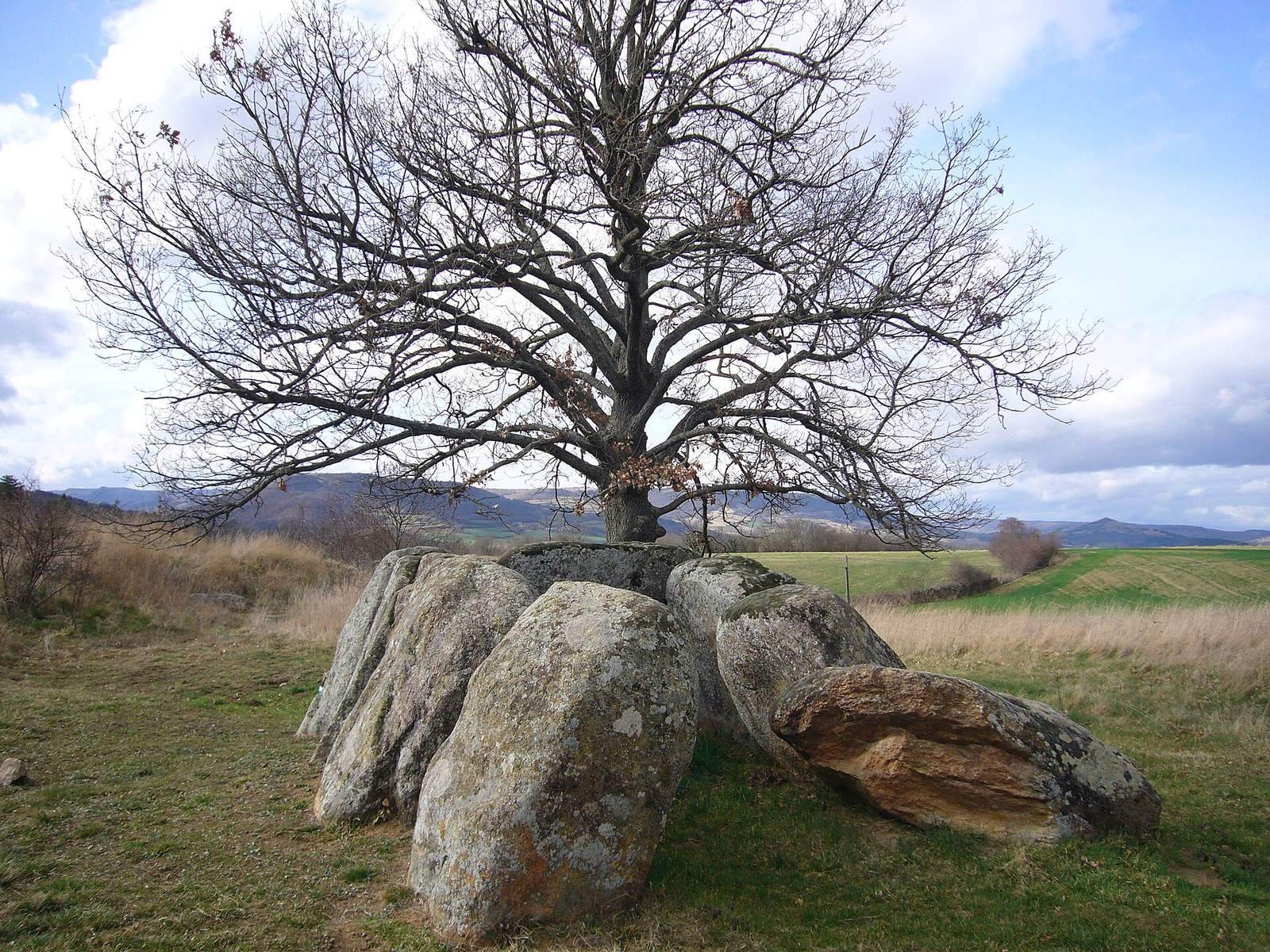
The monument stands on a small granite outcrop beneath an oak, among high hills, northwest of the hamlet of Unsac and southwest of Saint-Gervazy. Its stones are local granite, brought from nearby. The chamber faces east and is formed by three upright slabs along each side and two at the ends. The side slabs lean slightly inward, while their inner faces and those of the end stones are smooth.
The monument measures 5.30 m long, 4.50 m wide, and 2.20 m high; the chamber itself is 4.40 m long, 2.40 m wide, and 1.60 m high. A large covering slab lies on the ground. The largest granite block measures about 3.8 by 2.7 by 0.7 m and weighs approximately 20 tonnes. Two smaller, partly buried slabs a short distance away may be pieces of another covering stone. Other large blocks lie behind and near the chamber.
Excavated Finds
The excavation yielded 230 pottery sherds, including 26 pieces of cord-impressed pottery attributed to the Bell Beaker period, a prehistoric European period named for its distinctive bell-shaped vessels. The finds also included a few flint pieces and fragments of iron, glass, and later pottery.