Acanthus: An Ancient Greek City-State in Chalcidice
Site at a Glance
- Popularity
- Medium
- Country
- Greece
- Primary era
- Classical
- Eras represented
- Classical, Medieval
- Civilizations
- Ancient Greek, Byzantine, Roman
- Site type
- City
On this page14 sections
History
Foundation and Archaic prosperity
Acanthus was an ancient Greek city-state near modern Ierissos in Greece, founded in the seventh century BCE by colonists from Andros. Andros was itself a colony of Chalcis on Euboea. Acanthus developed into a polis, an independent Greek city-state comprising an urban center and its surrounding territory. A foundation around 655 BCE has been proposed, while silver coins dating to about 520 BCE provide the earliest secure evidence that Acanthus was autonomous.
Ancient writers preserved different accounts of the city’s beginnings. Thucydides attributed its foundation to people from Andros. Plutarch described Andrian and Chalcidian settlers arriving at a settlement whose inhabitants had fled. In Plutarch’s story, an Andrian envoy claimed the city by throwing his spear at its gate before a Chalcidian rival arrived.
Acanthus prospered during the Archaic period, an era of Greek history preceding the Classical period. Mining, forests, farming, and trade through its harbor supported the city’s wealth. Its coins circulated widely, and at least 92 designs are known. Early coins showed a lion attacking a bull, an image that may recall Herodotus’s account of lions attacking the camels of the Persian king Xerxes near the city. The name Acanthus is associated with Acanthus mollis, a plant of Mediterranean rocky coasts. Its flowering, thorny leaves were used medicinally and inspired the leaf ornament on Corinthian column capitals, the decorated tops of columns in that style.
Persian and Athenian-Spartan rivalries
During the Persian Wars, the conflicts between the Persian Empire and Greek states, Acanthus supported Persian military operations. The Persian general Mardonius used the city as a base in 492 BCE, and Xerxes I did so in 480 BCE. Acanthians helped dig Xerxes’ canal and received rewards from the king. They also honored Artahei, a relative of Xerxes who died nearby, as a hero, a deceased person honored through religious rites. Acanthus joined the Persian expedition against Greece.
After the Persian Wars, Acanthus entered the Delian League, an alliance of Greek cities led by Athens. It first contributed ships and later paid tribute to Athens. In 424 BCE, after a short siege, the city changed sides and joined Sparta following an appeal by the Spartan commander Brasidas. Thucydides considered concern for the city’s profitable vineyards a more likely influence on this decision than Brasidas’ speech.
Autonomy and Macedonian rule
The Peace of Nicias, an agreement in 421 BCE intended to suspend fighting between Athens and Sparta, left Acanthus autonomous but still liable to pay tribute to Athens. The city probably gained full freedom after Athens’ defeat in 405 BCE. An agreement between the Macedonian king Amyntas III and the Chalcidian League, a federation centered on Olynthus, confirmed Acanthus’ autonomy between 393 and 389 BCE.
Acanthus later resisted pressure to join the federation. In 382 BCE, Spartan and Acanthian forces captured and destroyed Olynthus, temporarily breaking the League’s power and securing Acanthus’ autonomy. Philip II of Macedon conquered the city around the middle of the fourth century BCE, but it was not destroyed at that time. It later became part of the territory of Ouranoupolis, founded by Alexarchos, the brother of Cassander, a Macedonian ruler after Alexander the Great’s death.
Roman rule
A Roman-Pergamene fleet attacked Acanthus in 199 BCE. During Rome’s conquest of Macedonia, the city was captured and sacked in 168 BCE. It was rebuilt afterward, and Roman veterans settled there. Roman authorities exploited its natural resources and harbor. An inscription dated between 27 BCE and 14 CE records a substantial community of Roman merchants.
In the Roman period, Acanthus’ name began to appear in Latin as Ericius, a form linked with the later names Erissos and Ierissos. The city was also called Echinia, meaning “hedgehog,” reflecting an interpretation of its name as “spiny.”
Byzantine, Ottoman, and modern periods
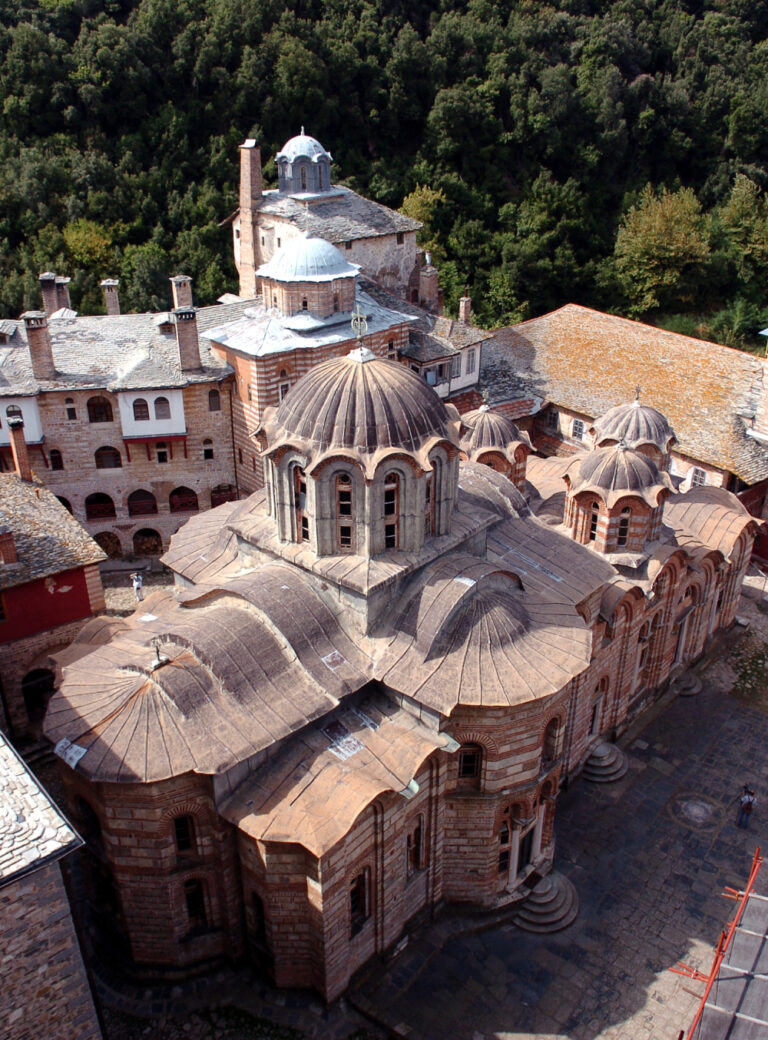
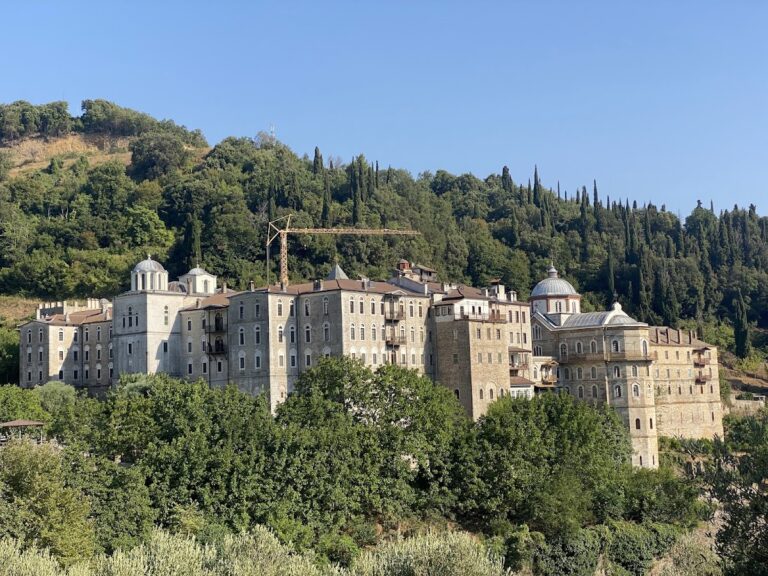
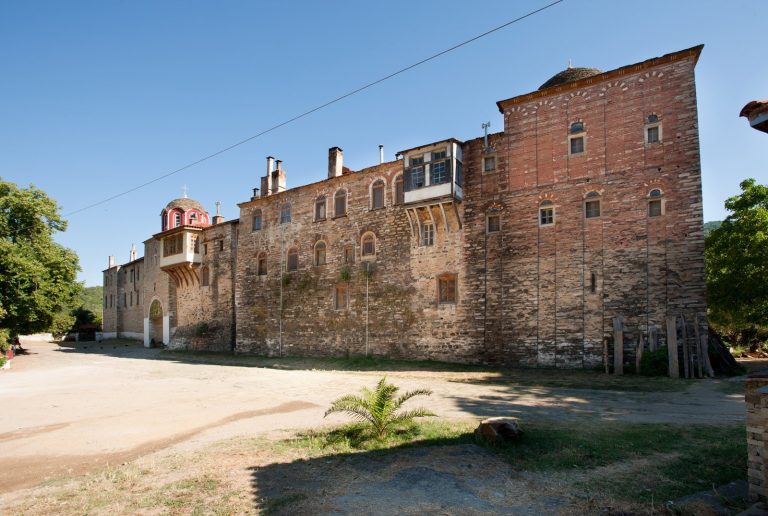
From about 541 CE, plague and wider decline in the Byzantine Empire, the eastern continuation of the Roman Empire, contributed to population loss on the peninsula. Greeks withdrew as Slavic communities gradually settled the region. In the ninth century, Byzantine authorities returned and brought Greek and Armenian settlers from Asia Minor. They established fortified towns, including Erissos over the site of Acanthus. Erissos later became a bishop’s seat and acquired the form Ierissos. The Kolovou Monastery was founded on the hill in 883 CE.
From the late fourteenth century, Ierissos passed among Byzantine, Ottoman, and Venetian powers. Ottoman control was established in the early fifteenth century. The authorities compelled residents who had fled to return and later settled Yuruks, semi-nomadic Turkic pastoral communities, from Anatolia in the region. In 1821, during the Greek uprising against Ottoman rule, Ierissos joined the revolt. Ottoman forces burned the town, and much of its population was killed.
Ierissos became part of Greece in 1912, when Halkidiki passed from Ottoman rule. The 1923 population exchange brought Anatolian Greeks to the town. An earthquake in 1932 devastated the settlement beyond reuse, and a new Ierissos was built in the valley below.
Archaeological investigation at Acanthus became urgent in 1973, when a bulldozer preparing a building site struck stone coffins and broke pottery. The archaeological service halted construction and began rescue excavations, setting systematic investigation in motion. A separate medieval cemetery at Ierissos was discovered in 1984.
Remains
The remains of Acanthus occupy a ridge formed by three hills on the northeastern side of the Akti peninsula, about 0.6 kilometres southeast of modern Ierissos. The site lies near the narrow land connection between the Athos peninsula and the mainland, northwest of Xerxes’ canal. The ridge overlooks the surrounding terrain and is now partly wooded. Estimates place the site’s area at about 560 acres, though that figure may refer either to the walled city or to the wider city-state. Its reported elevation is about 20 metres.
Urban ridge and buildings
Wall and citadel
Sections of the city’s circuit wall survive to a height of about 8 metres. The ridge also contains a citadel, the fortified core of a settlement. Together, these remains mark parts of the ancient city’s defensive layout.
Buildings and churches
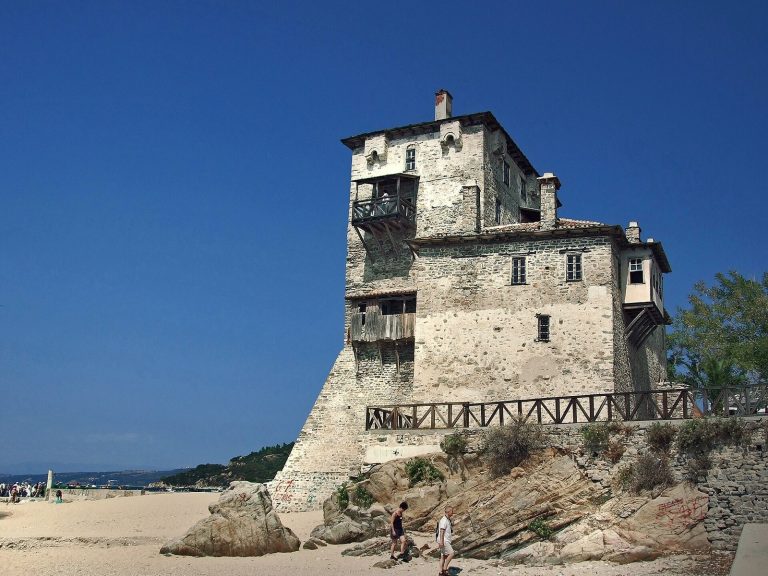
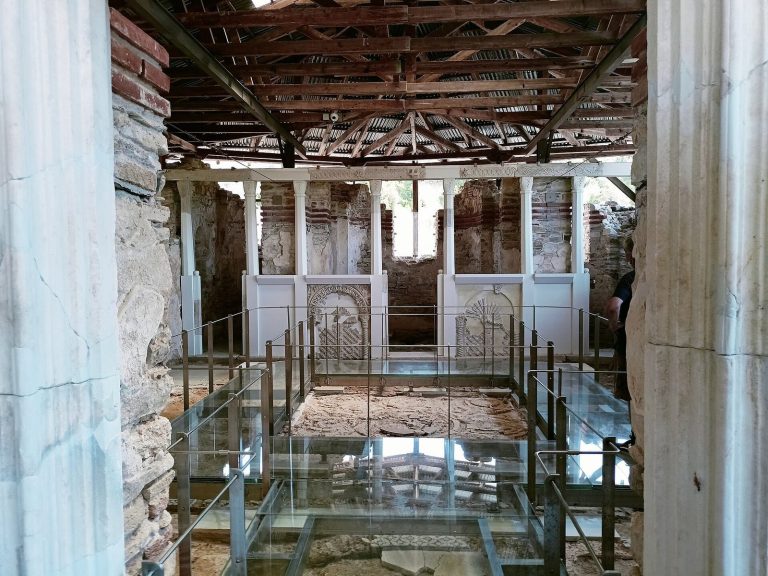
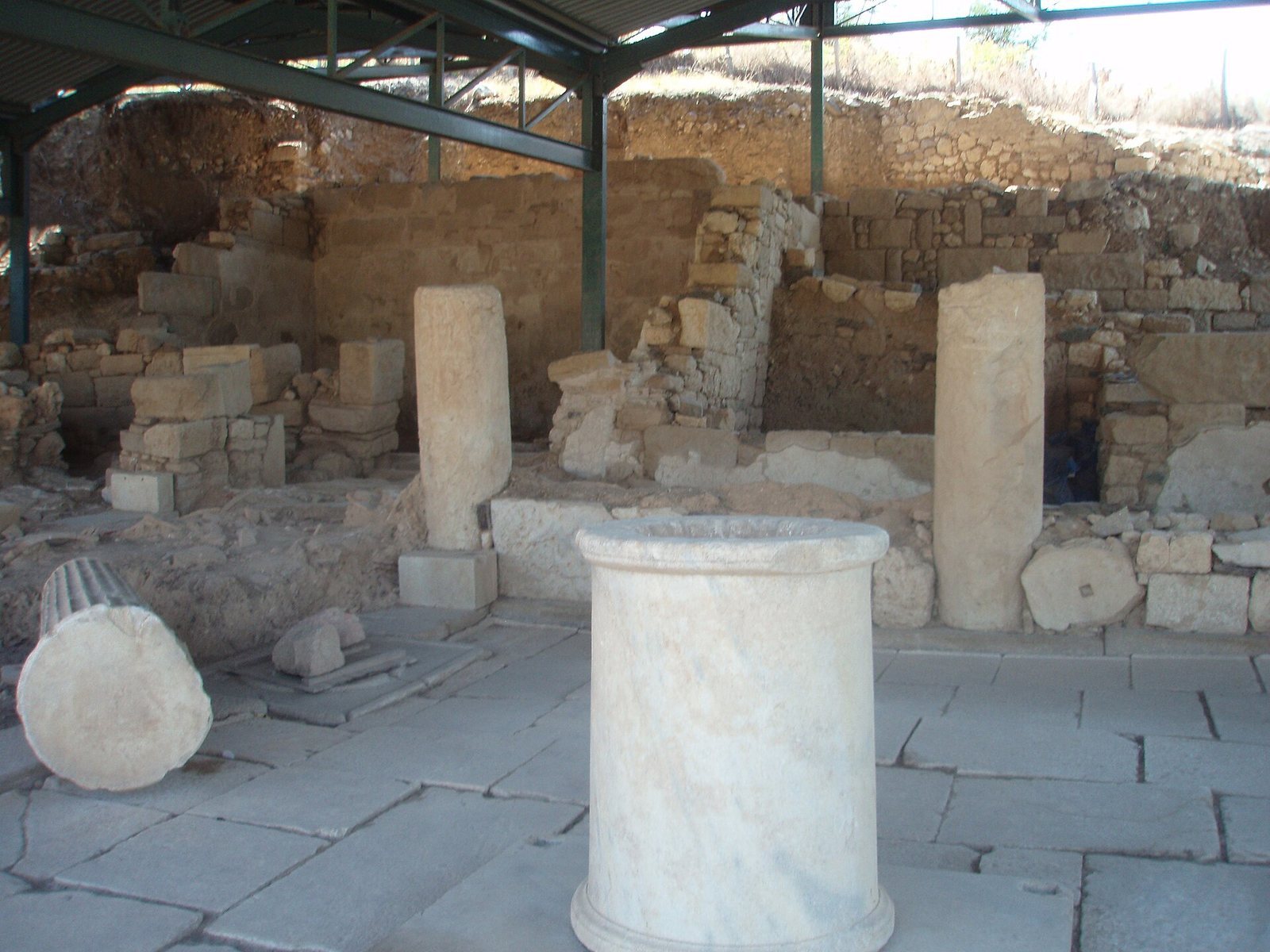
Hellenistic buildings, from the period following Alexander the Great’s conquests, and the excavated remains of an ancient house are visible at the site. A deserted Byzantine church and two churches built after the Byzantine period also stand in the area.
Burial grounds
Ancient cemetery
The ancient cemetery extended across the area of Ierissos. Its earliest burials lay farther inland, near the town center, while later graves were closer to the sea and oriented toward it. Use began in the Proto-Geometric period, an early phase of Greek Iron Age material culture recognized partly through pottery styles, and continued until the end of Acanthus’ ancient occupation. Most graves date to the fifth and fourth centuries BCE.
The burials belonged to ordinary people, with women and children predominating. The dead were placed in different types of coffins or containers for cremated remains. Grave goods were plentiful; some favored objects had been deliberately broken. The quantity and quality of the offerings indicate differences in wealth and status. Clay figurines add evidence about life in the city. The cemetery’s total number of graves remains uncertain, with estimates ranging from about 600 to 60,000, since graves were sometimes cleared for later burials or placed over earlier ones.
Pottery from the cemetery is especially useful for studying vessel shapes and decoration. These features can be assigned to established chronological types and compared with pottery from Corinth, eastern Greece, Thasos, Attica, and the Cyclades. Coins minted locally also form part of the cemetery finds.
Medieval cemetery
A cemetery associated with Ierissos contains burials dating from the ninth to the twelfth century, beginning around the time the Kolovou Monastery was founded. Sixth-century coins found in the area indicate activity before this medieval burial phase.
Valley-floor cemetery
The valley beneath new Ierissos contains another cemetery. Its use began before Acanthus was founded and continued until the seventeenth century.