Thapsos: A Bronze Age Settlement and Burial Ground in Sicily
Site at a Glance
- Popularity
- Medium
- Country
- Italy
- Primary era
- Bronze Age
- Eras represented
- Bronze Age, Classical, Modern
- Civilizations
- Ancient Greek, British, Italian
- Site type
- City
On this page18 sections
History
Thapsos is a Bronze Age settlement and burial ground on the Magnisi Peninsula near Priolo Gargallo in Sicily, Italy. The earliest human traces date to about 2300 BC, but the settlement and graves associated with the Thapsos culture belong chiefly to the Middle Bronze Age, around 1450–1270 BC. This distinct Sicilian tradition was closely related to the Milazzese culture of the Aeolian Islands and followed the earlier Castelluccio culture of inland Sicily. It differed from most mainland Italian traditions, except those found in parts of Calabria.
Bronze Age chronology
Luigi Bernabò Brea established the main date range for the Thapsos culture by comparing groups of finds, especially Mycenaean pottery from the Bronze Age civilization of mainland Greece, with material of known date. Later finds and analyses supported his chronology, which remains widely accepted.
Giuseppe Voza proposed three settlement phases. He placed the first, from the second half of the 15th century to the late 14th century BC, in the northern district and the central area. His second phase, dated to about 1300 through the first half of the 11th century BC, included central complexes A and B. For the third phase, from the mid-11th to the 9th century BC, he proposed rectangular buildings and Complex C. This sequence relied mainly on building types and assumed that settlement continued for a long period.
In 2007, Gianmarco Alberti proposed a revised chronology that was later adopted in major studies. He dated the northern district and central round buildings from the late 15th century to the first half or middle of the 13th century BC. He placed the rectangular buildings and large complexes between the first half of the 14th and the first half or middle of the 13th century BC, meaning that these areas overlapped in use. He also identified a later reoccupation of Complex C during the Final Bronze Age. Cassibile-style pottery, associated with Sicily’s Final Bronze Age around the 10th and 9th centuries BC, supports this later phase.
Maritime exchange
Thapsos was a major centre for long-distance trade in the western Mediterranean and an important partner of communities in the Aegean. Its maritime connections included Mycenaean, Cypriot, and Maltese communities. The site is often interpreted as a trading station, but the extent and permanence of Mycenaean residence there remain disputed. Local pottery predominates, and pottery of the Maltese Borg in-Nadur culture is more common at the settlement than Mycenaean pottery.
Thapsos’s planned streets and houses have been compared with those at Enkomi, a major Bronze Age settlement in Cyprus. The comparison has been used to suggest eastern Mediterranean influence, but does not resolve the character of the community. Some building complexes and beehive-shaped tombs have likewise been linked to Mycenaean or Cypriot influence, or to construction by people from the eastern Mediterranean. Small Mycenaean perfume vessels have also prompted the suggestion that perfumed oils were made at Thapsos for overseas trade.
Early historic and Greek activity
A Phoenician trading post, associated with an eastern Mediterranean people known for seafaring and commerce, has been proposed for an early historic phase. The fifth-century BC Athenian historian Thucydides relates that settlers from Megara, a Greek city-state in central Greece, arrived under the leadership of Lamis in the late 8th century BC. After Lamis died, they left Thapsos and founded nearby Megara Hyblaea on land associated with Hyblon, a Sicel ruler from the indigenous people of eastern Sicily. A shortage of water has been suggested as one reason for their departure.
In 415 BC, during the Peloponnesian War, the conflict between Athens and Sparta and their allies, the Athenian army camped at Thapsos before beginning its siege of Syracuse. The anchorage was fortified and served as a naval base and supply point. Ancient Greeks also obtained a pale-yellow dye produced at Thapsos. Its association with the toxic plant Thapsia garganica is probably mistaken; the plant may instead be connected with Thapsus in North Africa.
Excavations and later change
Excavations began in 1879 under Francesco Saverio Cavallari. Paolo Orsi later investigated about 100 tombs and published his results in 1895. Luigi Bernabò Brea began work on the settlement in 1964, followed by intensive investigations led by Giuseppe Voza from 1968, including excavations in the late 1960s and 1970s. Further tombs were explored from the 1970s onward.
During the British protectorate over Sicily, the British built the circular Magnisi Tower in 1806 in anticipation of a French attack. Industrial development in the 1950s added a pier at the peninsula’s southern end for Enichem. The structure remains, though it is no longer used.
Remains
Settlement and defences
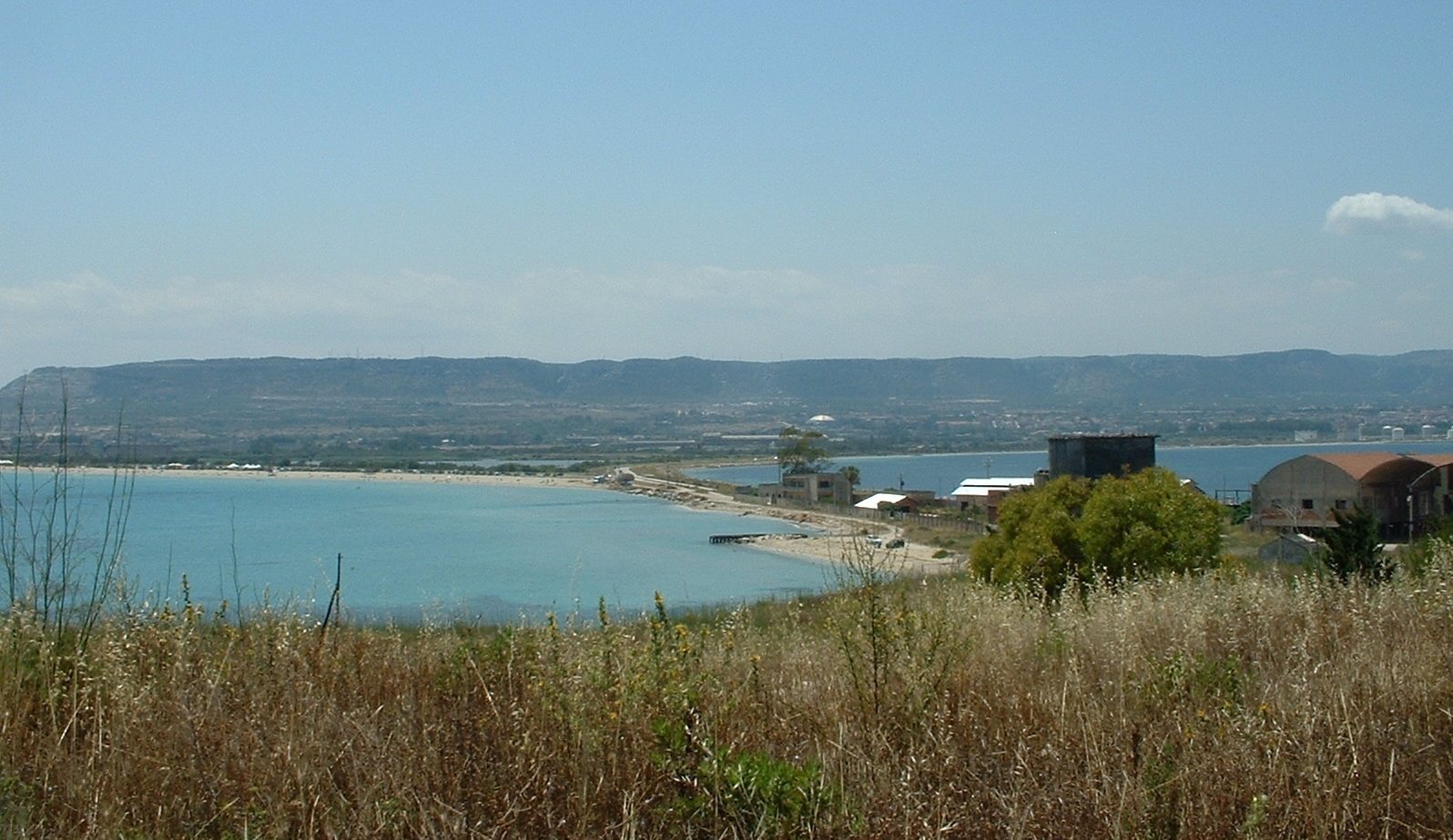
The site occupies the small, flat Magnisi Peninsula on Sicily’s eastern coast, about 18 km northwest of Syracuse. A narrow isthmus joins it to the mainland, stretching about 2.5 km and narrowing in places to roughly 100 m. Although some ancient and medieval writers described Thapsos as an island, Thucydides called it a peninsula. The settlement lay on the peninsula’s western side, immediately east of the isthmus, and covered an estimated area of about 1,000 by 300 m. Excavated remains are concentrated in a northern district and a central area. Two good anchorages lay to the west, one north and one south of the isthmus.
Northern quarter
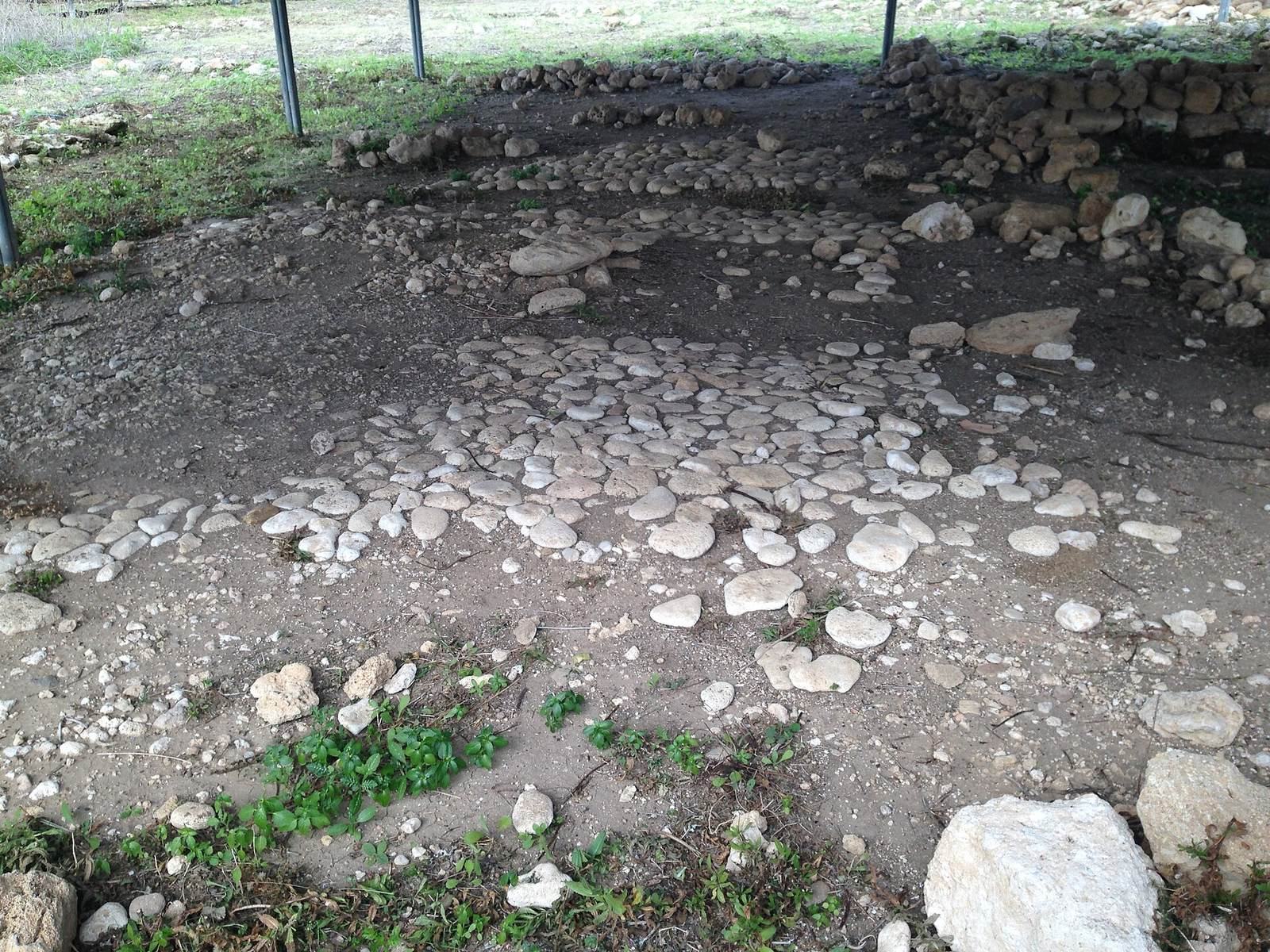
The northern settlement is made up chiefly of single-room huts with circular, oval, and sometimes semicircular plans. Rings of postholes show where upright wooden supports held the roofs. The huts had dry-stone foundations, while wood, straw, and clay formed their walls and roofs. Some had rectangular additions, with narrow paths running between buildings.
Central quarter
The central area contains round huts and rectangular buildings, including three large complexes labelled A, B, and C. Walls divide the complexes into rectangular rooms, most of which had benches along their inner walls; some rooms were arranged around courtyards. The buildings are unusually large and complex for Bronze Age Sicily, and their precise function is uncertain. Finds from them include pottery of the Maltese Borg in-Nadur culture.
Streets in the central area follow a more regular plan than those in the north, with some measuring about 4 m across. Houses were often arranged in wings around cobbled courtyards, and the overall layout has proto-urban characteristics. In the settlement’s later phase, this more ordered arrangement gave way to huts built without an apparent overall plan.
Fortifications
A defensive system protected the settlement. It included semicircular towers about 5 m in diameter, placed at regular intervals.
Burial areas
About 300 tombs have been identified in burial grounds to the north, east, and south of the peninsula. The largest lies at the northern end, and tombs are especially concentrated in the northern and eastern areas.
Rock-cut tombs
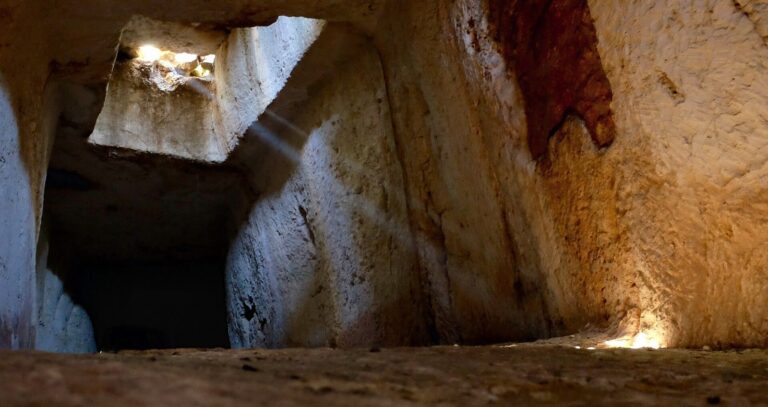
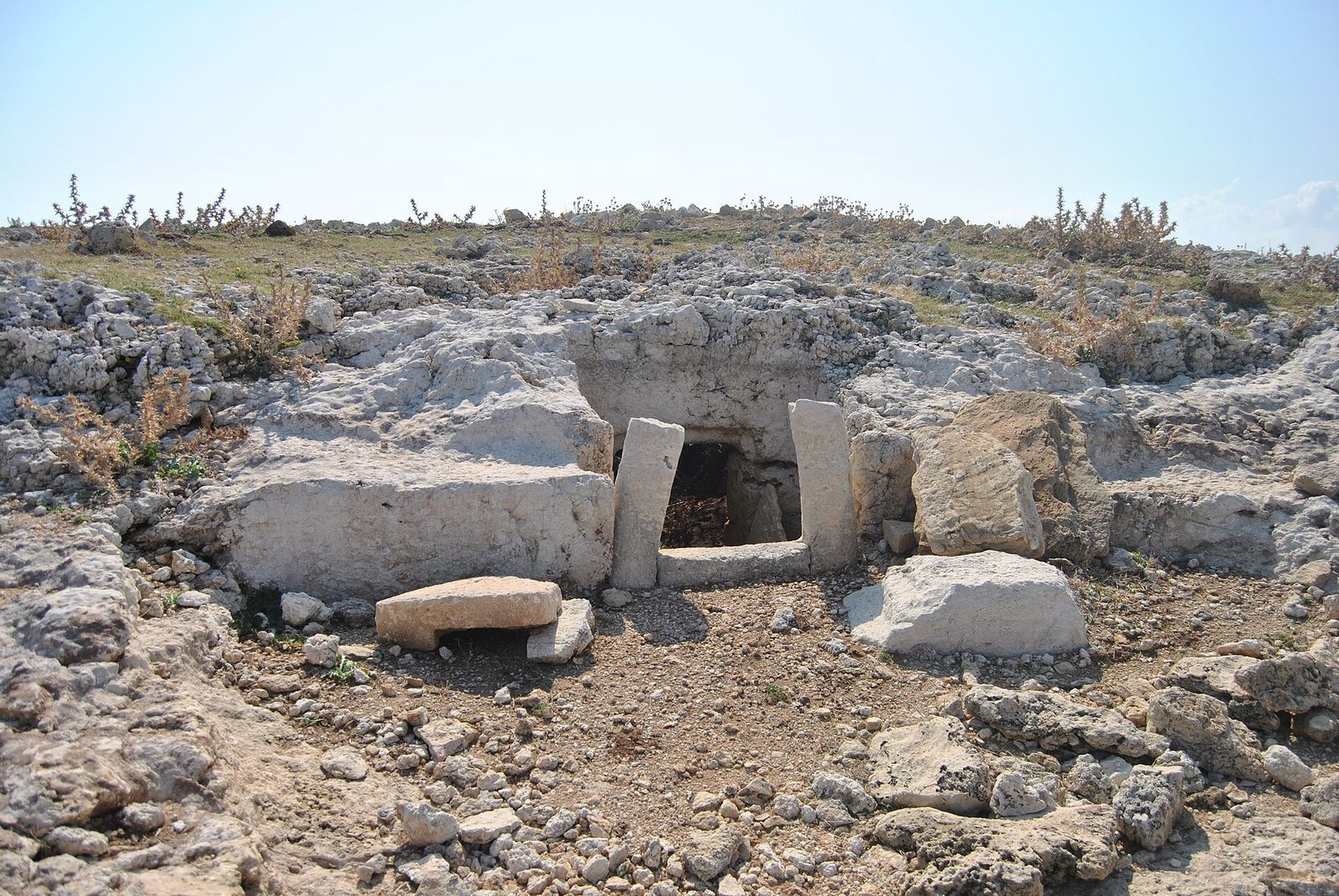
Most graves are chambers cut into the rock and were generally used for multiple burials. Excavated tombs held between one and about 50 individuals. Access passages, sometimes lengthened into corridors, lead to burial chambers of varied shapes. Some have a beehive-shaped chamber and an entrance room, with niches in the walls for the dead. Other graves are pits cut into relatively level bedrock, with wall niches and low benches around their edges.
Coastal tombs near the Magnisi lighthouse have drainage channels. During severe storms, seawater could reach or cover the stone or wooden slab sealing a tomb, and many of these graves were in poor condition when discovered.
Jar burials
A separate burial area in the centre of the peninsula contains jar burials. Bodies without grave goods were placed in large, oval storage jars with cordoned surfaces, then set into natural hollows in the rock.
Grave goods and finds
Burial offerings include pottery, knives, swords, everyday objects, and jewellery made from gold, bronze, amber, glazed silica-based faience, and ivory. Mycenaean, Cypriot, and Maltese pottery was also found. Of the 67 tombs whose contents have been published, 58 held grave goods and 23 contained objects of clearly Aegean origin. Rich or foreign offerings occur far less often than modest objects made locally. Most excavated finds are now at the Paolo Orsi Regional Archaeological Museum in Syracuse.
Later structures
Magnisi Tower
The circular Magnisi Tower stands alone on the peninsula. It is a surviving later structure distinct from the Bronze Age settlement.
Second World War bunkers
Several bunkers from the Second World War also remain on the peninsula.
Industrial pier
The industrial pier at the peninsula’s southern end remains in place and is no longer in use.