Neapolis Archaeological Park: Greek and Roman Monuments in Syracuse


Site at a Glance
- Rating
- 4.3
- Popularity
- Very High
- Country
- Italy
- Primary era
- Classical
- External website
- Open
- Eras represented
- Classical, Medieval
- Civilizations
- Ancient Greek, Byzantine, Norman, Roman
- Site type
- City
On this page21 sections
History
Neapolis Archaeological Park in Syracuse, Italy, preserves part of the ancient Greek and Roman district of Neapolis, or “New City,” whose major monumental development began in the third century BC. The district was one of five areas of ancient Syracuse, alongside Ortigia, Acradina, Epipoli, and Tiche. Its monuments reflect the transformation of an area once occupied by necropolises and limestone quarries into a major civic, religious, and theatrical complex.
The development of Neapolis
After the First Punic War, the conflict between Rome and Carthage fought from 264 to 241 BC, Hiero II directed the construction of a monumental complex in Neapolis. Hiero II was the tyrant and ruler of Syracuse, and his building programme reinforced both his personal authority and the standing of the city. The Greek Theatre formed a central part of this development, which reshaped land previously used for burial and quarrying.
The quarries, known as latomiae, were first excavated around the fifth century BC. These large artificial limestone excavations probably supplied stone for the construction of Neapolis before being reused as prisons. The district also retained evidence of earlier activity. Excavations near the Grotticelle Necropolis uncovered part of a road and wall structures from the pre-Greek or Greek period, together with possible remains of a sacred building erected over a more archaic structure.
Excavation and protection
Investigation of the area began under Domenico Lo Faso, Duke of Serradifalco, whose work was published in 1840. Archaeologists Paolo Orsi and Luigi Bernabò Brea continued the excavations and protection of the monuments. Orsi, followed later by V. Cabianca, incorporated the archaeological area into Syracuse’s urban plan.
Between 1952 and 1955, the Soprintendenza della Sicilia Orientale created the archaeological park under Luigi Bernabò Brea. The project built on Orsi’s earlier planning and protection work and enclosed the surviving monuments to shield them from urban expansion. Syracuse’s population grew from about 66,000 to 117,000 between the 1950s and the 1980s, while construction elsewhere covered many ancient necropolises, baths, temples, and roads. The enclosed park protected the monuments within its boundaries from this building activity.
Neapolis forms part of the UNESCO World Heritage property “Syracuse and the Rocky Necropolis of Pantalica,” inscribed in 2005 for its evidence of cultural interchange, historical development, architecture, archaeology, and religious and cultural traditions. Later autonomous management allowed admission and concession revenue to be reinvested in the park, partly addressing earlier organizational and staffing problems.
Medieval and later transformations
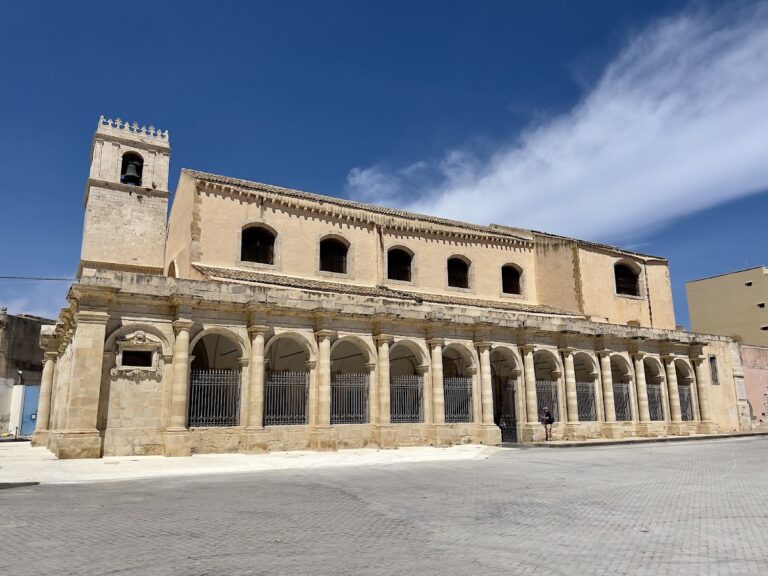
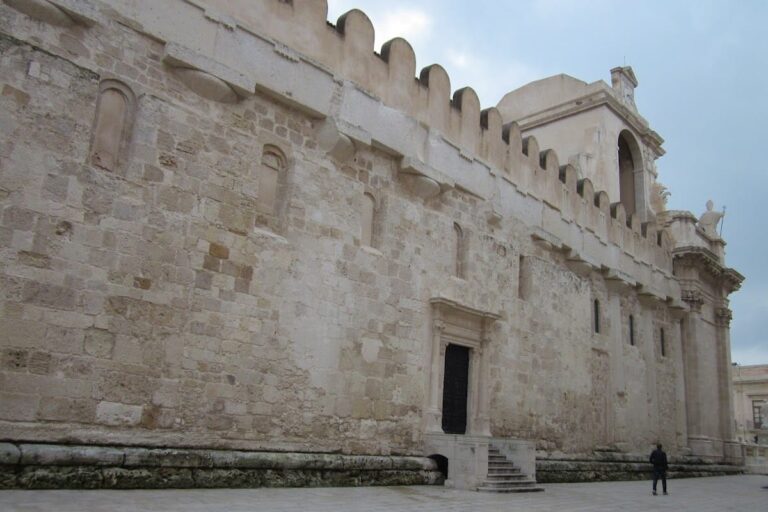
The church of San Nicolò ai Cordari was built in the eleventh century during the Norman period, after the Arab domination of Syracuse. In 1093 it hosted the funeral of Jordan of Altavilla, Count of Syracuse and son of Roger I of Sicily. The building lost its religious function during the Middle Ages and became the headquarters of the rope-makers’ guild in 1577. When the archaeological park was established in 1955, it was adapted for use as an information office.
The large chamber tomb traditionally called the Tomb of Archimedes belongs to the Imperial Roman period, many centuries after Archimedes. Archimedes was the celebrated Syracusan mathematician, engineer, and inventor killed during the Roman capture of Syracuse. The tomb’s traditional identification arose from the belief that the most monumental tomb in the city must have belonged to its most famous citizen.
The actual location of Archimedes’ tomb remains uncertain. Possible locations include the Via dei Sepolcri, Acradina, and the area near the River Ciane. Cicero, a Roman statesman and writer who served in Sicily, described finding an abandoned tomb near the Ciane marked by a sphere and cylinder. These symbols were associated with Archimedes and were said to have been installed by the Roman general Marcus Claudius Marcellus, but the tomb Cicero found cannot be securely placed in either Neapolis or Acradina.
Remains
The park covers approximately 240,000 square metres on the Temenite hill, a modest limestone elevation near the River Anapo. The hill divides the archaeological area into a southern zone containing the principal monuments of Neapolis, northern quarries, and a summit terrace with further remains. The surviving structures range from Greek theatres and Hellenistic houses to Roman buildings, rock-cut tombs, quarries, and water installations.
Theatre and Roman spectacle buildings
Greek Theatre
The Greek Theatre occupies the principal southern zone of the park. Its cavea, the banked seating area of an ancient theatre, contains 67 rows divided into nine sections by eight passageways. The building was modified during the Roman period, leaving a monument whose principal form belongs to the theatrical development of Neapolis but whose history continued under Roman rule.
Roman Amphitheatre
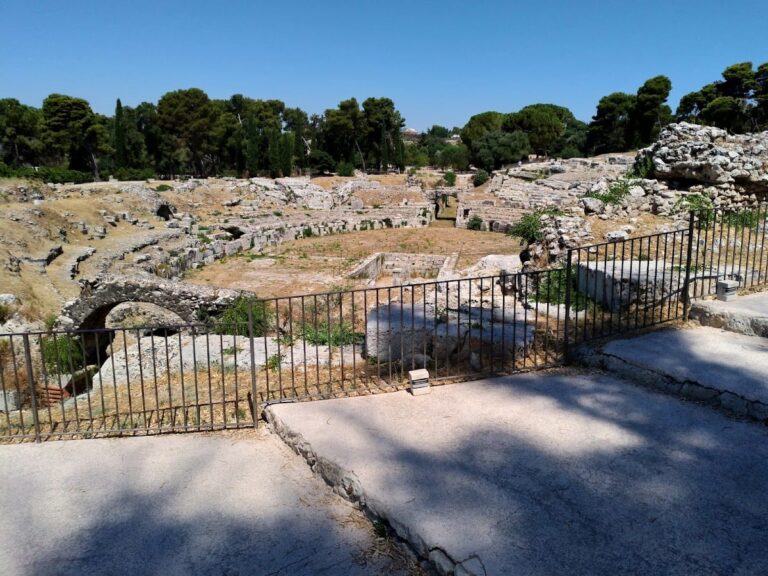
The Roman Amphitheatre dates from the Imperial Roman period, the era of Roman rule under emperors. It is partly cut into the limestone and contains a rectangular central space used for stage machinery. Its construction and arrangement reflect the adaptation of the district for Roman public spectacles, including staged naval displays known as naumachiae, a type of arena entertainment involving naval combat or spectacle.
Roman Pool
Below the church of San Nicolò ai Cordari are the remains of the Roman Pool, a cistern with a vaulted roof carried by 14 pillars. It probably served as a reservoir for water used in the naumachiae held in the Roman Amphitheatre. The underground position of the pool preserves its connection with both the church above and the Roman entertainment complex.
Monumental altar and urban remains
Altar of Hiero II
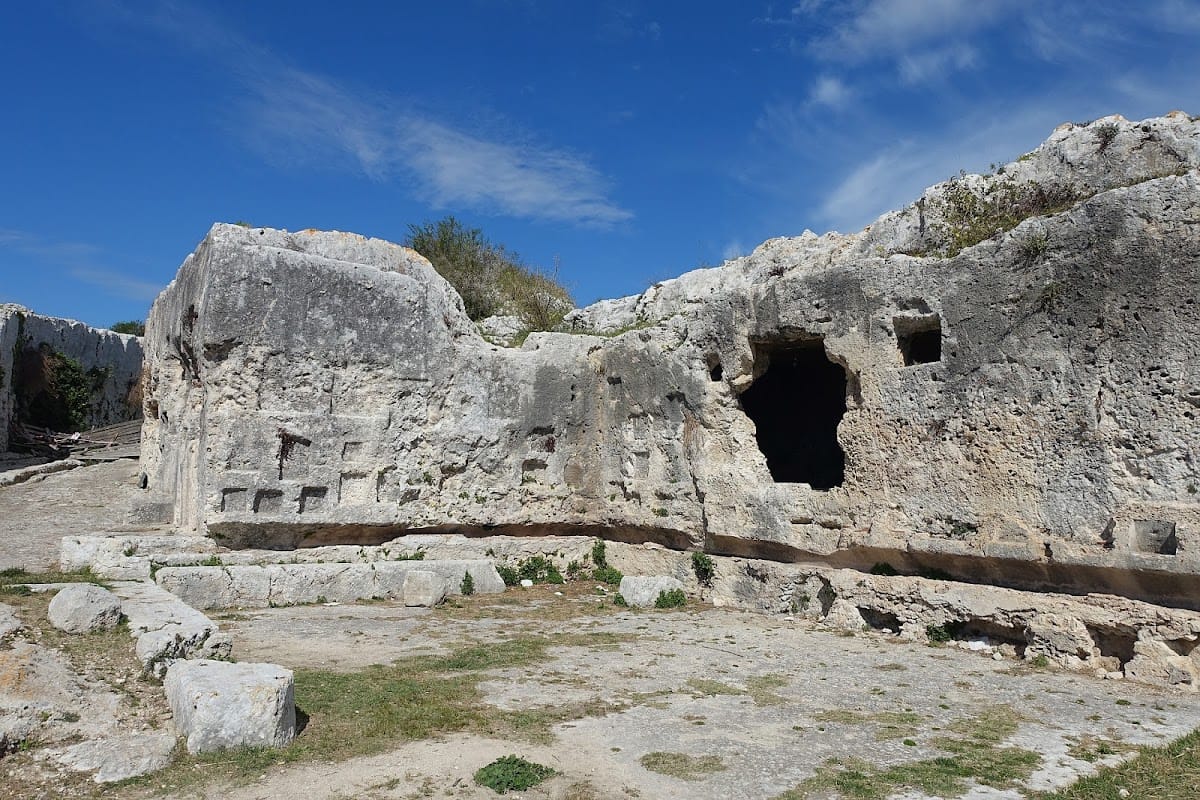
The structure traditionally called the Altar of Hiero II was built between 241 and 215 BC and is thought to have been dedicated to Zeus Eleutherios, meaning “Zeus the Liberator,” a cult title associated with freedom and civic liberation. Measuring 198 metres long and 22.8 metres wide, it is considered the largest known altar of antiquity. Only the substantial basal structure survives. The rest was dismantled during the sixteenth century, when its stone was reused in Spanish fortifications.
Other remains identified in the park include the Arch of Augustus, Roman stone sarcophagi, Hellenistic houses, and the Galerme Mills. Together with the principal theatre buildings, these features illustrate the mixture of civic, domestic, funerary, and infrastructural elements that occupied the Neapolis district.
Quarries and rock-cut spaces
Latomia del Paradiso
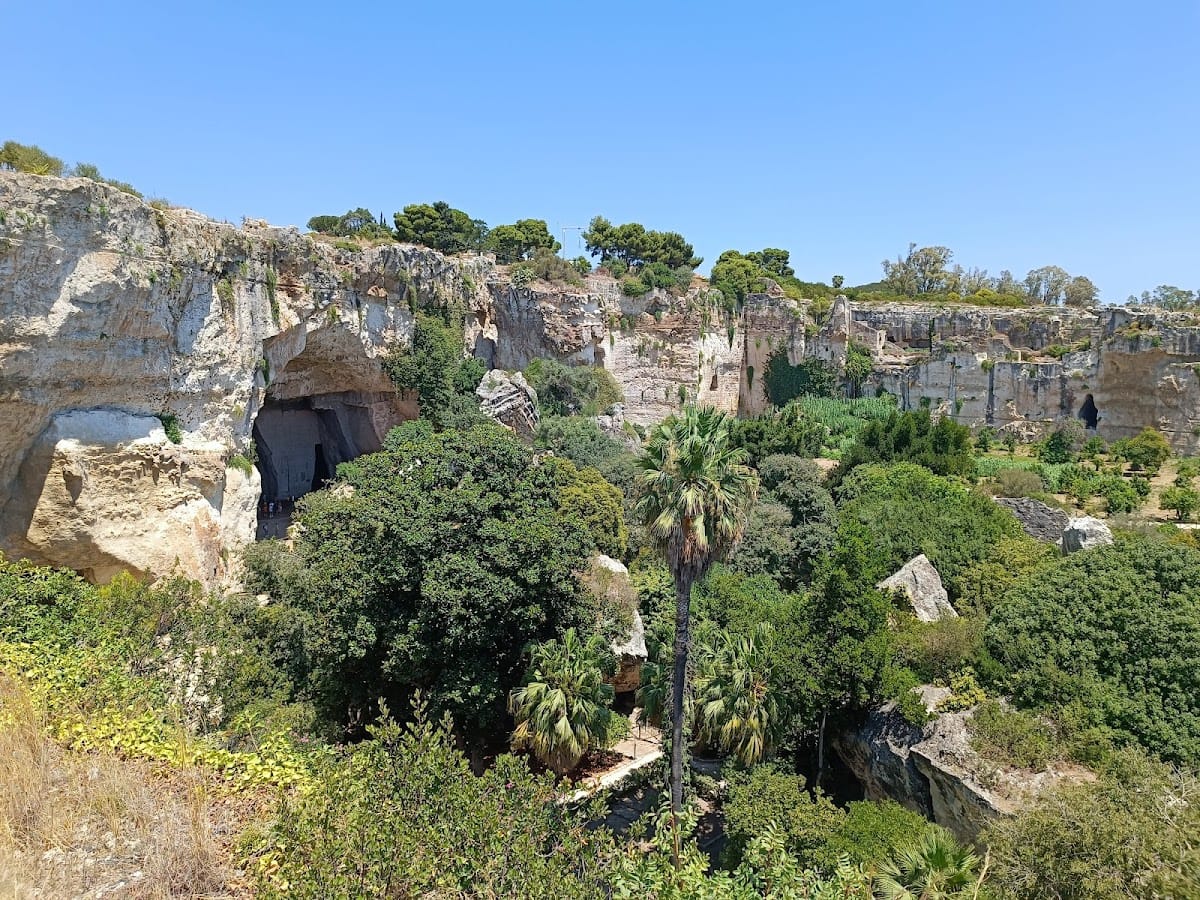
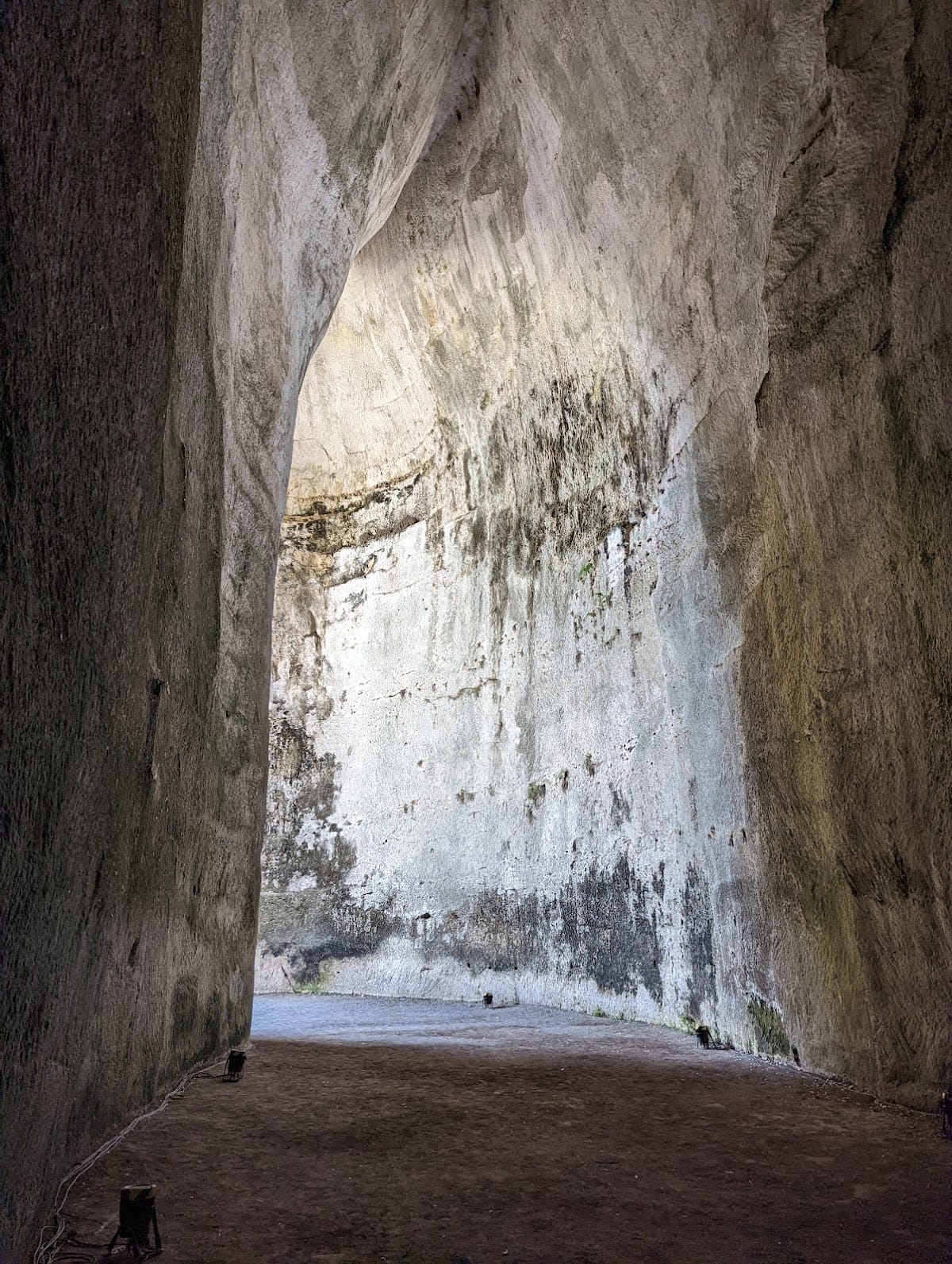
The Latomia del Paradiso is the largest and westernmost quarry in the Neapolis area, near the Altar of Hiero II. Some parts are inaccessible, and sections reach about 45 metres in depth. Its artificial cavities include the Ear of Dionysius, the Grotta dei Cordari, and the Grotta del Salnitro. These spaces belong to the wider network of limestone excavations that supplied building material and were later used as prisons.
Other latomiae
The other principal quarries are the Latomia dell’Intagliatella and the Latomia di Santa Venera. Santa Venera contains the large, century-old Ficus delle Pagode, identified as Ficus macrophylla. The tree grows within a quarry landscape shaped by the removal of limestone and the later development of dense vegetation.
Temenite hill and water installations
Grotta del Ninfeo
The Grotta del Ninfeo is an artificial cave at the top of the Temenite hill. It opens at the centre of a rock wall above the Greek Theatre and lies within a rectangular terrace. The cave has a vaulted roof and a rectangular basin. Water from the Galermi and Ninfeo aqueducts reaches the site and falls in a cascade from a cavity in the rock wall.
The name Nymphaeum reflects the association of the spring with the cult of the nymphs. The cave is also thought to have contained a sanctuary of the Muses, or Museion, where actors gathered before performances in the theatre. Honorary inscriptions and three female marble statues identified as Muses support this interpretation. The statues are preserved in the Paolo Orsi Regional Archaeological Museum. Small shrine-like structures called naiskoi beside the entrance wall were used for hero cult.
Via dei Sepolcri and the aqueducts
The Via dei Sepolcri begins west of the Grotta del Ninfeo and extends for about 150 metres through a cutting between rock walls. Small niches along the route held votive plaques, while underground chambers known as hypogea date from the Byzantine period, the later Roman Empire centred on Constantinople. The path leads to the summit of the Temenite hill, where remains attributed to the Sanctuary of Apollo Temenite have been found.
The Ninfeo aqueduct supplied water to the Temenite terrace. The Galermi aqueduct was formerly connected with the park by a bridge that has since been demolished, leading towards the small waterfall associated with the Ninfeo cave.
Necropolises and chamber tombs
Grotticelle Necropolis
The Grotticelle Necropolis occupies the northeastern end of the park beyond the Latomia di Santa Venera. It contains rock-cut Sicel, Greek, and Roman tombs. The Sicels were an ancient people of eastern Sicily who preceded or coexisted with the Greek communities of the island. The earlier Sicel and Greek pit graves are less visible, while the Imperial Roman chamber tombs are more prominent.
The so-called Tomb of Archimedes
The most conspicuous chamber tomb in the necropolis is the structure traditionally called the Tomb of Archimedes. Its rock-cut facade has Doric half-columns and a pediment with a triangular tympanum. Cinerary urns found inside, together with its Imperial Roman date, identify it as a Roman tomb rather than the resting place of Archimedes.
Landscape and associated features
The natural conditions of the park vary across the hill. Deeper, densely vegetated areas are humid, while elevated sunny ground near the Greek Theatre is hotter and drier. Salty sea winds and low rainfall influence the climate. Surveys and vegetation-clearance work between 2011 and 2013 recorded more than 250 plant species, including olive, Mediterranean cypress and pine, date palm, ficus, citrus, carob, pomegranate, myrtle, acanthus, ivy, bramble, Mediterranean grasses, and flowering plants such as hibiscus, mallow, campanula, bougainvillea, tamarisk, and water lilies.
A rare oregano, Origanum onites, grows on the Temenite hill, alongside capers, thyme, and Mediterranean maquis, the dense shrubland typical of Mediterranean climates. Acanthus leaves also have a wider architectural history, becoming a characteristic ornament of capitals in the Corinthian order. Near the entrance, outside the archaeological enclosure and beside Syracuse’s centuries-old tree, stands a three-metre-high bronze statue of Prometheus by the sculptor Biagio Tommaso Poidimani of Rosolini, Sicily. Prometheus is the Greek mythological figure associated with giving fire to humanity and suffering punishment from Zeus.