Gouy Cave: A Prehistoric Engraving Site in Normandy
Site at a Glance
- Popularity
- Medium
- Country
- France
- Primary era
- Stone Age
- Eras represented
- Stone Age
- Civilizations
- Unclassified
- Site type
- Civic
- Remains
- Rock Art
On this page7 sections
History
Gouy Cave is a limestone cave in Gouy, Normandy, France, with engravings associated with the Magdalenian, a late prehistoric culture of western Europe, and the later Azilian culture. The cave provides evidence of prehistoric activity in the Seine valley during a period of climatic change.
Prehistoric use
Collagen from a bone fragment yielded a date of 12,050 ± 130 years before present (BP, counted from 1950). This establishes human visitation at that time, but does not date the cave’s engravings as a whole.
The art has been interpreted as evidence of Magdalenian communities in the Seine valley around the transition from the end of the last glaciation to the Azilian, perhaps with links to groups in the Paris Basin. These people may have witnessed the disappearance of the last mammoths and woolly rhinoceroses, which they probably hunted on the frozen Seine. Reindeer and horses persisted for a time before moving east. After major warming, a forest-adapted culture focused mainly on small game followed; the Magdalenians were the region’s last major Paleolithic hunters.
Discovery and protection
In 1881, Gouy residents Jamelin and Narcisse Reboursier found the cave but kept their discovery private. An inscription bearing a date, which they left behind, later established their visit. Roadworks in 1934–35 altered the entrance and destroyed part of the passage. Workers noticed a fissure, but the foreman stopped them from exploring it because he considered the descent dangerous. Pierre and Yves Martin rediscovered the cave in 1956; Yves later became a prehistorian, a scholar of societies before written records.
At the request of Henri Breuil, a French prehistorian whose work helped establish the study of Paleolithic art, Gouy Cave was classified as a French historic monument on 11 May 1959. In 2010, the Archaeological Institute of America identified it as at risk because tree roots were growing into its limestone walls. Natural deterioration and human activity have severely damaged the cave, leading to its closure to the public.
Remains
Gallery and engraved art
Gallery
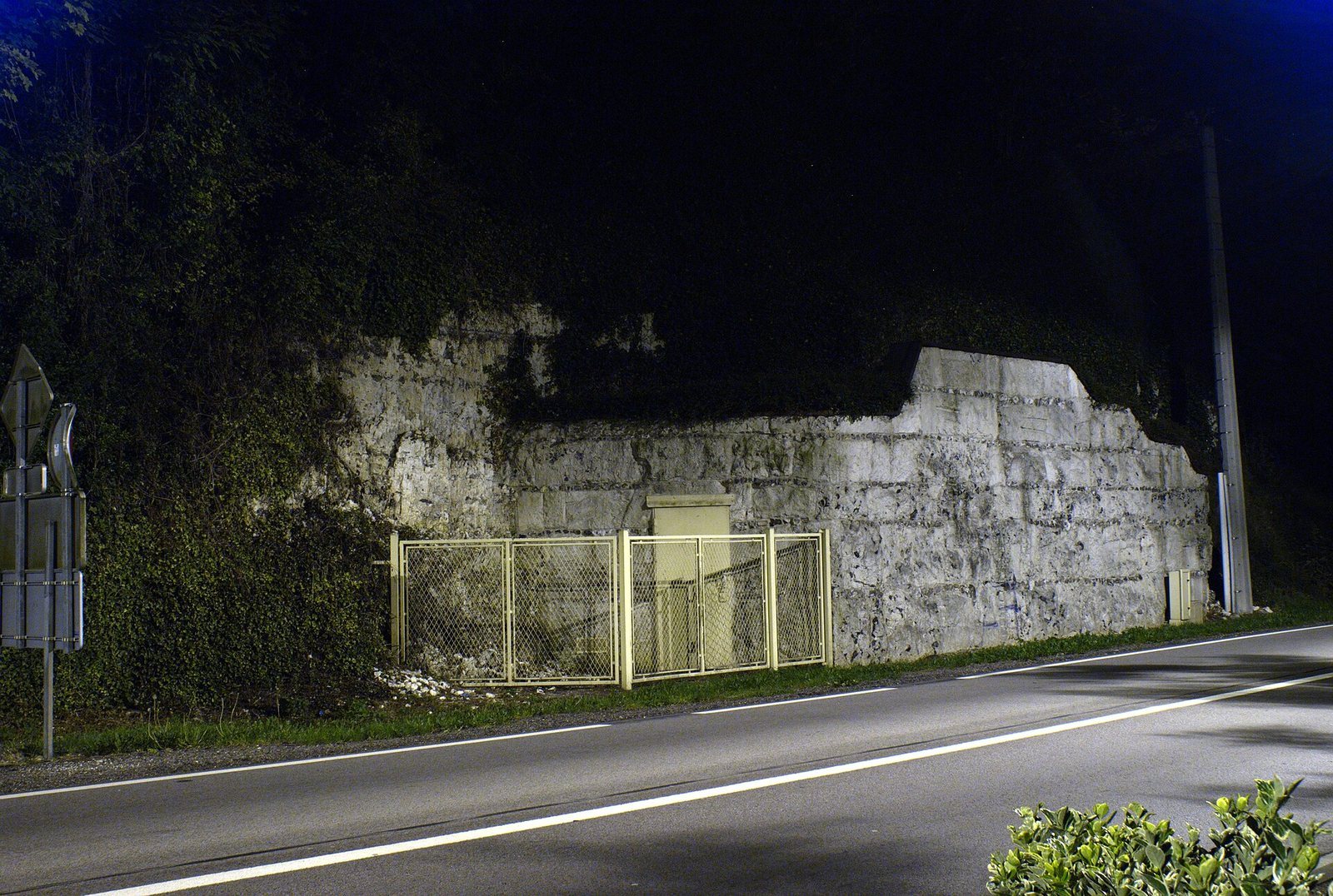
The cave lies at the foot of the right-hand slope of the Seine valley, about 10 km from Rouen and beside the D6015 road. Following the roadworks, the remaining gallery measured about 12 m long and 2 m wide, and was divided into three chambers. The engravings are made on chalk. The entrance has been cemented and sealed with a metal door.
Engravings
About 37 engravings were counted in 1972. They include 18 animals: seven horned animals, seven horses, one bird, probably a bird of prey, and three animals whose identities are uncertain. Other images comprise a possible human figure and eight vulva-shaped forms. The signs include feather-shaped, barbed, and club-shaped forms, alongside seven signs of undetermined shape. Red lines and patches also appear in the cave.