Dolmen des Aguals: A Prehistoric Burial Monument in France
Site at a Glance
- Popularity
- Very Low
- Country
- France
- Primary era
- Bronze Age
- Eras represented
- Stone Age, Bronze Age, Iron Age
- Civilizations
- Unclassified
- Site type
- Burial
- Remains
- Burial Mound
On this page16 sections
History
Prehistoric funerary use
The Dolmen des Aguals is a prehistoric burial monument in Montbrun, France, on the administrative boundary with Gréalou. Its position on a cadastral boundary may have served as a marker between properties. The monument is also known as the dolmen de la Combe de l’Ours, after the sinkhole below it. That name can be confused with two other dolmens a few hundred metres away, both within Montbrun.
The chamber’s finds connect the monument with the Chalcolithic, or Copper Age. Pottery and metal objects indicate later activity from the Middle Bronze Age through the Late Bronze Age or early Iron Age. The site is also associated with the Iron Age, and its funerary use appears to have continued across these prehistoric phases.
Excavation and protection
Archaeologist Jean-Pierre Lagasquie excavated the dolmen in the early 2000s. It was listed as a historic monument, a form of legal heritage protection in France, by an order dated 19 October 2001. The order was amended on 7 January 2002.
Remains
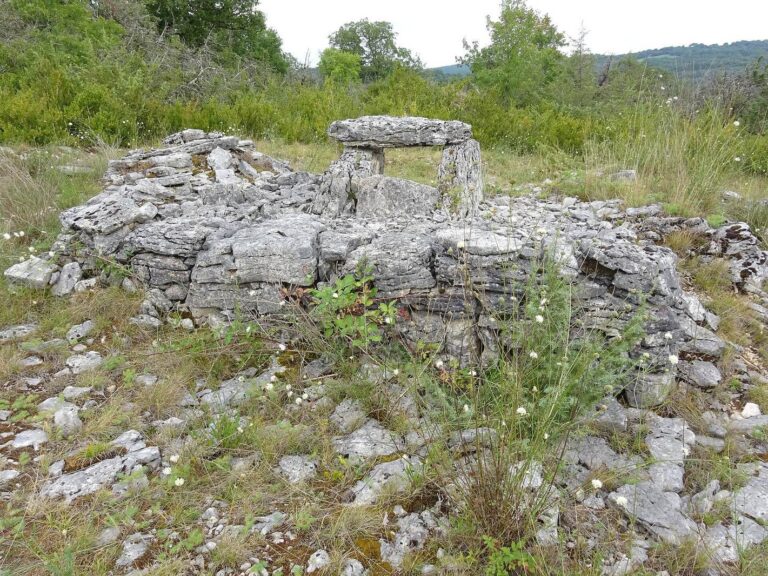
The monument stands on a ridge above the large sinkhole of the Combe de l’Ours. A burial chamber sits within a broad mound enclosed by two circular stone structures. The central cairn, a mound of stones, follows a regional Quercy form; Quercy is the historic region centred on the Lot area. The inner ring of upright stones and the chamber’s alignment toward sunrise have been interpreted as possible influence from megalithic traditions of Atlantic Europe.
Mound and enclosing structures
Burial mound
The mound averages 29 metres across, reaches 3.80 metres at its highest point and has an estimated volume of 800 cubic metres. Its size is unusually large in comparison with other dolmens in the Lot. Behind the chamber, the stone mound extends 18 metres down the slope, possibly forming a ramp used to position the roof slab.
Concentric stone rings
The inner circular structure lies 6 metres from the chamber at the entrance and 3 metres from it at the rear. It consists of small, thin, remarkably even slabs. Stones packed around their bases show that the slabs originally stood upright; pressure from the mound later pushed them outward. Their position suggests that they marked the edge of an earlier mound and faced its exterior. The slabs came from a lower geological layer toward the Lot valley. Similar upright-slab circles occur at excavated sites, particularly in Brittany, and this form is chiefly associated with the Late Neolithic and Bronze Age.
In a later building phase, blocks, slabs and clay-rich earth were piled against the first circle. Another ring of upright slabs was set into the mound, probably leaving an open space behind it like a passage around the structure. A second outer circle, made from large slabs carefully laid flat, marked the mound’s new edge. Its circular outline is exceptionally regular, and it now averages 0.40 metres in height. A surface layer about 10 centimetres thick, made of clay-rich earth and small quartz pebbles from the nearby sinkhole, covered the earlier structures. Erosion or later filling without this pebble layer subsequently covered the outer facing, softening the visible boundary between the mound and surrounding ground.
Chamber and secondary burials
Burial chamber
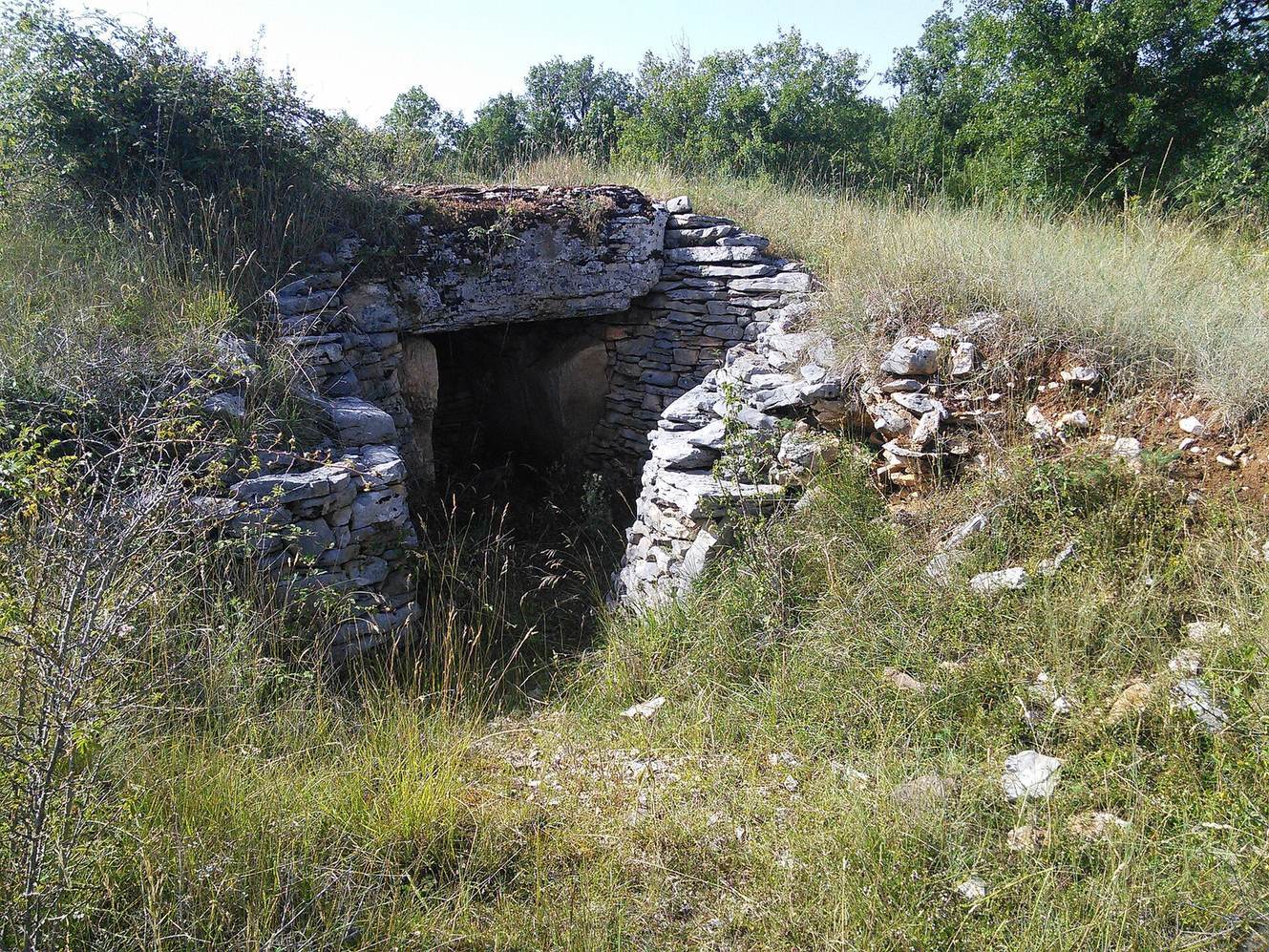
The chamber’s two side supports and rear slab are limestone and hold a roof slab. Their bases are wedged into fractures in the underlying limestone pavement. The slabs appear to have been shaped to provide a level support for the roof and a close fit between the rear and side stones. A microgranite hammerstone found in front of the entrance may have been used for this work; two flakes from the same tool came from inside the chamber.
The chamber averages 1.30 metres in width. Before excavation, its fill reached to within about 50 centimetres of the ceiling. The rear slab’s base is 0.25 metres higher than that of the left side support, a difference that may indicate an original floor of stone slabs, later destroyed. The chamber is oriented 130 degrees clockwise from north, and at the winter solstice the sunrise aligns exactly with its axis.
Eastern cremation burial
Within the first stone ring in the mound’s eastern quarter, a small stone burial box measures 0.50 metres long, 0.40 metres wide and 0.30 metres deep. It was built from small limestone slabs and held a broken funerary urn with cremated bone fragments, as well as a tiny iron fragment whose form could not be identified.
Southern urn burial
A second burial lay in the southern quarter, nearly aligned with the chamber and 0.80 metres below the surface. A large flat slab covered the urn, which contained burned bone fragments and four pieces of a bronze bracelet. The burial was identified as that of a newborn.
A test excavation in front of the chamber’s southeast entrance found a disturbed deposit where a later cut had been made into the earlier mound. Earth and rock debris filling the area were mixed with human bone and funerary objects. Bones and objects also came from the chamber and the space behind its rear slab, as well as from the two burials in the mound.
Objects from the burials
Human remains and ornaments
The identifiable human remains consisted of three partial lower jaws and 161 teeth. Ornaments included 44 ring-shaped shell beads, four cylindrical beads of soapstone or jet, two prism-shaped buttons with V-shaped holes, and one tubular bead made from bone.
Flint and stone tools
The flint finds comprised seven arrowheads with stems and barbs, 19 assorted flakes, one scraper and one oval side-scraper. Other stone objects included a hammerstone, a four-sided quern used for grinding grain, a polishing stone and a tool for smoothing pottery.
Metal objects
Metal finds included two unidentified bronze fragments, five iron nails, two spring fragments, a thin iron plate, a bronze arrowhead, a bronze ring fragment and a copper dagger blade. The dagger’s distinctive shape resembles examples of the Fontbouisse culture, a prehistoric culture of southern France, although it may instead belong to the Bell Beaker culture, a widespread prehistoric culture named for its bell-shaped pottery.
Pottery
Some pottery sherds from inside the chamber belong to the older group of finds. Later material includes black pottery that was well fired and highly polished, with grooved decoration, thin rims and lips that were either bevelled or rounded.