Château de Cénevières: A Renaissance Castle in France


Site at a Glance
- Rating
- 4.6
- Popularity
- Medium
- Country
- France
- Primary era
- Early Modern
- External website
- Open
- Eras represented
- Medieval, Early Modern
- Civilizations
- French
- Site type
- Domestic
- Remains
- Castle
On this page15 sections
History
Château de Cénevières is a historic castle in France, in the commune of Cénevières in the Lot department, whose origins date from the thirteenth century and whose later transformation created a Renaissance complex. It stands in the historic Quercy region within the Causses du Quercy Regional Natural Park. The castle is associated with the La Popie and Gourdon families, the Wars of Religion, and the political history of southwestern France.
Early stronghold and the La Popie family
Local tradition identifies the site as a stronghold of Waifer, the eighth-century duke of Aquitaine who fought Pepin the Short, the Frankish king and father of Charlemagne. According to this tradition, Pepin captured Cénevières in 767 after a four-year siege. The La Popie family, who held the lordship of Cénevières, constructed and occupied the castle between the ninth and fourteenth centuries. The present castle itself dates from the thirteenth century, while major alterations followed in the fourteenth, fifteenth, and sixteenth centuries.
During the twelfth century, Guillemette de La Popie sold her rights in Cénevières to Jean de Gourdon. The viscounts of Gourdon-Cénevières then became lords of the castle and its surrounding lands. In 1469, Olivier de Penne de Gourdon paid homage for his holdings in the Duchy of Guyenne, a historic province of southwestern France. His possessions included the castles and places of Gourdon, Cénevières, Saint-Jean de Laur, Limogne, La Toulzanie, Lugagnac, Cornuts, Puigourde, Gaiffier, Saint-Martin-Labouval, and Puylagarde.
The Renaissance transformation
From the beginning of the sixteenth century until 1561, Flottard de Gourdon, Viscount of Cénevières and Gaiffier, pursued a military career. He fought at Marignano in 1515 and at Pavia in 1525, where he was wounded and taken prisoner. He later travelled to Turkey with his friend Gaillot de Genouillac. After marrying Marguerite de Cardaillac, Baroness of Saint-Cirq-Lapopie, in 1531, Flottard transformed the medieval fortress into a Renaissance palace.
The Renaissance was a European period that revived classical forms, learning, proportion, and elaborate decoration. In France, noble residences often retained defensive structures while adding larger windows, galleries, and more refined domestic interiors. At Cénevières, this transformation continued through the sixteenth century, and construction was recorded as complete in 1585.
Cénevières during the Wars of Religion
From 1561 to 1616, Antoine de Gourdon was a knight of the Order of the King, a royal order of chivalry, as well as a councillor of state and captain of fifty men-at-arms. Queen Jeanne d’Albret, the Protestant queen of Navarre, converted him to Protestantism. He became an important Huguenot leader during the Wars of Religion, the sixteenth-century conflicts between Catholics and Protestants in France.
Antoine de Gourdon frequently received the young Henry of Navarre at Cénevières. Henry later became King Henry IV of France. The castle also hosted the Protestant theologian Theodore Beza and the Quercy poets Clement Marot and Olivier de Magny. On 15 May 1580, Henry of Navarre captured Cahors with Antoine de Gourdon’s assistance, after which Gourdon became governor of the city.
Marquisate and changing ownership
In 1612, Louis XIII elevated the lands of Cénevières to a marquisate, a territorial lordship held by a marquis. Antoine de Gourdon died without issue in 1616 and was the last member of the Gourdon branch to reside at Cénevières. His widow, Isabeau d’Astorg de Montbartier, married Charles de la Tour in 1617. Charles was Marquis of Gouvernet, Baron of Ail, marshal of camp, royal councillor, seneschal of Diois in Valentinois, governor of the Lower Dauphiné, and a prominent Protestant captain.
The viscounty of Calvignac was acquired in 1638. In 1691, Charles Barthélémy de la Tour du Pin, Marquis of Cénevières, left the Protestant faith and married Louise Émilie Goussé de Rochelard in Paris. Louis XIV and Madame de Maintenon acted as witnesses. Charles Barthélémy died in 1703, and an inventory of the castle was prepared in 1704. The Marquise of Cénevières died in 1717 and was buried in the church of Saint-Martin-Labouval.
Charles Frédéric de la Tour du Pin, Marquis of Gourvenet, married Mademoiselle de Livry. His cousin Jean Frédéric de la Tour du Pin became Marquis of Cénevières and Viscount of Calvignac. In 1789, Jean Frédéric became Louis XVI’s minister of war.
Revolution and modern preservation
During the French Revolution, the castle was saved from fire with the aid of Cahors wine, but revolutionaries from Cajarc pillaged it. On 30 July 1793, shortly before his execution, the Marquis de la Tour du Pin sold Cénevières to Louis Naurissart for 524,000 livres. The purchase was made in the name of Naurissart’s wife, Anne de Labiche. Naurissart had been mayor and deputy of Limoges, a member of the National Constituent Assembly, president of the Finance Commission, and director of the Limoges Mint. He died in 1809 and was buried at Cénevières.
Anne de Labiche’s nephew, Mortimer Lesage, inherited the castle in 1826. His son Charles Lesage later succeeded him and undertook substantial maintenance of the ramparts, guardhouse, and interiors. Charles Lesage was mayor of Limoges at the end of the Second Empire. In 1919, his daughter Odette Lesage married the Count of Combarel du Gibanel and continued the restoration work.
Germaine de Combarel inherited the castle in 1946. She had married Max de Braquilanges in 1919; he died at Cénevières in 1943. Germaine maintained the property until 1981 and secured its classification as a French historic monument in 1957. A historic monument is a building or site protected under French heritage law for its architectural or historical importance. She also opened the castle to visitors. The property remains privately owned by the Braquilanges family, represented by Guy, Marquis of Braquilanges. The castle, its enclosing wall, and the former Protestant temple at the entrance were classified as historic monuments on 9 December 1957.
Remains
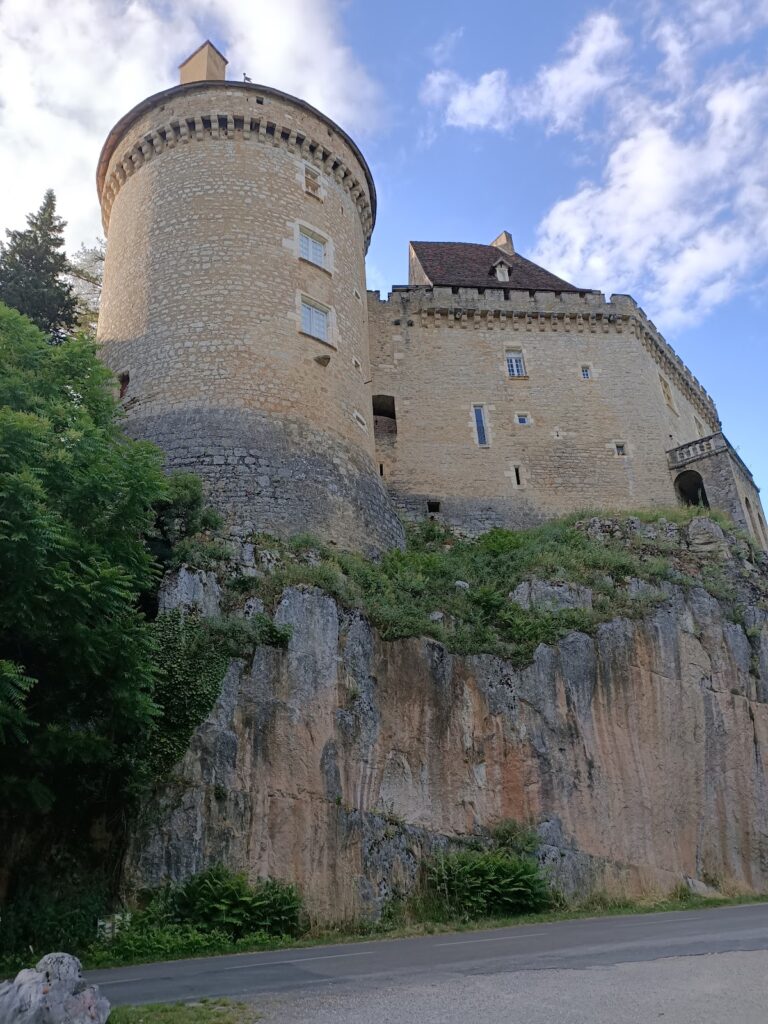
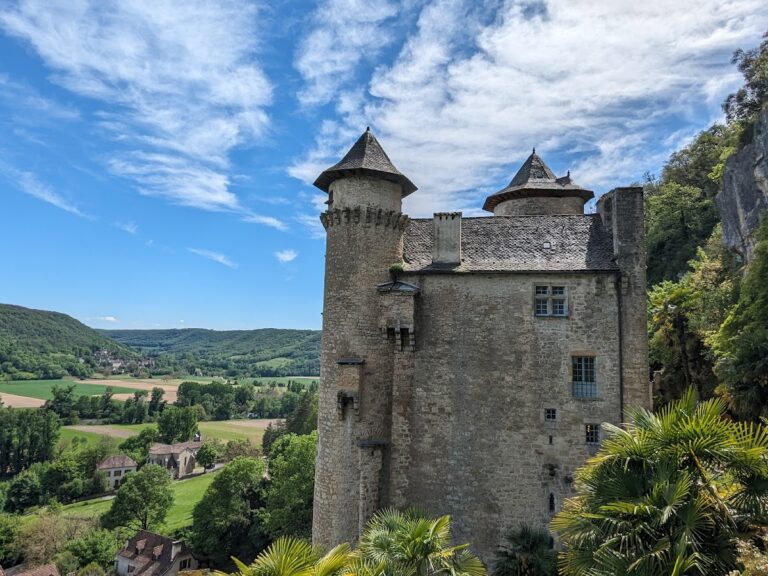
Château de Cénevières occupies a cliff or rocky outcrop and forms an irregular Renaissance complex. Buildings are arranged around towers and terraces, combining the surviving logic of a fortified residence with the larger openings and decorative spaces introduced during its sixteenth-century transformation. The castle includes a former rampart, a guardhouse at the entrance, an outer courtyard, a left wing, a columned gallery, and a terrace on the Lot side.
Fortifications and exterior arrangement
Ramparts and Gourdon Tower
A former rampart wall links the stables with the Gourdon Tower, which may have served as the castle’s keep. A keep was the principal fortified tower of a medieval castle. The defensive framework belongs to the earlier history of the site, although later alterations changed the character of the complex. Gothic openings were replaced by large Renaissance windows, and dormer windows were inserted into the defensive walls.
Guard tower and entrance
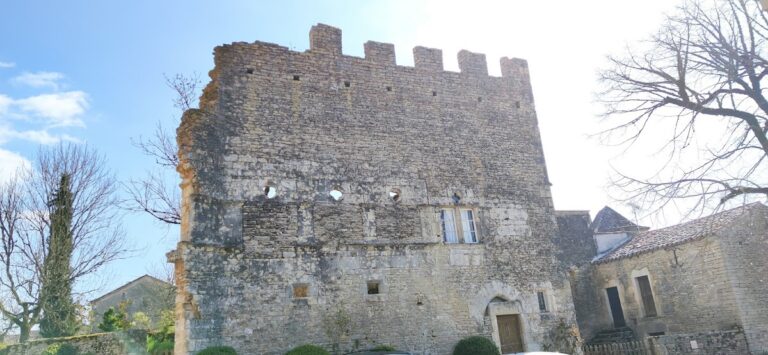
The entrance is preceded by a square building known as the guard tower or postern, a small secondary entrance. It was constructed in 1585, the year associated with the completion of the castle’s construction. The former Protestant temple stands at the entrance to the castle enclosure and forms part of the surviving group of buildings around the approach.
Gallery and terraces
A columned gallery runs around the exterior of the grand salon. The terraces extend the irregular arrangement of the buildings across the rocky site, including a terrace on the Lot side. Together with the outer courtyard entrance and left wing, these elements show how the fortress was reorganized as a Renaissance residence without losing its fortified setting.
Interior rooms and decoration
Painted apartment
One apartment preserves traces of painted frescoes with subjects drawn from Greek mythology and ancient legend. The scenes include the Flight of Icarus and the Chariot of the Sun, the story of Astyanax and the Burning of Troy, and the abduction of Helen. These painted rooms form part of the decorative programme associated with the palace created from the earlier fortress.
Grand salon and chapel
The grand salon has a painted ceiling, while another room contains a monumental fireplace. The castle also includes a consecrated chapel with an altar dedicated to the Holy Shroud. These rooms reflect the ceremonial, domestic, and religious functions incorporated into the Renaissance residence.
Alchemy cabinet and kitchen
A room known as the alchemy cabinet contains an alchemist’s furnace and painted scenes associated with Greek mythology. The kitchen includes a game table. Together, these spaces preserve details of the varied uses assigned to the castle’s interior rooms after its transformation from a military stronghold into a noble palace.