Dolmen D9: A Funnel Beaker Chamber Tomb in Annen, Netherlands
Site at a Glance
- Popularity
- Low
- Country
- Netherlands
- Primary era
- Stone Age
- Eras represented
- Stone Age
- Civilizations
- Unclassified
- Site type
- Burial
- Remains
- Tomb
On this page9 sections
History
Dolmen D9 is a stone-chamber tomb in Annen, Netherlands, built around 3300–3250 BCE by communities of the western group of the Funnel Beaker culture, a Neolithic farming culture named for its distinctive funnel-shaped pottery. Its pottery traces a main period of use in the early phases of that culture, followed by renewed activity in later prehistoric periods.
Prehistoric use
Twenty-eight vessels can be dated more closely within phases 3–5, a pottery-based system archaeologists use for relative dating in the western Funnel Beaker group. Two belong to phase 3, dated 3300–3250 BCE. Their small number may indicate that construction took place toward the end of that phase. Twenty-four vessels belong to phase 4, dated 3250–3190 BCE, which marks the tomb’s principal period of use. Two vessels belong to phase 5, dated 3190–3075 BCE, suggesting that use probably came to a temporary end after about two centuries.
Later pottery points to renewed activity during two Late Neolithic periods, 3000/2900–2450 BCE and 2550–2050 BCE, and during the Early Bronze Age, 2050–1850 BCE.
Early records and surveys
Ludolf Smids first mentioned the tomb in 1711. Petrus Camper drew it in 1769, capturing a condition broadly similar to its later appearance. In the 1840s, antiquarian and museum curator Leonhardt Johannes Friedrich Janssen visited D9. His 1848 survey of Dutch antiquities included descriptions and schematic plans of megalithic tombs.
In 1878, British antiquarians William Collings Lukis and Henry Dryden surveyed D9 as part of a study of 40 megalithic tombs in Drenthe. The Society of Antiquaries of London, a learned society concerned with antiquities and historical research, commissioned their work amid concern that restoration could obscure the monuments’ original condition. D9 appears in their Plan IV. Drenthe archaeologist Wijnand van der Sanden published the survey material in 2015. Willem Johannes de Wilde documented surviving Dutch megalithic tombs between 1904 and 1906, and Albert Egges van Giffen recorded D9 in 1918 for an atlas of the country’s tombs.
Excavation and later use
Van Giffen led an archaeological excavation and restoration at D9 in 1952. Dutch archaeologist D. J. de Groot published a study of the excavation in 1987. Since 1978, the tomb has been protected under the Netherlands’ national-monument designation.
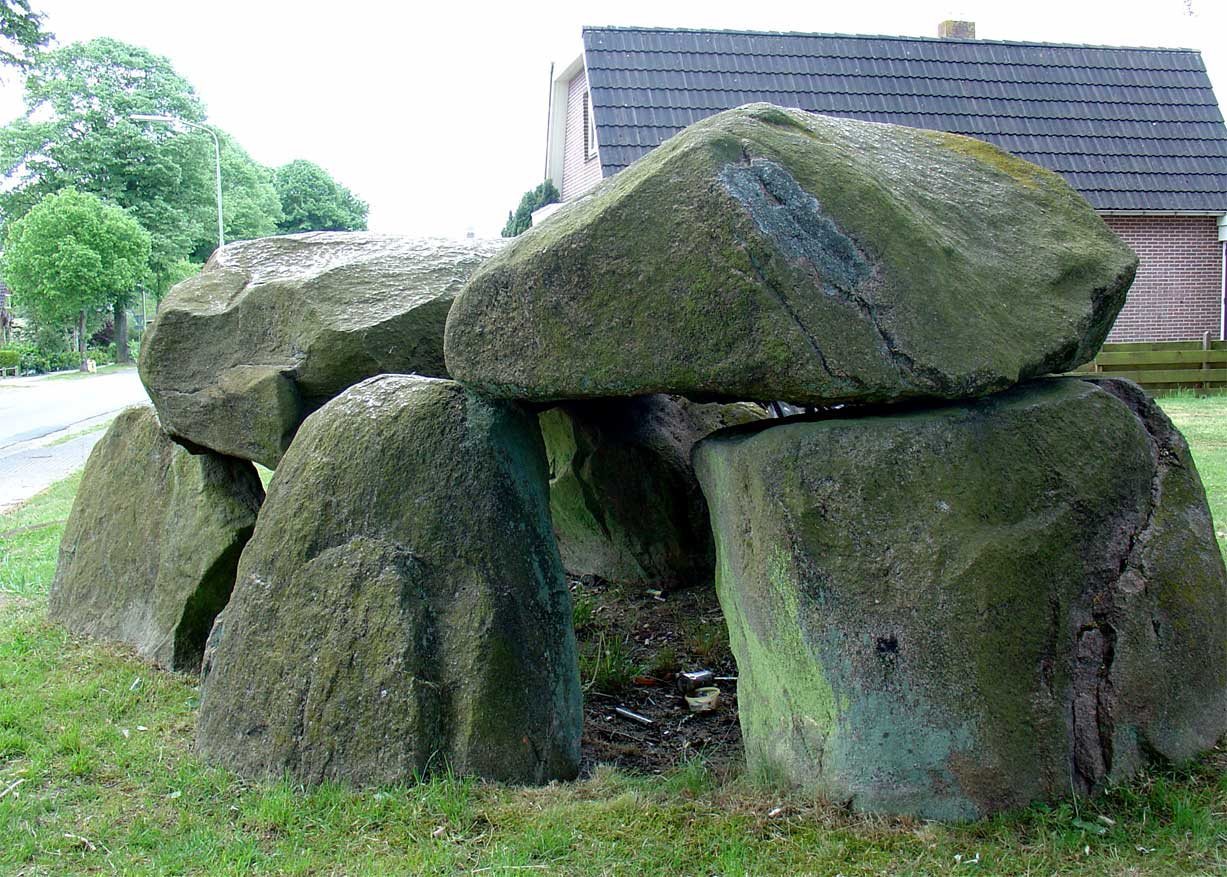
In 2017, the Province of Drenthe and the University of Groningen, with the Gratama Foundation, used photogrammetry, a method of creating three-dimensional records from photographs, to include D9 in a 3D atlas of the surviving Dutch megalithic tombs. The chamber was also used as bicycle parking for public-transport passengers. Annen’s historical society criticized this use, and the tomb acquired the nickname “prehistoric bicycle shed.”
Remains
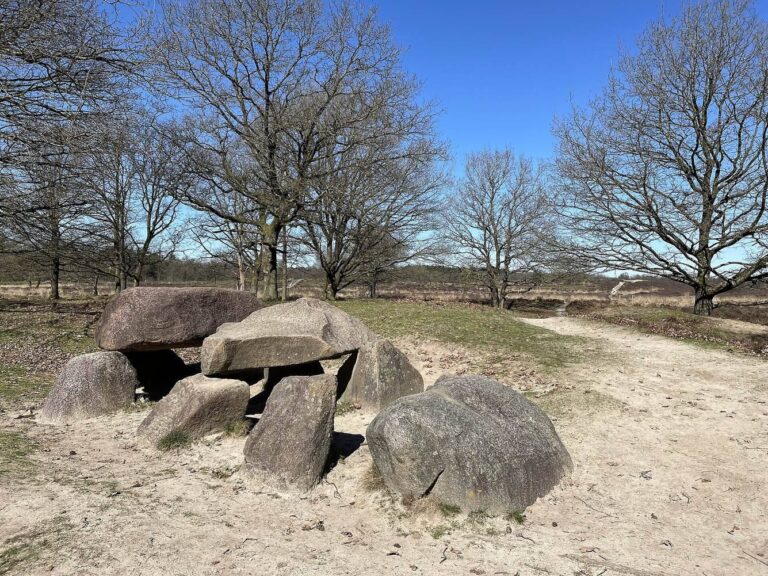
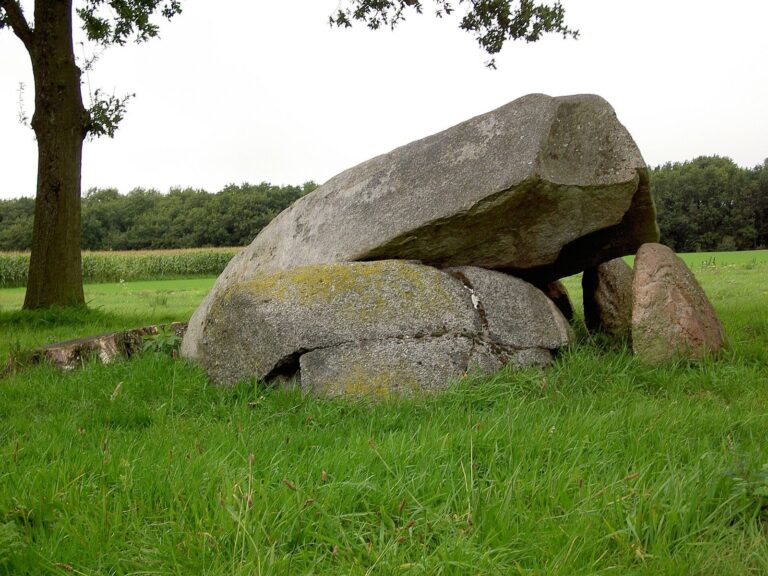
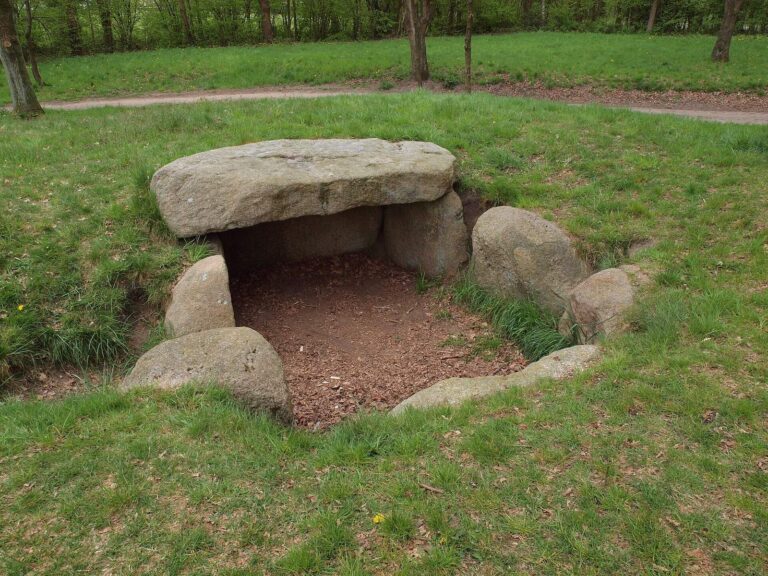
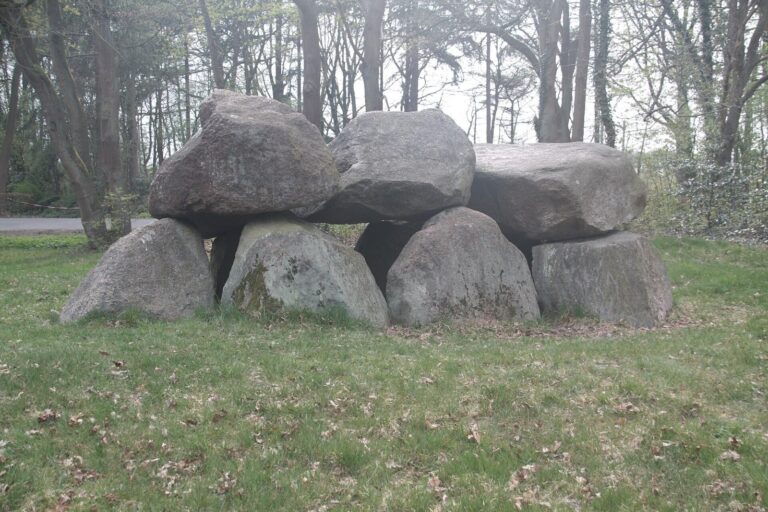
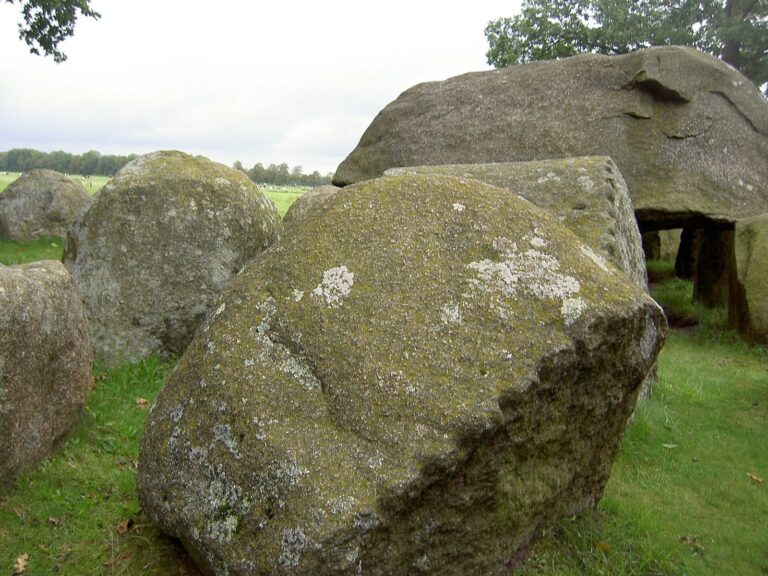
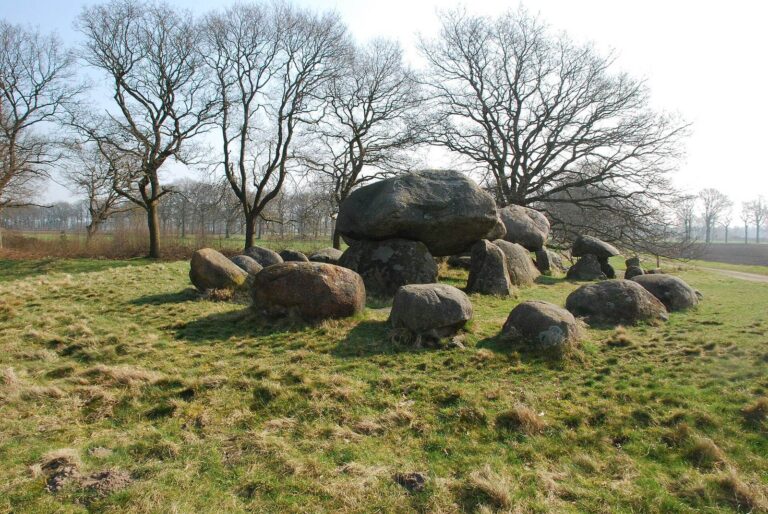
The tomb stands on a grassy plot along Zuidlaarderweg in built-up northern Annen. Its chamber is oriented east–west, with an entrance passage centered on the south side. The original chamber measured about 7 metres long and 2.5 metres wide. Four wall stones lined each long side, with an end stone at each short end and four capstones above. The passage had two side stones and probably a capstone. The surviving western half consists of the two western pairs of wall stones, the western end stone, and two capstones. Concrete fills ground traces marking earlier wall-stone positions. During the 1952 restoration, a fallen capstone was reset on its supports.
Excavated finds
Pottery
The excavation recovered 870 pottery sherds, including 810 attributed to the Funnel Beaker culture. Of these, 452 could be joined into 101 vessels: 41 funnel beakers, 23 bowls, 10 shoulder cups, six amphorae, one steep-sided cup, five collared bottles, and 15 other vessels. The finds also included 21 vessel bases and three handles whose cultural affiliations remain uncertain.
The other 60 sherds represent at least eight vessels from later prehistoric cultures. Four vessels belong to the Single Grave culture and one or two to the Bell Beaker culture, both identified partly through burial practices and pottery styles. Two vessels are associated with early Bronze Age Corded Ware, named for pottery decorated with cord impressions.
Flint and stone tools
Of 75 flint finds, 55 had been worked. They include 11 transverse arrowheads, two objects that may have served as fire strikers, a chisel, a sickle blade, a burin, a stone tool for cutting or engraving, four blades, and 28 flakes, one made from Heligoland flint. Other pieces include a fragment bearing the impression left by a removed flake, two small blocks, three axes, and another reworked axe.
A separate stone axe, possibly made of siltstone, was also found. The axes are held at the Dutch National Museum of Antiquities in Leiden.
Beads
Five beads were recovered, shaped as discs or cylinders. One was made of amber and four of jet.