City Church Königsbrück: A Protestant Parish Church in Germany
Site at a Glance
- Popularity
- Low
- Country
- Germany
- Primary era
- Early Modern
- Eras represented
- Early Modern, Modern
- Civilizations
- Electorate of Saxony, German, Holy Roman Empire, Kingdom of Saxony
- Site type
- Religious
- Remains
- Church
On this page14 sections
History
Medieval parish and rebuilding
City Church Königsbrück is a Protestant parish church in Königsbrück, Germany. A parish priest appears in a Meissen diocesan register of 1346, indicating that a church already stood in the town; it may also have had a defensive role.
The church burned along with Königsbrück during the Hussite Wars in 1431. These conflicts were associated with the religious reform movement led by Jan Hus in Bohemia and nearby regions. A replacement church was built soon afterward, probably as a three-aisled Gothic hall church, in the Gothic period and style of European art and architecture. It had a shingled roof and a small roof turret that carried the bells.
Religious change and fire
On Ascension Day in 1513, a fire destroyed the church’s roof structure, which was rebuilt shortly afterward. The stonemason Wolff Hrobisch may have advised on the repairs. He was working on the Nikolaikirche in nearby Pulsnitz from 1510, where his mason’s mark appears on a choir buttress.
In 1535, Donat Pfeiffer, who had been expelled from Kamenz, held Königsbrück’s first Protestant service. The Reformation, a 16th-century movement that established Protestant churches and practices in parts of Europe, was then introduced in the town.
A town fire gutted the church in 1631. It was rebuilt ten years later as an emergency church. During the intervening period, the hospital church probably served as Königsbrück’s town church.
The present church
The foundation stone of the present parish church was laid on 5 November 1682. Christoph Gottschick of Pirna directed the construction, and the church was dedicated on 13 August 1689 under the local lord, Baron Maximilian von Schellendorff.
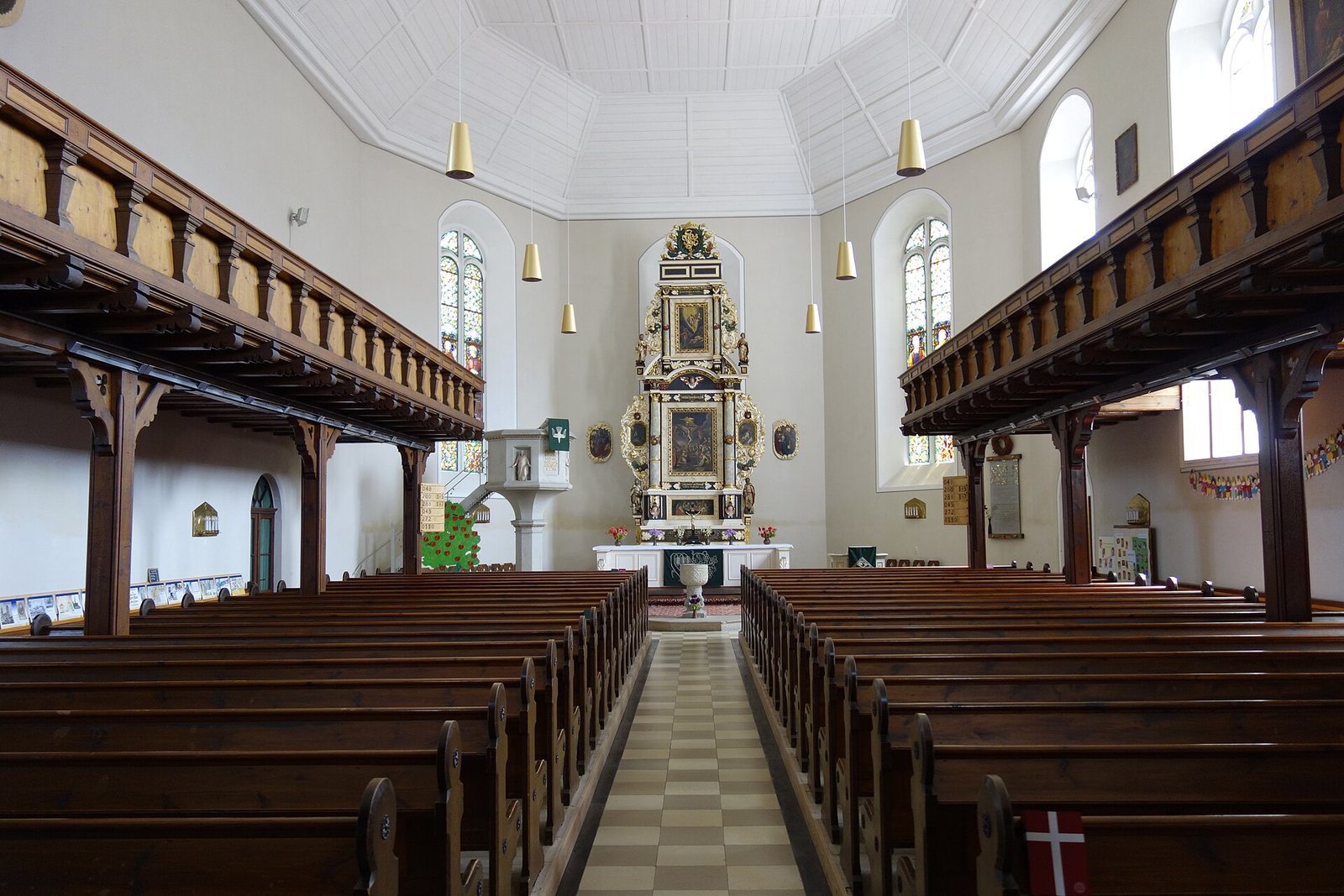
In 1891, the interior was remodeled in the Historicist style, an approach that drew on earlier architectural styles. The interior largely retains this design.
Remains
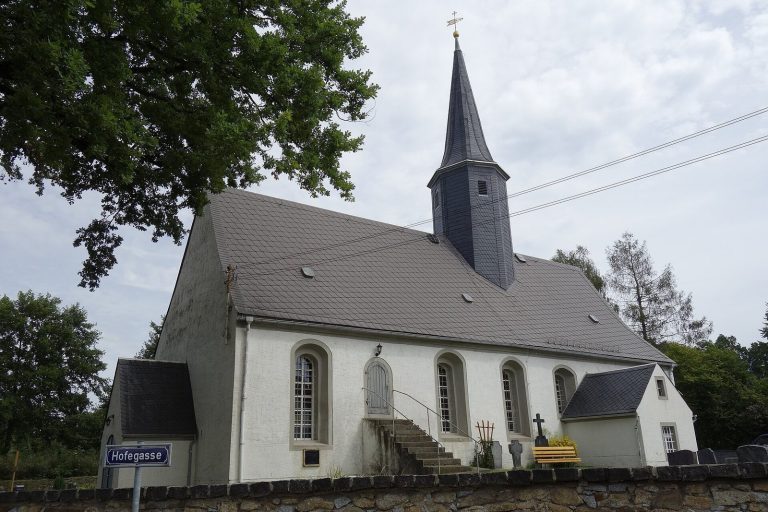
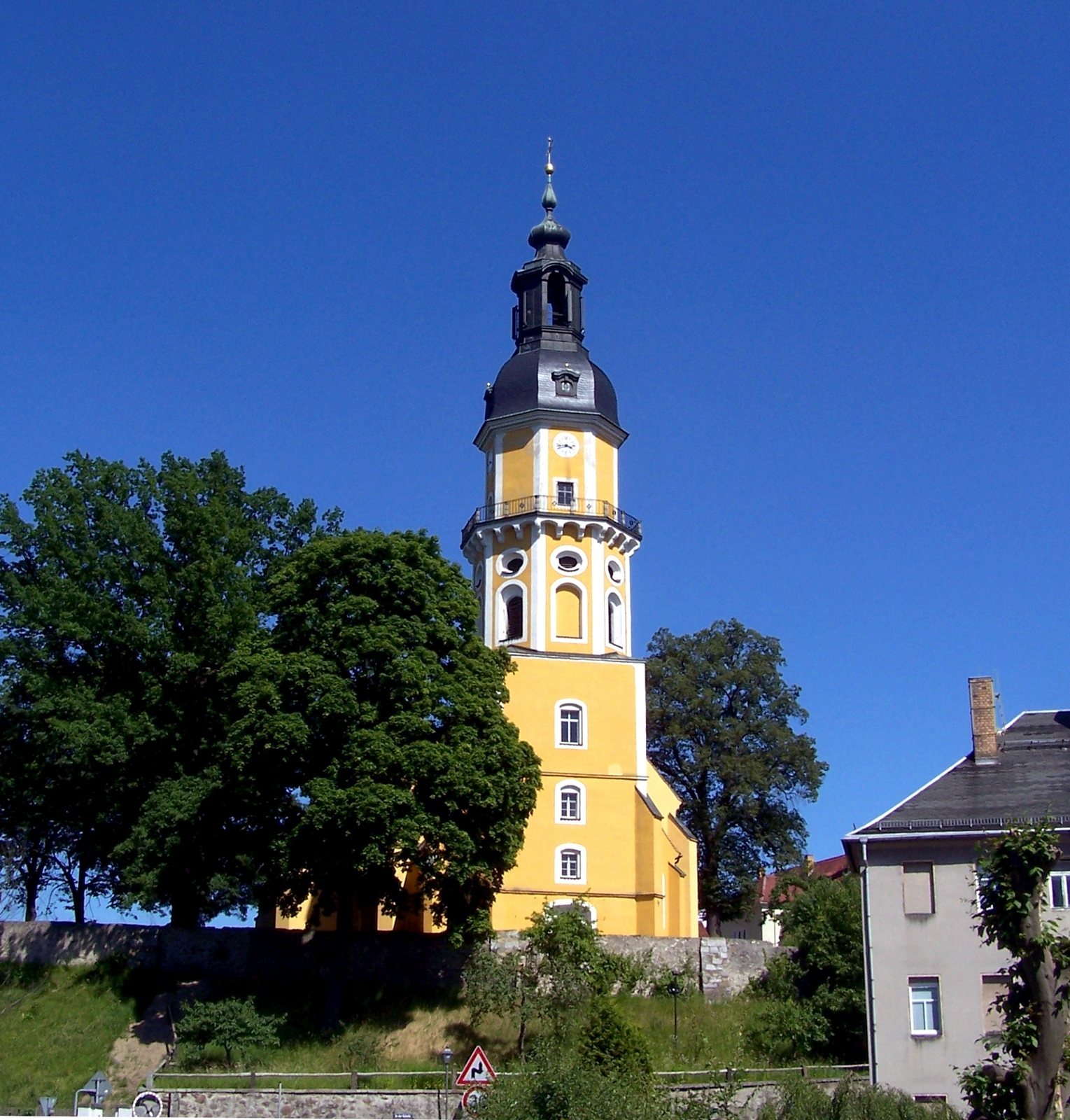
The present church is a plain, plastered hall with a three-sided end. Its tower rises to an octagonal bell chamber with a surrounding gallery, then a curved hood and a lantern, a small roofed structure. Inside, single-level galleries run along the north, west, and south sides. A flat ceiling meets the walls through a curved transition.
Altar and furnishings
The altar
Dedicated in 1692, the altar came from the workshops of painter Sigismund Heinrich Kauderbach and carpenter Joachim Stöckel of Bautzen. Woodcarvers Gerber and Götzelt made all its carved work. An inscription on the predella, the lower section beneath an altarpiece’s main images, names Baron Maximilian von Schellendorff as donor. It shows the Last Supper on Maundy Thursday, flanked by two cherubim, heavenly beings in Christian tradition, and by the Evangelists Matthew and Mark, traditionally identified as Gospel writers. The central Crucifixion is framed by columns with acanthus-leaf capitals. Scenes of Christ’s Entombment and his prayer in the Garden of Olives appear to either side. Above, an angel’s head sits in a broken arch-shaped top, over a Resurrection painting flanked by John and Luke. An intertwined JESVS monogram, wreath, and crown complete the uppermost section.
Baptismal font and candlesticks
The church has two Gothic candlesticks from the early 16th century and a baptismal font dating to around 1600. The font is richly ornamented in the Renaissance style, a distinct period and style in European art and architecture.
Organ
The Jehmlich organ was made in 1949. It has two keyboards, 23 stops that select different pipe sounds, and exposed pipes at the front.
Bells
The present bell set consists of two steel bells and one bronze bell. The large bell cracked in 1783 and was recast in Dresden; it is the only surviving bell from the earlier set. The other two bronze bells were recast by Friedrich Gruhl in Kleinwelka between 1839 and 1841, then surrendered during the First World War in the campaign known as the Metal Donation of the German People.
Paintings and memorials
Paintings
Two Gothic panel paintings, one showing the Flagellation and the other the Death of Mary, probably date to about 1475, though their dating is uncertain. They came from the destroyed village church at Krakau in Saxony. Two Baroque canvases, from a distinct period and style in European art, hang on the north wall above the gallery: Holy Night and The Exchange of Hearts of Saint Catherine of Siena.
Memorial sculpture and relief
A large memorial to Maximilian von Schellendorff, who died in 1703, has an allegorical composition and was sculpted by Paul Heermann. A Baroque bust of the apostle Paul also came from Krakau. In the western entrance hall, a relief dated 1891 bears the words “Blessed are those who are called to the supper of the Lamb.”
Burial vaults
Aristocratic burial vaults were bricked up and leveled in the late 19th century. They included the burial places of Countess Louise Charlotte Hohenthal-Königsbrück and Baron Maximilian von Schellendorff.