San Giorgio: A Romanesque Church in Albenga, Italy
Site at a Glance
- Popularity
- Low
- Country
- Italy
- Primary era
- Medieval
- Eras represented
- Medieval, Early Modern
- Civilizations
- Genoese
- Site type
- Religious
- Remains
- Church
On this page15 sections
History
San Giorgio is a Roman Catholic church in Campochiesa, Albenga, Italy. It is Romanesque in origin, a broad medieval European architectural style, with Gothic alterations, another medieval European style, especially in the fourteenth century. Religious activity here may predate AD 1000, and the church was built over a chapel dated to the eighth through tenth centuries. Dedicated to Saint George, it belongs to the Diocese of Albenga-Imperia. Its position beside the Via Julia Augusta, a Roman road, helped make the locality a center of religious life.
Medieval church and priory
The church was probably founded by Benedictine monks, members of a Catholic monastic order, who were established on Gallinara Island. San Giorgio initially depended on the island’s abbey and later became a priory, a religious house governed by a prior. Its first recorded prior, Nicolò Moreno, appears in a document from 1204.
Medieval records call the church San Giorgio de pratis and San Giorgio de campora. The first name referred to surrounding meadows that extended toward the sea. The parish served communities across the Albenga plain, including Campora, Craviö, and Ròllu, whose settlements later largely disappeared.
Parish changes and decline
During the sixteenth century, the smaller settlements lost population and the parish’s care of surrounding communities diminished. The parish seat moved to the church of Saints Fabiano and Sebastiano in central Campochiesa. Bernardo Bruno, the last prior cited, was recorded in 1616. When a parish for central Campochiesa was established in 1661, San Giorgio became subordinate to it. The church later served as a cemetery church and was gradually abandoned.
Earthquake and restoration
The earthquake of 1887 severely damaged the church, destroying its bell tower and right aisle. Restoration began in 1901. Further work in the mid-1930s included reconstruction using original elements, with the municipality of Albenga financing the work.
Remains
Plan and exterior
Overall plan
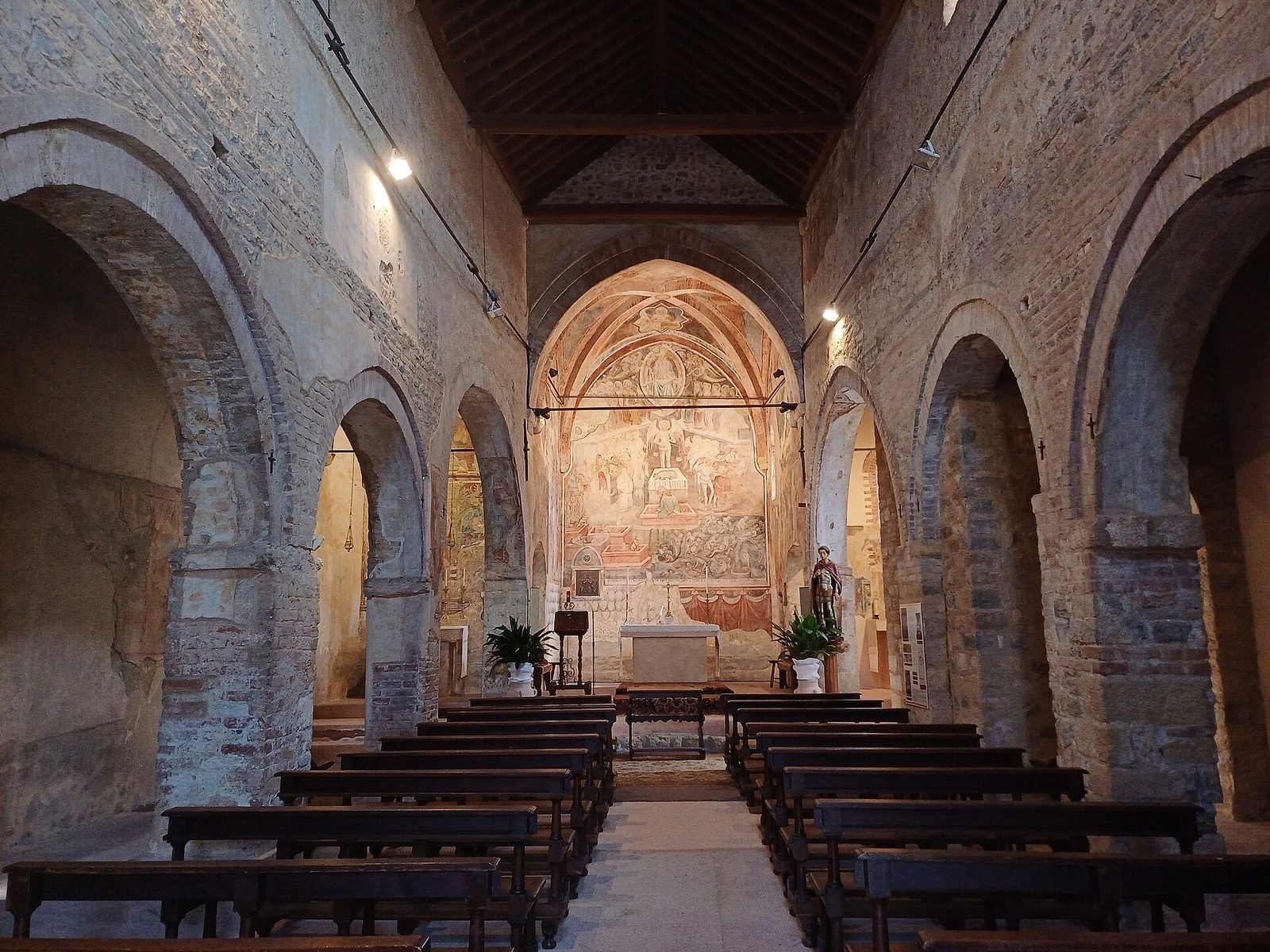
The church stands within the cemetery at Campochiesa. Its interior has three aisles divided by round arches. In the fourteenth century, the building was lengthened with two pointed arches. Traces of the earlier chapel lie beneath the floor in the central aisle, and part of it is incorporated into the first step leading to the sanctuary.
Facade
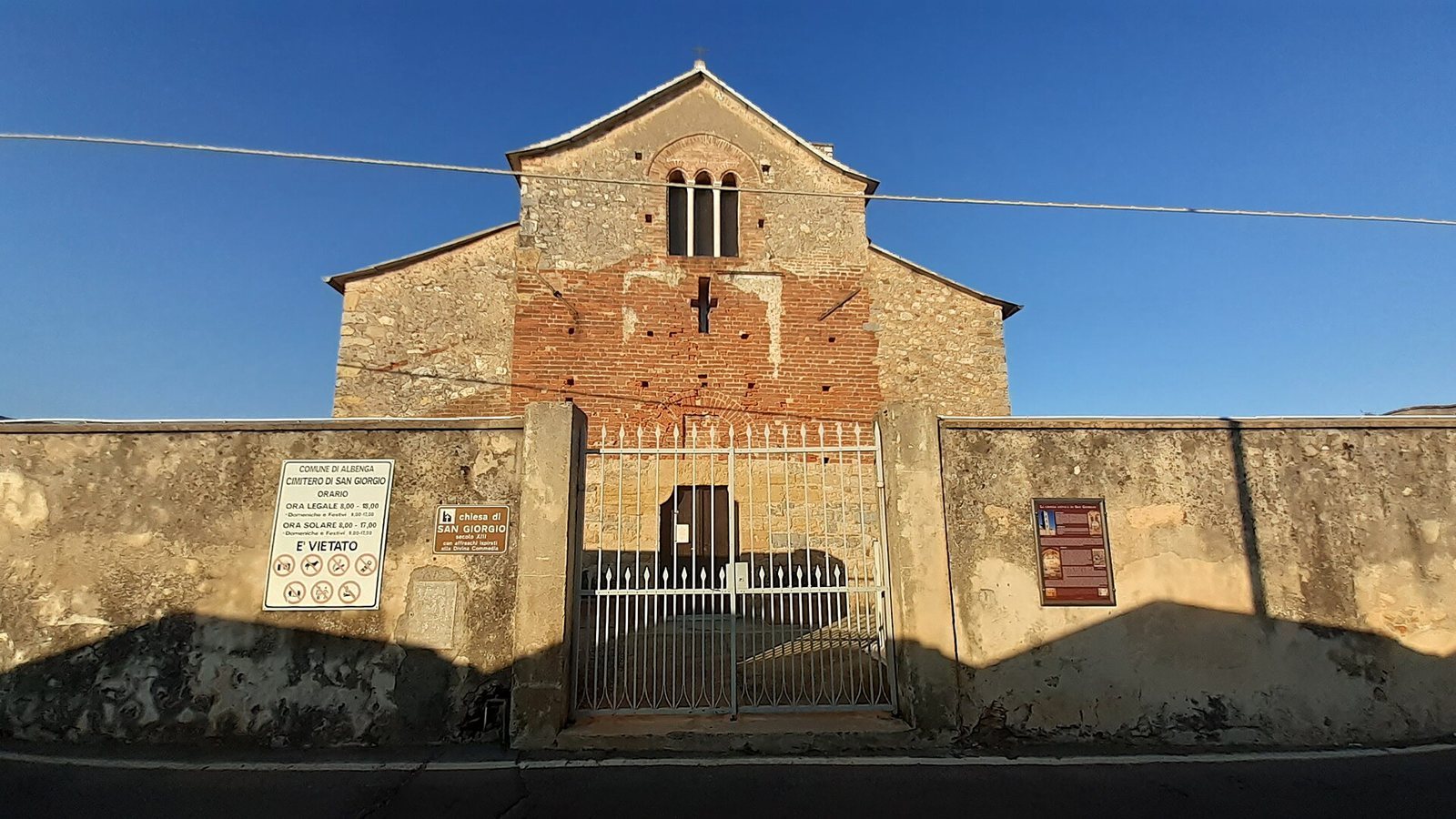
The facade has distinct bands of masonry. Its lower section uses stone from quarries at Cixan and Peagna, while the middle section is built of rough bricks. The upper section includes stonework from Cixan associated with a fourteenth-century rebuilding. A three-part opening supported by two columns has been interpreted as referring both to the Holy Trinity, the Christian belief in one God in three persons, and to Christ’s divine and human natures. The opening was moved over time and rediscovered in the twentieth century. A small cross-shaped opening sits below it.
Apses and bell tower
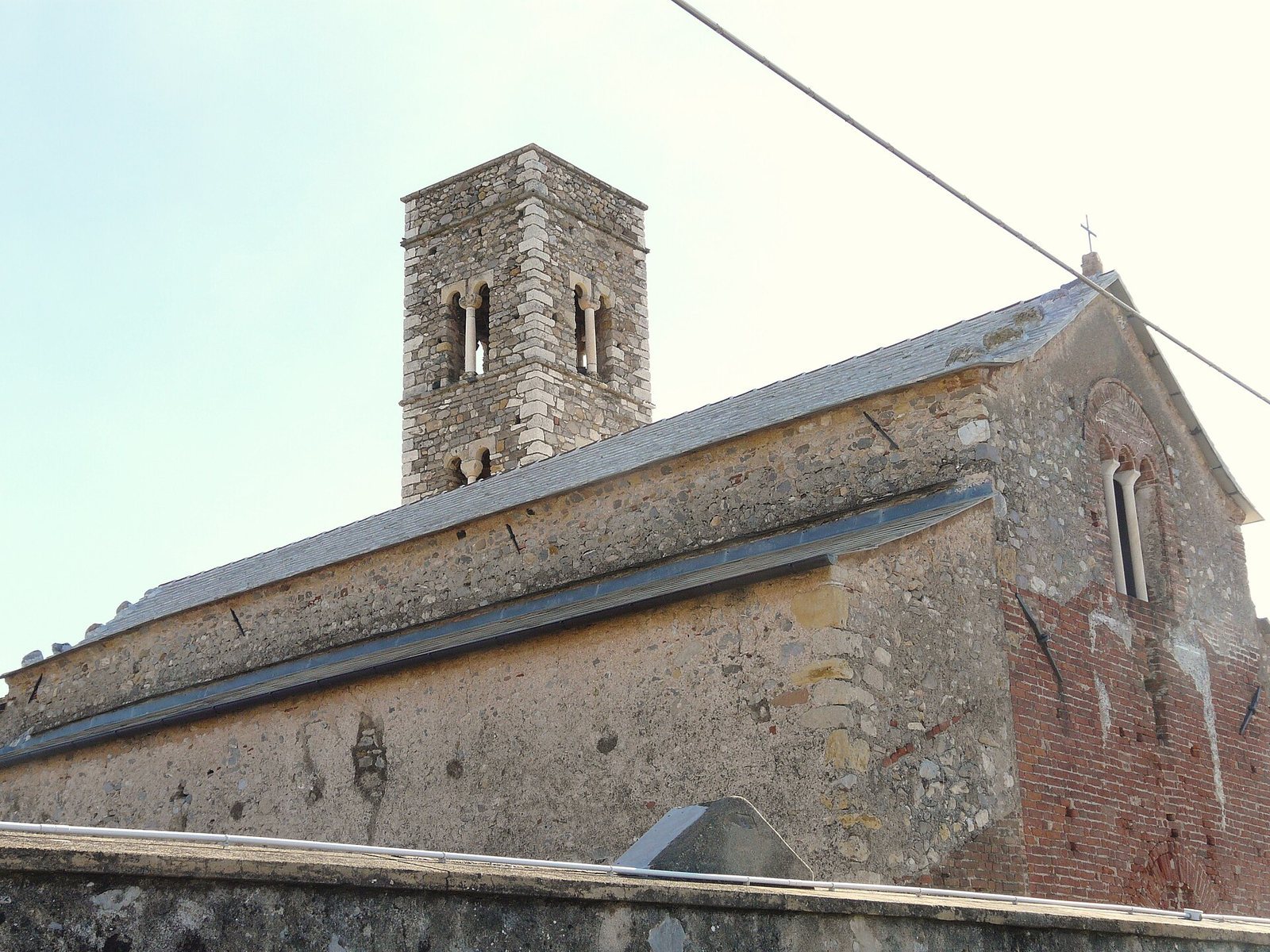
Three small openings on the southeast side are also associated with the symbolism of the Trinity. The rectangular apses have single openings made of brick. These were blocked in the fifteenth century to provide more wall space for painted decoration. The bell tower is built of squared stone, rises from a Romanesque base, and is incorporated into the right aisle.
Frescoes and painted decoration
Universal Judgment
The presbytery contains a fresco of the Universal Judgment dated to about 1446 by a Latin inscription, which names Antonio Caresia, then prior, as its patron. The painter may have been Antonio Dragun of Monteregale, a Piedmontese artist who moved to western Liguria. Christ appears as judge within an almond-shaped frame, raising his right hand toward the blessed and his left toward the damned. Angels hold the frame, while the twelve apostles sit in balanced groups facing Christ. Saint Michael, armed with armor and a sword, weighs good and evil and defeats the Devil.
In the scene of Hell, inscriptions identify the seven deadly sins, a traditional Christian grouping of vices. The punishments include gluttons bound before a laden table as snakes consume their food, sinners made to drink molten gold, and others scourged by a demon. A spotted creature with a serpent’s tail tortures one figure; another is bitten by a griffin and encircled by a snake. The lustful are forced to see the Devil in a mirror, while the wrathful suffer on a toothed wheel.
Dante and Virgil, his guide in the Divine Comedy, also appear among the damned. In a scene drawn from the poem, Count Ugolino bites the head of his adversary, Archbishop Ruggieri degli Ubaldini. The contrast between the refined figures of Paradise and the punishments in Hell has been interpreted as a warning against sin. Franciscans, members of another Catholic religious order, appear among the damned; this has been linked to conflict between the orders and a Benedictine victory in the struggle for control of the convent on Gallinara.
Other paintings in the nave
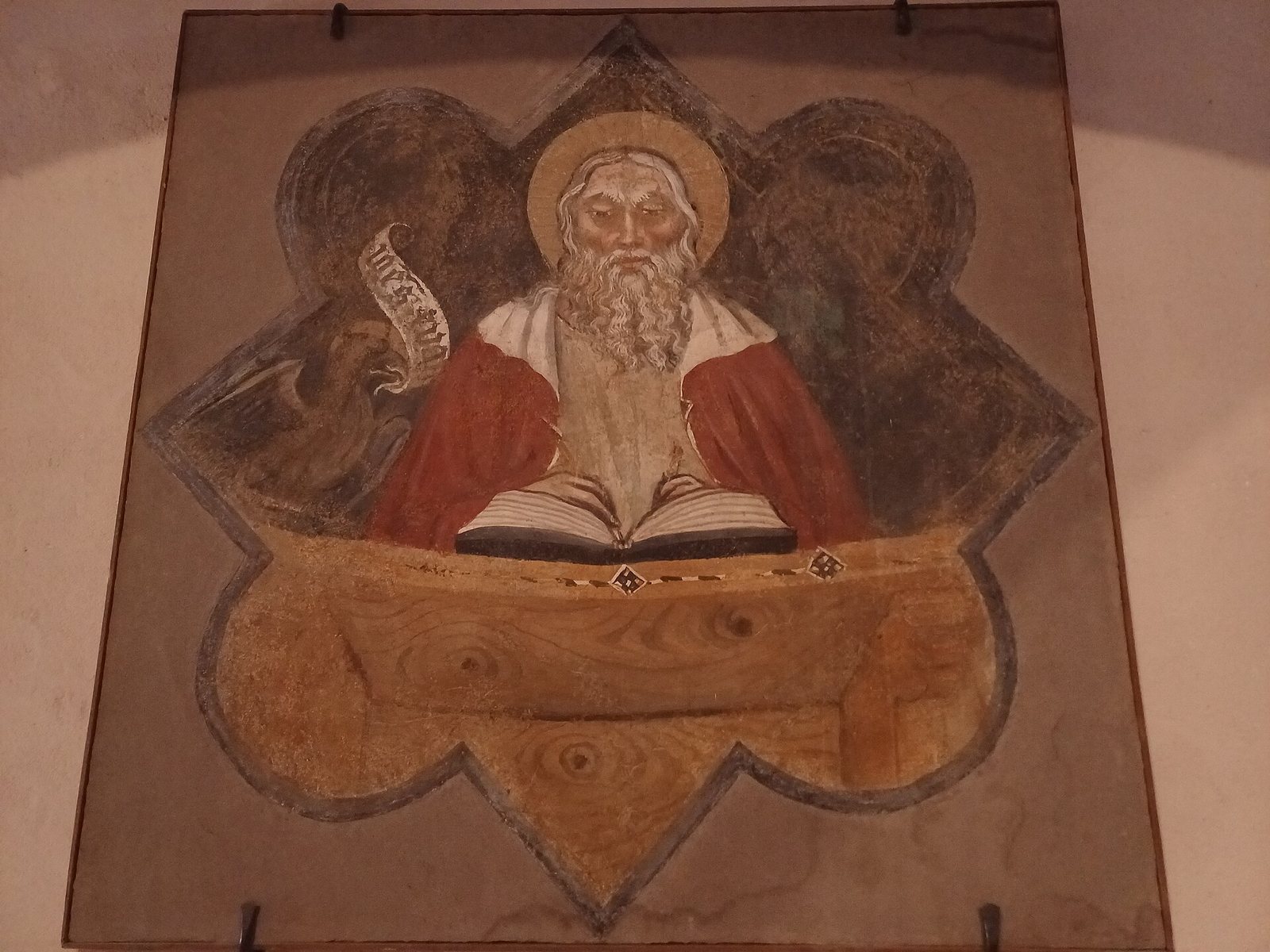
Frescoes along the side walls include the Twelve Apostles, with six on each side, a Nativity high on the left, and Jesus within a large almond-shaped frame on the opposite side. The Four Evangelists are painted in the vault. The church’s interior was once covered throughout with brightly painted plaster and rich decoration.
Right aisle
Near the apse, the right aisle preserves some of the church’s oldest surviving images of saints, dating to the thirteenth century. A cycle of scenes from the life of Saint Blaise covers the wall at the far end. Painted in the fourteenth century by an anonymous artist, it follows a Tuscan style of fourteenth-century Italian art.
Left aisle
The left aisle contains a partly legible image of Saint George among three apostles and Saint Christopher. Nearby are frescoes of Saints Fabian, Sebastian, and Roch. This devotional work, dated to 1476, was commissioned by the prior and inhabitants of Campora. A further fresco depicts Mary Magdalene and dates to the fifteenth century.
Apse and sacristy
The apse preserves an old altar dedicated to the Virgin Mary. Its sixteenth-century frescoes include an Assumption of Mary in an arched panel and a three-part painting of the enthroned Virgin holding the Christ Child. An armed saint stands to her left and Saint Stephen to her right. The style has been tentatively compared with that of Pe’ Guido da Ranzo, a Ligurian painter. A fifteenth-century Crucifixion fresco is preserved in the sacristy.