Serra di Vaglio Archaeological Park: An Indigenous Center in Ancient Lucania
Site at a Glance
- Popularity
- Low
- Country
- Italy
- Primary era
- Classical
- Eras represented
- Iron Age, Classical
- Civilizations
- Unclassified
- Site type
- City
On this page16 sections
History
The Serra di Vaglio archaeological park preserves the remains of a major indigenous center in Vaglio Basilicata, Italy, whose urban occupation lasted from the eighth century to the middle of the third century BCE. In Lucania, an ancient region of southern Italy, the center connected communities and cultural traditions in Campania and Apulia with those along the Ionian coast, where Greek settlements had been established.
Early settlement and growth
The earliest settlement, dating to the eighth century BCE, is attributed to the Peuketiantes, an ancient population of the region. Their burial customs included placing the dead in a fetal position.
During the sixth century BCE, the settlement developed a more planned layout. The date of a princely residence on the eastern slope remains uncertain; its reconstruction has been based on an architectural terracotta frieze dated to the second quarter of that century.
The Lucanian city
The Lucanians, an ancient Italic people associated with Lucania, occupied the area during the fifth century BCE. Their hilltop settlements dominated smaller agricultural communities in the valleys. Serra di Vaglio underwent major restructuring during the fifth and fourth centuries BCE and was enclosed by defensive walls in the fourth century.
The Braida necropolis reflects the customs of the city’s aristocratic group. Nine burials, dating from the late sixth to the middle of the fifth century BCE, contained grave goods that point to the adoption of Greek customs, including practices connected with feasting and the use of Greek-style weapons and jewelry.
Destruction and the sanctuary at Rossano
A fire destroyed the city in the early third century BCE, after which it was abandoned. A separate sanctuary at Rossano di Vaglio was dedicated to Mefitis, an Italic goddess associated with springs and vapors rising from the earth. The sanctuary was in use from the middle of the fourth century to the first century BCE.
Excavation and collections
Excavations in the archaeological areas began in the 1950s. Some finds are displayed at the Museo delle antiche genti di Lucania in Vaglio, opened in 2006, and at the National Archaeological Museum of Basilicata in Potenza. Other material is held by the archaeological superintendency in Potenza.
Remains
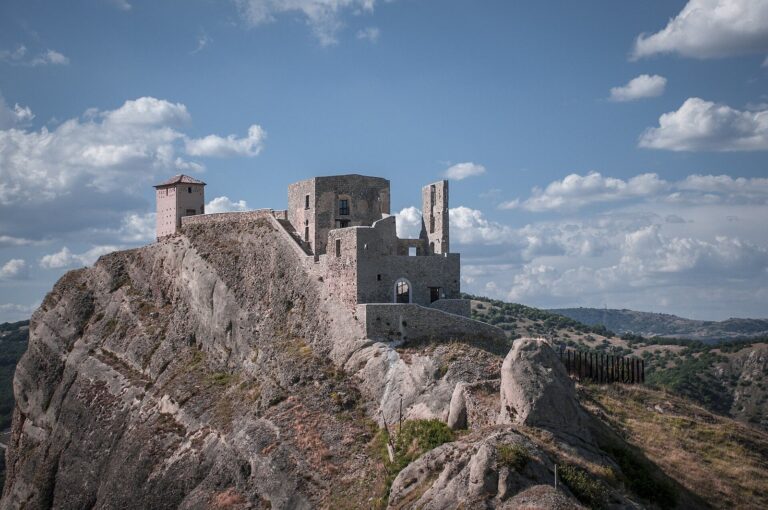
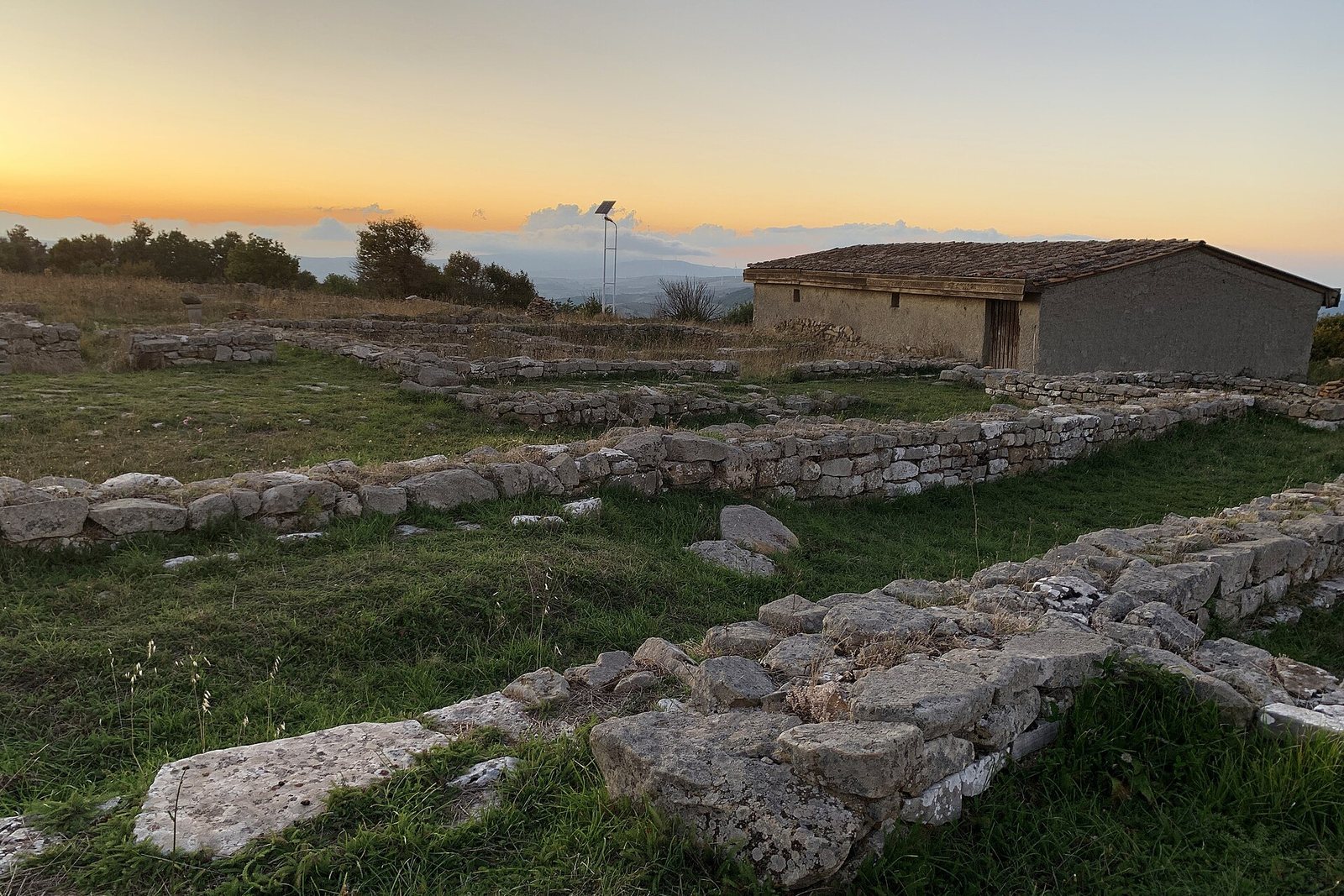
The park comprises the settlement area of Serra San Bernardo, the Braida necropolis, and the sanctuary at Rossano di Vaglio. The settlement stands on a rise at about 1,100 metres above sea level, overlooking a route through the Basento valley between Metaponto, inland areas, and Tyrrhenian centers in southern Campania. The wider area lies between the Bradano River to the north and the Basento to the south, about 15 kilometres east of Potenza. The remains range from early huts to paved streets, defensive walls, and buildings associated with worship and storage.
The settlement at Serra San Bernardo
Early buildings
The earliest settlement remains are oval huts with pebble floors, alongside scattered burial areas. These date to the eighth and seventh centuries BCE. By the sixth century, rectangular buildings had been constructed along the principal roads. The streets were paved during the fifth and fourth centuries BCE.
Defensive wall and gates
A defensive wall about 2.5 kilometres long enclosed the settlement. Its outer face was built from irregular sandstone blocks, while the inner face was left rough. Greek letters carved into the outer blocks relate to the organization of the building work. Towers flanked the gates, where an inscription names Nummelos as the city magistrate responsible for overseeing the works.
Sacred area at Braida
On the plateau’s northeastern slope at Braida, a terracotta frieze, a decorated architectural band, depicts horsemen and hoplites, heavily armed Greek infantry. It was found in a sacred area that also contained an offering deposit and the limestone foundations of a small cult building; the plaques are thought to have come from that building. Comparable plaques come from the Anaktoron at Torre di Satriano, a somewhat later elite residence. That building is associated with the same craft tradition and with archaic models from Taranto and Metapontum.
House of the Pithoi
An experimental archaeology project produced a full reconstruction of a fourth-century BCE building known as the House of the Pithoi. The name refers to pithoi, large storage jars. Three spaces are divided by partition walls. Reused perimeter walls include a western wall that supported two additional rooms and a staircase to an upper floor. In the storage area, four large jars for food were found arranged in a row and held in place with stones.
Braida necropolis
Burial group
The necropolis contained nine graves covered by stone mounds and the remains of ten people: six men, a woman aged between 40 and 60, and three children aged one, seven, and twelve. The burials may represent two generations connected by kinship or by high social standing. Tombs 101 and 102 were especially rich.
Tomb 101
Tomb 101 held a man buried with offensive and defensive weapons and bronze horse equipment. The fittings included two chest protectors and two forehead pieces shaped by hammering the metal from its reverse side. The forehead pieces show winged female figures associated with birds; one also bears a Gorgon’s head on its chest. Archaeologists have proposed that the figures represent Athena, with her protective aegis, and Artemis, associated with the female-animal motif. The bronze work was probably made locally, though itinerant Greek craftspeople may have produced it. Its technique, style, and imagery combine Achaean, Laconian, and Etruscan influences. The grave also contained numerous vessels, including an Attic black-figure cup, a Greek style that uses dark figures against lighter clay, decorated with funeral games.
Tomb 102
The grave of a girl contained Attic and other Greek-style vessels, including cups, a cooking or storage pot, and a ceramic dipper. Its bronze objects included basins and two tripod cauldrons; bronze and iron tools included graters, firedogs, and spits. Her jewelry comprised nearly 300 Baltic amber beads and pendants, silver brooches, rings, additional beads, and two gold hair ornaments. An amber bead shaped like a contorted winged sphinx was probably placed at the center of the jewelry. It may have had a protective meaning related to local beliefs about the afterlife. The rich adornments may have been intended for a future wedding ceremony.
Sanctuary at Rossano di Vaglio
About 10 kilometres northeast of Serra di Vaglio, the sanctuary consisted of an open area with an altar, surrounded by buildings for practical and ritual activities. These included receiving worshippers and displaying offerings.