Santa Maria del Sepolcro Church and Convent in Potenza


Site at a Glance
- Rating
- 4.6
- Popularity
- Low
- Country
- Italy
- Primary era
- Medieval
- External website
- Open
- Eras represented
- Medieval, Early Modern, Modern
- Civilizations
- Crusader, Kingdom of Naples, Knights Templar, Spanish
- Site type
- Religious
- Remains
- Church
On this page9 sections
History
Santa Maria del Sepolcro Church and Convent is a Roman Catholic complex in Potenza, Italy, dedicated to the Holy Sepulchre and associated with the Archdiocese of Potenza-Muro Lucano-Marsico Nuovo. Its foundation belongs to a period between the early twelfth and early thirteenth centuries, although the exact date is uncertain. Tradition attributes its construction to the Knights Templar, a medieval military-religious order that protected pilgrims and supported Christian institutions in the Holy Land.
Foundation and medieval associations
One foundation tradition links the church to the Counts of Santasofia, lords of Rivischio. They took part in the Third Crusade in 1190-1191 and, after returning to Potenza, are said to have established the place of worship. The church or an associated settlement later came under the authority of the Bishop of Potenza in the early fourteenth century.
The name Santa Maria del Sepolcro has several proposed explanations. It may refer to a planned burial place for the de Guevara family, or to a settlement called Santo Sepolcro that was owned by the Templars and existed near the church in the fourteenth century. In 1312, the settlement came under the jurisdiction of Guglielmo, Bishop of Potenza. He added the name Santa Maria, possibly in reference to a Marian chapel or image in the area, or to gain the inhabitants’ support.
The site is also traditionally connected with Saint Gerard of Potenza, the city’s principal patron saint. A local tradition says that the medieval bishop changed water from a spring into wine. Some scholars instead place this miracle at Potenza Cathedral, leaving the association with Santa Maria del Sepolcro as a matter of tradition.
The de Guevara rebuilding
In 1488, Innico de Guevara, the fifteenth-century Count of Potenza, enlarged and embellished the church and built the adjoining convent. An inscription in the entrance hall, or narthex, recalls the importance of the de Guevara family in the reconstruction of the religious complex in 1488 and its rebuilding in 1652. The church’s long association with the Franciscan Order also developed through the friars who occupied the convent.
The Friars Minor, followers of Saint Francis of Assisi, were entrusted with the church and convent until the nineteenth-century suppression of religious orders. After their departure, books and artworks kept in the complex were dispersed or looted. Friars associated with the convent included Blessed Egidio of Laurenzana, Ginepro of Potenza, Matteo of Tito, Gianfrancesco Caporella of Potenza, and Luigi Filippi of Avigliano.
The relic and later Franciscan history
In 1647, during an apostolic journey to Grumento, Bishop Claverio encountered a relic identified as the blood of Christ. He took part of it and retained it for an extended period before it became associated with Santa Maria del Sepolcro. The relic later shaped the devotional history of the church, and Pope Francis granted a plenary indulgence for the 460th anniversary of its arrival at Potenza.
The earlier bell tower, which stood beside the main façade, was demolished in 1959. A new Franciscan friary was built in the late 1960s, and the Franciscans returned to the site in 1938 after their earlier departure. These changes form part of the complex’s modern history while preserving its continuing Franciscan identity.
Remains
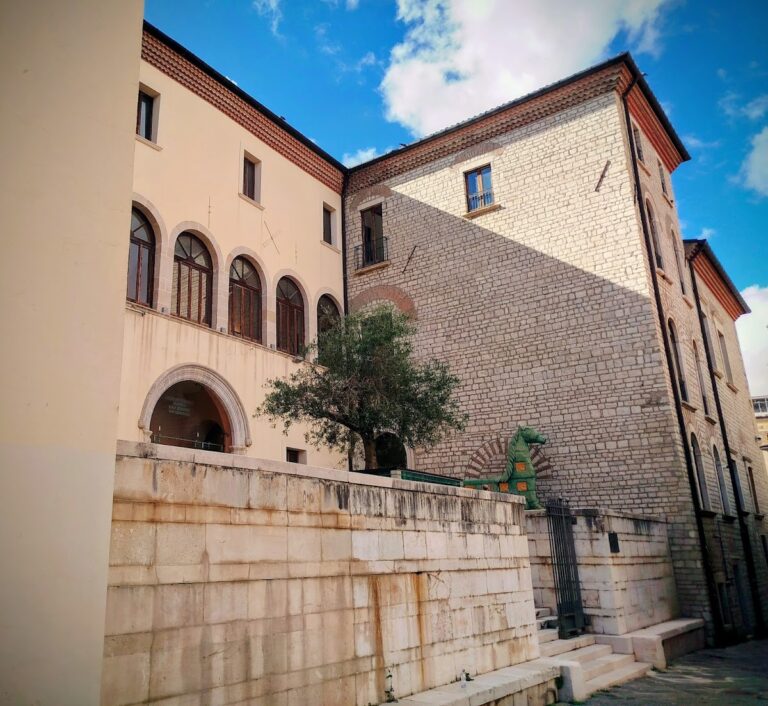
The church has a central plan and a Gothic-Catalan design, a regional form of Gothic architecture associated with Catalonia and its cultural sphere. Its original worship space was a single nave. The interior now includes the principal nave and a later lateral nave on the left, creating a longitudinal arrangement around the older central space.
Façade and entrance
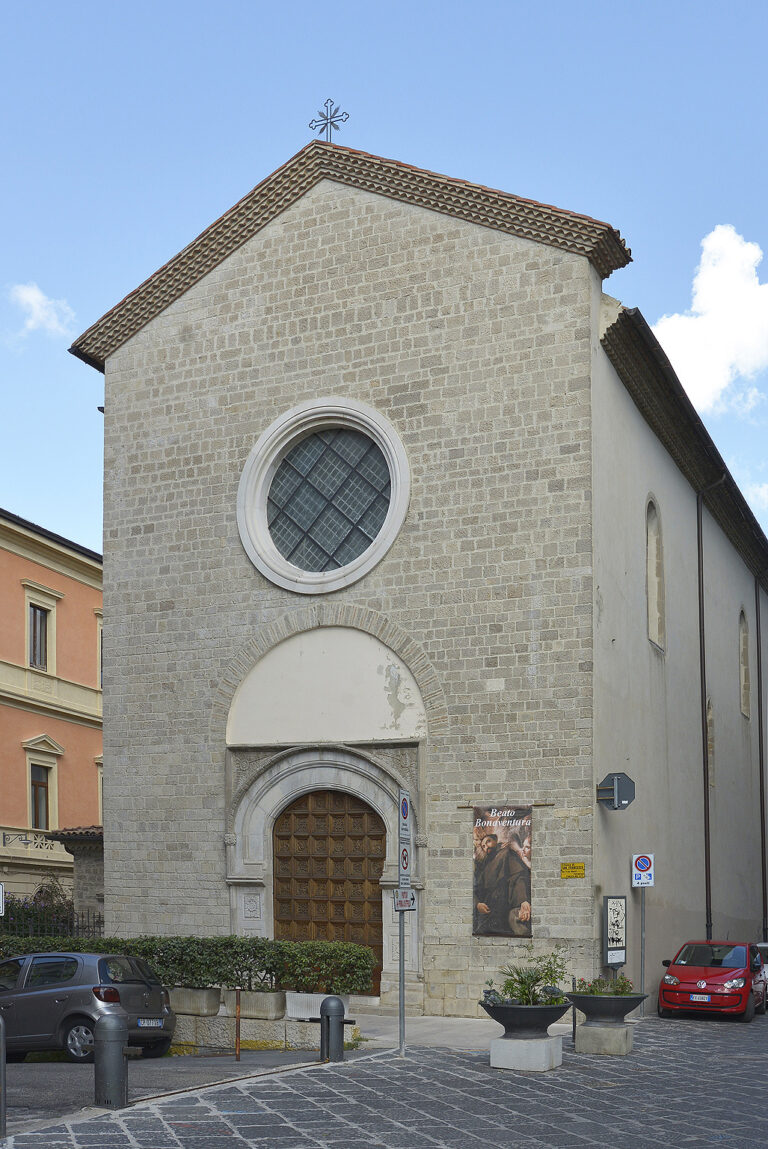
The main façade is fronted by a portico with three arches. Its carved-stone jambs, capitals, and archivolts end in a cornice beneath a gabled roof with a central rose window. The entrance has stone mouldings and two finely made side portals, while the central doorway retains a sixteenth-century wooden door carved with floral motifs and geometric panels. The limestone entrance frame carries Franciscan and noble heraldic emblems.
Two stone emblems on the façade express Franciscan symbolism. One shows a cross between the arms of Christ and Saint Francis, each marked by nail wounds. The other combines a cross with the spear and the vinegar-soaked sponge associated with the Passion. Above the central entrance, a lunette, or semicircular space for a painting, contains a fresco of the Deposition dated 1658. Its Gothic-Catalan frame bears the inscription, “O all you who pass along the road, attend and see whether there is any sorrow like my sorrow.”
Nave and ceiling
Four round arches divide the principal nave from the later lateral aisle on the left. Three Baroque altars are attached to the aisle’s perimeter wall. The first altar contains devotional statues of Saint Nicholas, Saint Anthony of Padua, and Saint Anne with the Virgin Mary.
Above the principal nave is a large seventeenth-century coffered ceiling, made from recessed panels of carved, gilded, and polychrome wood. Bishop Bonaventura Claver, also known as Bishop Claverio, commissioned the ceiling. Its construction belongs to the period when the church was being furnished and reshaped around the devotion to the relic of the Most Precious Blood.
Altars and presbytery
On the right side of the church stands the large Baroque altar of the Blessed Sacrament, erected in 1656 and richly decorated with stucco. Its gilded central compartment contains a copper-gilt container holding the relic identified as the Most Precious Blood of Christ. The altar also includes a statue of the enthroned Virgin with the Child on her lap, accompanied by two winged angels.
The statue of the Virgin and Child is tentatively dated to the fifteenth or sixteenth century and attributed to the Lucanian artist known as the Master of Noepoli. The altar dedicated to the Most Precious Blood also has gilded polychrome wooden statues of the archangels Michael, Gabriel, and Raphael. Michael tramples a dragon and carries a flaming sword, while Gabriel is identified as the archangel of the Annunciation.
At the rear of the church, a round-headed triumphal arch rests on stone columns. The column bases bear lion heads and leaves, and the capitals are carved with acanthus leaves, crouching lions, rams, and floral rosettes. The keystone shows Christ emerging from the tomb to the waist, an image following the Christ of Pity tradition and reinforcing the church’s dedication to the Holy Sepulchre.
The polygonal apse has a Gothic-Catalan half-dome with three trefoil-headed lancet windows. A cross-vault precedes it, while projecting ribs converge in a stone ring bearing the Christogram IHS, a representation of the name of Jesus associated with the preaching of Saint Bernardino of Siena, and a Bernardine monogram. The apse also retains traces of an earlier structure, including a splayed window and areas of exposed masonry.
The stone altar, ambo, and baptismal font, together with the copper tabernacle and the arrangement of the liturgical spaces in the presbytery, were made in the 1980s by Tarcisio Manta, a Franciscan artist from Potenza.
Paintings and sculpture
The church contains a painting of the Nativity with the Adoration of the Shepherds. It was formerly attributed to Jusepe de Ribera, known as Lo Spagnoletto, and later to Onofrio Palumbo. The work is now attributed to Giovanni Ricca, a Neapolitan painter of the early seventeenth century.
Near the presbytery on the right wall stands a thirteenth-century stone sculpture of the Madonna and Child between two angels. It came from the church of Noepoli. The church also contains the Immaculate Conception between Saint Francis and Saint Roch, a panel from the Raffaelesque school dating to the second half of the sixteenth century and attributed to Leonardo da Pistoia. The Virgin appears within a mandorla, an almond-shaped halo, while God the Father is shown above and the kneeling saints contemplate her against a mountainous landscape.
Antonio Stabile’s 1582 panel, Our Lady of Graces with the Child and Saint John between Saint Francis and Saint Patrick the Bishop, reflects Franciscan devotion and late-Mannerist Neapolitan artistic traditions. It includes the miraculous milk motif associated with the Child Jesus. Saint Patrick’s presence is connected with a relic of the saint kept at the site.
The convent preserves a canvas of the Crossing of the Red Sea. It was once incorrectly attributed to Luca Giordano and later attributed to Domenico Polino, a Lucanian painter from Irsina.
A large dismembered polyptych, or multi-panel altarpiece, formerly stood on the church’s right wall. It consisted of four panels depicting Saint Peter, Saint Jerome, Saint Catherine of Alexandria, and Mary Magdalene, along with two predella fragments, the horizontal lower sections of an altarpiece, each made up of four panels showing groups of three apostles. The polyptych was stolen in the 1970s and has not been recovered. It was first attributed to Antonio Solario, known as Lo Zingaro, and is now attributed to Simone da Firenze, who was active in the first half of the sixteenth century.
Santa Maria del Sepolcro is also identified as one of three places in Italy containing a work known as the Veiled Christ.