Basilica of the Nativity of the Virgin Mary: A Marian Pilgrimage Church in Slovakia
Site at a Glance
- Popularity
- Medium
- Country
- Slovakia
- Primary era
- Medieval
- Eras represented
- Medieval, Early Modern, Modern
- Civilizations
- Austria-Hungary, Habsburg, Hungarian
- Site type
- Religious
- Remains
- Sanctuary
On this page15 sections
History
Origins and medieval foundation
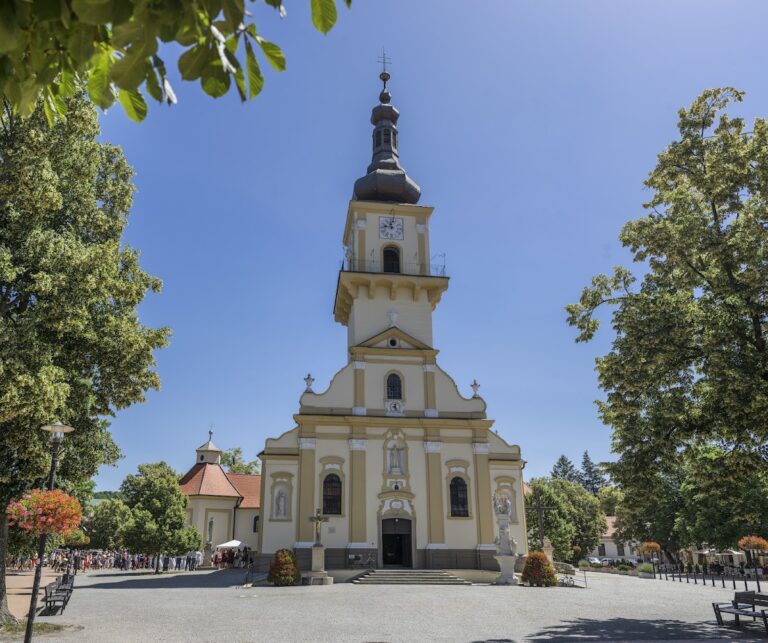
The Basilica of the Nativity of the Virgin Mary is a Marian pilgrimage church in Marianka, Slovakia, traditionally associated with an eleventh-century shrine and completed as a Gothic church in 1380. Local tradition attributes the shrine’s beginnings to a hermit who carved its revered image, sometimes dated to around 1030. It was said to have been hidden during wartime and found again around 1300, although that date may instead refer to the image’s creation.
On 16 May 1377, Louis I of Hungary confirmed the shrine’s antiquity, placed it under royal protection, and provided for a church and monastery. The church was completed three years later. It became a major destination for pilgrims and was cared for over the centuries by the Order of Saint Paul the First Hermit, commonly called the Paulines. The Catholic order takes its name from Paul of Thebes, an early Christian ascetic traditionally regarded as the first hermit.
Pauline leadership and royal pilgrimage
Marianka’s standing within the Pauline order grew after Ottoman forces destroyed the order’s monastery of St Lawrence in Buda in 1540. The superior general found refuge at Marianka, which became the order’s official seat. It also developed into a center for theological study. A papal bull issued by Clement X in 1671 established it as a place of study for the whole order and allowed its superior, or a deputy, to award doctorates in theology and philosophy. Emperor Leopold I recognized those degrees in 1674, but Joseph II withdrew that right in 1774.
The church was plundered and burned twice during the Hungarian uprisings. Leopold I paid for its renewal and enlargement in the late seventeenth century. The shrine also formed part of a Habsburg tradition of royal pilgrimage in honor of the country’s patron. Ferdinand IV was the first newly elected Hungarian king to visit, in 1647. Leopold I came in 1659. During the Hungarian Diet of 1687–88, the kingdom’s representative assembly, Leopold’s nine-year-old son Joseph was elected and crowned king, then made a formal pilgrimage to Marianka. Neither Leopold nor Joseph returned to Hungary after 1688. The next royal visit came in 1712, when Charles VI arrived with Christian August of Saxe-Zeitz and the Hungarian palatine Paul Esterházy, a senior royal official.
Marianka’s image was regarded as the patroness of Hungary, a claim it shared with the shrine of Mariazell in present-day Austria. Hungarian nobles also supported Mariazell, and in 1693 Leopold I formally gave that shrine’s image the title of patroness of Hungary. Charles VI’s wife, Elisabeth Christine, never visited Marianka herself. In 1719 she sent her midwife and the midwife’s family there incognito, carrying devotional gifts for the image and praying for a healthy heir. The imperial family’s final visit took place in 1766, when Maria Theresa, Joseph II, and the newly married Maria Christina and Albert of Saxony-Teschen stopped at Marianka while travelling to visit Leopold Pálffy at Stupava.
Christian August became an important patron of the shrine. He used Marianka as a summer residence from 1711 and as a residence from 1721; from 1720 he was also archbishop of Esztergom and protector of the Pauline order. He supported the church and monastery, celebrated Mass and heard pilgrims’ confessions, and gave 600 gold florins a year from his own income. Alongside Leopold I, he was regarded as a second founder of Marianka.
Suppression and restoration
Joseph II’s decree of 7 February 1786 suppressed the Pauline order. Proclaimed at the monastery on 20 March, it ended about four centuries of Pauline activity at Marianka. The monastery was later plundered and used for a time as a hunting lodge by nobles.
Fires severely damaged the church in 1817 and 1820. Parish priest Jozef Talčík, who served from 1863 to 1897, led efforts to restore the pilgrimage site, consulting the archbishop and Bratislava canon Karol Heiller. An architect’s plans guided extensive Gothic Revival work, carried out in part by artists and craftspeople also employed at Bratislava’s Cathedral of St Martin.
The church received national monument protection in 1963. On 31 July 2011, Pope Benedict XVI raised it to the status of a minor basilica, a papal honorific rather than a particular architectural form. The Congregation of the Brothers of the Consolation of Gethsemane took over the deteriorating monastery from 1927 to 1950 and again from 1990 to 2003. It now manages the basilica, pilgrimage site, and retreat house.
Remains
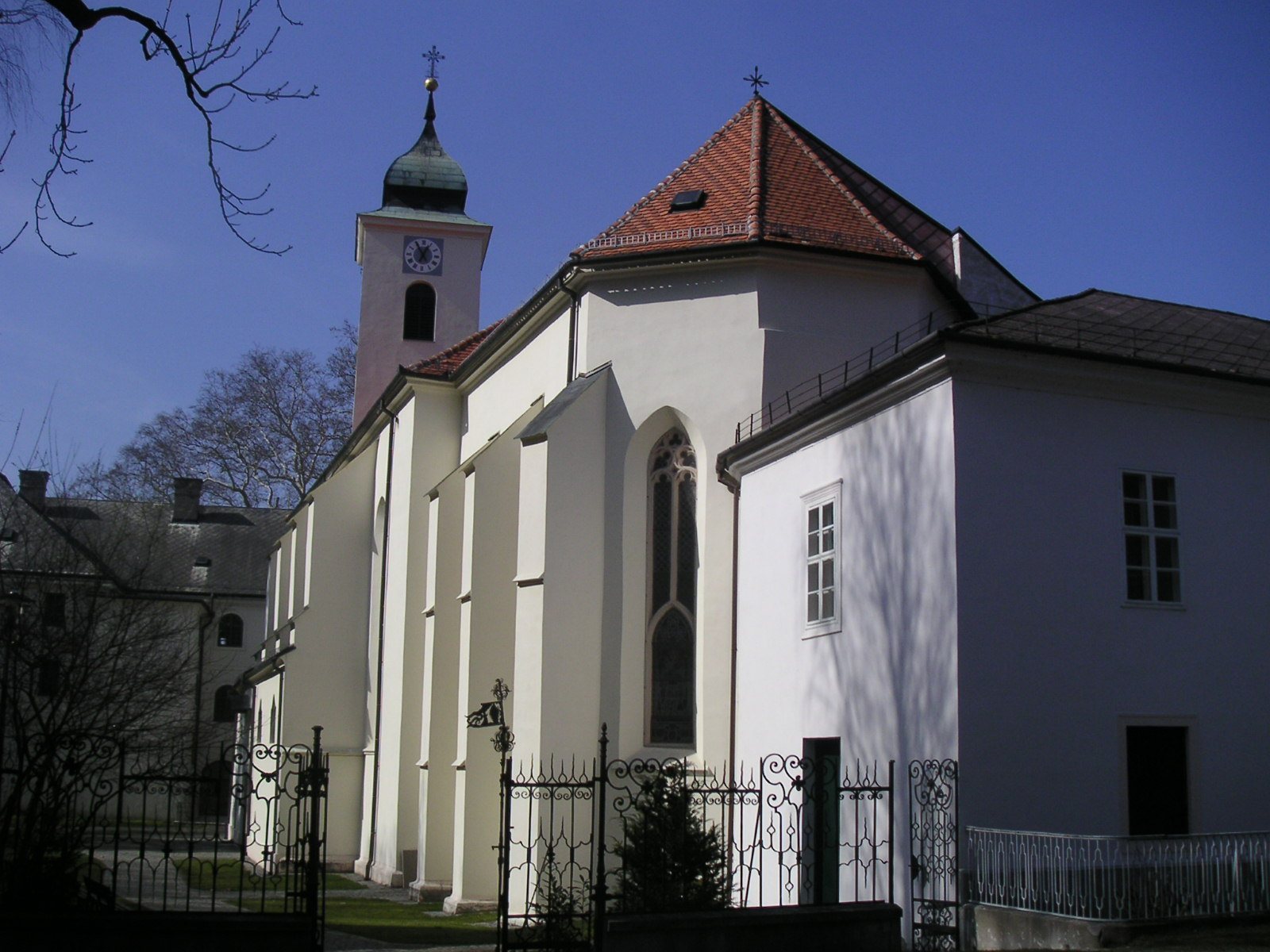
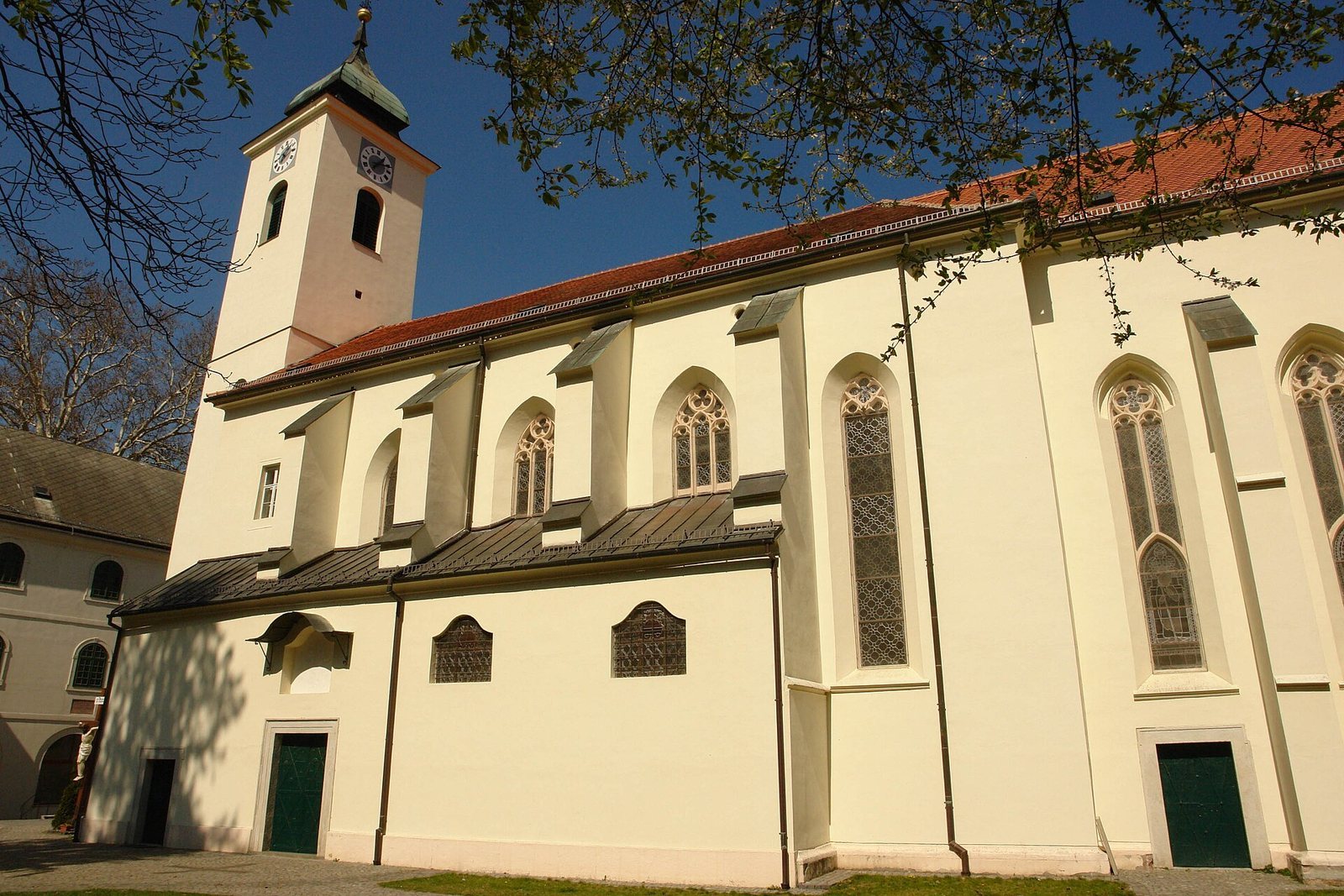
The original church was a single-nave Gothic building beside a spring, but its initial form has not survived intact. Successive changes reshaped the building, leaving a combination of Gothic fabric, Baroque additions, and later Gothic Revival work. The associated monastery precinct also retains features linked to Christian August’s building campaign.
Church fabric and furnishings
The Marian image
The shrine’s central image is a seated figure carved from pear wood. The Virgin holds an apple in her right hand and the infant Jesus in her left; both figures wear crowns. The image is painted in several colors and has been altered repeatedly over the centuries. Christian August gave it a reliquary containing a relic of the True Cross, believed to come from the cross on which Jesus was crucified.
Main altar and choir
A monumental Baroque main altar of dark-stained wood replaced an earlier altar that had been damaged. It placed the Marian image at its center. Bishop Paul Szechényi of Veszprém consecrated it on 27 June 1694 and deposited relics of the martyrs Magna, Fortunata, Lucida, and Justina in the altar.
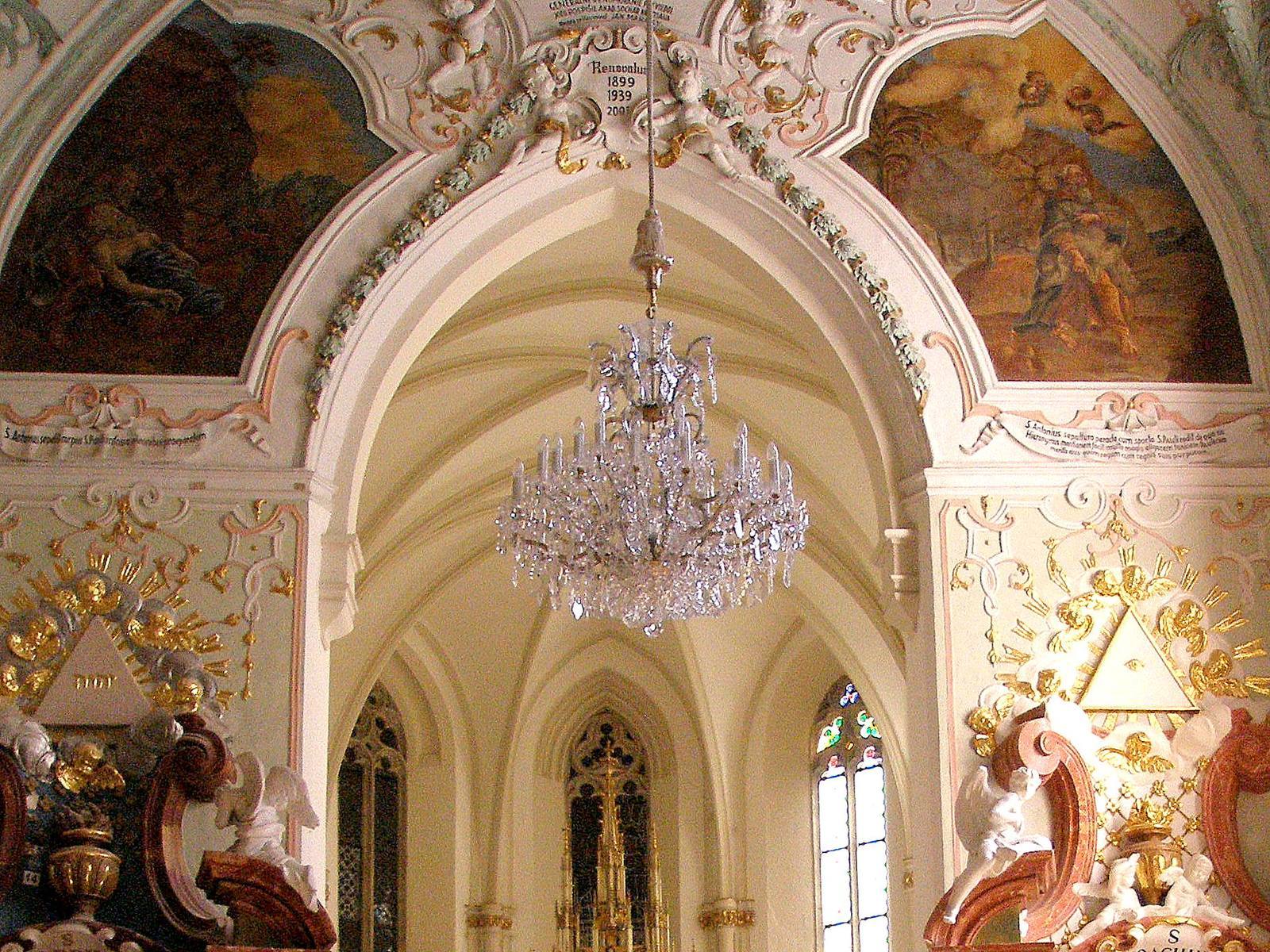
The late Gothic vaulted ceiling was covered with stucco, a molded plaster decoration. Around 1728, an unidentified artist painted scenes there from the later life of Saint Paul the Hermit and his meeting with Saint Anthony the Great, an early Christian desert monk. After 1735, Archbishop Imre Esterházy de Galántha commissioned Georg Raphael Donner to provide a main altar and remodel the choir.
Side chapels and altars
During alterations between 1717 and 1735, small chapels were built between the projecting supports on the church’s north and south sides. They provided spaces for side altars dedicated to Saint Michael the Archangel, Saint Joachim, Saint Paul the Hermit, and Saint Teresa of Ávila. Some of the Gothic windows were partly blocked during this work.
Gothic Revival furnishings
Nineteenth-century Gothic Revival work, a return to medieval Gothic forms, brought new flooring and stained glass for the original Gothic windows. The presbytery, the area around the main altar, was painted white. Donner’s work and that of his school were removed, and a Neo-Gothic vaulted ceiling and winged altar were installed. The winged altar, an altarpiece with hinged panels, dates to 1877. A side altar was dedicated to the Sacred Heart of Jesus, and the church has since undergone further extensive reconstruction.
Tombs and memorials
Andrew Báthory, lord of Devín Castle and a supporter of Marianka, died in 1566 and was buried in a crypt in the middle of the church. His epitaph dates to 1567 and was built into the wall beside the rear entrance on 9 August 1736. Two Gothic grave slabs beneath the choir commemorate Kunigunde Tovačovská of Cimburk, wife of Sigismund of St George and Pezinok, and John of Scharfeneck. Christian August’s separate crypt beneath the presbytery, intended for his burial, remains empty.
Saint Theodora’s relics
The relics of Saint Theodora, identified as a virgin and martyr, are housed in a wooden Neo-Gothic altar of the Sacred Heart of Jesus, opposite the main entrance. Cardinal Friedrich von Hessen-Darmstadt had bequeathed the relics to his confessor, the Pauline Leopold Aschperger, who died in 1682. At Christian August’s initiative, they were transferred to a side altar at Marianka in 1717. After they were lost, parish priest Evarist Czajkovszky found them in the former monastery’s attic in 1906 and arranged for an altar to house them.
Monastery precinct
Tower and courtyard
The church tower, built during Christian August’s building campaign of 1711–14, still bears his coat of arms. A statue of Saint Paul the First Hermit, commissioned by Christian August, stands in the monastery courtyard. A wall was also built around the monastery during this period.
Monastery buildings
From 1711 to 1714, the monastery was repaired and enlarged, then decorated with stucco and paintings. These works formed part of the broader building campaign that reshaped the church and monastery precinct under Christian August’s patronage.