Kerléven Cairn: A Neolithic Burial Monument in France
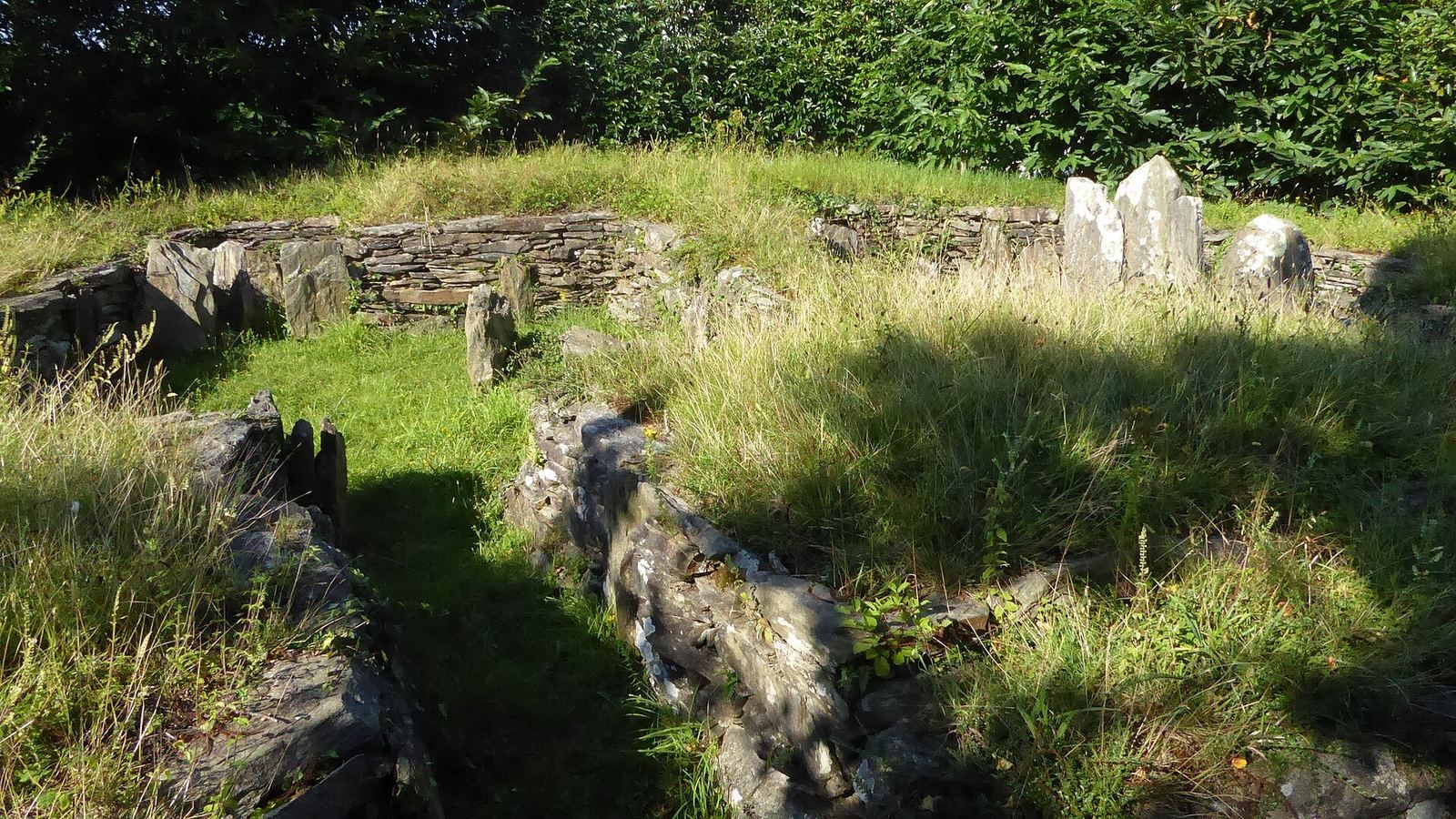
Site at a Glance
- Popularity
- Low
- Country
- France
- Primary era
- Stone Age
- Eras represented
- Stone Age
- Civilizations
- Unclassified
- Site type
- Burial
- Remains
- Burial Mound
On this page14 sections
History
Neolithic chronology
The Kerléven cairn is a Neolithic stone burial monument at La Forêt-Fouesnant, France, associated with the Chasséen culture, a Neolithic archaeological culture of France. A charcoal sample from the southeast corner of chamber A yielded a date around 2875 BCE, plus or minus 125 years. The pottery and tomb architecture are consistent with this dating, though the result is not an exact construction date. Kerléven has been described as Brittany’s third-largest cairn, after Barnenez and Gavrinis.
Rediscovery and protection
The monument was known but left out of nineteenth-century inventories. In 1937, the Breton archaeologist Pierre-Roland Giot sketched slabs visible on the surface. Vegetation later concealed the cairn, which was temporarily thought to have disappeared.
Earthworks for a proposed campsite accidentally exposed Kerléven in 1960. The work lowered the mound’s top and nearly destroyed its western part. Three excavation campaigns followed between 1961 and 1965, with partial restoration at their conclusion. An order dated 15 April 1965 classified the cairn as a protected historic monument in France.
Remains
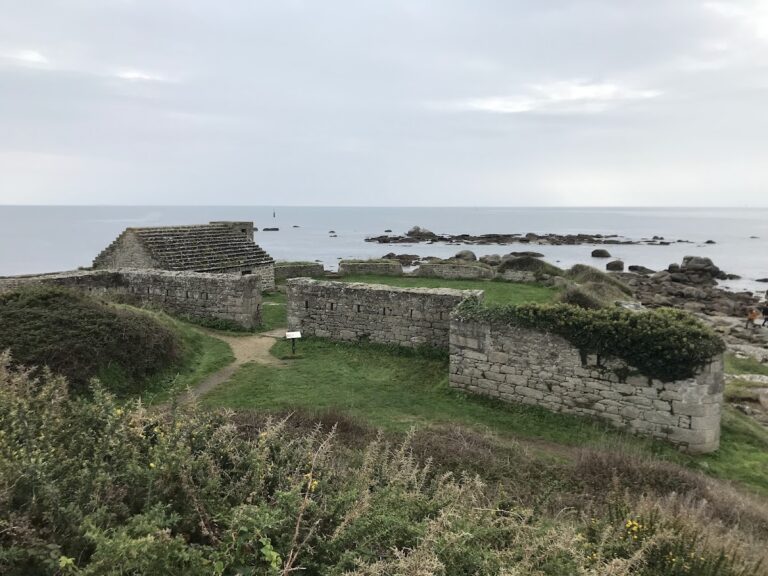
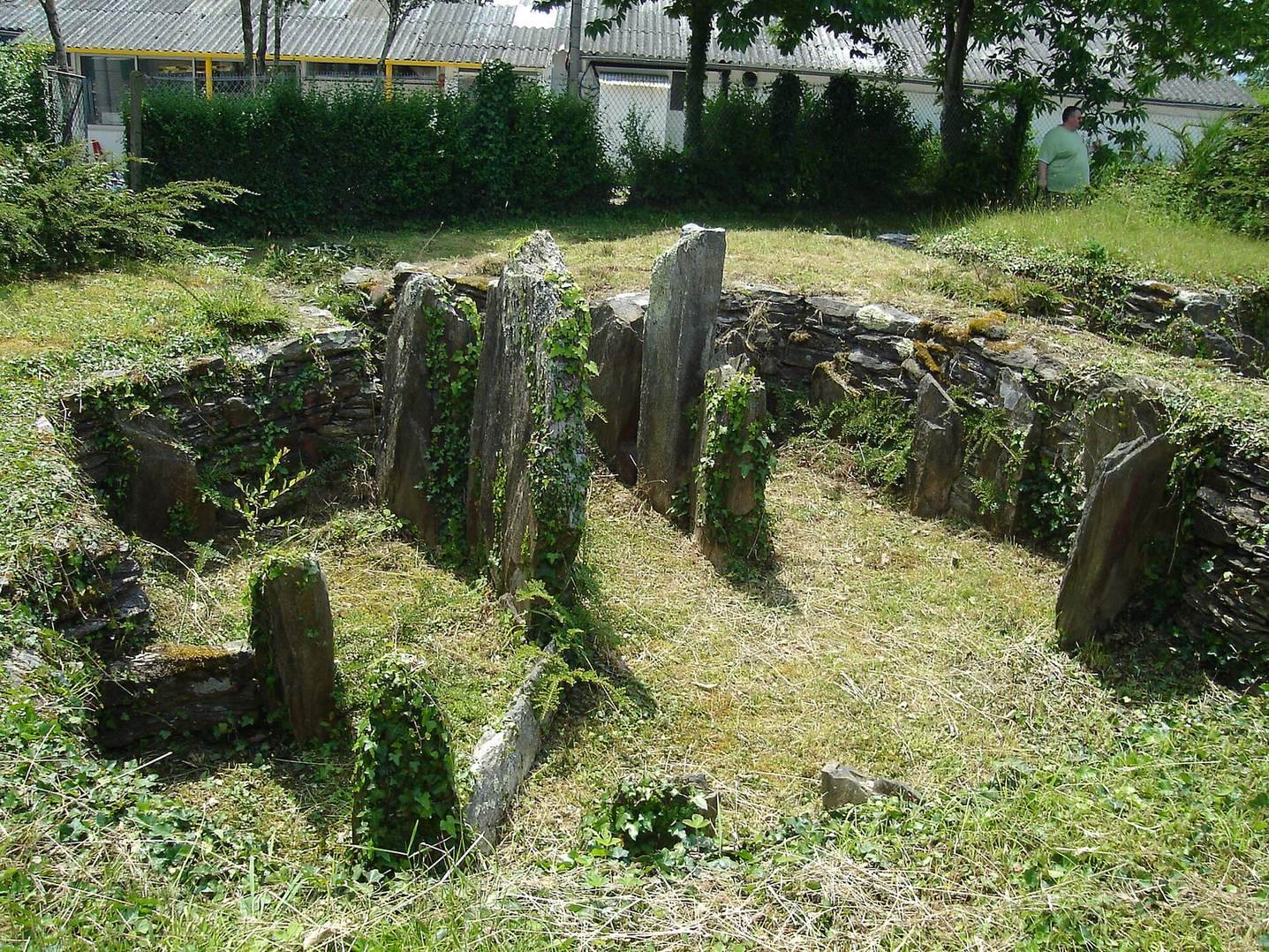
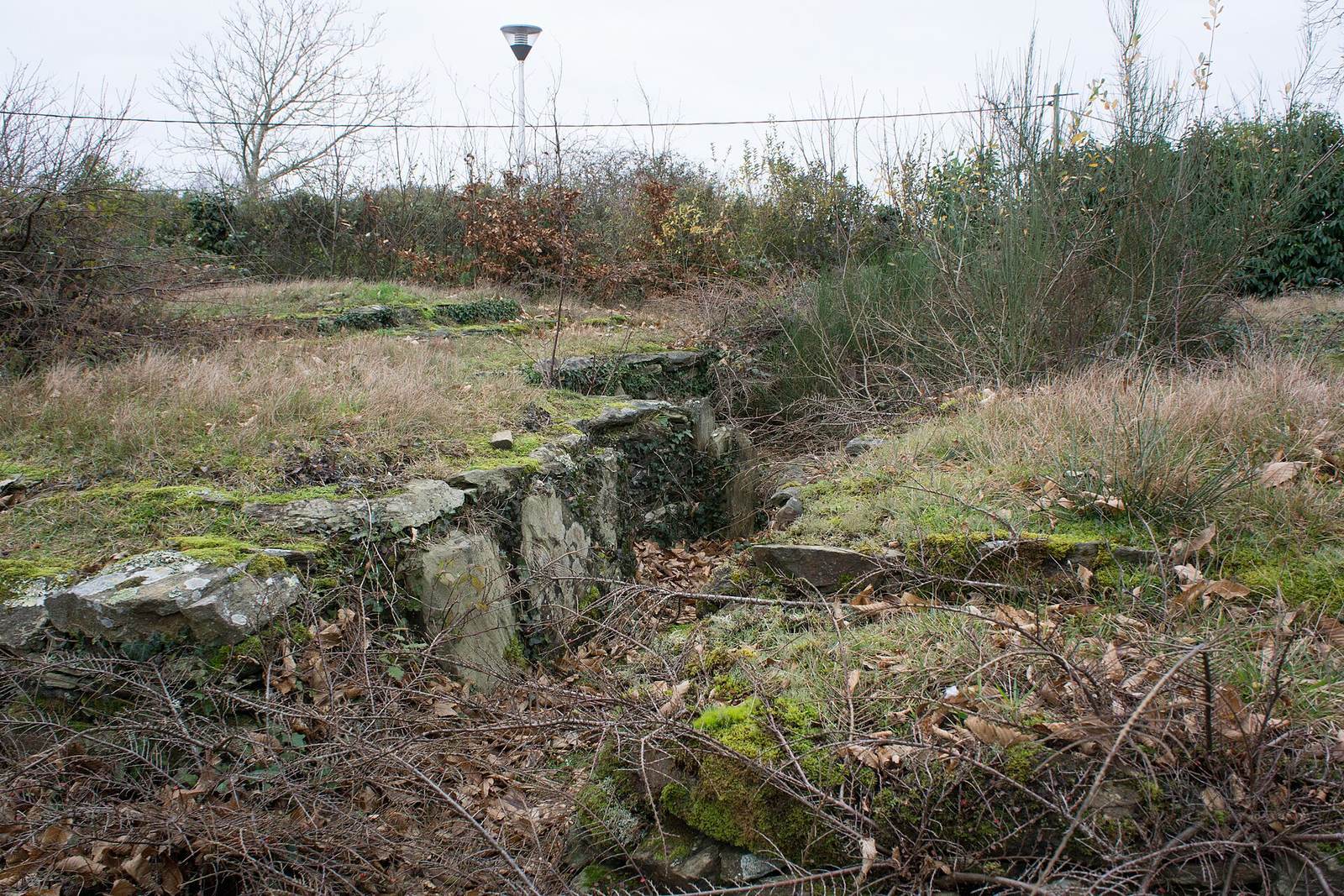
Kerléven stands on a promontory, a projecting point of land, overlooking the head of the Bay of La Forêt. Its overall outline is roughly trapezoidal, a four-sided shape with one pair of parallel sides, and it runs west-northwest to east-southeast. Facing walls built from stone laid without mortar enclose the mound. Its original size is uncertain, but it may have measured about 8–12 metres across and 25 metres long. The small, symmetrical chambers have architectural parallels with tombs in Morbihan, including Gavrinis, Petit Mont, Mané-Carnaplaye, and Roc-en-Aud; their internal compartments also resemble those at Menez Goarem ar Feunteun and Pointe du Souc’h in southern Finistère.
Western cairn
Outer structure
The western cairn was originally close to square, measuring about 12 metres on each side. Its surviving remains include the eastern side and part of the southern front, with the rounded southeast corner the only corner still preserved. The southern front has a single facing wall, while two such walls line the eastern side.
Chamber A
Only the southeast corner of chamber A and part of its entrance passage remain. The chamber was probably four-sided. Along the passage, low walls of small slabs alternate with upright stones, and three long slabs laid across the passage form its floor.
Second cairn
Outer structure
Added against the western cairn, the second mound has an irregular trapezoidal plan. Its southern side is about 14 metres long, its western side about 10.5 metres, and its eastern side about 8 metres. A second facing wall runs inside the outer southern wall, roughly 0.80 metres from it. The partly damaged northern side has rougher facing, and the eastern side has been destroyed.
Chamber B
Chambers B and C were built together, separated by a partition. Their parallel entrance passages run on a 195-degree alignment. At the entrances, the passages measure about 0.70 and 0.75 metres across, widening to about 0.95 and 1 metre where they meet the chambers. Each passage continues into its chamber, creating internal divisions. Chamber B measures about 4 by 3.75 metres. In its northwest corner, an irregular pentagonal compartment measures about 1.60 by 1.40 metres; two upright slabs frame its narrow, 0.50-metre entrance.
Chamber C
Chamber C is the best-preserved of the three, particularly at its southeast corner. Standing slabs indicate a minimum height of about 1.70 metres in the chamber and 1.10 metres in its passage. Closely spaced upright stones line the passage, which extends 1.75 metres into the chamber. The chamber is trapezoidal, measuring about 4 metres across at the passage end, 3 metres at the rear, and 8 metres deep.
Compartments occupy the southwest, northwest, and southeast corners. The northeast corner is less clearly defined and has three pillars arranged in an arc. This arrangement may have formed a low hall serving the other compartments. The pillars may also have supported horizontal stones carrying roof slabs, or a low corbelled roof, built from stone courses that project inward as they rise. The southeast compartment has a floor paved with small mica-schist slabs, a type of metamorphic rock. The passages may have had coverings of locally obtained migmatite slabs, also a metamorphic rock, while the chambers probably had low corbelled roofs. Chamber C was filled with jumbled rubble, possibly from a roof collapse.
At the entrance to chamber C, excavators found a large notched slab with shaping marks alongside a smaller slab. Together, they may have formed a closure in which a small opening was blocked by the smaller stone.
Archaeological finds
Pottery
Most of the recovered material came from outside the three chamber entrances, probably in soil disturbed by earlier looting; smaller amounts were scattered through the mound rubble. Pottery includes fragments of round-bottomed vessels, usually with fine black fabric, as well as smaller pieces of red fabric. The vessels are generally well made, smoothed, and of good quality. Fragments of a vessel resembling an incense burner were also found. Coarser sherds from upper levels are associated with Kerugou pottery and may indicate later visits to the mound rather than renewed use of the chambers.
The burial assemblage has similarities to finds from the Kervadel-Kervinion and Souc’h necropolises. Its pottery has been assigned both to the Chasséen culture and to the Chassey-Lagozza-Cortaillod grouping, a label for related Neolithic traditions in parts of western and central Europe.
Stone tools and personal ornament
Finds include small flakes of flint and quartzite, small flint blades, a polished greenstone axe, and part of a polished type A dolerite axe. The axes are later than the pottery. Their presence in chamber B may indicate that this chamber alone was reused later. A blue glass bead was also found.