St. Anthony’s Hill: A Baroque Pilgrimage Site in Czechia
Site at a Glance
- Popularity
- Medium
- Country
- Czechia
- Primary era
- Early Modern
- Eras represented
- Early Modern, Modern
- Civilizations
- Austria-Hungary, Austrian Empire, Habsburg, Holy Roman Empire, Margraviate of Moravia
- Site type
- Religious
- Remains
- Sanctuary
On this page17 sections
History
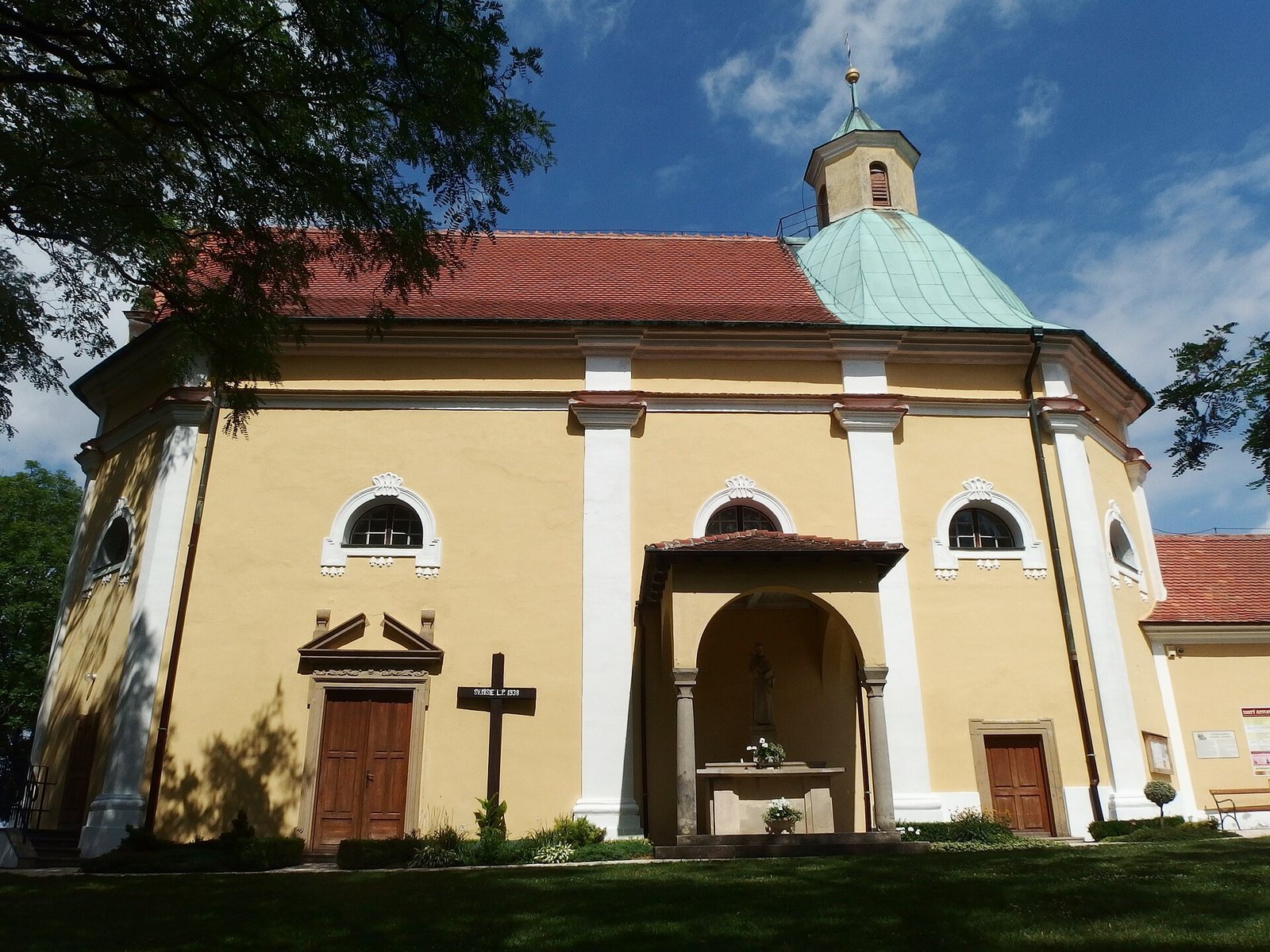
St. Anthony’s Hill is a pilgrimage hill in Czechia between Blatnice pod Svatým Antonínkem and Ostrožská Lhota, crowned by a Baroque chapel dedicated to Saint Anthony of Padua. The chapel, designed by Moravian architect Jan Křtitel Erna, was completed in 1670 and became a major Catholic pilgrimage destination. Saint Anthony was a thirteenth-century Franciscan friar and preacher.
Before the chapel was built, the hill served as a regional landmark and may also have been used for defense. Archaeologists have considered it a former pagan sanctuary and Slavic burial ground. Local traditions say that Saints Cyril and Methodius, ninth-century Christian missionaries associated with the spread of Christianity and literacy among Slavic peoples, passed through on their way to Veligrad. Another tradition recalls an ancient cross on the summit before the chapel existed.
Foundation and early pilgrimages
Hartmann of Liechtenstein, prince and owner of the Ostroh estate, sought permission to build a chapel on the hill on 21 April 1662. He hoped it would help protect local harvests from damaging weather. Approval came in 1668, and the foundation stone was laid that spring in the presence of the rector of the Jesuit college in Uherské Hradiště and the estate captain.
Pilgrimages began on 13 June 1670. By 1672, 5,000 people had come to venerate Saint Anthony. Pilgrims prayed for the return of lost or stolen possessions, peace in marriage, and children’s health. In later years, seeking help to find a life partner also became part of the pilgrimage tradition.
The chapel was enlarged in 1696–1697, and residents of Blatnice, Ostrožská Lhota, and Hluk supplied labor as part of their required service. A house offering refreshments was built for pilgrims at the same time. A further restoration took place in 1748–1749, initiated by Blatnice parish priest Jiří Hnátek. Workers discovered a spring while looking for water to extinguish lime. Reports of healings associated with its water drew more people to the hill. A local tradition instead held that the spring predated the chapel and had healed a prince’s child.
In 1749, an archdiocesan commission investigated claims of healing. Among the cases it examined were Jan Vlach, whose legs had gangrene; Antonín Hanák, who had inflamed eyes; Jan Galuška of Kvačice, who had digestive problems; and a son of Josef Kölbel, who had paralysis of the legs. Václav Máder was also included. Martin Miklíček and Pavel Blahuš of Ostrožská Lhota gave testimony about the hill’s history. As pilgrimages grew during the eighteenth century, more clergy were needed. An endowment left by priest Jan Maluš, who died in 1764, required the chaplaincy established at Ostrožská Lhota in 1765 to help hear confessions during the hill’s pilgrimages.
Suppression and revival
The chapel closed during the religious reforms of Emperor Joseph II, a Habsburg ruler whose policies affected religious institutions. The archdiocesan consistory permitted its furnishings to be sold in May 1784. A decree in 1786 formally suppressed and deconsecrated the chapel, and its equipment was distributed among poor churches. The building was sold to Sára Dobrušková, who intended to use it for building materials. The last pilgrimage before the interruption took place on 1 May 1786. Stripped of its furnishings, the chapel fell into ruin, and livestock wandered inside.
As religious life revived after the Napoleonic Wars, Martin Straka of Ostrožské Předměstí had a cross erected beside the ruined chapel in 1810. Between 1812 and 1815, efforts to recover the building included an audience with Emperor Francis I. The municipality of Blatnice bought it back with voluntary contributions for 2,000 gulden. On 30 May 1815, the municipality undertook to repair and maintain the chapel permanently. Financial difficulties delayed its reconsecration until 16 June 1819. From 28 June that year, the consistory authorized summer Masses and sermons on Sundays and holy days. Pilgrimage and worship at the hill resumed and have continued since.
Nineteenth-century pilgrimage growth
In the nineteenth century, pilgrims commonly came from the Sunday after Saint Anthony’s feast on 13 June through the Sunday after the feast of Saints Cyril and Methodius on 5 July. That July observance had been marked since 1863. The main gatherings followed Saint Anthony’s feast and took place on 29 June, the feast of Saints Peter and Paul, early Christian apostles. Local practice also included a pilgrimage on Saint Anthony’s feast and a thanksgiving gathering after the harvest.
Pilgrims sought water from the spring for drinking and for washing children and sick people, particularly those with tuberculosis. Slovak visitors also used it to sprinkle fields against hail. The pilgrimages were social as well as religious occasions. Local priests celebrated Mass, while sometimes as many as 20 visiting priests heard confessions. From 1860, pilgrims could receive plenary indulgences, which in Catholic teaching remit the temporal punishment associated with sins whose guilt has been forgiven. On the largest feast days, attendance ranged from 2,000 to 4,000 in 1888.
Growth in the 1860s and 1870s was associated with the work of Blatnice priest František Vlk, indulgences granted by Pope Pius IX in 1860, and the Czech national movement. The main pilgrimage drew 60,000 people in 1867, and a public assembly attended by 30,000 took place on 24 September 1871. From 1898, priest Antonín Horný led men’s pilgrimages at the site. That year, Blatnice priest and dean Mořic Růžička asked Prince John II of Liechtenstein to become patron of the chapel. The prince declined but paid for its paving. Shortly before the Second World War, attendance at the hill exceeded 100,000.
The pilgrimage on 29 June 1914 coincided with news of the Sarajevo assassination. The hill remained a major pilgrimage destination during the interwar years.
Occupation and political pressures
During the German occupation, pilgrimage gatherings were also used for political demonstrations. The Protectorate of Bohemia and Moravia was the Czech territory administered under Nazi rule from 1939 to 1945. In 1940, its prime minister Alois Eliáš attended the 16 June pilgrimage amid concern about the activities of the collaborationist organization Národopisná Morava. A pro-German demonstration was organized at the hill on 14 June 1941. A pilgrimage on 22 June, attended by 20,000 people, became an expression of public anxiety after Germany invaded the Soviet Union that morning.
After Reinhard Heydrich’s assassination, Protectorate education minister Emanuel Moravec spoke at a memorial gathering on 28 June 1942. The event, part of a series intended to display loyalty to Germany, drew 35,000 to 40,000 people. Moravec may also have attended a pilgrimage on 30 June, which attracted 40,000. Resistance members may have planned to assassinate him at one of the gatherings, though this remains uncertain. On 20 June 1943, the Protectorate’s Curatorium for Youth Education organized a Moravian Slovak youth rally. It brought 10,000 young people and 20,000 adults to the hill, many of the adults having been coerced into attending.
Priest Antonín Šuránek served at the site during the Second World War and again from 1968 to 1970. While living in the sacristy, the room where clergy prepare for services and keep religious objects, he organized retreats and night-time adoration. In 1940, he proposed a Capuchin monastery with support from Ostrožská Lhota, but opposition in Blatnice prevented the plan. He founded the Matice svatoantonínská on 8 October 1946 to develop the pilgrimage site; its activities were halted after the communist takeover.
Continuity after 1945
Under communist rule, restrictions made participation in pilgrimages more difficult. Public expressions of pilgrimage culture, including transport, food stalls, and rides, were curtailed. The hill nevertheless continued to function as a religious destination, rather than becoming a venue for pro-regime political demonstrations. Restrictions eased after the fall of communism in 1989.
Since 1997, the Matice svatoantonínská has continued Šuránek’s initiative as an association that helps organize pilgrimages and publishes a periodical. The main annual pilgrimage is held around 13 June. Other recurring observances include a gathering near the feast of Saints Peter and Paul, an August thanksgiving pilgrimage, and an autumn pilgrimage commemorating the dead. Parishioners from Ostrožská Lhota, which belonged to the chapel’s parish during its first two centuries, continue to help care for the site.
Remains
The chapel stands on the summit of a spur of the Vizovice Highlands, between Blatnice pod Svatým Antonínkem and Ostrožská Lhota, about 14 kilometres south of Uherské Hradiště. Its Baroque plan developed from an octagonal central building into a chapel with a single nave. The altar faces southeast, in a direction measured at 145 degrees clockwise from north. Vineyards have occupied the slopes for centuries, while the summit was probably wooded as pilgrimages grew.
The chapel
Plan and construction
The original chapel was an octagonal rotunda, meaning a centrally planned building, in this case with eight sides. The enlargement added a single nave, the main body of the chapel. A small tower was built above the presbytery, the area around the altar reserved for clergy, during a later restoration; it was enlarged during a major repair in 1936–1937. The chapel also has a sacristy extension and a triumphal arch, the division between the nave and presbytery.
Altars and interior decoration
An inventory from 1672 lists a silver chalice and paten, the plate used with a chalice, as well as a ciborium, a covered vessel for consecrated hosts, from the church at Blatnice. It also records a portable altar stone containing relics on one fixed altar and six wooden candlesticks. An Italian stucco artist involved in the enlargement made a new image of Saint Anthony for the chapel. By 1771, it had two altars dedicated to the Holy Family and the Fourteen Holy Helpers, a group of saints traditionally invoked for protection and assistance.
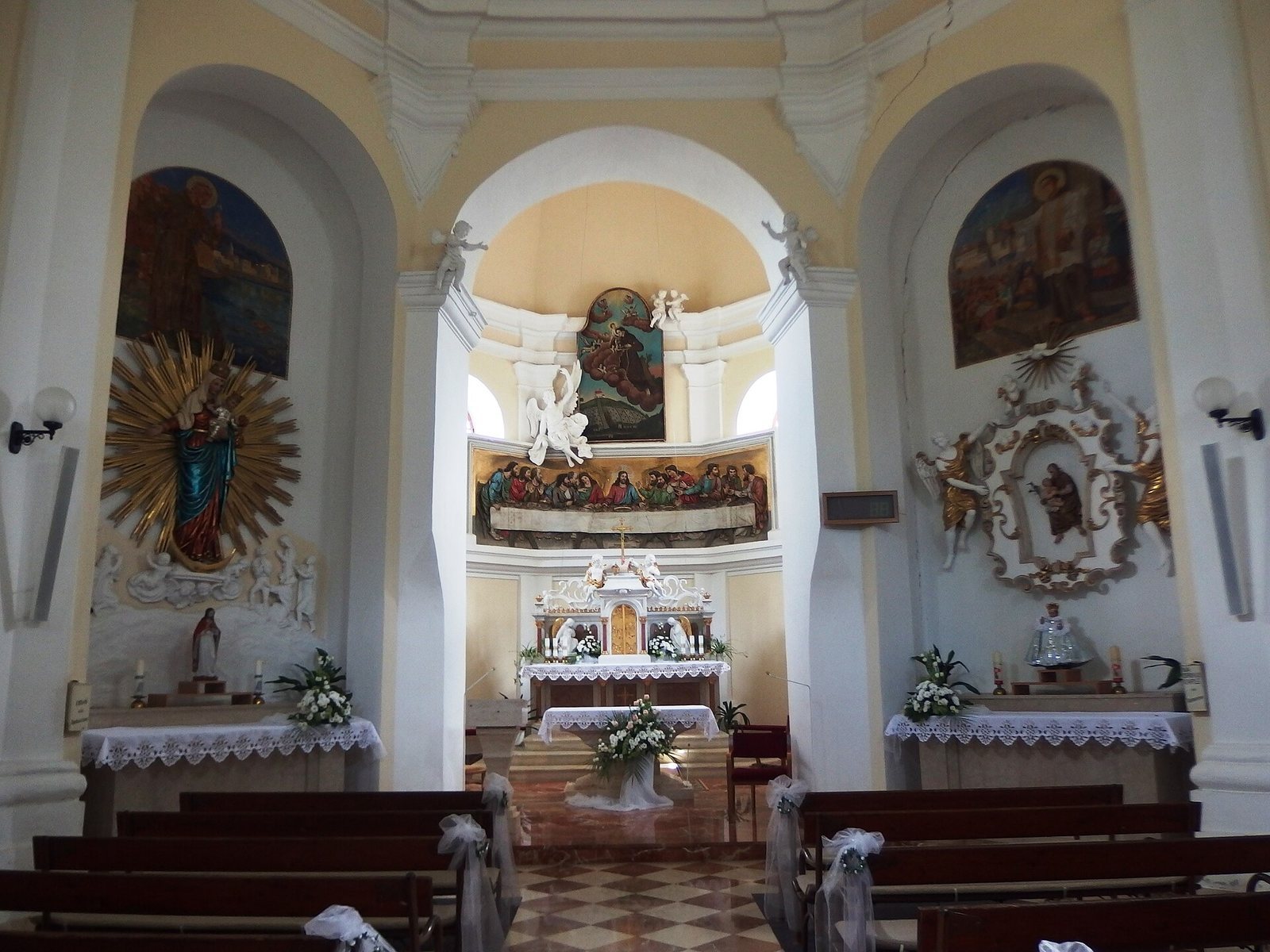
Church caretaker and folk painter František Hána painted Saint Anthony floating above the hill and chapel on the presbytery ceiling. In 1888, a builder from Strážnice named Slovák donated a sculpture of the Last Supper, which was placed beneath the painting. A new main altar made by František Štábl was consecrated on 30 May 1905 by auxiliary bishop Karel Wisnar, a bishop who assists the leader of a diocese. A new organ and statues were installed in 1907, and a statue of Our Lady of Hostýn, a Catholic title for the Virgin Mary associated with a Moravian pilgrimage shrine, was acquired in May 1917.
Twentieth-century repairs and paintings
A major repair in 1936–1937 reinforced the dome with masonry and iron bands and added a reinforced-concrete ceiling, new roof, gutters, lightning conductors, and crosses. Copper sheeting covered the rotunda above the dome and a small roof. The work also repaired the doors, windows, sacristy extension, and triumphal arch; the chapel was replastered and whitewashed. A new wooden frame for the bells was installed, and the existing small bell was joined by one weighing about 100 kilograms, donated by two local families.
Above the side altars, academic painter Jan Köhler created wall paintings dated 3 August 1937. They show Saint Anthony preaching to fish and preaching to people in Padua. The Last Supper sculpture, ceiling painting, and other interior features form part of the chapel’s documented history of decoration and repair.
Spring and surrounding grounds
Water sources
The spring discovered during the chapel’s restoration lies about 200 paces south of the building. Its water became part of the pilgrimage tradition, with visitors seeking it for drinking and washing. North of the chapel, a 47-metre borehole was drilled in 2019 to supplement two older wells that were drying up.
Pilgrimage landscape
The municipality planted an avenue of trees in 1898 to mark the fiftieth anniversary of Emperor Francis Joseph I’s reign. Twenty-six acacia trees were planted on the chapel’s south side in 1913. A Way of the Cross, a devotional sequence of stations recalling Christ’s Passion, was laid out in a forest clearing northwest of the summit in the mid-twentieth century. The area around the spring was also improved.
A field altar and other facilities for outdoor services were put into use beside the chapel in 2008. These additions provide for worship outside the building while remaining part of the hill’s pilgrimage setting.
Art and commemoration
Joža Uprka’s depictions
The chapel and pilgrimage inspired Moravian painter Joža Uprka, known for depicting regional life and customs. His painting Pilgrimage at St. Anthony’s Hill, made in 1893, was shown in Paris in 1894 and received an honorable mention. A printed portfolio of 15 Uprka depictions of the pilgrimage appeared between 1920 and 1935. His 1900 watercolor is the only work in that group that shows the entire chapel.
Memorial plaque
A copper memorial plaque to Uprka was unveiled on the chapel wall in 2011. Sculptor Otmar Oliva created it, and Jan Graubner, the Catholic archbishop of Olomouc and metropolitan, the senior bishop of an ecclesiastical province, blessed it.