Blue Grotto: Tiberius’s Roman Sea Cave and Marine Nymphaeum on Capri
Site at a Glance
- Popularity
- Very High
- Country
- Italy
- Primary era
- Classical
- Eras represented
- Classical
- Civilizations
- Roman
- Site type
- Religious
- Remains
- Sanctuary
On this page13 sections
History
The Blue Grotto is a sea cave on Capri’s northwestern coast in Italy. In Roman times, it served Emperor Tiberius, who ruled from AD 14 to 37, as a private swimming place and formed a submerged extension of the Augustan-Tiberian Villa of Gradola.
Roman use
The first-century Roman writer Pliny the Elder described a Triton, a sea deity often shown with a shell, playing a shell inside the grotto. This description has been tentatively connected with a Triton statue later recovered from the cave.
Decline and rediscovery
After the Roman period, the cave fell into a long decline. The name Gradola appeared on a map by Vincenzo Coronelli in 1696. During the eighteenth century, islanders and sailors reportedly kept away, believing the grotto was inhabited by witches, spirits, or monsters. A local legend tells of two priests who entered to drive out its supposed demons. They fled in panic and afterward raved. An eighteenth-century Neapolitan song titled The Blue Grotto indicates that the cave was known before its celebrated rediscovery.
On 17 August 1826, Prussian poet August Kopisch, painter Ernst Fries, local mariner Angelo Ferraro, innkeeper Pagano, and mule driver Michele Federico explored the grotto. Pagano had urged the expedition, and Ferraro guided it. Kopisch popularized the name Grotta Azzurra, meaning Blue Grotto. Other proposed names, including Grotta Pagano and Grotta Glauca, did not take hold. Russian exile Apostol Mouravieff proposed Grotta Glauca, associating it with the color blue and a marine deity.
Kopisch published his account in 1838. The cave’s growing reputation also owed much to Wilhelm Waiblinger’s writing in 1828 and Hans Christian Andersen’s novel The Improviser (1835), which found a broad European readership. The grotto’s rediscovery helped attract wealthy Europeans to Capri as part of the Grand Tour, an extended educational journey through Europe that was popular among affluent travelers from the seventeenth to the nineteenth centuries.
Cultural influence and archaeological study
In 1842, Danish choreographer August Bournonville set the second act of his ballet Napoli in the cave. Its fantasy plot follows the demon Golfo as he transforms the heroine, Teresina, into a water nymph. From 1875 to 1877, King Ludwig II of Bavaria, who ruled from 1864 to 1886, had an artificial Venus Grotto built in the grounds of Linderhof Palace. It evoked the Venusberg scene in Richard Wagner’s Tannhäuser and recreated the Blue Grotto’s appearance with arc lamps, electric generators, and specially developed blue glass.
Edwin Emmanuel Bradford drew on the image of a boy bathing in the cave for two poems, In Quest of Love (1914) and The Bather in the Blue Grotto at Capri (1918). In the twentieth century, archaeologist Amedeo Maiuri recognized the grotto’s Roman character as a marine nymphaeum, an ornamental sanctuary or grotto associated with water and nymphs.
Remains
The Blue Grotto belongs to a multi-chamber karst system, terrain shaped as water dissolves soluble rock to form caves and underground passages. Its broad main chamber is the part commonly called the Blue Dome. The cave extends about 50 metres into the cliff at the surface, while narrower chambers and passages continue farther inside.
Main chamber
Chamber and entrance
The main chamber measures about 60 metres long and 25 metres wide, with a sandy floor. Its depth is about 22 metres overall, including 14 metres within the cave. The ceiling averages 7 metres high and reaches 14 metres in inner areas. From the underwater threshold to the ceiling, the full height is 36 metres. The entrance is partly submerged and measures about 2 metres wide and 1 metre high at low tide.
Light and water
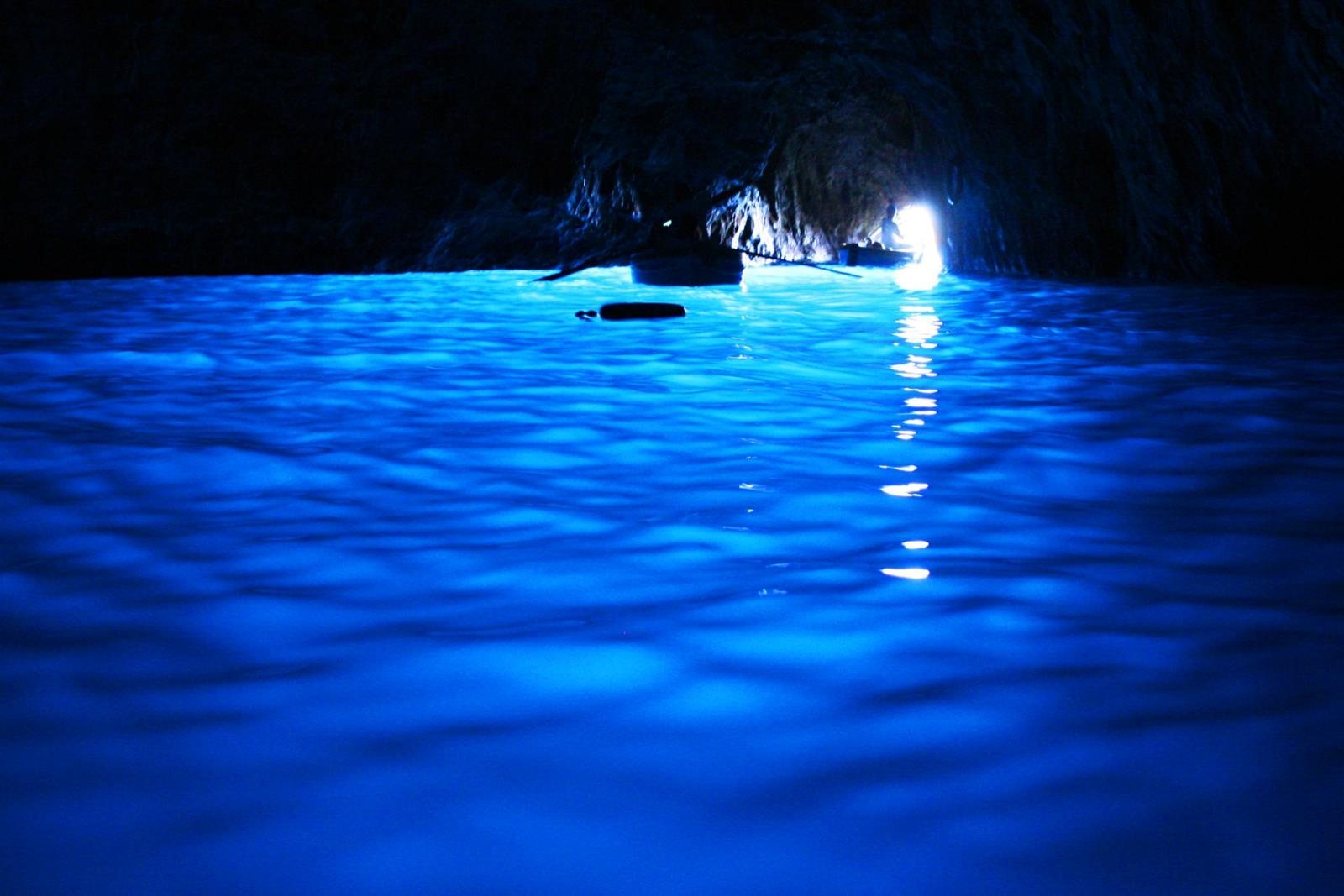
A second opening beneath the entrance, separated from it by a band of rock about 1 to 2 metres high, provides the main light entering the water. As light passes through the water, red wavelengths are absorbed and blue light illuminates the chamber. When the sea is completely still, light can be reflected within the water rather than lighting the cave, so some water movement is needed. The vivid color inspired the name Capri blue. Tiny air bubbles cling to immersed objects and bend light differently from the surrounding water, making the objects appear silvery.
Roman platform and statues
In the southwestern corner, the Romans built a platform and levelled it with brick rubble. Statues of Neptune, the Roman god of the sea, Triton, a sea deity often shown with a shell, and other marine figures were thought to have stood along the chamber walls. Resting places were arranged around the edge. One reconstruction proposes a group of Triton figures led by Neptune. Three Roman statues recovered in 1964 are now held at the Casa Rossa Museum in Anacapri. Seven statue bases found on the cave floor in 2009 suggest that at least four further statues may remain there.
Inner chambers and passages
Side passages and cavity
Several narrow passages open toward the rear of the main chamber on the left, both above and below the waterline. A separate cavity opens on the right. Humidity, dripping water, and temperature changes contribute to its formation and the continuing fragmentation of its walls.
Gallery of Pillars and Room of Names
Beside the Roman platform, three branches known as the Gallery of Pillars lead to the Room of Names. Its name refers to visitors’ graffiti signatures, including names written in the nineteenth and twentieth centuries.
Corrosion Room and inner passages
Beyond the Room of Names, the cave narrows into the Corrosion Room, the furthest chamber that can be explored. Narrow natural passages continue into the mountain, becoming smaller and ending farther within; their air is unbreathable. Once thought to be ancient stairways leading to Tiberius’s palace, they are now understood as natural passages. They may not connect with the exterior and have been interpreted as the result of an unsuccessful Roman search for fresh water.