Bílovice Castle: A Municipal and Noble Residence in Czechia
Site at a Glance
- Rating
- 4.6
- Popularity
- Very Low
- Country
- Czechia
- Primary era
- Early Modern
- Eras represented
- Early Modern, Modern
- Civilizations
- Austria-Hungary, Habsburg, Holy Roman Empire
- Site type
- Domestic
- Remains
- Castle
On this page7 sections
History
Bílovice Castle is a late eighteenth-century noble residence in Bílovice, Czechia, about 7 kilometres northeast of central Uherské Hradiště. It probably arose for Ignác Kajetán Bevier von Freiried, holder of the Bílovice episcopal fief, a territory held from an ecclesiastical lord under a bishop’s authority. The castle later became a cultural and social centre under the Greek-origin Logothetti family and continues to serve municipal and local administrative purposes.
From fortress to late eighteenth-century castle
The predecessor of the present building was a fortress first mentioned in 1592. Its location is no longer known. The present castle was probably built in the late eighteenth century for Ignác Kajetán Bevier von Freiried. Its existence is described in František Josef Schwoy’s 1793 work Topographie vom Markgrafthum Mähren. Ferdinand Count Laurencin d’Armond, who held the Bílovice fief from 1809 to 1831, is also sometimes identified as the castle’s builder.
By 1820, the castle was described as a two-storey building with 17 rooms and four chambers. From 1831, the Bílovice fief belonged to the Logothetti family, who also owned the nearby Březolupy estate. Under their ownership, the castle became a setting for cultural and social activity. In 1854, Hugo I Logothetti hosted Josef Mánes, a nineteenth-century Czech painter and draughtsman, who made several drawings at the castle.
The Logothetti estate
Hugo I’s son, Vladimír Emanuel Count Logothetti, founded the Bílovice fire brigade and commissioned a west wing with a dance hall. After the feudal system was abolished in the early 1870s, he became the hereditary owner of the Bílovice estate. His son Hugo II continued the building works. In the early twentieth century, he arranged for the façades to be restored, replaced the clock in the entrance-front tympanum with the Logothetti family coat of arms, and placed a statue of Saint Wenceslas on the northwestern corner. Saint Wenceslas is the patron saint of Bohemia and a tenth-century duke regarded as a major patron of the Czech lands.
Confiscation and municipal use
After Hugo II died suddenly in Tehran, ownership passed to his wife, Frieda Barbara, née Baroness Zwiedinek von Südenhorst. Because she identified as German, the castle was confiscated after the Second World War and transferred to the municipality in 1947.
The Logothetti family left an extensive library at the castle. Part of it entered the collections of the museum in Uherské Hradiště, while another part was looted around 1948. The building subsequently served residential purposes. From 1952, it housed the Bílovice Municipal National Committee, the local administrative institution used in communist-era Czechoslovakia, together with the municipal library, a medical practice, a nursery school, and a district station of the National Security Corps, the period’s local policing institution. A modern east wing, used as a cultural hall, was added at the end of the 1940s.
The castle was reconstructed in 2005 and 2006 and continues to serve the municipality and local administration. Since December 1968, the castle and its adjoining English landscape park have been protected as a cultural monument.
Remains
Main building and wings
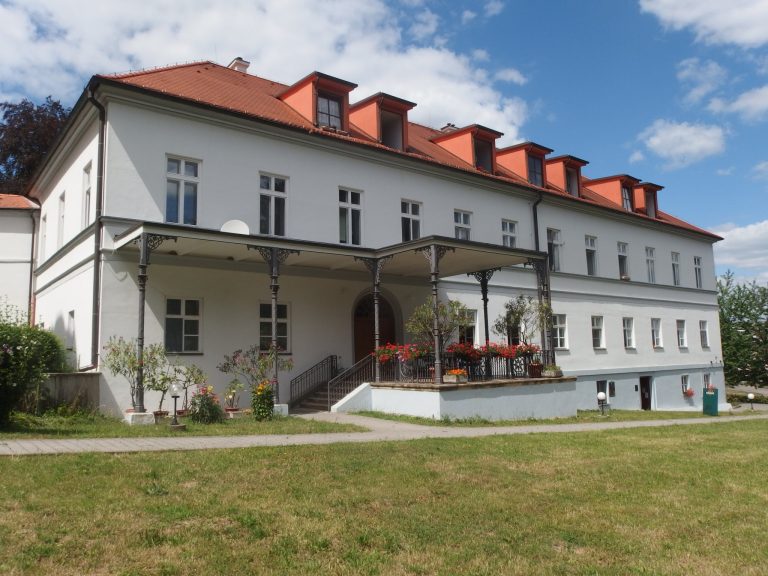
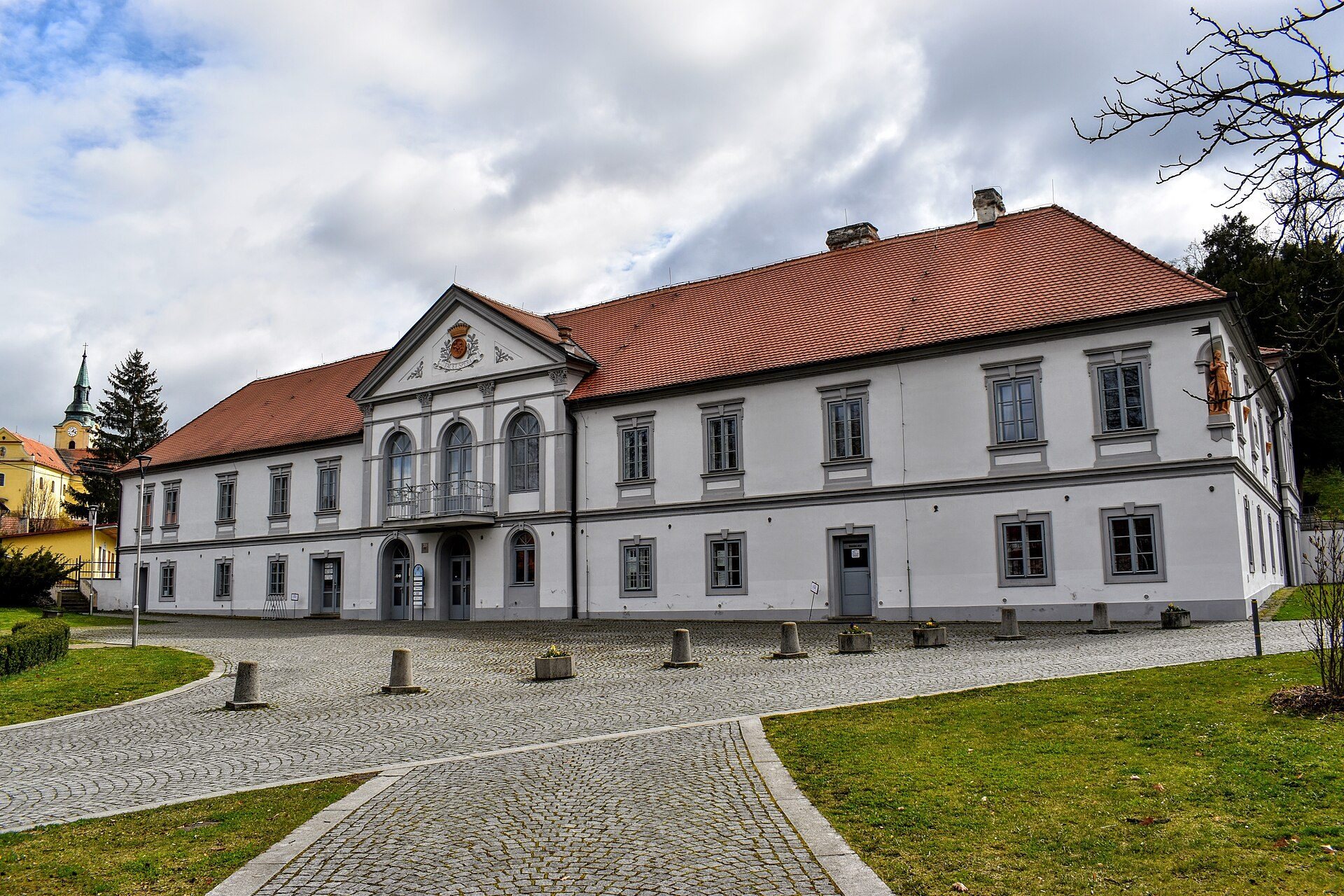
Bílovice Castle is a free-standing, two-storey building arranged in three wings beneath a hipped roof, which slopes upward from all sides towards a ridge. A central projection, or risalit, extends from the entrance façade and emphasizes its main axis. It is crowned by a tympanum, the enclosed field above a façade, bearing the Logothetti family coat of arms.
A cordon cornice separates the ground floor from the upper storey. The rectangular windows have surrounding frames, while those in the central projection are topped by semicircular arches. The rooms and corridors have flat ceilings. The west wing contains the dance hall commissioned by Vladimír Emanuel Count Logothetti, while the later east wing contains the cultural hall added after the Second World War.
Park and corner statue
The castle is surrounded by a protected English landscape park. Its northwestern corner carries a statue of Saint Wenceslas, installed during the early twentieth-century alterations carried out under Hugo II Logothetti.