Miskinta Church: An Armenian Apostolic Church in Baghdad
Site at a Glance
- Popularity
- Medium
- Country
- Iraq
- Primary era
- Early Modern
- Eras represented
- Early Modern, Modern
- Civilizations
- Armenian, Ottoman
- Site type
- Religious
- Remains
- Fortified Church
On this page12 sections
History
Miskinta Church, also known as the Church of the Virgin Mary, is an Armenian Apostolic church in Baghdad, Iraq. Traditionally founded in 1639 and built in 1639 to 1640, it is believed to be Baghdad’s oldest church, though its construction chronology and the circumstances of its Armenian foundation remain disputed.
Foundation and contested origins
One proposed chronology places the church’s construction between 1616 and 1628, before its traditionally claimed Armenian foundation. Another tradition credits its establishment to Gevorg Nazaryan, also known as Gog Nazar, an Armenian artillery officer serving Ottoman Sultan Murad IV, who reigned from 1623 to 1640. Nazaryan is associated with the 1638 Ottoman siege and capture of Baghdad. His artillery unit reportedly helped breach the city’s fortifications, and he is said to have received the church building as a reward. A separate tradition holds that Murad IV granted land to Baghdad’s Armenians, who dedicated their church to the Virgin Mary.
The Armenian community is said to have been formally registered in Iraq in 1638. Miskinta is also said to have been Baghdad’s only church at the time, open to Christians from different denominations. The Armenian Apostolic Church claims the church’s foundation, ownership, and use. The Church of the East, a distinct Christian communion associated with the East Syriac tradition, maintained that the building existed before it came under Armenian control. The ownership deed is not disputed, but the church’s Armenian origins are. A further tradition says control changed hands repeatedly, sometimes going to the community offering the highest payment.
Relics and Marian devotion
Nazaryan is believed to have brought relics of the Forty Martyrs of Sebastia to Baghdad, where they were placed in the church. The martyrs are traditionally identified as soldiers of the 12th Roman legion who took refuge in Melitene, in the historical region of Lesser Armenia. After refusing to renounce Christianity, they were condemned to die from exposure on a frozen pond near Sebastia. Miskinta’s principal devotional focus is the Virgin Mary rather than the martyrs. As a Marian shrine, it draws Iraqi Christians and Muslims, especially for the Assumption on August 15, the feast commemorating Mary’s being taken into heaven.
Diocesan role and rebuilding
Miskinta belongs to the Diocese of the Armenians of Iraq, a regional church jurisdiction within the Armenian Apostolic Church, an ancient Oriental Orthodox Christian church. The diocese is under the Mother See of Holy Etchmiadzin, the church’s principal spiritual and administrative center. Miskinta formerly served as the diocese’s seat, until the Church of St Gregory the Illuminator was built, and continues to serve Baghdad’s Armenian Apostolic community.
The church underwent repeated repairs and rebuilding, particularly during the nineteenth century. Extensive reconstruction and renovation followed from 1967 to 1970 under Catholicos Vazgen I, the senior ecclesiastical leader of the Armenian Apostolic Church. The 1970 restoration is also associated with Bishop Asoghik Ghazarian. Work during this period brought the reliquary containing the martyrs’ relics back to light.
Remains
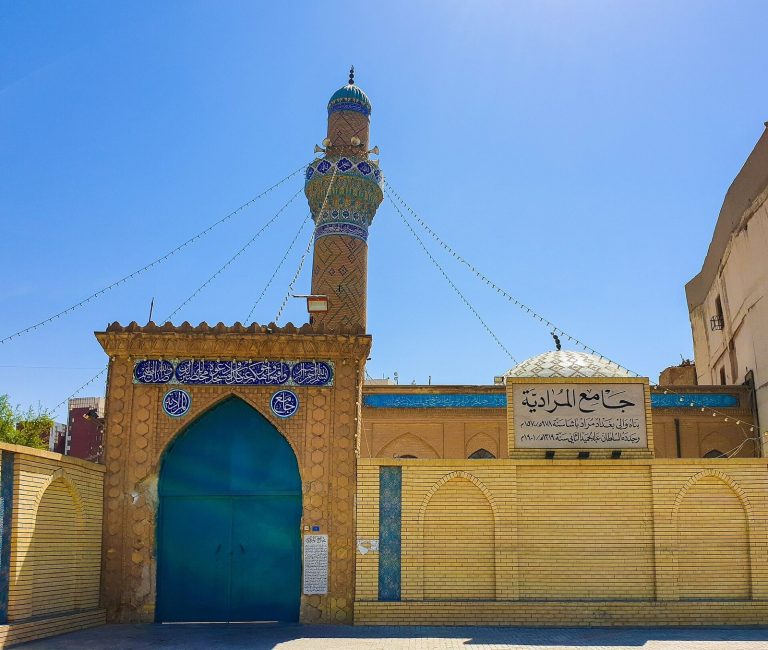
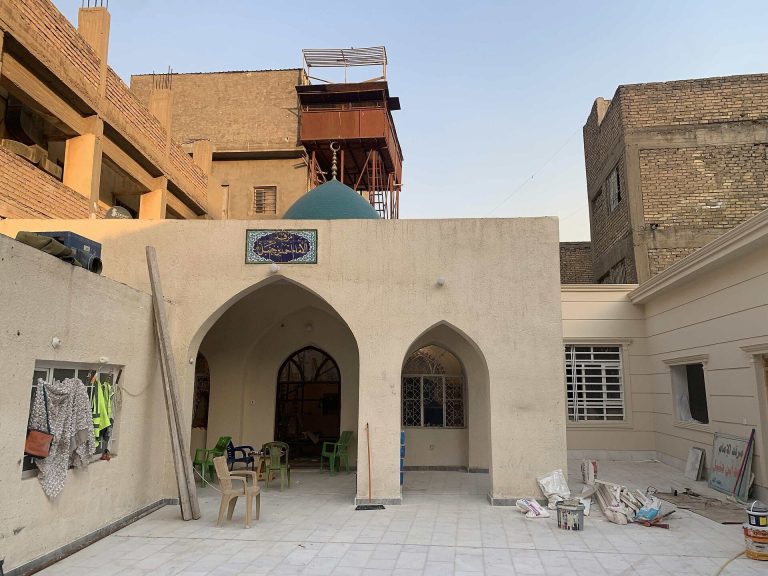
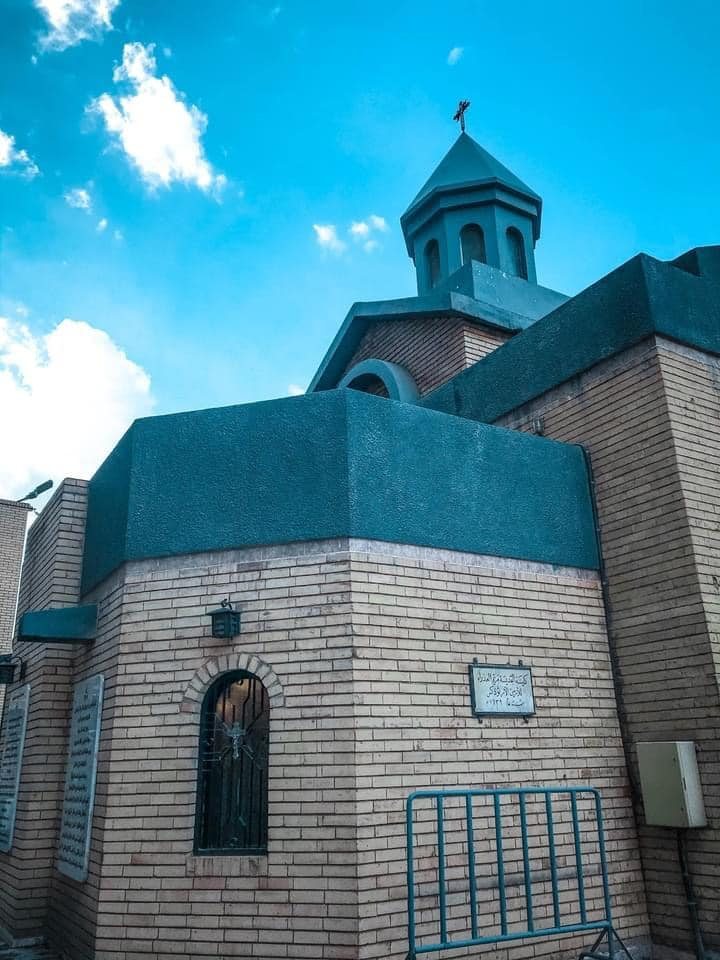
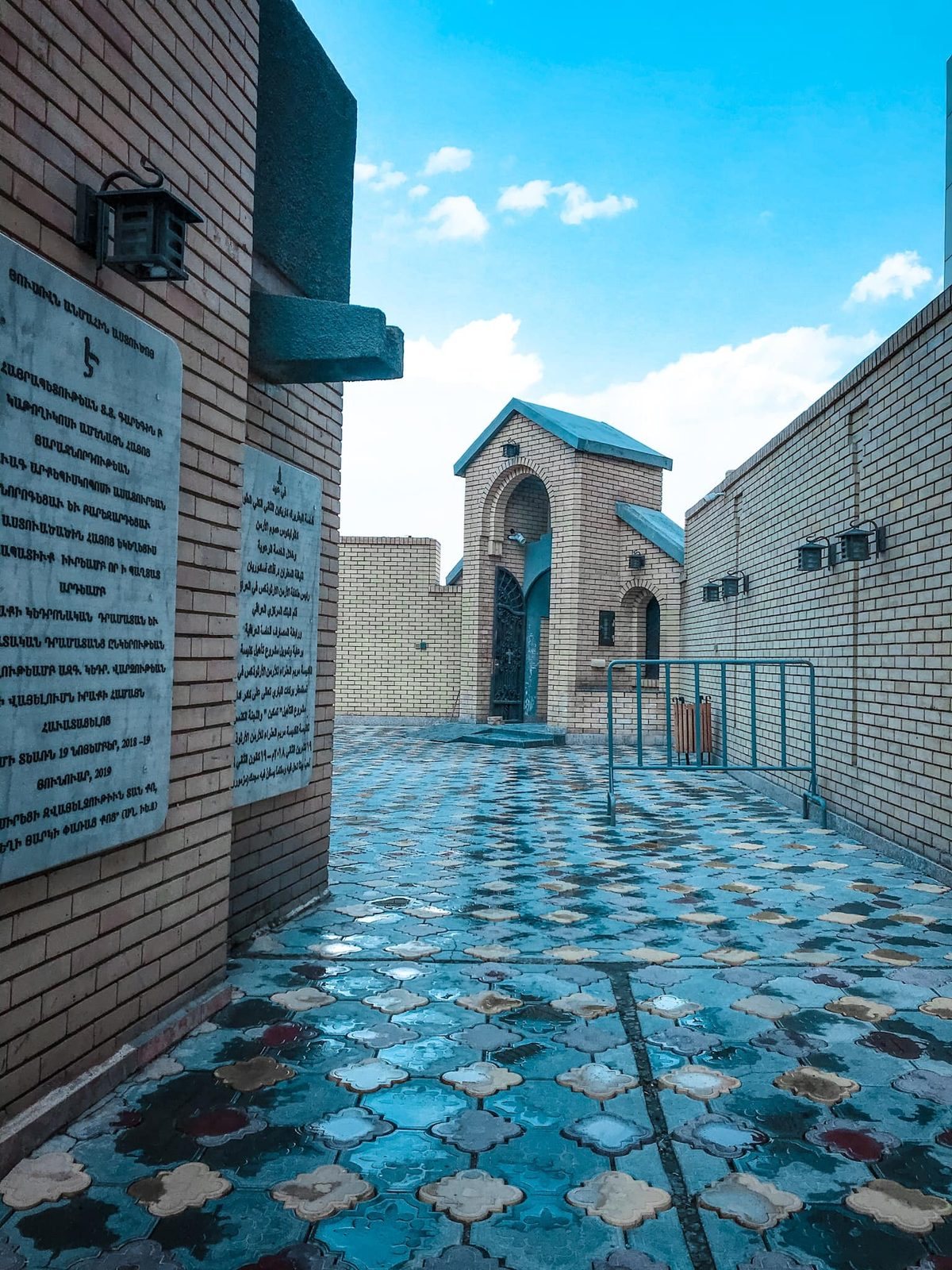
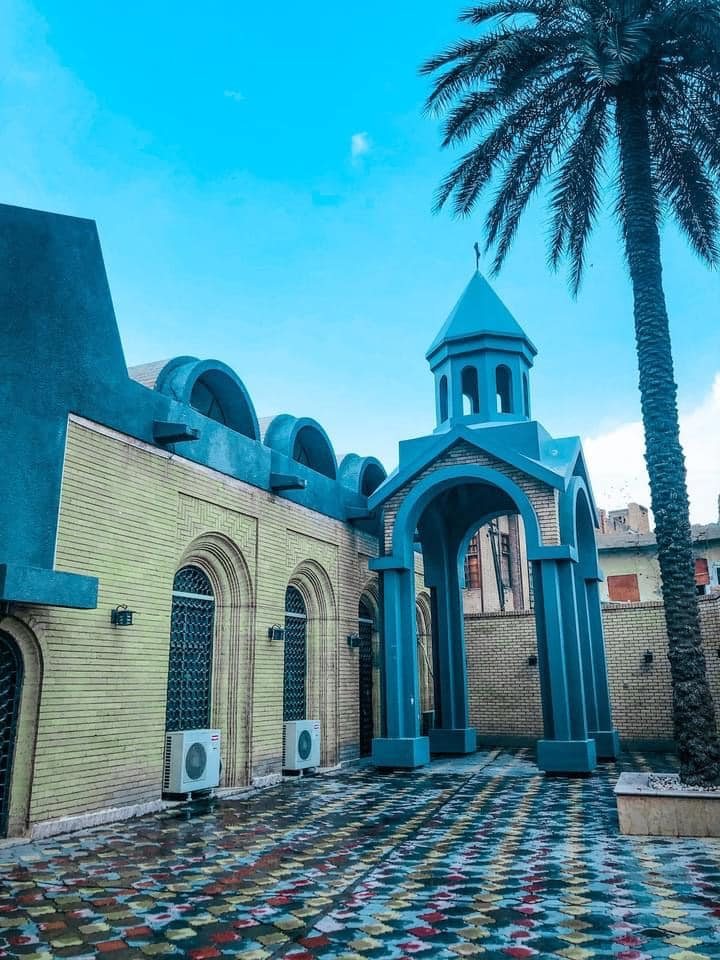
The religious complex is enclosed by a defensive wall, with the church and associated buildings arranged around an inner courtyard. Brick and concrete were used when the church was rebuilt. The Armenian community has added buildings to accommodate growing numbers of visitors and enlarged and decorated the courtyard.
Entrance and courtyards
An entrance vestibule displays an image of an Armenian-style metal cross and leads to the larger inner courtyard. A smaller courtyard extends along the church’s north facade. At its far end stands a bell tower with an octagonal roof carried on a drum, a raised circular support. The church and other buildings stand around the inner courtyard.
Roof and sanctuary exterior
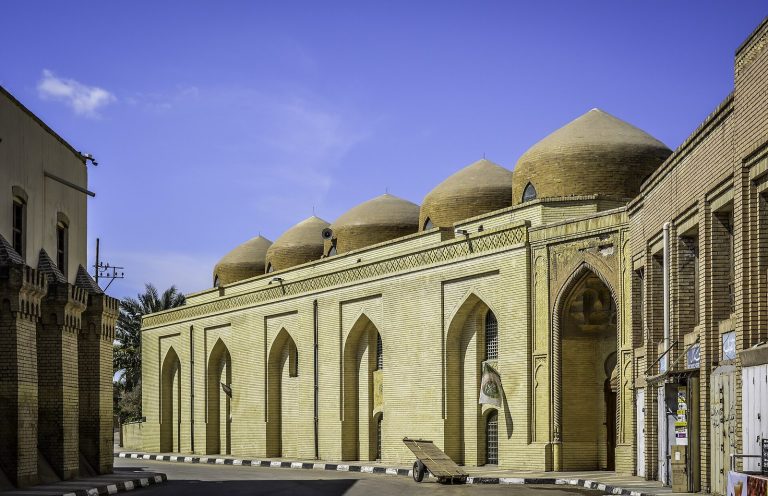
Four broad barrel vaults, tunnel-shaped ceilings, span the church, each ending in a semicircular window. Above the sanctuary, an octagonal drum supports a dome. Behind the dome, a projecting apse, a recess at the end of a church, contains a baptistery, a place for baptism, and a book.
Church interior
Narthex
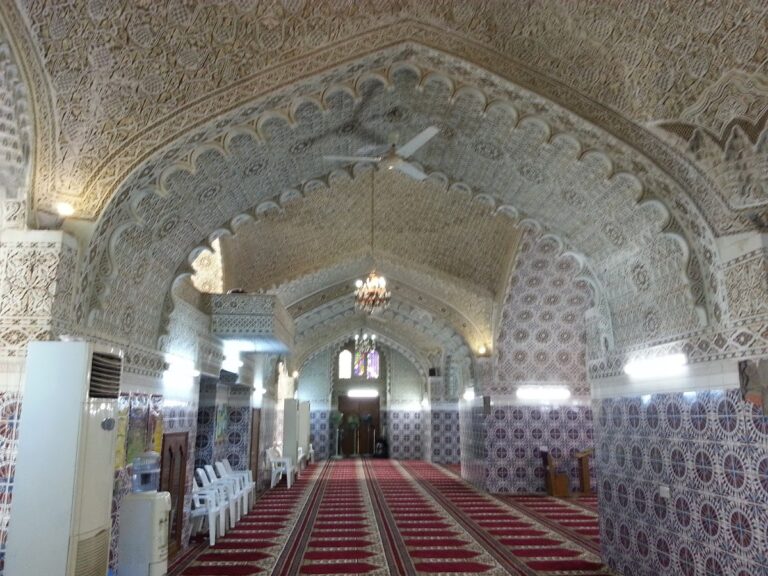
A narthex, or church entrance area, precedes the building and is topped by a polygonal dome on a drum. Its drum has a blind arcade, a decorative row of arches, and the space includes an area for lighting votive candles, devotional offerings. The narthex opens into the rear of the nave, the church’s main area for the congregation, where clergy and deacons sing the liturgy beneath the pulpit.
Nave and inscribed stones
Niches line the nave’s side walls and contain embedded stone slabs carved with crosses or Armenian inscriptions. One slab is dated to 1750.
Sanctuary
An iron choir screen, a barrier separating the nave from the sanctuary, divides the church’s main congregational space from the sacred area around the altar. The lower part of the sanctuary is accessible to worshippers for communion, the rite of sharing consecrated bread and wine. A red velvet curtain bearing a cross conceals the higher part, reserved for priests, deacons, and ministers. The altar stands on the raised platform.
Reliquary
The church’s relics are kept in an octagonal reliquary, a container for sacred relics, set in a marble niche behind a finely worked gold grille. Armenian inscriptions appear on the reliquary.