Calden Stone Cist: A Neolithic Gallery Grave in Germany
Site at a Glance
- Popularity
- Very Low
- Country
- Germany
- Primary era
- Stone Age
- Eras represented
- Stone Age
- Civilizations
- Unclassified
- Site type
- Burial
- Remains
- Tomb
On this page12 sections
History
The Calden Stone Cist, also known as Gallery Grave Calden I, was a communal burial monument near Calden in Hesse, Germany, used by people of the Wartberg culture from about 3400 BCE. It was a megalithic gallery grave, an elongated stone chamber for collective burial, built during the Neolithic, the later Stone Age associated with farming and settled communities. The Wartberg culture was a late Neolithic archaeological tradition of central Germany. The grave lay between concentrations of this culture around Fritzlar in northern Hesse and Warburg in eastern Westphalia.
Wartberg-culture use and later disturbance
Radiocarbon dates from human bones place the earliest burials in the 34th century BCE. Use probably began by about 3400 BCE and had ended by around 3200 BCE. This proposed end date takes account of pottery chronology at the nearby earthwork and at Calden II. The grave was disturbed during the Roman imperial period, when Rome was ruled by emperors, and again in the Middle Ages.
Recognition and investigation
The grave’s damaged condition and pottery initially regarded as unusual kept it outside scholarly discussion. A teacher’s report of a possible find near the springhead of the Calde led to a test trench, which uncovered a Roman-period settlement. In 1947, a plough apparently struck a large boulder. After the stone was recovered, Otto Uenze investigated the location in 1948. Human skulls and other bones prompted further excavation by the Office of Antiquities in Marburg. New excavations began in 1988 as part of the Calden Project.
Remains
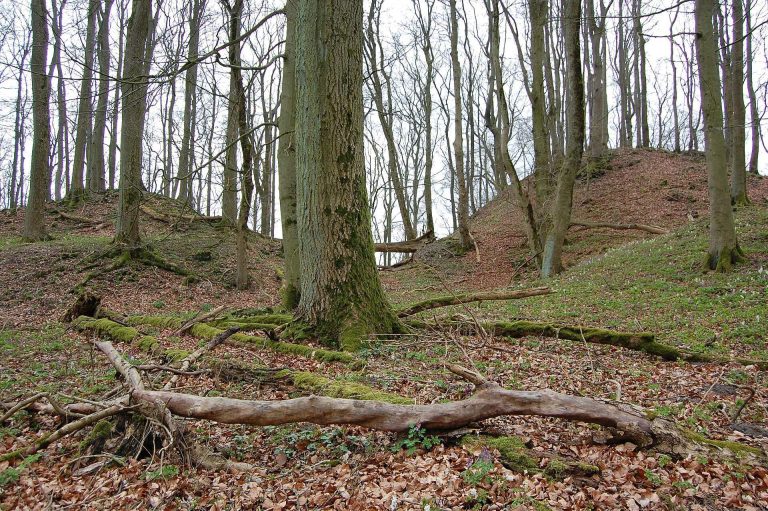
The grave lay in a small valley south of Calden, close to two springs. Set partly into the ground, it had a southeast-facing entrance and an elongated chamber with a small antechamber. Its surviving stones and foundation traces provide evidence for the layout and construction.
The burial chamber
Plan and construction
Measurements based on traces of the walls give an overall length of about 12 metres and a width of roughly 2 metres, including the antechamber; a more detailed reconstruction gives dimensions of 12.6 by 3 metres. The chamber’s clear internal height is estimated at 1 to 1.5 metres. About 20 wall stones of quartzite and roughly 10 capstones formed the structure. Gaps between the walls were packed with limestone laid without mortar, and the floor was tamped into a compact, clay-like surface.
At one end, a closing stone was set about 1.2 metres behind projecting ends of the side walls. This arrangement resembles the Züschen type of gallery grave and has been interpreted as an entrance through a small opening, sometimes called a soul hole. Two wall stones remained in their original positions, and two others had fallen into the chamber. Foundation trenches and surviving stones helped establish the plan. Calden I is similar in overall dimensions to Calden II, about one kilometre away, although their lengths differ. Comparison with graves of varying sizes in the Warburg necropolis has been taken to indicate a consistent building tradition.
Burial and human remains
Parts of the burial deposit survived disturbance. The excavator’s estimates ranged from 40 to 80 burials, with Otto Uenze recording counts of 40 in 1951 and 80 in 1956. Because excavation was brief and the grave badly disturbed, the original total was cautiously estimated at 100 to 200. At least 40 skulls were recovered, and in the 1960s anthropologist Alfred Czarnetzki examined remains representing at least 30 people.
The bones lay both scattered and in anatomical groups. Some remained connected closely enough to help reconstruct burial positions. The dead appear to have been placed in several crosswise rows, with their heads toward the entrance, and stacked in as many as four layers. Skulls were often separated from bodies and arranged along the walls. Similar arrangements have been identified at Altendorf, Calden II, and Wewelsburg I.
Of 26 skulls classified in more detail, two belonged to children aged 7 to 14, 19 to adults aged 20 to 40, and five to adults aged 40 to 60. Other bones indicated four adolescents aged 15 to 20. The estimated average age at death was about 30. Estimated heights were 1.62 to 1.65 metres for men and 1.50 to 1.59 metres for women. Teeth were heavily worn; about one in nine showed decay, and root disease and hardened dental deposits were also identified.
Pottery
Pottery came from disturbed ground at the entrance. Comparison with Calden II suggests that Wartberg-culture vessels were placed outside the chamber. A small funnel-shaped beaker with projections inside it was reconstructed from its pieces. Comparable vessels occur in northwestern German pottery decorated with deep grooves and in the Baalberge culture, another Neolithic archaeological culture associated with central Germany. Most other fragments came from vessels with flaring rims, some marked by a fine row of punctures beside the edge. A fragment with an arcade-shaped rim may also belong to the grave, though its connection is uncertain.
Other grave goods
Perforated animal teeth came from brown bear, dog, cattle, red deer, pig, and, more rarely, wildcat. Other animal remains included halves of lower jaws, including fox and, in one case, roe deer. The finds also included flint blades and numerous arrowheads made from flint and silica-rich slate, an axe-shaped perforated amber bead, and a fragment of hematite, an iron-rich mineral. Green staining on the chamber floor suggests that copper objects may also have been buried there. The finds are held at the Hessian State Museum in Kassel.
Capstones and a possible menhir
Surviving capstones
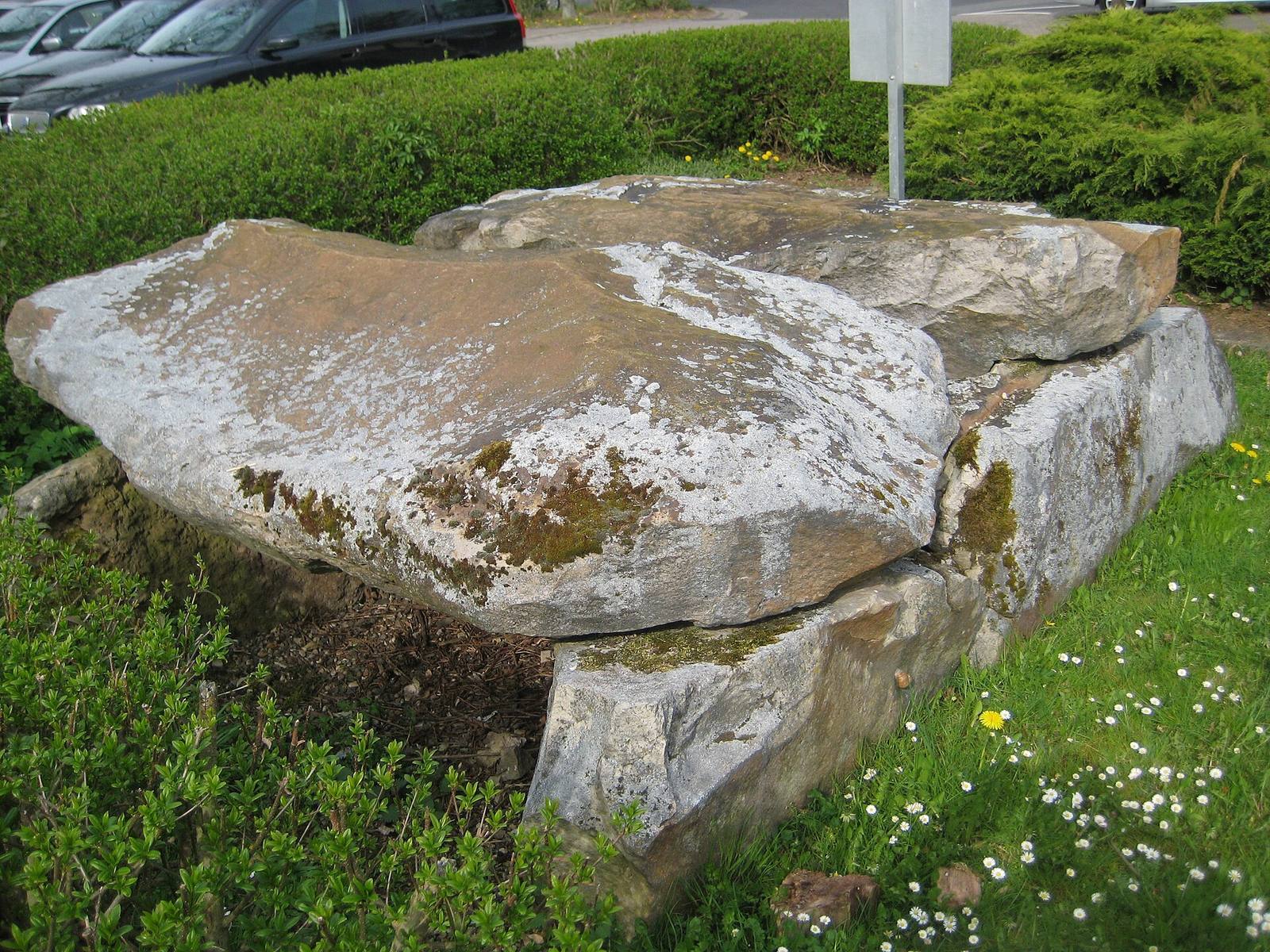
Two capstones were found in disturbed ground in front of the entrance. They may have survived because they were buried more deeply, probably in the third century CE, to keep them from obstructing cultivation. Two surviving capstones were set upright opposite Calden comprehensive school, while reconstructed capstones were placed at the town’s southern edge.
A possible standing stone
A large stone apparently removed from a point 34 metres northeast of the grave measured about 4 metres long and 0.6 metres across in each other dimension. A hollow marking its extraction point was visible in the field in 1948. The stone may have been a menhir, a large prehistoric standing stone. Comparable finds occur at the broadly contemporary gallery graves of Großenrode I and II, Odagsen, Muschenheim, and Gudensberg. A possible connection between the stone, the grave, and the nearby springs has led to the interpretation that they may have formed a small religious precinct.