Grebenstein Castle: A Hessian Hilltop Stronghold in Germany


Site at a Glance
- Rating
- 4.5
- Popularity
- Low
- Country
- Germany
- Primary era
- Medieval
- Eras represented
- Medieval
- Civilizations
- Holy Roman Empire
- Site type
- Military
- Remains
- Castle
On this page8 sections
History
Grebenstein Castle is a medieval hilltop castle in Germany, located at Grebenstein on the Burgberg above the town. It originated probably in the second half of the eleventh century as a relatively minor fortification. From 1266 or shortly afterward, Count Ludolf V of Dassel enlarged it to protect his surrounding possessions. The castle became involved in territorial disputes and later formed part of the Hessian frontier system in the Diemel region.
Origins and territorial disputes
The castle first appears in written evidence in 1272, during disputes between the Bishopric of Paderborn and Landgrave Heinrich I of Hesse. The arguments concerned the borders of Schartenberg and Grebenstein castles and jurisdiction at Hainbuche.
Grebenstein Castle and the town were both Mainz fiefs. Through marriage, they probably passed around 1279 to Ludolf’s son-in-law, Otto of Everstein. In the same year, Paderborn bishop-elect Otto of Rietberg promised Mainz Archbishop Werner that Grebenstein Castle would be demolished as part of an agreement concerning the former Dassel fiefs of Schartenberg and Grebenstein. The planned demolition did not take place, and Landgrave Heinrich of Hesse apparently controlled at least part of Grebenstein by 1282.
Hessian control and princely residence
Otto of Everstein entered Heinrich’s service as a Burgmann in 1293. A Burgmann was a castle-dependent nobleman whose duties and rights were linked to a particular fortress. Otto promised to open all his castles to Heinrich, including any he might acquire later. Hessian castle men Tammo of Alnhausen, Willekin Hase, and Johann Riedesel then held Grebenstein in trust. On 28 August 1297, Otto sold the castle and town, together with the court and associated rights, to Landgrave Heinrich I and was released from his service.
Grebenstein remained staffed by Hessian officials until 1529. As a Hessian outpost opposite the Mainz-held town of Hofgeismar, it initially occupied an important position in the Diemel region. In military terms, however, the fortified town of Grebenstein and its landwehr, a defensive boundary system, were more valuable than the castle, which was less suited to warfare.
After Landgrave Heinrich II came to power in 1328, he granted the castle and its associated lands as a parage to his brother Ludwig the Younger. A parage was a grant of lands or revenues to a member of a ruling family. Ludwig’s son Hermann II, who later became Landgrave of Hesse, was born at Grebenstein Castle in 1341. From 1349 to 1368, the castle was held by another brother of Heinrich II, Hermann I the Elder, who died in 1368 or 1370.
Siege, decline, and destruction
During a renewed feud with the Hessian landgraves, forces belonging to Mainz Archbishop Adolf I besieged Grebenstein Castle in 1385. The attack failed. A Mainz interim administration under Konrad of Spiegel zum Desenberg is recorded from 1385 to 1399.
The Mainz Diocesan Feud of 1461 to 1463 was a fifteenth-century conflict involving the Archbishopric of Mainz. After the war, Mainz possessions between the Weser and Diemel were pledged to Landgrave Ludwig because of war debts and later became permanently Hessian. Grebenstein Castle consequently lost its strategic importance. By 1471, probably only a scribe still lived there. From about 1540, the castle was probably uninhabited and served instead as a grain store.
In 1631, during the Thirty Years’ War, the castle and town were destroyed. The Thirty Years’ War was a major European conflict that devastated many territories between 1618 and 1648. Residents of Grebenstein then quarried the ruins for rebuilding material, while the remaining structures decayed. Structural securing took place only toward the end of the twentieth century.
Hessian administration
The castle’s long administrative role is reflected in the succession of Hessian Amtmänner, appointed officials responsible for governing a district or lordly estate. They included Ludwig of Grebenstein in 1336; Johann of Schachten in 1339; Hermann of Uffeln around 1350; Willekin Hase the Elder in 1355; Friedrich II of Hertingshausen and Ditmar of Hanstein in 1375; Dietrich of Schachten, probably, in 1383; Friedrich III of Hertingshausen in 1414; Johann of Wolmeringhausen, called “the Bold,” in 1417; Eckebrecht of Schachten in 1421, 1426, and 1436; Heinrich Hase in 1426; Werner of Uffeln in 1428; Eckebrecht of Schachten from 1455 until before 1466; Werner of Elben from 1472 to 1482; Dietrich of Schachten in 1485 to 1487 and 1496 to 1498; Friedrich Trott the Younger in 1493 to 1494; Eberhard Hake in 1498; Dietrich of Schachten the Younger from 1499 to 1514; Jorg of Schachten in 1528 and 1530; and Heiderich of Kalenberg in 1529.
Remains
Grebenstein Castle occupies the 249-metre-high Burgberg, a basalt cone at the southern edge of Grebenstein. The hill rises about 56 metres above the town and is partly encircled by the Esse, a tributary of the Diemel. The surviving complex is centered on the large residential building, while the moat and outer bailey are preserved mainly as outlined elements of the former defensive layout.
Residential building
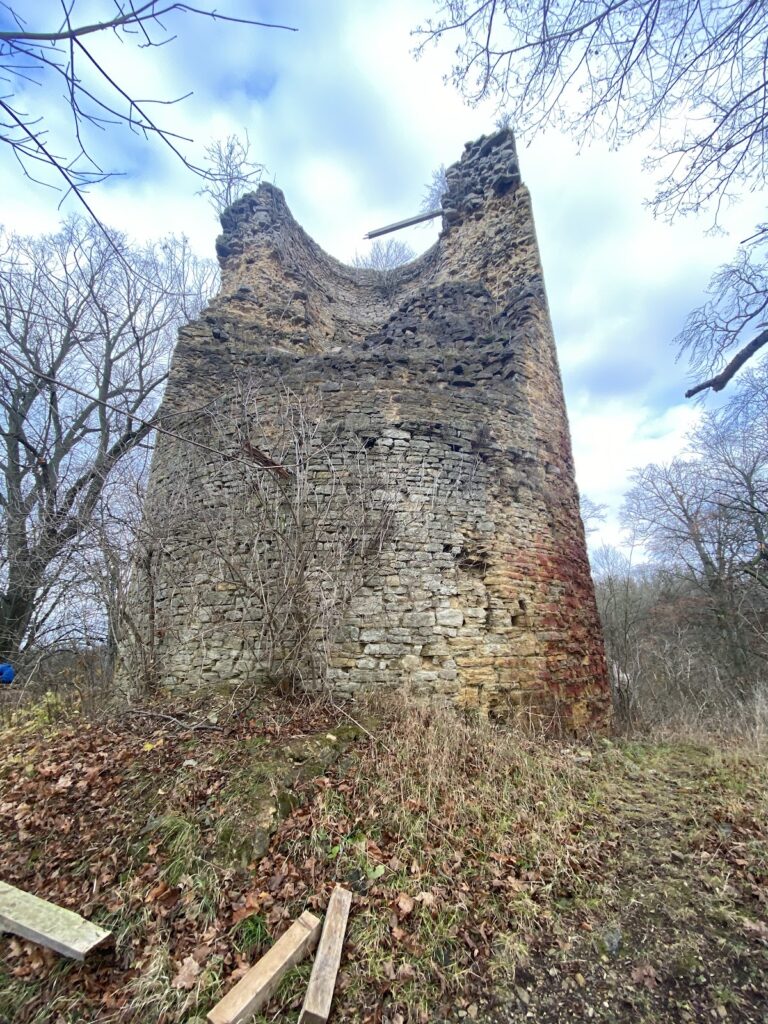
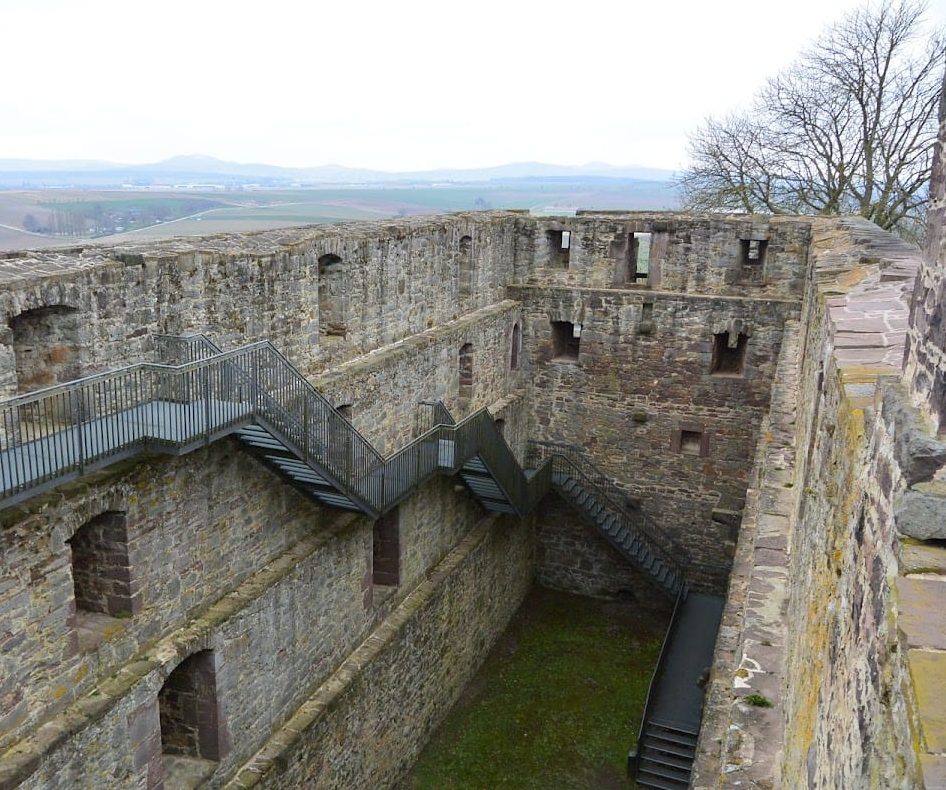
The principal surviving structure is the palas, the main residential and representational building of a medieval castle. It measures about 37 metres in length and 12 metres in width. Its exterior walls are almost completely preserved and rise more than 13 metres. The building had a basement and three upper storeys, with the first-floor wall reaching nearly 3 metres in thickness.
Surviving details include remains of oriels and fireplaces. The basement contained a kitchen, while the former women’s chamber, or Kemenate, occupied part of the residential complex. A Kemenate was a heated living chamber traditionally associated with women’s quarters. A steel stairway now reaches a viewing platform on the upper masonry of the ruin, from which the historic town and parts of the Habichtswald and Reinhardswald can be seen.
Moat, outer bailey, and surroundings
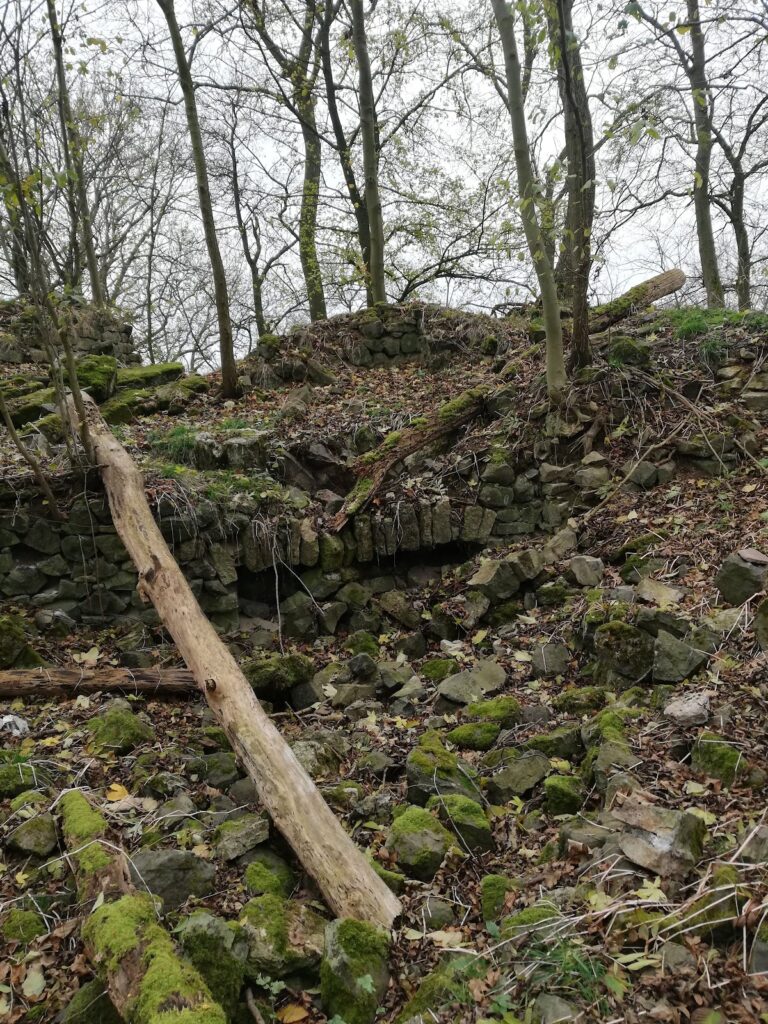
A partly preserved moat continues to surround the castle complex. The outer bailey and moat retain the outline of the former arrangement, although their original dimensions are uncertain. Below the castle lies a small Jewish cemetery, forming part of the immediate historical landscape of the ruin.
Nearby sites