Överselö Church: A Medieval Gothic Hall Church in Sweden
Site at a Glance
- Popularity
- Low
- Country
- Sweden
- Primary era
- Medieval
- Eras represented
- Medieval, Early Modern, Modern
- Civilizations
- Swedish
- Site type
- Religious
- Remains
- Church
On this page22 sections
History
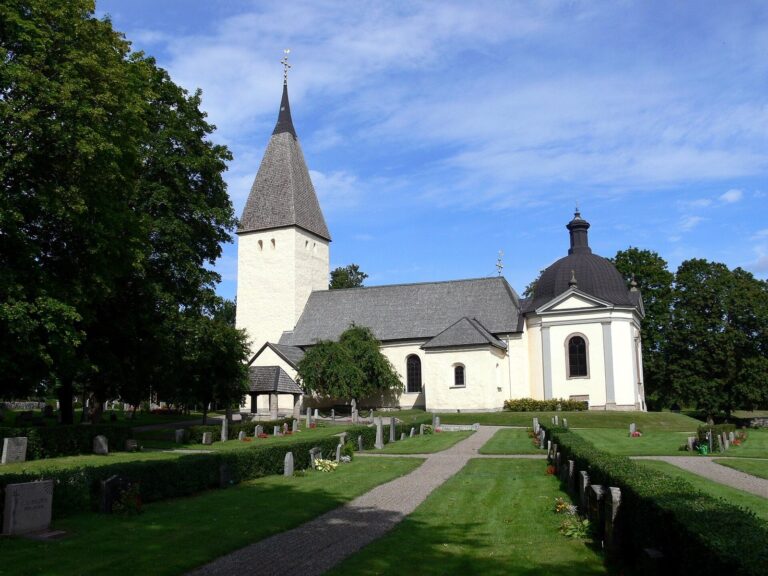
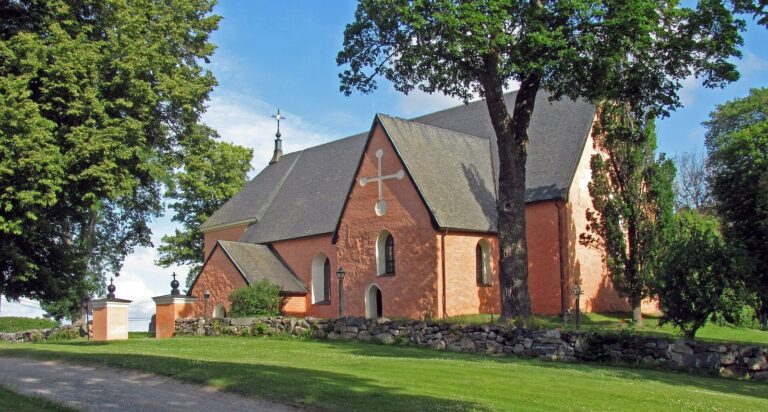
Överselö Church stands in Stallarholmen on the northwestern part of Selaön in Södermanland, Sweden. Built of stone around 1200 and consecrated in the thirteenth century, it is a Gothic hall church, a medieval design with a broad, unified worship space. It belongs to the Church of Sweden’s Strängnäs Diocese and Stallarholmen Parish.
Medieval origins and enlargement
The stone church may have replaced an earlier wooden church on the same site. Runestones elsewhere on Selaön point to an early community on the island. In the 1380s, the church was extended eastward and probably gained a sacristy, a room used to prepare for services and store religious objects. Brick vaults were also built during this phase. A chapel was added on the south side in the 1470s.
Fire and early modern use
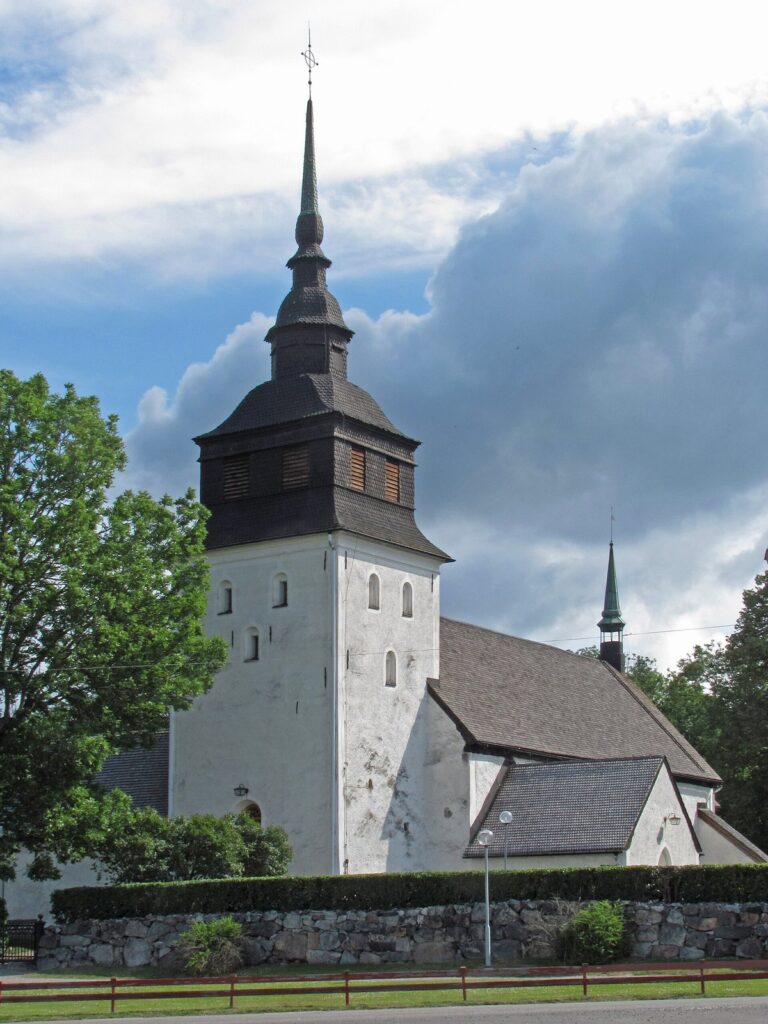
A fire in 1641 badly weakened the church tower, making a separate bell frame necessary. Martin, a master builder from Gripsholm, built a replacement frame in 1688. It was painted red and tarred in 1691. After repairs strengthened the tower, the frame was removed in 1745, and its weather vane was placed on the south transept.
The churching ceremony, which marked a woman’s return to church after childbirth, involved offerings at an altar near the Skäggesta women’s pew. A shrine of John the Baptist stood at that location until 1728.
Nineteenth- and twentieth-century changes
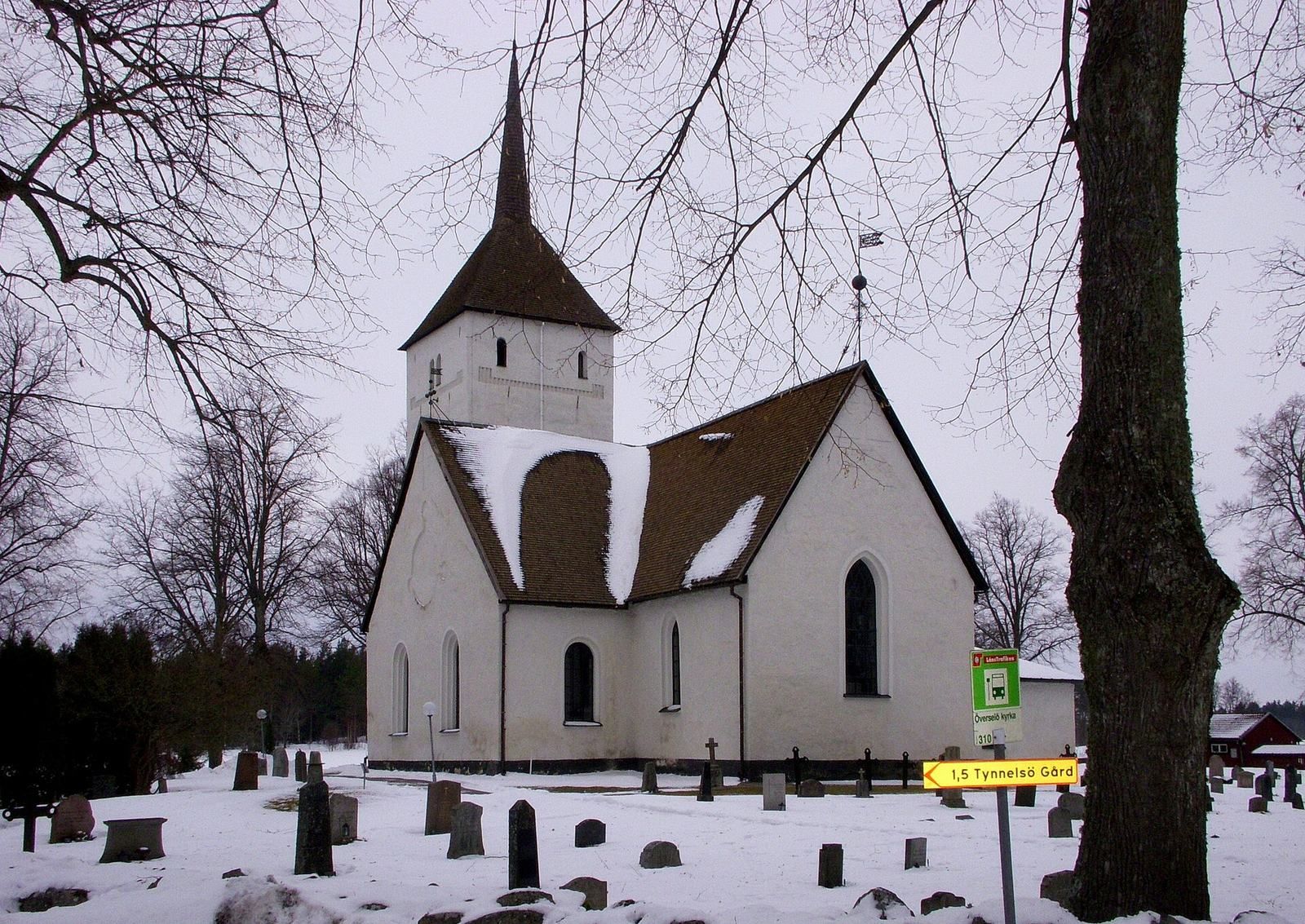
A north aisle was built in 1881–82, giving the church a cruciform plan. The first pipe organ, made for the church in 1754, underwent repairs in 1839, 1882 and 1891, and was altered in 1852. In 1952, Olof Hammarberg’s workshop restored it, removed the additions made in 1852 and moved the older instrument into the north aisle. Hammarberg also built a larger organ in 1952–53.
Remains
The stone church has a broad central worship space, a tower, a sacristy, a south-side chapel and a north aisle. The chapel and aisle form the crosswise arms of its cruciform plan. Brick vaults span the interior, while the surviving furnishings and artworks include medieval sculpture, painted decoration and objects given to the church over several centuries.
Architecture and painted surfaces
Tower and masonry
Openings in the stone tower are framed by slender limestone columns. These date to about 1240–50 and have capitals, or carved column tops, decorated with leaves. The sacristy, south chapel and north aisle form distinct parts of the church’s overall plan.
Vaults and wall paintings
The four nave vaults carry paintings from the mid-fifteenth century. They depict biblical scenes, apostles, Nordic saints and symbols of the four Evangelists. The painters came from Mälardalen, the region around Lake Mälaren in east-central Sweden. In the chancel vault, the Father presents the sacrificed Son in an image of the Trinity. Paintings in the tower room and south chapel date to the later seventeenth century.
In 1973, a paste made from flour, water, copper sulfate and washing soda was used to remove centuries of soot and grime, including from the vaults. Work on the wall paintings in 2011 included cleaning, strengthening the painted surfaces and securing loose plaster; a restoration lasting two years was completed in 2013.
Altars, sculpture and devotional images
Font and altarpiece
A stone baptismal font dates to the thirteenth century and was probably made around the time of the church. The late-fifteenth-century altarpiece, probably produced in northern Germany, centers on the Coronation of Mary. Its doors show the twelve apostles.
Madonnas, crucifix and saint shrines
Two oak images of Mary are kept in the church. The seated figure from the early 1320s, known as the Överselö Madonna, is attributed to a Gotland woodcarver conventionally called the Bunge Master, an art-historical name for an otherwise unidentified medieval artist. A second image, from the late fifteenth century, is thought to be Swedish work.
A triumphal crucifix, a large cross traditionally placed above the chancel arch, dates to about 1510 and probably came from Lübeck. Two saint shrines, enclosures for devotional images, are also associated with the church. One, probably Swedish and made around 1450, contains Saint Erik and Saint Olaf. The other, probably Swedish and dating to about 1500, contains John the Baptist; it stood by the women’s pew until 1728.
A painting of the Last Supper, donated in 1822 by Filip Bernhard Hebbe of Tynnelsö, hung behind the altar until 1881.
Furnishings and sound
Pulpit
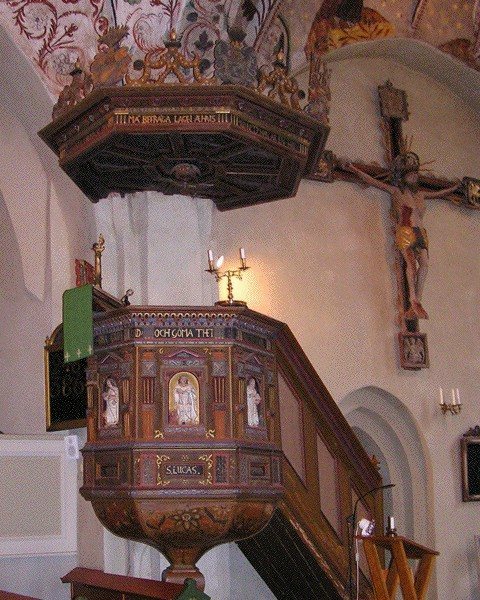
The pulpit bears the arms of the Slatte, Skytte and Kagg families, associated with Lieutenant Colonel Erik Slatte and his wives, Marta Kagg and Sofia Beata Skytte af Duderhof. Its painted date, 1667, may refer to its decoration; the pulpit itself is thought to have been made in the 1640s. On stylistic grounds, it has been attributed to Mikael Rechner, a carpenter at Strängnäs Cathedral.
Organs
The older mechanical organ was made by Jonas Gren and Petter Stråhle of Stockholm. It was originally equipped with one manual, or keyboard, nine stops that control ranks of pipes, an attached pedalboard and two wedge bellows. After its restoration, it had seven stops and a reservoir bellows, and the pipes in its façade Principal rank were made to sound again. It is among the oldest organs still in use in the Strängnäs Diocese. Behind its case stands Hammarberg’s second, larger organ, with 17 stops, tubular-pneumatic action that transmits control through air-filled tubes, round-bellows windchests that supply air to the pipes, and two preset selections of stops.
Bells
The large bell was cast in Stockholm in 1647 by Gerhard Meijer. It carries the initials H E S and A T S, together with the arms of the Soop and Natt och Dag families. A T S refers to Axel Turesson of the Natt och Dag family. The person represented by the Soop arms is uncertain, although Karin Larsdotter Soop held Algö manor at the time.
The smaller bell was recast in 1940 in a form resembling its predecessor. That earlier bell was cast in Stockholm in 1638 by Jurgen Putensen and bears an inscription naming Johan Tavast, Hinrich Piper, Casper Croen and Kexholm. It was apparently first made for the church at Kexholm, completed in 1638, before reaching Överselö for an unknown reason.
Chandeliers
A medieval wrought-iron chandelier survives in the church. The nave’s eight-arm brass chandelier was given in 1700 under Gustaf Oljeqvist’s will. Nearer the east end, a sixteen-arm chandelier bears the initials N S and K S and the Slatte and Soop arms. It appears to be a later-seventeenth-century work, probably given by Erik Slatte in memory of his parents, Nils Slatte, who died in 1638, and Karin Soop, who died in 1658. Another sixteen-arm chandelier was bought in 1665; the vicar Erik Grubb paid for its chain.
Two six-arm chandeliers in the south transept were given by the heirs of Captain von Andersson after his death in 1797. They were already older objects: one probably dates to about 1640 and the other to around 1700. A twentieth-century chandelier hangs in the north transept.
Vessels, textiles and ceremonial objects
Vessels and altar textiles
A chalice given in 1668 by Baltasar Marschalk and his wife was made by the Stockholm goldsmith Henrik Möller. One of the church’s two wine jugs dates to 1635 and bears the Hund arms and the initials O D D H. It was donated by Orania Danielsdotter Hund. The communion-wafer box, made by Stockholm goldsmith Jacob Garnier, carries the initials G O Q and the Oljeqvist arms. Gustaf Oljeqvist gave it to the church in 1671.
A red-flowered gold-cloth altar hanging was donated in 1678 by Baltasar Marschalck and Elisabet Gyllenhielm. They also gave a red-velvet chasuble, a priest’s vestment worn during the Eucharist, which was later transferred to the Strängnäs Church Museum. Another black-velvet chasuble, embroidered with gold, silver and silk, shows the crucified Jesus and the Slatte arms. It was probably donated by Erik Slatte and was also transferred to the museum. The church retains a separate black-velvet chasuble dated 1782, given by Captain Alexander von Andersson. Christina Lovisa Humbla donated a white silk altar cloth embroidered with silk and gold in 1766.
Bridal furnishings
C. Gerdes donated a bridal crown in 1733. In 1739, the church’s bridal outfit was noted as having been used 36 times and needing repair. Later purchases included an imitation wreath and three ornaments in 1742; a necklace in 1744 with 21 garnets, 12 set in sepiolite and nine arranged in rows with white pearls between them; a stiff petticoat in 1747; and a new bridal skirt in 1749.
Memorials and inscriptions
Epitaphs, funeral arms and gravestones
A small epitaph in the north tower commemorates Jöns Ols son and Las Jöns son and bears the date 1590. In the sacristy, another commemorates Holgierd Andersson, who died on 14 May 1598; a later epitaph there remembers Andreas Kjulin, who died in 1688.
Erik Slatte’s arms are displayed on the south chancel wall, to the right of the window. Sixteen shields showing his ancestry, carried in his funeral procession, are now displayed in different parts of the church. Olof Nordenstråle’s funeral arms are also present. The floor laid in the late eighteenth century incorporates numerous gravestones taken from the churchyard and other parts of the church.
Runestones
Five runestones are recorded at the church, catalogued as Södermanland Runic Inscriptions 204, 205, 206, 207 and 208.