Kleinenknetener Steine: Neolithic Megalithic Tombs in Germany
Site at a Glance
- Popularity
- Medium
- Country
- Germany
- Primary era
- Stone Age
- Eras represented
- Stone Age
- Civilizations
- Unclassified
- Site type
- Burial
- Remains
- Necropolis
On this page10 sections
History
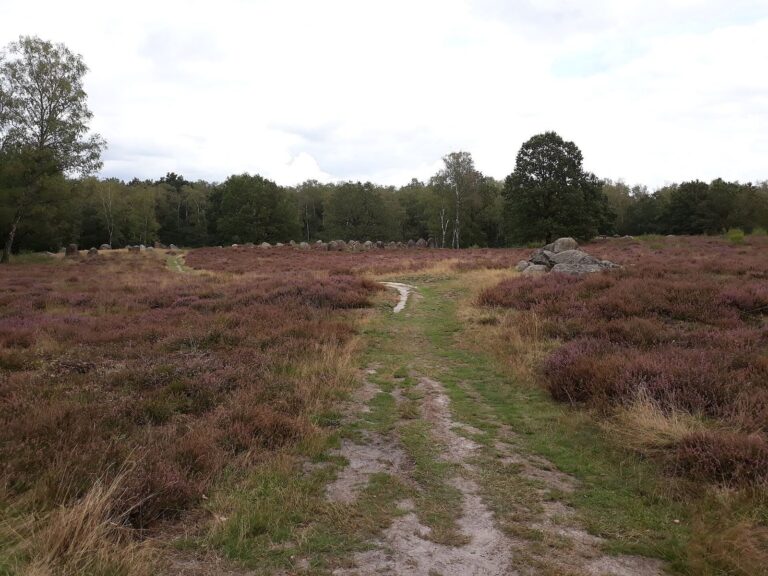
The Kleinenknetener Steine are a group of Neolithic megalithic tombs near Kleinenkneten in Wildeshausen, Germany. They date to about 3500 to 2800 BCE and are attributed to the Funnel Beaker culture, a Neolithic culture named for its distinctive funnel-shaped pottery. The tombs lie in the Wildeshauser Geest, about 3.5 km south of Wildeshausen’s town center. Around 36 comparable monuments are found in the nature park and nearby area.
Prehistoric use and rebuilding
Two tombs, Hünenbett I and Hünenbett II, remain in their original locations. Hünenbett is the German archaeological term for a megalithic tomb set within a long mound bordered by stones. A third tomb, known as Grave 3, was brought from Dötlingen in 1930.
Hünenbett I’s chamber was cleared more than once in prehistory and later used for burials. Hünenbett II appears to have been altered through prehistoric rebuilding. One proposed sequence places its second chamber between the first and third, with the second chamber added last. Builders may have opened earlier enclosures and reused their stones either in its construction or to close the enclosure. A local shortage of suitable building stone is considered a likely reason for this reuse. It may also help explain the second chamber’s small size and uneven stone dimensions, as well as the trapezoidal shape of the complex thought to have been built last.
Investigation and later recognition
Hünenbett I and II were investigated in 1934 and 1935 under the direction of the Landesmuseum für Natur und Mensch in Oldenburg. The finds were analyzed and are held at the museum.
The site became part of the Megalithic Culture Route, which was officially inaugurated there on 14 May 2009. The route has 33 stations, and Grave 3 is designated station 25c.
Remains
The surviving layout centers on two tombs in their original positions, each set within a stone enclosure. Both are passage graves, megalithic tombs with a burial chamber reached by a distinct passage. Hünenbett I is a restored monument, while Hünenbett II has three chambers within a single irregular enclosure.
Hünenbett I
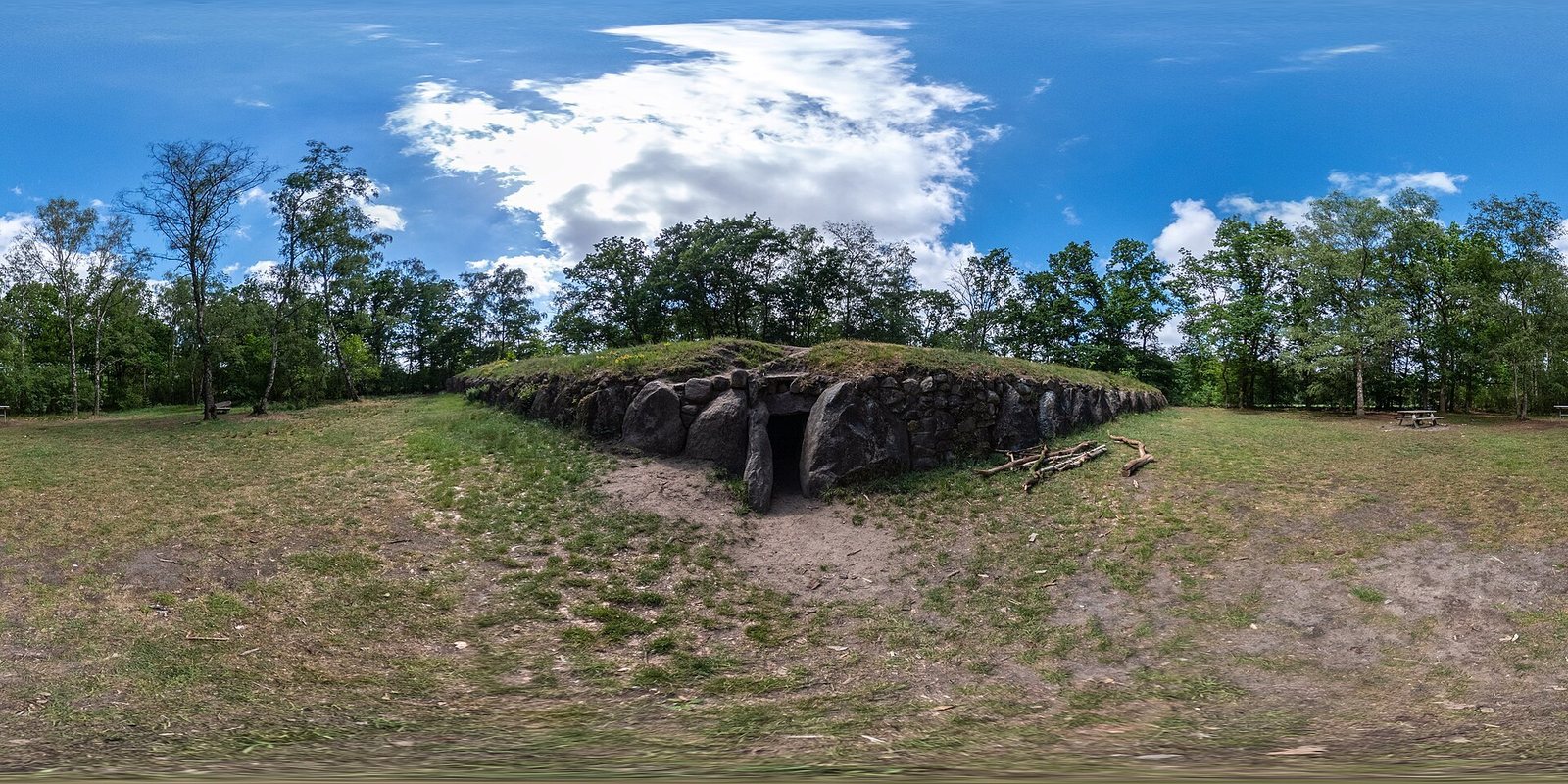
Hünenbett I runs approximately north to south. Its enclosure is about 50 m long and 7 m wide, and consists of 85 large boulders around a covering mound containing roughly 1,200 m³ of earth. Stones at the narrow ends rise to about 2 m and are the tallest in the enclosure. Together, the boulders weigh about 3,400 tonnes, with an average weight just under 4 tonnes each.
An entrance interrupts the middle of the enclosure’s eastern side. It is 1.2 m high and 0.6 m wide, and leads to a short, unpaved passage marked by a threshold stone. The trapezoidal chamber measures 6.8 m long, 2.4 m wide at its north end and 2.1 m at its south end. Its height is about 1.7 m at the north and 1.6 m at the south. Eleven upright stones frame the chamber, with one original capstone and two added capstones above them. Rounded stones pave the floor, in places in two layers. Restored infill follows a characteristic form, but the restoration represents a conjectured original appearance. At the chamber’s northwest side, an opening in the upper stone layer lets daylight inside.
Hünenbett II and its chambers
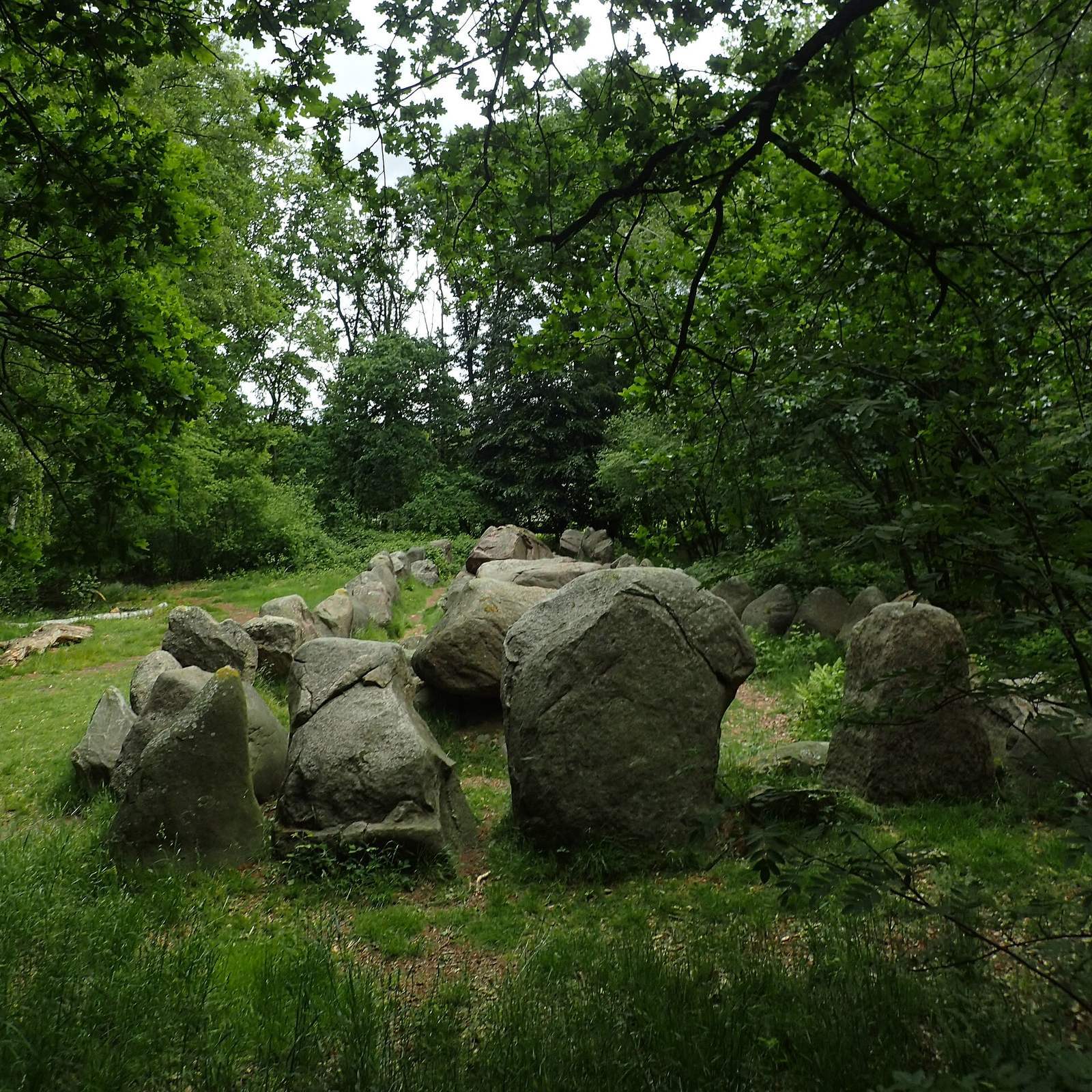
Hünenbett II combines three chambers inside one irregular enclosure, an arrangement found nowhere else in Lower Saxony and in only a few examples in Germany. The enclosure is about 35 m long and up to 8 m wide. It narrows to about 6 m at its middle.
Chamber 1
The first chamber is 7 m long, 2 m wide and 1.4 to 1.6 m high. Thirteen upright stones support the structure, and one capstone survives. A gap on the southeast side and two passage-support stones mark the entrance. The threshold stone and another stone that may have served as a closure were also found.
Chamber 2
The low second chamber is 5 m long and 1 to 1.5 m wide. It is formed from 13 support stones and has five relatively small capstones. Its passage is marked by a southeast gap, two pairs of support stones and a recovered threshold stone.
Chamber 3
The third chamber measures 8 m long, 1.8 m wide and 1.2 to 1.5 m high. Fourteen support stones frame it, and four capstones survive. Its passage lies on the southwest side, where a pair of support stones and the threshold stone remain.
Finds from the chambers
The four chambers of Hünenbett I and II yielded about 10,000 ceramic fragments, along with flint axes and arrowheads, amber objects and a copper object. Some fragments were reconstructed as funnel-shaped vessels known as Funnel Beakers, as well as collar bottles, which have a narrow neck and a flaring rim. Finds from Chamber 1 include a box-shaped vessel and two collar bottles.