Vansö Church: A Medieval Church on Fogdön, Sweden
Site at a Glance
- Country
- Sweden
- Primary era
- Medieval
- Eras represented
- Medieval, Early Modern, Modern
- Civilizations
- Swedish
- Site type
- Religious
- Remains
- Church
On this page20 sections
History
Medieval foundation and expansion
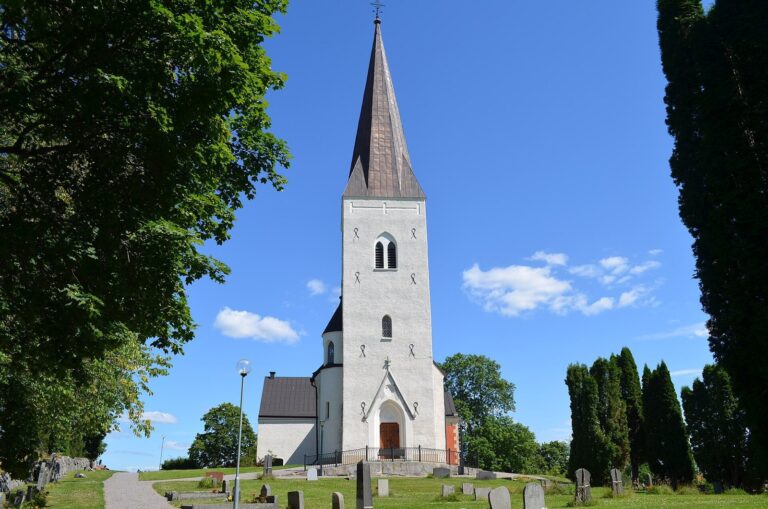
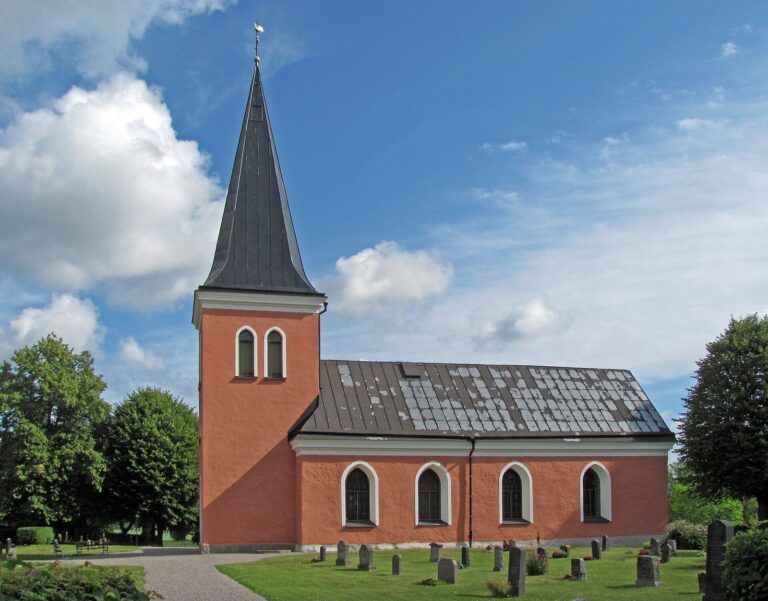
Vansö Church is a stone church on Fogdön in Sweden, about 12 kilometres northwest of Strängnäs. Consecrated in the twelfth century, it is affiliated with the Lutheran Church of Sweden, the Diocese of Strängnäs, a church district, and Vårfruberga-Härad Parish, a local church community. The oldest part of the building probably dates from the late twelfth century.
The church was extended eastward around 1300 and lengthened again around 1450. The later work included vaulted ceilings and a tower. Wall paintings inside date from around 1460.
Changes and gifts from the seventeenth century onward
Around 1680, cracking began in the eastern part of the church because the building stood on ground without solid bedrock. In 1682, builders strengthened the east and south walls with projecting supports called buttresses. The cemetery’s entrances and boundary also changed over time. Its earlier wall had a shingle roof and covered entrances, known as lychgates; a new gate was made on the east side in 1754. Workers from Dalarna built the present wall in 1776. A separate bell tower beside the cemetery’s south wall is first mentioned in 1711, when it was already an established structure.
The church received its small bell from Axel Oxenstierna and his wife, Anna Åkesdotter Bååt, in 1647, and its great bell was cast in 1662. County governor Jacob Grundel purchased a masonry burial chamber inside the church in 1736. That year, the vicar Harmolin donated an altar frontal embroidered by his daughters. Captain Rehnstrahl gave a chandelier in 1781, followed by two more from district judge Jonas Andersson and his wife, Anna Christina Lindström, in 1790.
A six-stop organ was built in 1850 by Gustaf Andersson of Stockholm. The freestanding cemetery bell tower remained beside the south wall until the start of the twentieth century.
Restoration and twentieth-century work
Architect Fredrik Lilljekvist led a restoration in 1901–02. During this work, the upper parts of the tower were demolished and rebuilt, and a narrower chancel was added. Large chandeliers were also donated in connection with the renovation. Architect Erik Fant directed another restoration in 1938. In 1939, Olof Hammarberg of Gothenburg built the present organ, keeping the earlier instrument’s front and much of its material; Einar Berg of Bromma rearranged it in 1959.
Remains
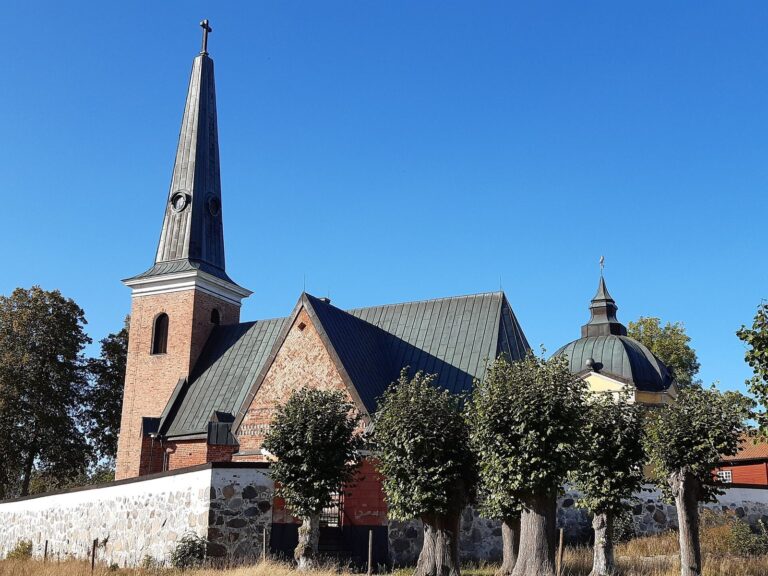
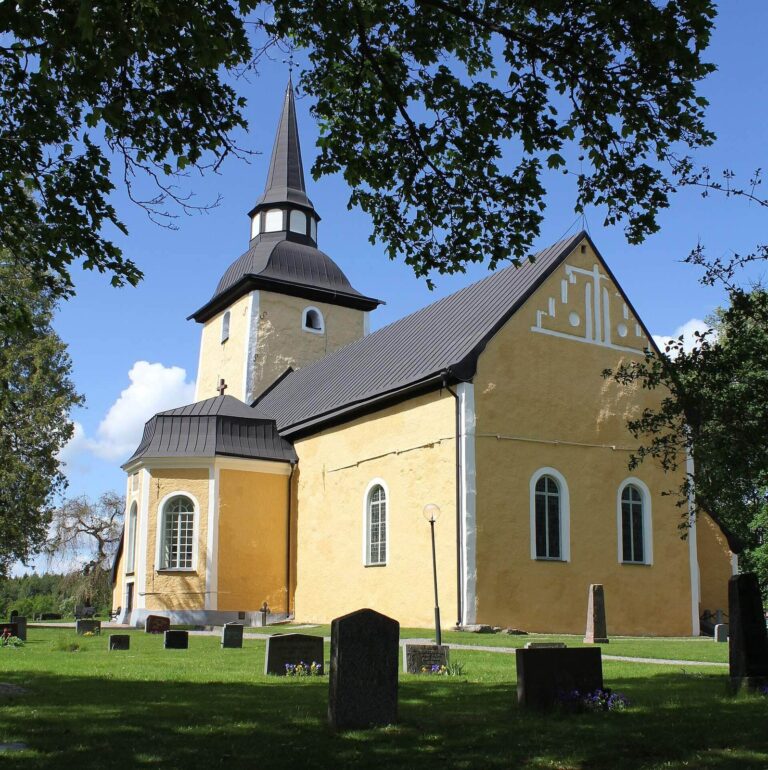
The church and its cemetery form a stone-built complex. The church has a tower and a narrower chancel, while a masonry wall with iron gates encloses the cemetery. Inside, medieval paintings and furnishings stand alongside objects added in later centuries.
Church fabric and interior
Building and supports
The church’s stone fabric reflects its successive extensions. The tower’s upper portion was rebuilt in the early twentieth century, and the chancel is narrower than the main body of the church. Of the large diagonal buttresses added in 1682 to brace the building, the one on the south wall survives.
Paintings and pulpit
Wall paintings dating to around 1460 survive in the interior. The pulpit was probably made around the middle of the seventeenth century.
Medieval furnishings
Altarpiece
The altarpiece, a decorated structure associated with the altar, dates from the 1490s and was probably made in Lübeck. Its central panel shows the Crucifixion, surrounded by John the Baptist, the apostle Andrew, Saint Eric, Saint Botvid, Catherine of Alexandria, Anne, Bridget, Margaret of Antioch, and Dorothy. Another figure, dressed as a deacon and holding three stones, is unidentified and may represent Lawrence, Eskil, or Nicholas. On the outer panels, the Virgin Mary is the central figure in the scenes.
Shrine cabinets and crucifixes
A devotional cabinet for sacred figures, probably made around 1475, is dedicated to Mary. Another cabinet, made around 1450, is dedicated to Saint Olof. A large crucifix traditionally placed between the nave and chancel dates from around 1270–1300. A second crucifix, badly damaged and probably made in connection with the church’s extension, dates from around 1500.
Baptismal furnishings
The baptismal font is made in a style associated with Gotland, the Swedish island, and dates from around 1300. A pewter basin for baptism dates from the latter half of the seventeenth century.
Later furnishings and objects
Altar frontal and chandeliers
The altar frontal is embroidered in cross-stitch, with the Last Supper at its centre and a floral design around it. Its signature reads “I:H. – H. G. Anno 1736.” Three older chandeliers remain: a six-armed example hangs in front of the organ gallery, while two three-armed ones are located in front of the baptismal altar and at the vicarage.
Communion vessels
The gilded-silver communion chalice was made in 1801 by Strängnäs goldsmith Alexander Prytz. Its paten, the plate used with a communion chalice, probably dates from the early sixteenth century. A beaded border surrounds engravings of Christ’s head and pierced hands and feet; the centre shows the Madonna on a crescent moon alongside two shields bearing house marks.
One wafer box, used to hold communion wafers, has chased floral decoration and dates from around 1700. A second, made in 1723 by Stockholm goldsmith Andreas Wall, is elongated and hexagonal, with engraved and punched leaf-and-ribbon designs. A pear-shaped jug made in Stockholm in 1737 by Petter Henning the Younger bears the initials I.G. and M.B.D.B. and the arms of the Grundel and de Besche families, referring to Jacob Grundel and his wife, Margareta Beata de Besche. Another chalice, used to take communion to the sick, dates from the late sixteenth century and has engraved plant motifs and applied flowers.
Textiles and bridal objects
The church’s bridal crown is made of gilded silver. A bridal outfit associated with it comprised a gown, bodice, mantle, and wig. Fine linen and lace were purchased for the outfit in 1738, and a bridal cloth was acquired in 1740. The surviving cloth is green silk, edged with gold-thread lace and further decorated with lace and floral embroidery in silver and silk.
A chasuble, the priest’s outer vestment, probably dates from the beginning of the seventeenth century. It is made of gold damask with a grey-violet pattern. Larger sections of a medieval stole, a long, narrow vestment, have been sewn onto it. The gold-brocade stole has a dark-blue pattern and ends embroidered with the arms of the Diocese of Strängnäs and Bishop Konrad Rogge. It probably belonged to vestments still preserved at Strängnäs Cathedral.
Bells and organ
Church bells
The great bell was cast in Stockholm by the widow of master bell-founder Jurgen Putensen. It carries a portrait medallion of Karl XI and a relief of the Crucifixion. The small bell was cast in Stockholm by Jurgen Putensen.
Organ
The present organ operates by air pressure and retains the façade, or front, and much of the material of the earlier instrument.
Cemetery enclosure
The cemetery is enclosed by a masonry wall with iron gates in its openings. Earlier entrances included covered passageways through the wall, called lychgates. A separate bell tower once stood beside the cemetery’s southern wall.