Necropolis of Anghelu Ruju: A Prehistoric Burial Ground in Sardinia
Site at a Glance
- Popularity
- Medium
- Country
- Italy
- Primary era
- Stone Age
- Eras represented
- Stone Age
- Civilizations
- Unclassified
- Site type
- Burial
- Remains
- Necropolis
On this page16 sections
History
The Necropolis of Anghelu Ruju is a prehistoric rock-cut burial ground near Alghero on Sardinia, Italy. Cut into sandstone by communities of pre-Nuragic Sardinia, it was used from the Late Neolithic into the Early Bronze Age. Ceramic finds indicate at least 1,500 years of activity, with the Ozieri phase dated to about 3200–2800 BC and use continuing through the Copper Age and into the Early Bronze Age, approximately 2800–1600 BC.
Prehistoric use
The sequence of cultures associated with the necropolis includes Ozieri, Abealzu-Filigosa, Monte Claro, Bell Beaker and Bonnanaro. During the Abealzu-Filigosa phase, at least ten tombs were used again for new burials. Although no undisturbed burial can be assigned with certainty to the Ozieri culture, pottery characteristic of that phase has been found in at least 27 tombs. Sardinian archaeologist Giovanni Maria Demartis proposed that the site was an important place in the transition from shaft entrances to tombs reached by passages. He also suggested that most tombs may have been cut during the Ozieri phase, with some later, more limited work.
Fishing, farming and pastoralism formed part of the region’s economy, while Alghero’s natural harbor connected Sardinia with places beyond the island. These activities and exchanges probably helped support the labor required for the necropolis’s elaborate tombs. Finds interpreted as evidence of wider connections include silver rings, copper daggers thought to have come from Spain, an awl possibly from southern France, a copper ring in an eastern European style and an axe attributed to the British Isles. Obsidian, a volcanic glass from Monte Arci in Sardinia, also relates to the region’s exchange networks.
Discovery and archaeological research
The necropolis came to light accidentally in 1903, when workers were extracting building stone for a farmhouse on the Sella&Mosca estate. In one underground tomb, later numbered Tomb I, they found a human skull and a tripod vessel and passed them to archaeologist Antonio Taramelli. He began excavations in 1904, and the draughtsman Nissardi prepared drawings of the first ten tombs, numbered I to X. Taramelli’s 1904 work, published in 1909, was considered the first extensive investigation of the site.
Taramelli carried out a systematic exploration in 1908 and found 21 further tombs. Materials from this work are now held at the National Archaeological Museum of Cagliari. Archaeologist Doro Levi identified four more tombs during a brief excavation in 1936; these were labelled A to D to distinguish them from the earlier numbered group. Restoration work in 1967, prompted by the neglected condition of the necropolis, led archaeologist Ercole Contu to identify Tomb VIII bis and tombs E and F.
Studies of human remains associated with the Bell Beaker and Bonnanaro cultures distinguished two main body-form groups. A longer-bodied group, described in the study as indigenous, accounted for 84 percent, while a shorter, broader group associated with Bell Beaker bearers accounted for 16 percent. The average height recorded for men was 1.62 metres, with a range of 1.42 to 1.72 metres. A 2020 ancient-DNA study found ancestry related to western hunter-gatherers and early European farmers among people buried at the site. One Copper Age individual had a North African-like ancestry profile similar to that of a roughly contemporary person from Camino de las Yeseras in Spain. If confirmed, this could indicate movement of ancestry between Africa and Europe across the Mediterranean before the Classical period.
In 2025, the necropolis was included with 26 other Sardinian sites in the UNESCO World Heritage property Funerary Tradition in the Prehistory of Sardinia: The domus de janas, a Sardinian term for rock-cut tombs often translated as “houses of the fairies.” The property was inscribed under cultural criterion III.
Remains
Setting and overall plan
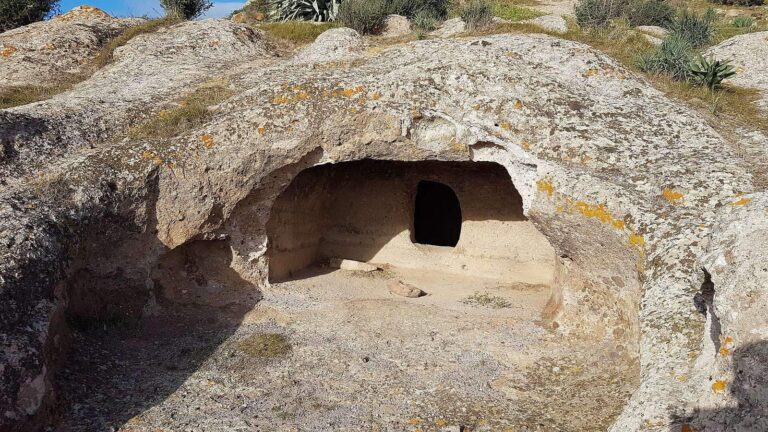
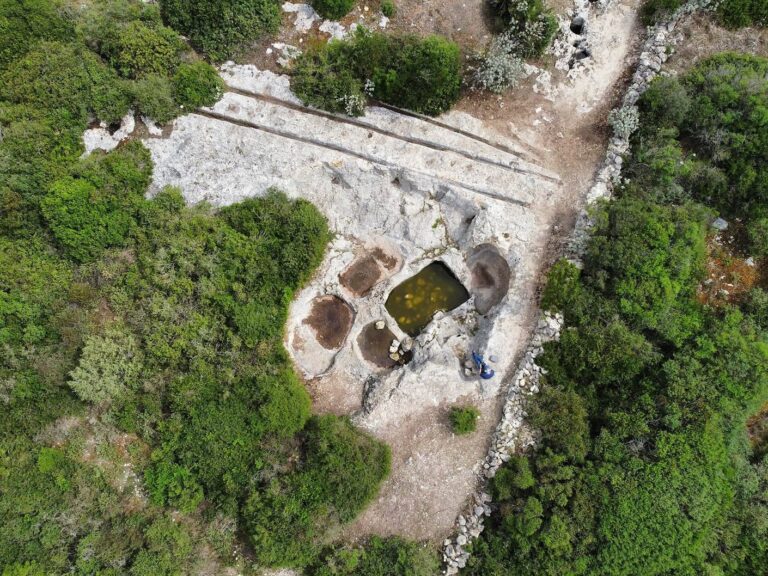
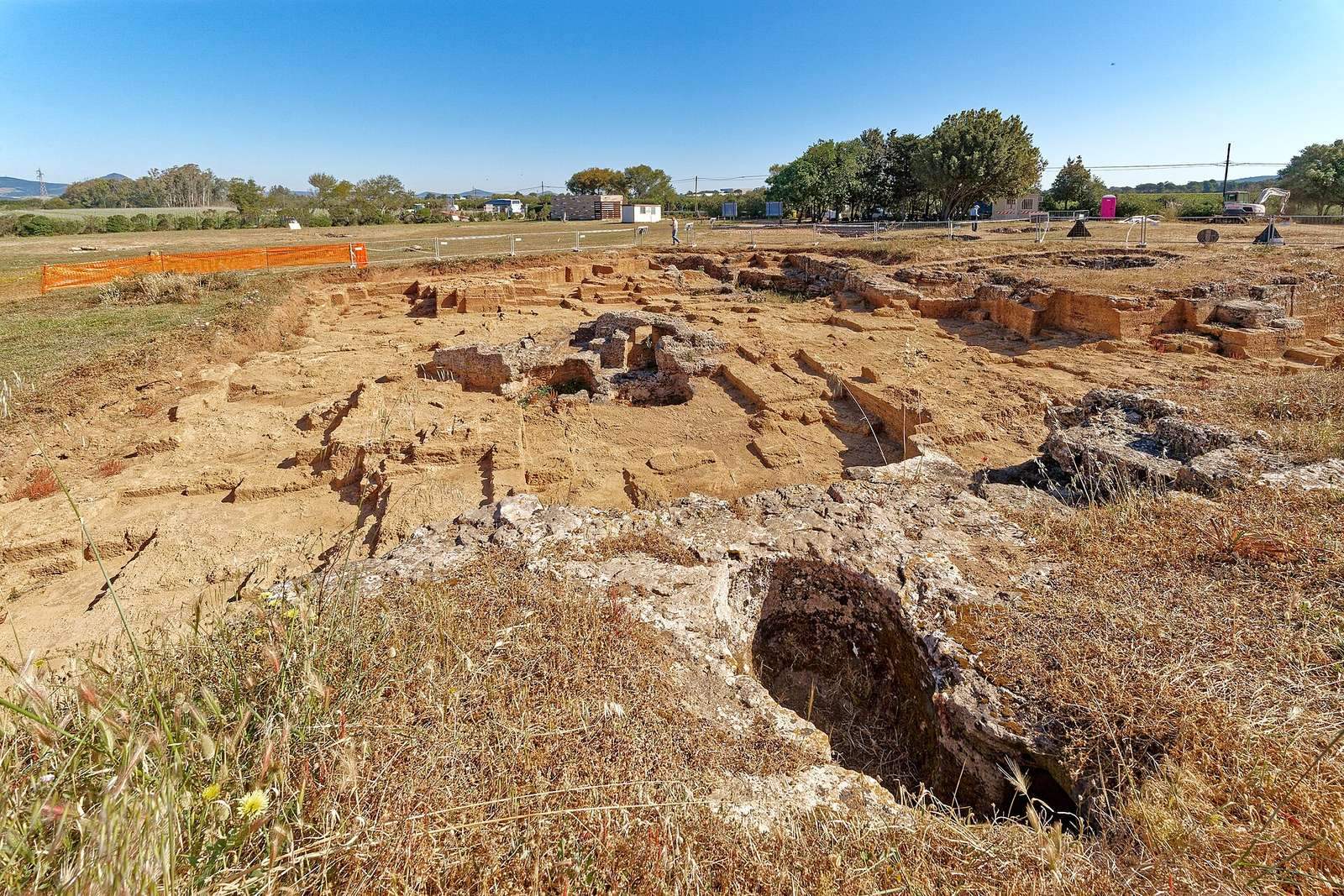
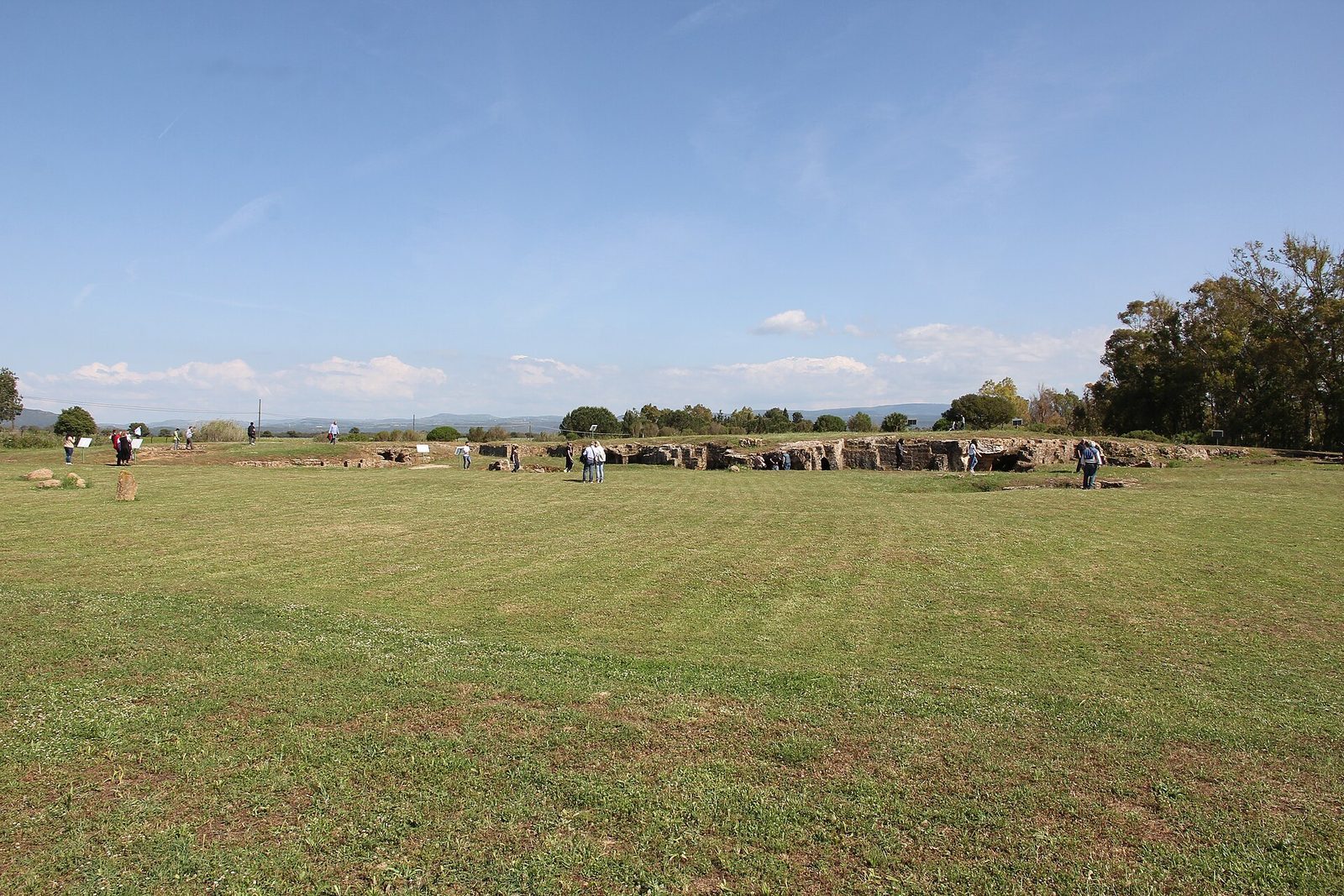
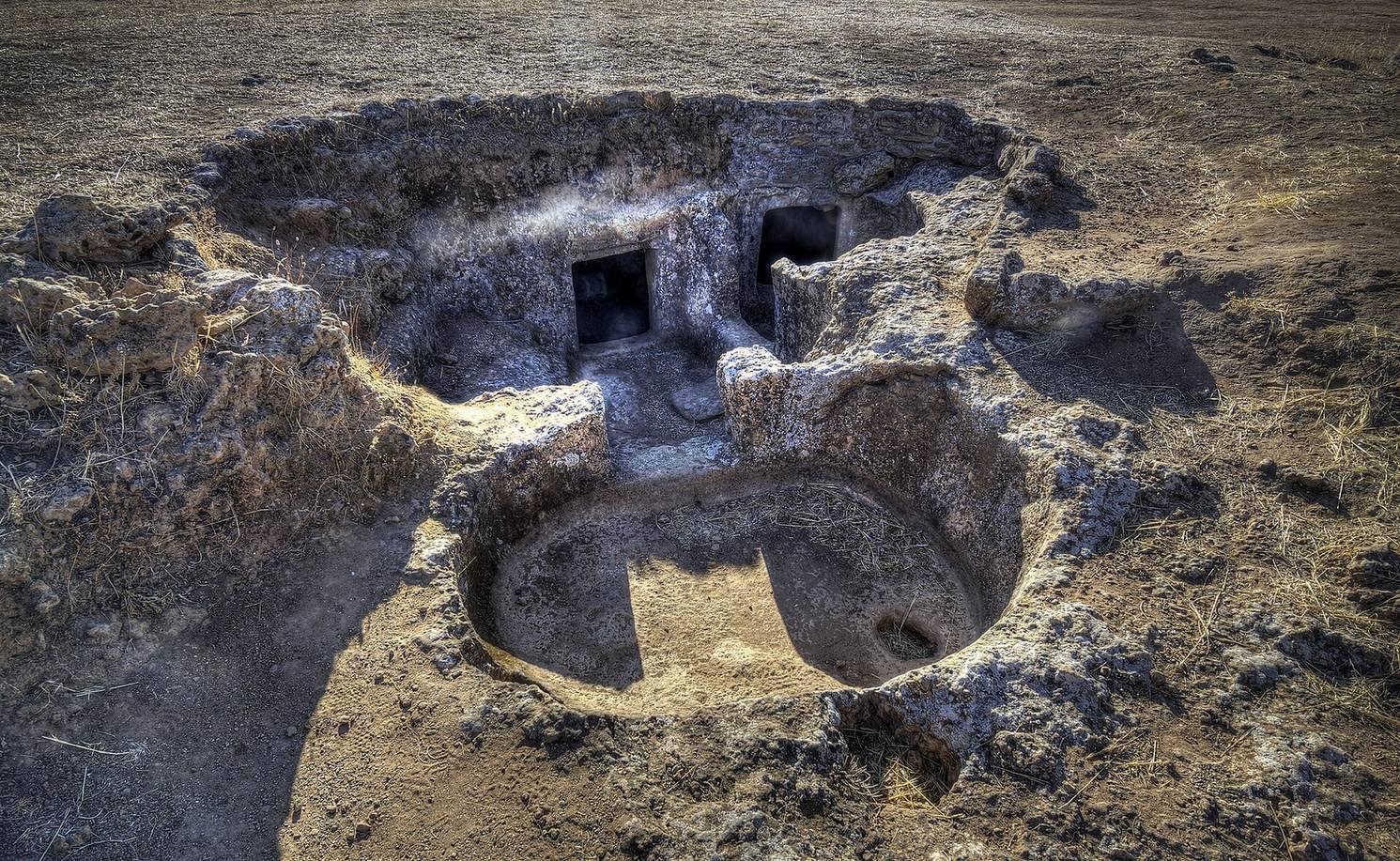
The necropolis covers about 13,000 square metres beside the small Rio Filibertu. Its 38 identified tombs form two groups: seven are cut into a flat rocky outcrop, while 31 occupy the slopes and summit of a low hill. The tombs follow the shape of the rock rather than a regular plan, yet they do not intersect, even where they are closely grouped. The local sandstone was soft enough to excavate but compact enough to hold carved chambers. Stone picks used in the digging have been found inside the tombs.
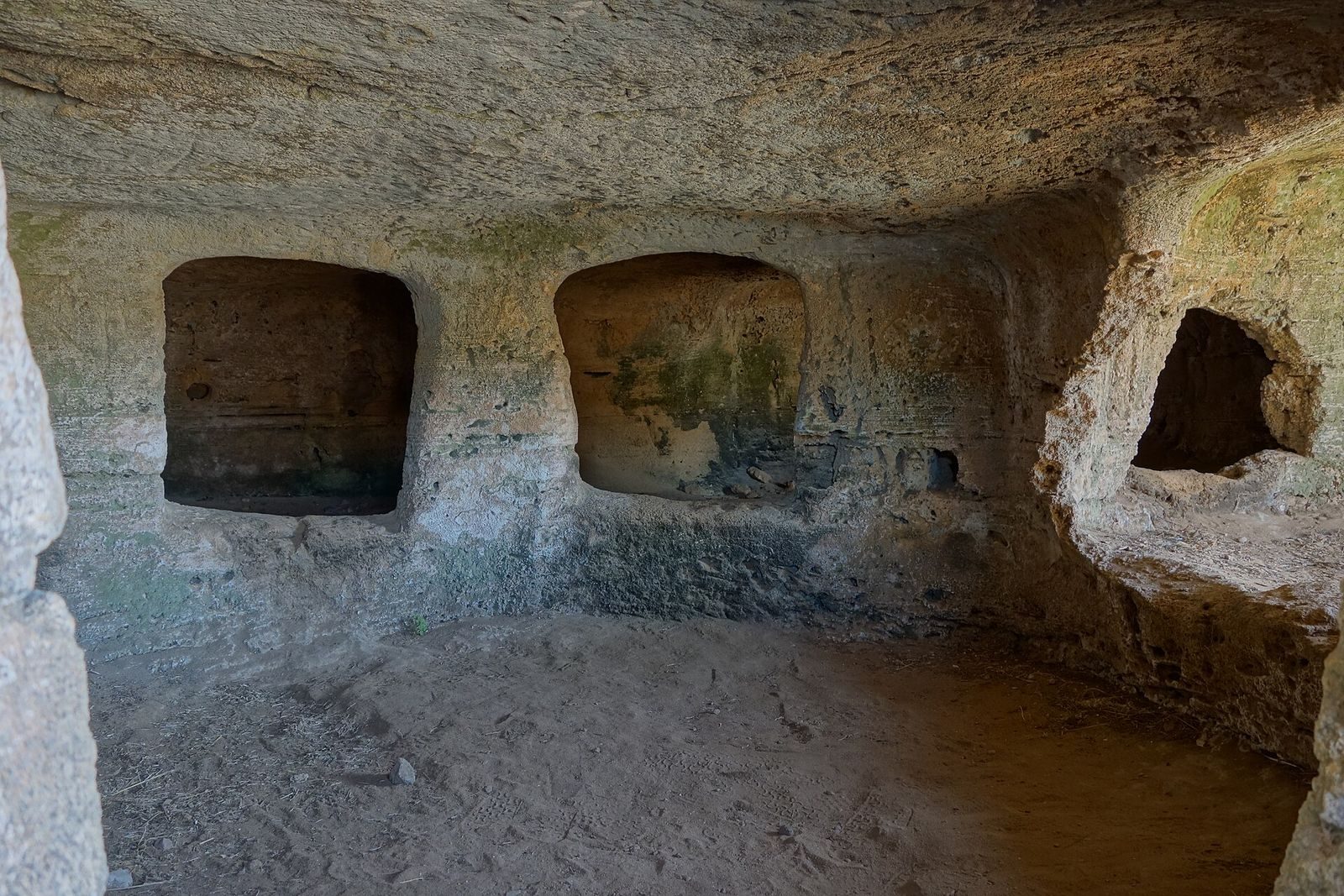
A layer of sand close to the surface limited how thick the tomb ceilings could be. Several ceilings later collapsed, leaving chambers exposed to the sky. Tomb entrances generally face east or southwest. Some are reached through a shaft, occasionally with irregular steps; others have a usually descending entrance passage, often with carved steps near its opening. Passages of this kind are especially monumental at Tombs II and XX bis.
Entrances and chamber layouts
Chamber plans
Most tombs contain several rooms, and Tomb III has as many as eleven spaces. Tomb XXVI is the sole single-chamber example. Shaft-entry tombs tend to have more irregular arrangements, with rounded or oval rooms, while passage-entry tombs are often more symmetrical. A common design places a nearly square main room at the end of the passage, with smaller chambers opening from its shorter sides to form a T-shaped plan. Tombs V, XI, XVII and XXII provide examples of this arrangement.
Some tombs were enlarged in stages, with later chambers cut into earlier spaces, as at Tombs I and A. Unfinished rooms and partly carved doorways retain grooves made by the digging picks. Interior designs include carved columns, pillars, bases and pilasters. Tomb XX bis has a ceiling with one slope, while Tomb XXX has a double-sloping ceiling. Bull-head carvings appear in Tombs A, XIX, XX bis, XXVIII and XXX; carved false doors occur in Tombs VIII, XXI and XXX. Red ochre survives on walls in Tombs VII, XIX, XX and XXIX, and on the floor of Tomb XXVII.
Individual tombs
Tomb A
A long entrance passage and a small vestibule lead through a tiny four-sided antechamber to a rectangular main room. A small chamber and a funerary bed flank the main room, while three more small chambers open from the right side of the antechamber. Its recessed doorway is crowned by four small carved bull heads with triangular faces and distinct horns; two larger examples are set beside it near the entrance wall. The chamber to the right has two more bull-head carvings on its left wall and twelve raised rectangular panels.
Tomb III
This large tomb has the necropolis’s longest entrance passage, measuring 10.60 metres. Two small chambers and a niche run along its right side before a vestibule and a deep, four-sided main room. Broad doorways connect the main room to six chambers arranged around it. Finds from the tomb include Ozieri pottery, pottery decorated in the Filigosa style and complete Bell Beaker vessels.
Tomb XI
Tomb XI is among the few tombs found with its closure slabs in place. Stone piles had sealed both the outer doorway and the passage between the antechamber and main room. Its T-shaped arrangement has a rectangular main room with two small chambers opening from its short sides. One burial was surrounded by about fifty stone picks used for digging.
Tomb XVII
A long stepped passage leads to a small chamber, a vestibule and a nearly square antechamber. An ornate doorway with carved cornices opens into the rectangular main room. Four raised chambers, two on each short side, complete a T-shaped layout. Finds include Ozieri pottery and Early Bronze Age objects: an armband with two perforations, a bone button pierced by a V-shaped channel, and a small copper or bronze dagger.
Tomb XX bis
Steps lead to this monumental tomb. Its main room is trapezoidal, with a widened portico at the entrance and two pillars supporting the ceiling. The restored right pillar bears two bull-head carvings, one above the other. Four secondary chambers open around the main room, and some were left unfinished. Finds include fragments of calcite figures in a style associated with the Cyclades, silver necklace pieces, part of an armband and Ozieri pottery. Partly burned human bones were found in an unfinished chamber at the rear right.
Tomb XXVIII
This tomb has seven spaces, reached through a long, narrow shaft and an oval antechamber. Two bull-head carvings with paired horns flank the doorway to the main room. Their heads are schematically rectangular and bear incised circles or spirals. Broad side niches, probably added later, partly cut into the decoration. A raised partition in the main room joins the base of a ceiling-supporting pillar, while three doorways at the rear lead to secondary chambers.
Tomb XXX
A small, elongated shaft opens into an almost square antechamber. Pilasters at the corners of its side walls frame two lowered rectangular panels bearing large curved bull horns. A doorway in the rear wall leads to a four-sided main room containing a carved false door. A raised partition divides the floor of its only secondary chamber. Burial remains found there, possibly from an initial placement, were accompanied by Bell Beaker pottery, necklace pieces, buttons pierced by V-shaped channels, a small copper or bronze dagger and small ornaments made from silver wire.
Burials and objects
Burial evidence indicates that inhumation was the predominant practice. People were laid on their backs in Tombs III, XI, XII, XIX, XXII and XXX. Possible secondary deposits, in which remains were moved or reburied after an earlier burial, occur in Tombs I, XIII, XVIII, XX and XXI. Tomb XII held two individuals, while Tomb XVIII contained remains from more than thirty; the evidence does not establish whether burials were generally individual or collective. Partly burned bones were found in Tombs XV, XX, XX bis and XXVI, usually in niches. Shells mixed with ash and charcoal above burials in Tombs III and XXIII, along with vessels near Tomb XI’s outer doorway, point to meals or food offerings in honor of the dead.
Other finds from the tombs include pottery, figurines interpreted as possible Mother Goddess figures, weapons, flint tools, axes, mace-heads, arrowheads and beads. Tomb XIII yielded many Bell Beaker pottery fragments, silver necklace pieces, V-shaped-channel buttons and two armbands; one armband was placed in a bone case decorated with small incised circles. The varied objects provide material evidence of the different communities that used the necropolis over its long history.