Schwedenschanze, Höhbeck: An Early Medieval Hilltop Fortification
Site at a Glance
- Popularity
- Low
- Country
- Germany
- Primary era
- Medieval
- Eras represented
- Medieval
- Civilizations
- Unclassified
- Site type
- Military
- Remains
- Fort
On this page6 sections
History
Early medieval fortification
Schwedenschanze, Höhbeck, is an early medieval hilltop fortification in Germany, established around or after AD 730. Charcoal from the rampart was dated to this period, but the builders’ identity remains uncertain because the finds do not identify a particular community. The fort was used for only a short time.
Archaeologist Jens Schneeweiß has suggested that Schwedenschanze may have been one of two forts Charlemagne built along the Elbe in 808. Charlemagne was the Frankish ruler who became emperor in 800, and the Royal Frankish Annals are a chronicle of events under Frankish rule. A separate rampart at Vietzer Schanze, nearly a kilometre to the west, is identified as the early ninth-century Höhbeck fort named in the annals. Under Schneeweiß’s proposal, Schwedenschanze may have been the other fort.
The fortification was later used again during the Middle Slavic period. Tenth-century pottery of the Menkendorf group, an archaeological classification of medieval Slavic pottery, points to this reuse.
Name and archaeological investigations
The area was associated with legend, and former names translated as Witch Mountain and Sun Mountain were taken to suggest pre-Christian use. Schwedenschanze means “Swedish fortification.” The name probably arose from the mistaken belief that local people built the rampart as a refuge from Swedish troops during the Thirty Years’ War, or that Swedish troops built it themselves. Sweden intervened in this major European conflict, fought from 1618 to 1648.
Slavic pottery came to light during construction-site monitoring in 1920. Wolf-Dieter Asmus cut through the rampart in 1956, followed by smaller investigations in 1965, led by Ernst Sprockhoff, and in 1975 and 1985. In 2008, Jens Schneeweiß excavated another section to clarify how the rampart had been built.
Remains
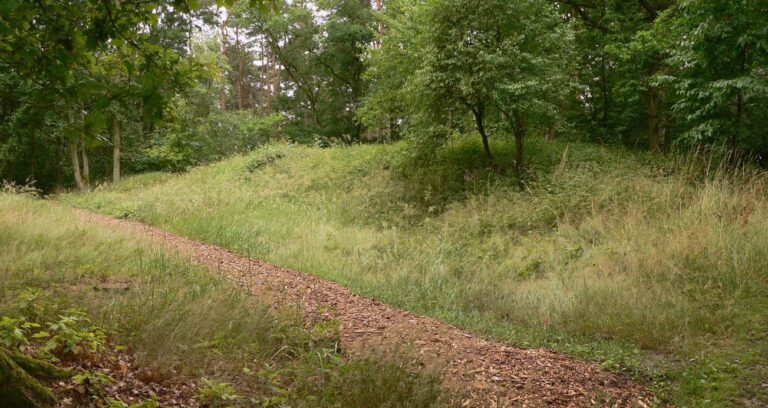
The semicircular enclosure covers 1.75 hectares on the Höhbeck elevation, which rises about 60 metres above the Elbe floodplain. Its defenses include an earthen rampart and a ditch, while steep slopes on the river-facing side also helped protect the site.
Main rampart and ditch
The rampart is nearly 13 metres wide at its base and still stands 3.1 metres high. It was formed from successive packed layers of clay and sand, unlike the timber-and-earth construction of the Höhbeck fort at Vietzer Schanze. A V-shaped ditch about six metres wide lies in front of it. On the rampart’s inner side, traces of intense burning include remains of burned structural elements. The section cut through the rampart during the 2008 excavation was later refilled.
Slopes and eastern rampart
Steep slopes on the side facing the Elbe provided a natural defensive feature. A smaller rampart lies 200 metres east of the main enclosure and probably served as an obstacle to attackers approaching the site.