Schloss Gadow: A Former Knight’s Estate in Brandenburg, Germany

Site at a Glance
- Rating
- 4.4
- Popularity
- Low
- Country
- Germany
- Primary era
- Early Modern
- External website
- Open
- Eras represented
- Early Modern
- Civilizations
- Holy Roman Empire, Kingdom of Prussia
- Site type
- Domestic
- Remains
- Manor House
On this page9 sections
History
Schloss Gadow is a former knight’s estate in Germany, located in the northwestern Prignitz region of Brandenburg in the wooded and meadow-rich lowland of the Löcknitz. The site developed from a fifteenth-century knight’s estate into a late-Baroque residence around 1790, then became a Classical three-wing complex surrounded by an extensive landscape park.
The von Moellendorff estate
Gadow was among the ancient Prignitz possessions of the von Moellendorff family, whose origins lay in the Altmark. Members of the family appear in Prignitz records during the thirteenth and fourteenth centuries, when they began acquiring extensive holdings in the region. The village of Gadow became deserted during the fourteenth century, but a knight’s estate was established there during the fifteenth century. Its medieval buildings did not survive.
Around 1790, Hans Georg Gottlob von Moellendorff established his household at Gadow and probably built an entirely new two-storey residence. The late-Baroque building had a high basement and a mansard roof. He also created garden grounds that later developed into a landscape park. His brother, Albrecht Otto Johann von Moellendorff, was a Prussian cavalry officer who died at the Battle of Pirmasens on 14 September 1793. His grave monument at Pirmasens names Gadow as his birthplace.
Ownership and nineteenth-century expansion
Hans Georg Gottlob inherited Gadow before selling it in 1804 to General Field Marshal Wichard Joachim Heinrich von Moellendorff, who owned the estate until his death in 1816. The field marshal’s adopted son, Hugo von Wilamowitz-Moellendorff, became his heir. In 1816, Hugo’s father, Daniel Theodor von Wilamowitz, commissioned a Classical mausoleum at the western end of the park. Designed by the Berlin architect Salomo Sachs as a Greek temple, it became the field marshal’s burial place.
In 1818, Daniel Theodor extended the Baroque residence with two equal-length wings set at right angles to the original building. The former outside staircase was replaced by a curved entrance ramp. After Hugo von Wilamowitz-Moellendorff took over Gadow in 1829, he enlarged the grounds in the English landscape-garden style, a park design based on naturalistic planting, open lawns, water, and controlled views. The animal park, greenhouse, ice cellar, stables, forester’s house, and other buildings were incorporated into the landscape and linked by designed sight axes.
Hugo also established a thoroughbred horse-breeding operation at Gadow. One later offspring was the stallion Scherz, which the painter Franz Krüger depicted after its victories in England with its owner, who was raised to the rank of count in 1857. In 1853, the residence was remodelled in the Classical style, with new staircases and richly decorated stucco ceilings.
The estate in the late nineteenth and twentieth centuries
The estate remained with the von Wilamowitz-Moellendorff family during the later nineteenth century. By that time, it covered at least 2,800 hectares and included the 72-hectare Jagel estate. Gadow was held as a fideicommiss, an estate kept undivided and passed through a prescribed line of inheritance. Around 1930, it formed part of a complex of eight knight’s estates covering 2,809 hectares.
From 1865, Count Wichard von Wilamowitz-Moellendorff enriched the landscape park with numerous woody plants, particularly conifers, rhododendrons, and Douglas firs. The estate’s last landowner was Rittmeister Hans Wichard Graf von Wilamowitz-Moellendorff, who died in 1939. His grandson Gero later ran a publishing house in Hamburg.
Most of the furnishings were lost in 1945. During the mid-1960s, the residence was remodelled as an FDGB holiday home. The FDGB, or Free German Trade Union Federation, was the state-aligned trade-union organization of the German Democratic Republic, whose holiday homes provided organized accommodation for union members. This conversion removed the historic interior structures and decoration. Since 1994, the residence has been used as a holiday facility for children. Schloss Gadow is legally protected as a monument, while the landscape park continues to be maintained.
Remains
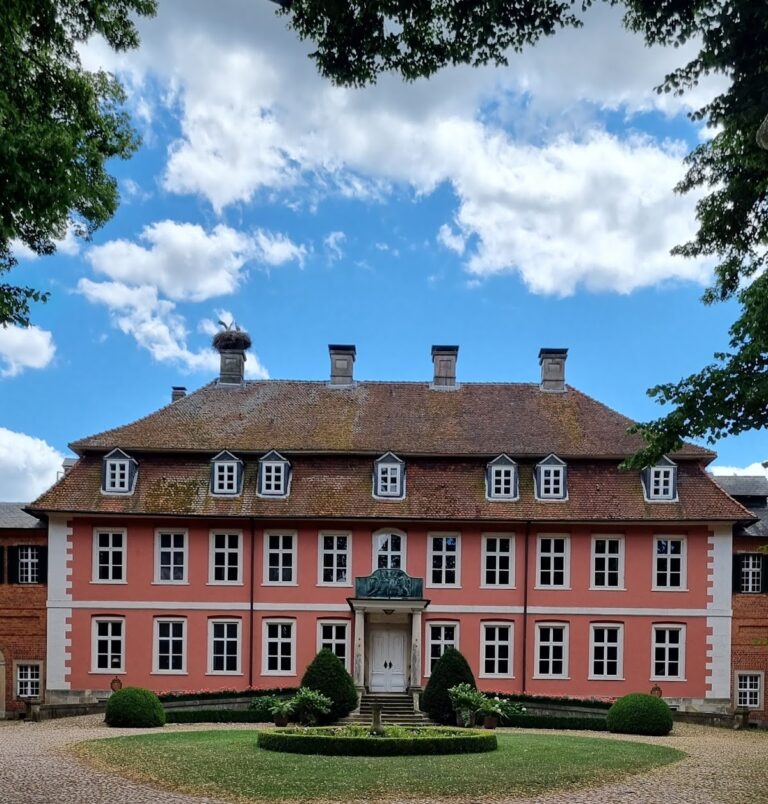
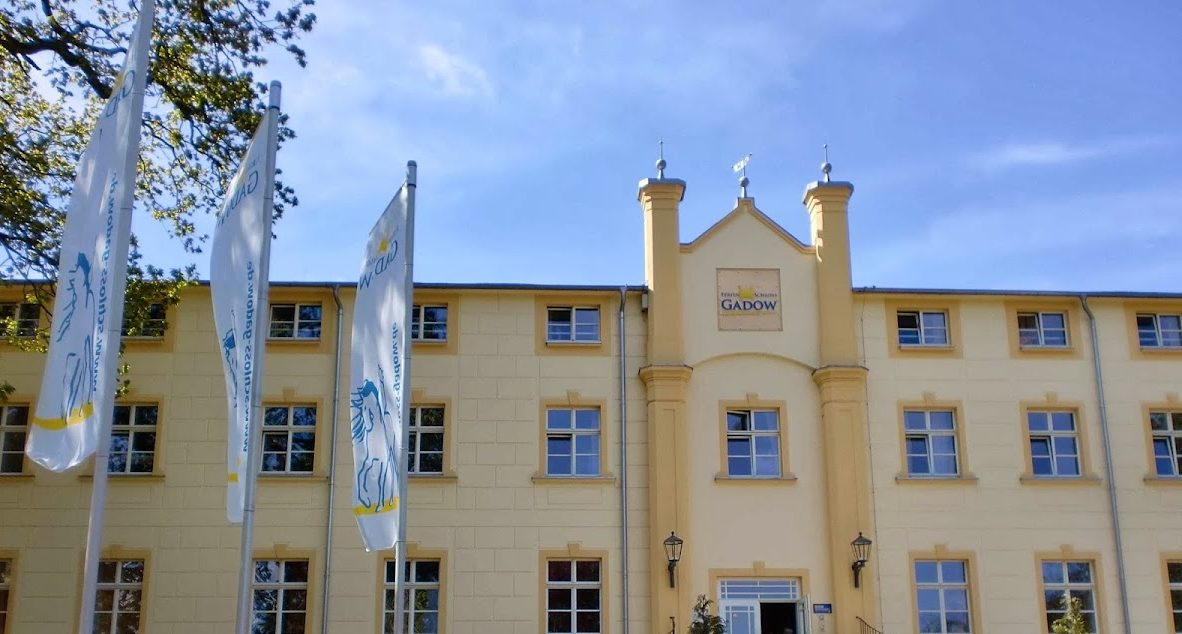
Schloss Gadow survives as a three-wing residence with two principal storeys, a basement, and a mezzanine, an intermediate or partial storey between the main floors and the roof. The former mansard roof was transformed into the mezzanine and is now topped by a very shallow slate-covered hipped roof. The residence stands within an extensive landscape park shaped by the Löcknitz, ponds, meadows, and designed views.
The residence and memorial architecture
Three-wing residence
The central late-Baroque building was enlarged in 1818 by two wings of equal length arranged at right angles to it. The curved ramp leading to the entrance replaced the earlier external staircase and remains part of the approach to the building. The 1853 Classical remodelling added staircases and richly ornamented stucco ceilings, but the mid-1960s conversion removed the historic interior structures and decoration. The exterior three-wing form, basement, mezzanine, and roof remain the principal architectural elements of the residence.
Classical mausoleum
At the western end of the park stands the mausoleum built in 1816. Salomo Sachs designed it as a Greek temple in the Classical style. It served as the burial place of General Field Marshal Wichard Joachim Heinrich von Moellendorff and forms a separate memorial structure within the park.
Landscape park and associated features
The park contains an animal park, greenhouse, ice cellar, stables, forester’s house, and other buildings arranged through designed sight axes. Its landscape incorporates the Löcknitz, several ponds, and meadows. The plantings include conifers, rhododendrons, Douglas firs, and other woody plants, forming a dendrologically valuable collection. Dendrology is the study and cultivation of trees and other woody plants.
Natural monuments are also part of the park, including the oldest oak in the Prignitz district. The landscape park survives and is maintained, with a forest educational trail associated with the Gadow forestry office. The site’s present physical character therefore combines the expanded nineteenth-century residence, the Classical mausoleum, associated estate buildings, and the wooded and water-rich park landscape.
Nearby sites