Santa Maria del Parto a Mergellina: A Church Founded by Jacopo Sannazaro
Site at a Glance
- Popularity
- Medium
- Country
- Italy
- Primary era
- Early Modern
- Eras represented
- Early Modern, Modern
- Civilizations
- French, Italian, Kingdom of Naples, Spanish
- Site type
- Religious
- Remains
- Church
On this page21 sections
History
Santa Maria del Parto a Mergellina is a Roman Catholic church in Naples, Italy, begun in 1504 by the Neapolitan Renaissance poet Jacopo Sannazaro. Its complex of two churches was completed in the early sixteenth century, and Sannazaro was buried there in 1530. The church is associated with his poetry, his tomb, and devotion to Mary as a protector of women in childbirth.
Sannazaro and the foundation
In 1497, Frederick I, an Aragonese king of Naples, granted Sannazaro an estate at Mergellina and an annual pension of 600 ducats. The property had belonged to the Benedictine monastery of Santi Severino e Sossio. Sannazaro took up residence in 1504 and began building two churches, one above the other. A villa may already have occupied the estate; he also added a tower.
The lower church, dedicated to Santa Maria del Parto, was finished around 1524–25. The upper church was planned as a private chapel for Saint Nazarius, an early Christian martyr, but remained partly incomplete amid plague and political unrest. Its dedication may have recalled a vow Sannazaro made while exiled in France, or it may have been chosen because the saint’s name resembled the poet’s.
The title Santa Maria del Parto means Holy Mary of Childbirth. It also refers to Sannazaro’s Latin poem De partu Virginis, or On the Virgin’s Childbirth, written at Mergellina and dated to 1526. The church’s dedication connected Mary with protection for pregnant women and women giving birth. Prayers for women seeking children were held there each month on the 25th.
Sack, completion, and burial
During the French siege of 1528, forces led by Philibert of Chalon sacked the complex and demolished Sannazaro’s tower. The following year Sannazaro handed the nearly finished church to the Servites, a Catholic religious order devoted to the Virgin Mary. He pledged them 600 ducats each year to complete the work and provide for his burial. The church was completed in 1529, shortly before his death in 1530; at his request, he was buried there.
Sannazaro’s heirs, Giovanni Carlo Mormile and Giovan Simone Moccia, enlarged and decorated the upper church. Its grounds, with gardens and statues, became a favored summer place of prayer for members of the viceroy’s court. A viceroy governed a territory on behalf of a monarch. After Sannazaro’s death, the lower church ceased to serve as a church and was adapted for burials, including those of members of the Confraternity of the Holy Rosary, a devotional association of laypeople. The upper church continued as the main place of worship.
Suppression and later use
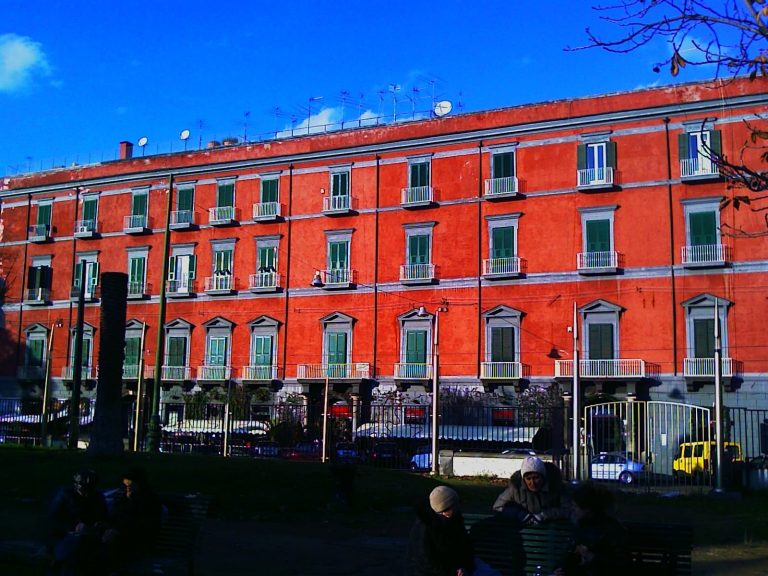
Under French rule during Joachim Murat’s reign in Naples from 1806 to 1815, the Servite monastery was suppressed and its monks expelled. The church and its property passed into private ownership. Apartments occupied buildings beneath the church, and the façade was altered to accommodate residences. The composer Gioachino Rossini reportedly lived for several years in an apartment rented from theatre impresario Domenico Barbaja.
The church was entrusted to the Confraternity of the Holy Rosary in 1812 and became an independent parish on 24 May 1935. It was declared a national monument and became state property in 1886. The Servites returned in 1971. The church belongs to the Archdiocese of Naples and remains associated with the order. Restoration work has also been carried out in recent years.
Remains
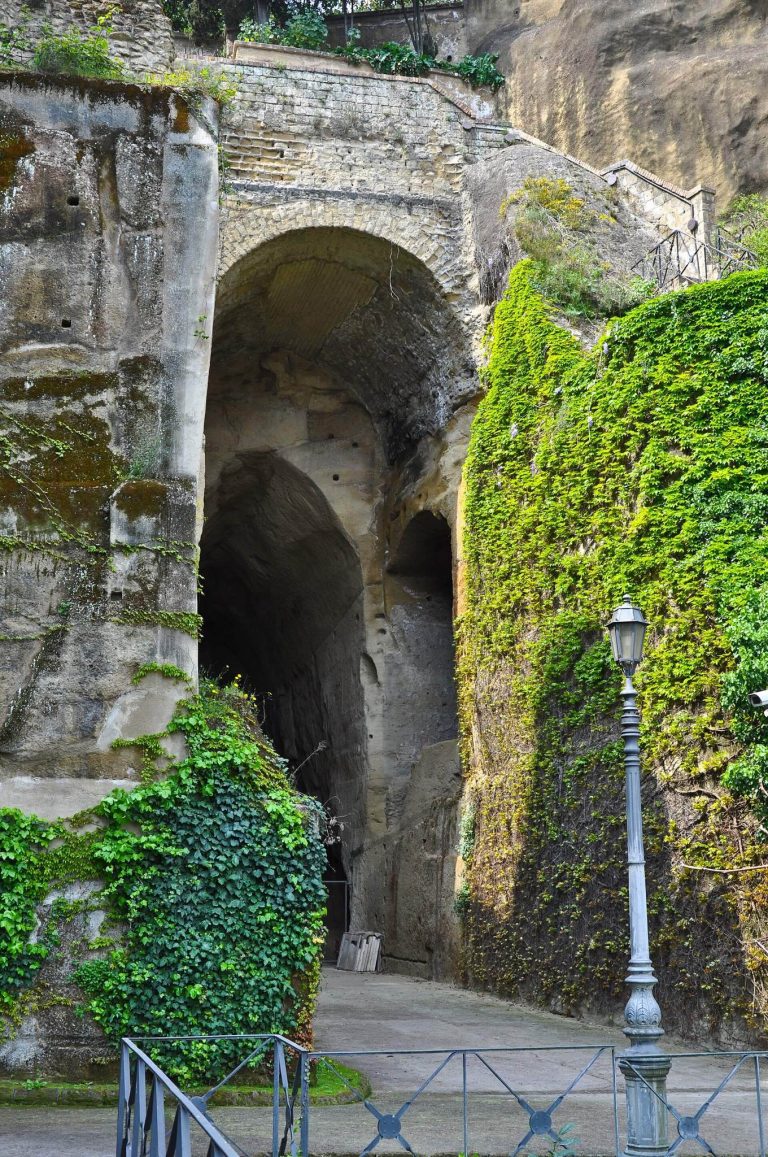
The complex occupies two levels, with the upper church raised above a building containing apartments and the lower church cut into the rock. Three narrow flights of stairs reach the upper church’s forecourt, which also forms the roof of the building below. The original plan for the grounds included a garden planted with poplar trees. The church stands near the Tomb of Virgil, the burial place associated with the ancient Roman poet.
Exterior and lower church
Façade
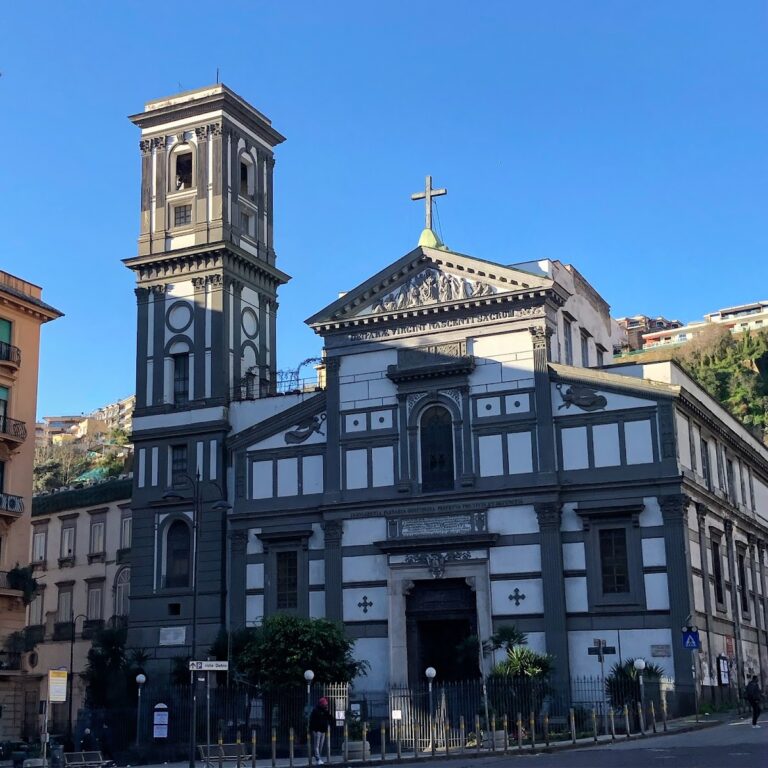
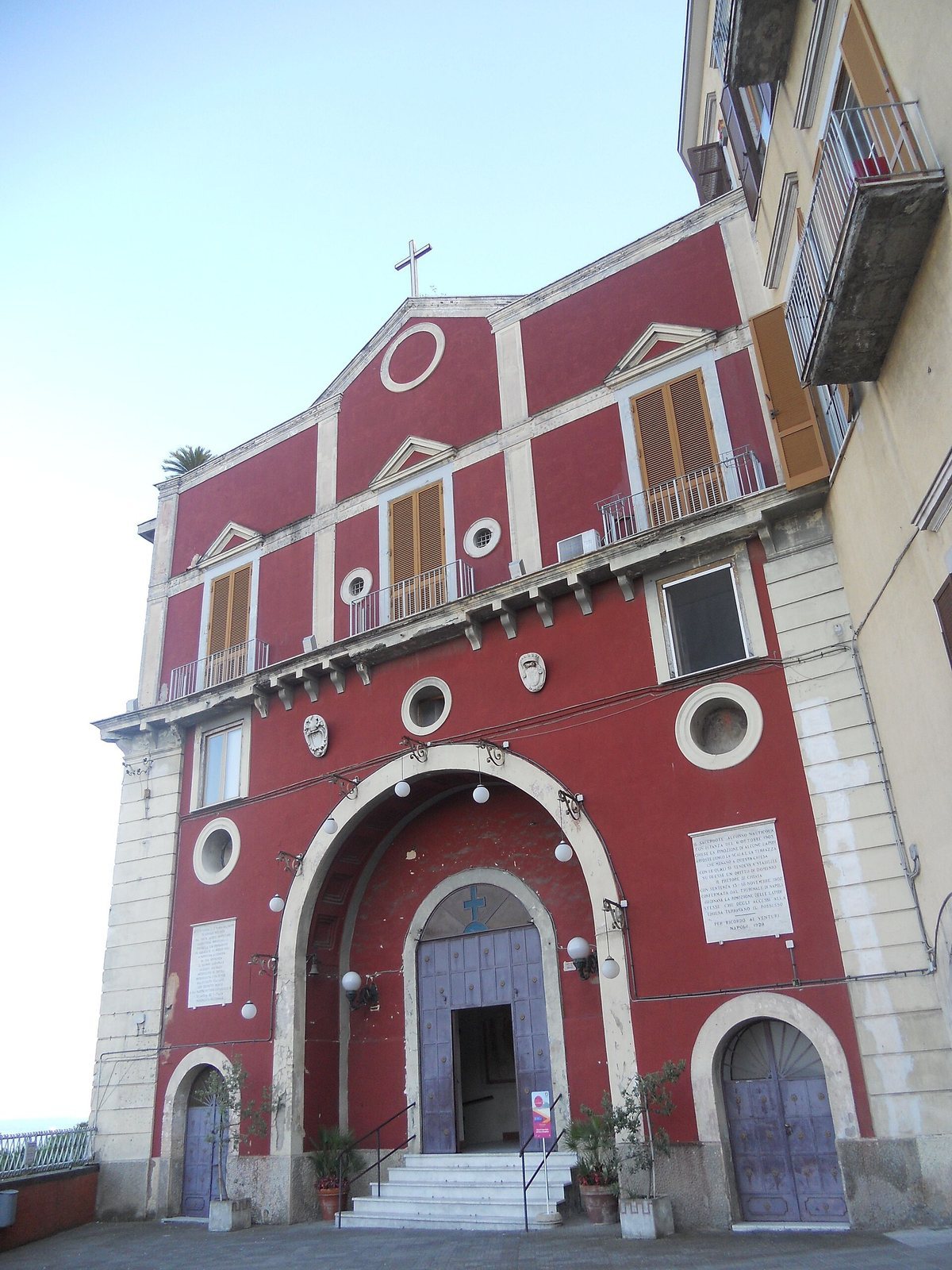
The façade has been altered and no longer retains its original appearance. Five steps rise to a round-arched main doorway, flanked by two smaller arches that serve as additional entrances. Plaques bearing inscriptions are set into the lower level. Circular panels contain badly damaged portraits of Sannazaro and Frederick of Aragon; a small round opening admits light, and two coats of arms complete the decoration. Above, three balconies sit beneath plaster pediments. The central upper section has a tympanum, the inset area within a pediment, with an iron cross and a rose window.
Lower church
The lower church has its own entrance and is hewn entirely from tuff, a volcanic rock. Its form resembles the nearby Tomb of Virgil. It was later put to use as a burial chamber.
Upper church interior
Nave and floor
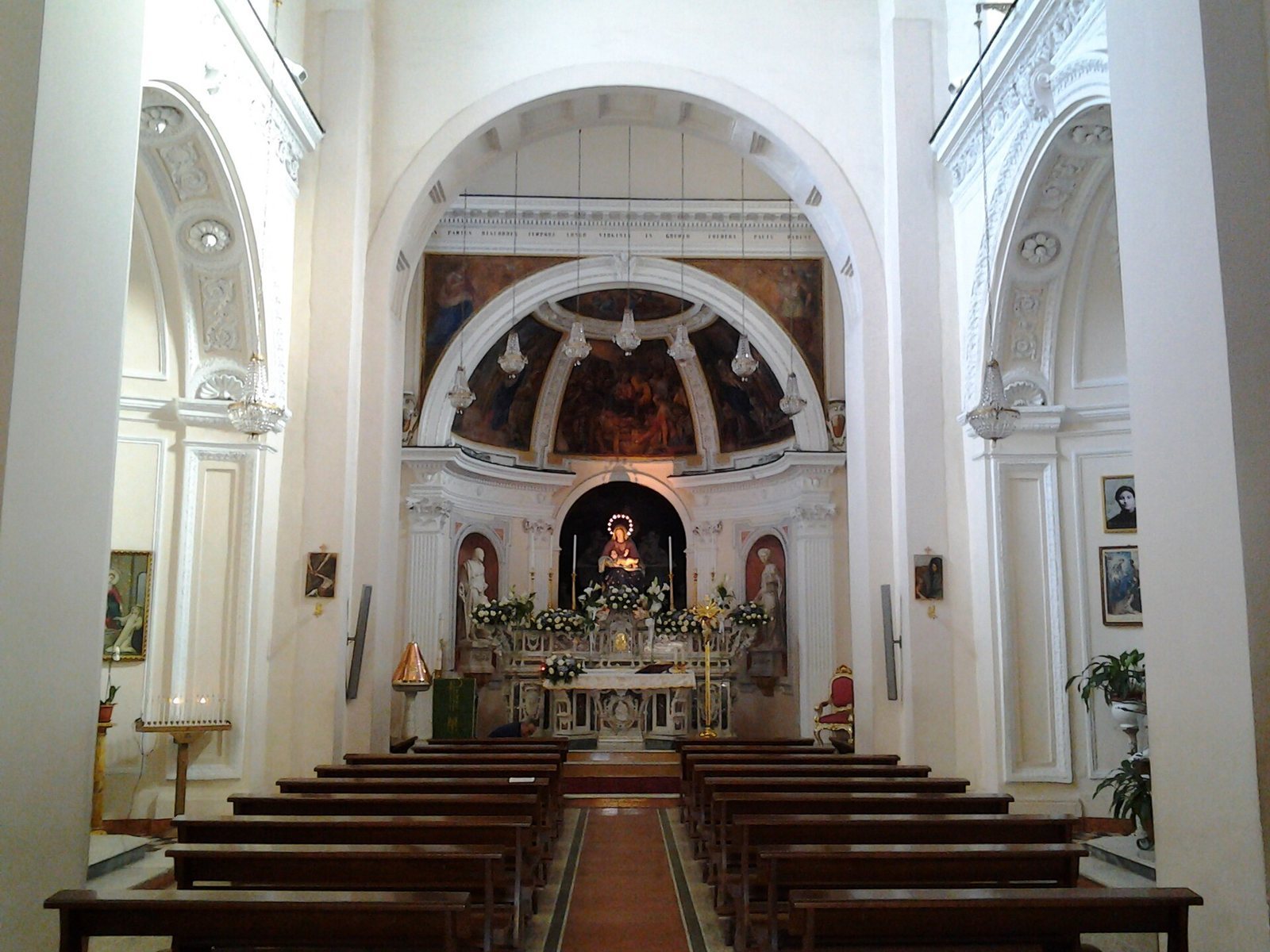
The upper church has a single nave, or main central space, with three side chapels on each side. White and gilded plaster decoration includes natural forms, small childlike figures known as putti, and personifications of Fortitude, Charity, Faith, and Hope. The present black-and-white tiled floor dates to the early twentieth century. It replaced an earlier floor of majolica, a tin-glazed pottery, traces of which remain in one side chapel. A pavement dated 1561 is attributed to Fabrizio Manlio di Barletta.
Choir gallery
The gallery once used by the choir holds an organ dated to 1770, finished in gilded and dark green wood. Renaissance-style choir stalls and their back panels survive in the apse, the end of the church containing the altar area.
Main altar
The multicolored marble main altar was added in the eighteenth century and made by Pietro Nicolini; a payment for it was entered on 22 January 1759. Its painted wooden statue of the Virgin and Child was carved by Francesco Saverio Citarelli in 1865.
Arch and vault paintings
An arch divides the nave from the apse. Paintings of putti carrying flower garlands decorate the arch and adjoining ceiling. Giovan Battista Lama and Jean-Baptiste Dubuisson completed work begun by Nicola Russo, and Lama also finished Russo’s Massacre of the Innocents. Frescoes of the Annunciation occupy spaces beside the arch. The adjoining barrel vault, a tunnel-shaped ceiling, carries scenes from the life of Mary, including the Visitation and Coronation of the Virgin. Paolo Guidotti painted this cycle in 1593; it was retouched in the early twentieth century. Niches at the foot of the arch hold statues of Saint James, an apostle, by Giovanni Angelo Montorsoli and Saint Nazarius by Bartolomeo Ammannati.
Apse paintings
Frescoes dated to 1699 cover the apse walls and ceiling. Nicola Russo painted Fame, the personification of renown, crowning a bust of Sannazaro, with Mount Helicon and the winged horse Pegasus behind them. The ceiling includes allegorical figures of Grammar, Philosophy, Astronomy, and Rhetoric. Abraham meeting three angels appears on the wall of the arch, while putti holding drapery decorate the side walls.
Sannazaro’s tomb and memorials
Sannazaro’s marble tomb stands in the apse near the main altar. The monument is chiefly attributed to Montorsoli, with Ammannati also credited; marble for it was purchased in 1537. Its inscription, written by Pietro Bembo, identifies the poet as Sincerus and compares his poetry and burial with Virgil’s. A bas-relief, a carving raised slightly from its background, shows a pastoral scene with Neptune, Pan, Marsyas, and nymphs. Ammannati’s statues of Apollo and Minerva stand beside the tomb, and their pedestals carry the names David and Judith. Above the decorated sarcophagus, a laurel-crowned bust identifies Sannazaro by his poetic name, Actius Sincerus. Two winged putti hold a book and an object described as either a helmet or a cornucopia.
A story associated with the tomb says that a Spanish viceroy objected to its imagery as pagan. The monks are said to have added the biblical names David and Judith to the pedestals beneath Apollo and Minerva. Funerary slabs for the painter Dirk Hendricksz, also known as Teodoro d’Errico, who died in 1594, and Manlio di Barletta, who died in 1566, were moved from the nave floor to the apse.
Chapels and other works
Left-side chapels
The first chapel on the left contains a Crucifixion panel by Dirk Hendricksz, dated 1591. Francesco Saverio Candido’s 1771 painting in the next chapel depicts Saint Philip Benizi, a medieval leader of the Servite order, raising a child from the dead. A panel of the Sorrowful Virgin occupies the third chapel.
Right-side chapels
Leonardo da Pistoia’s painting of Saint Michael defeating a demon hangs in the first chapel on the right. Known as the Devil of Mergellina, the demon is shown with a woman’s face, and the painting was commissioned at Cardinal Diomede Carafa’s request. Local legend associated the face with a beautiful woman loved by Carafa, a Renaissance churchman, whose affection was said to be unreturned. The woman may have been the noblewoman Vittoria Colonna d’Avalos, although that identification is uncertain. Matilde Serao retold the legend in 1890; in 1919, Benedetto Croce discussed the popular saying “beautiful as the Devil of Mergellina.” The next chapel contains a statue of the Sorrowful Virgin, and the third has an Adoration of the Magi panel.
Chapel beside the presbytery
An Adoration of the Magi in the chapel to the right of the presbytery, the area around the altar reserved for clergy, was given to Sannazaro by King Frederick. Its painter is uncertain.
Nativity group
Giovanni da Nola was commissioned in 1520 to make a wooden Nativity group of fourteen figures. Five survive: Mary, Joseph, and three shepherds. Worm damage has affected the figures, which have since been restored; they are kept in a room within the church.
Sacristy
The sacristy contains a panel of the Virgin and Child with angels by Francesco da Tolentino, dated 1515–20, and a Flight into Egypt by Russo. Its white marble washbasin dates to the early sixteenth century. A carved putto sits at its center, between the Servite coat of arms on the right and Sannazaro’s coat of arms on the left.