Crypta Neapolitana: An Ancient Roman Road Tunnel in Naples
Site at a Glance
- Rating
- 3.8
- Popularity
- Very Low
- Country
- Italy
- Primary era
- Classical
- Eras represented
- Classical, Medieval, Early Modern
- Civilizations
- Kingdom of Naples, Roman, Spanish
- Site type
- Infrastructure
- Remains
- Tunnel
On this page13 sections
History
Crypta Neapolitana is an ancient Roman road tunnel in Naples, Italy, constructed around 37 BC through Posillipo Hill. The engineer Lucius Cocceius Auctus built it at the direction of Marcus Vipsanius Agrippa, a Roman general and statesman who oversaw military and public-works projects for Octavian, during the civil wars involving Octavian and Sextus Pompeius.
Roman military road
The tunnel formed part of a wider military infrastructure network connected with Portus Julius, a Roman naval harbour complex developed in the Phlegraean area during the civil wars. It provided a direct route between Neapolis, the ancient city corresponding broadly to modern Naples, Puteoli, or modern Pozzuoli, and the Phlegraean Fields, the volcanic region west of Naples. By passing through the hill, the road shortened and simplified the earlier route over the surrounding heights.
After the civil wars, several other military tunnels in the Phlegraean region lost strategic importance. Crypta Neapolitana, however, continued as a civilian transportation route. It remained in use until the late nineteenth century, when structural problems led to its closure. A newer tunnel to the north, now known as the Galleria delle Quattro Giornate, entered service in 1885.
Alterations and later use
The passage was repeatedly modified to improve its usability and stability. In 1455, Alfonso V of Aragon ordered the floor lowered by about 11 metres in the eastern section and about 2 metres in the western section, reducing the steepness of the approaches. In 1548, the viceroy Pedro de Toledo had the tunnel widened and paved. Charles III ordered consolidation work in 1748, while Giuseppe Bonaparte commissioned further consolidation in the early nineteenth century and introduced oil-lamp lighting.
A landslide partly blocked the tunnel in 1917. During the Second World War, it served as an air-raid shelter for the inhabitants of Bagnoli. Wartime damage and additional landslides in the 1950s contributed to its later neglect. The tunnel has since been restored as an archaeological site.
Legend, religion, and cultural memory
Medieval tradition connected the tunnel with the poet Virgil, claiming that he created it by magic in a single night. The nearby ancient columbarium traditionally called Virgil’s Tomb strengthened the association, although its attribution to Virgil remains possible but unconfirmed. Benjamin of Tudela visited the tunnel in 1167, Gervase of Tilbury in 1180, and Petrarch described it in the fourteenth century. When Robert of Anjou asked Petrarch about the story, Petrarch reportedly joked that he had never read that Virgil was a stonemason.
From the sixteenth through the nineteenth centuries, the tunnel became a major attraction for Grand Tour travellers. Voltaire, Goethe, and P. A. Tolstoy described it, while artists including Caspar van Wittel, Hubert Robert, and François Marius Granet represented it in their work. Its entrances also influenced Neapolitan place-names. Piedigrotta refers to the area at the foot of the grotto, while Fuorigrotta refers to the area beyond it.
Religious traditions further shaped the tunnel’s history. Petronius described it as dedicated to Priapus, an ancient deity associated especially with fertility and generation, though this account has no independent confirmation. A relief connected with the Roman cult of Mithra led to the hypothesis that the tunnel, or part of it, had served as a mithraeum, a sanctuary dedicated to that deity.
Christian devotion later centred on the Madonna Odigitria, an image type in which the Virgin presents Christ as the way to salvation. Fourteenth-century Angevin records and Petrarch’s testimony refer to this cult and to an image associated with a chapel in the tunnel. Popular devotion contributed to the construction of the church of Santa Maria di Piedigrotta in front of the entrance.
The tunnel is also connected with the traditional Neapolitan Feast of Piedigrotta, held on 8 September. Earlier religious practices, Christian devotion, and beliefs concerning darkness, light, and passage between the entrances contributed to the festival’s cultural traditions.
Remains
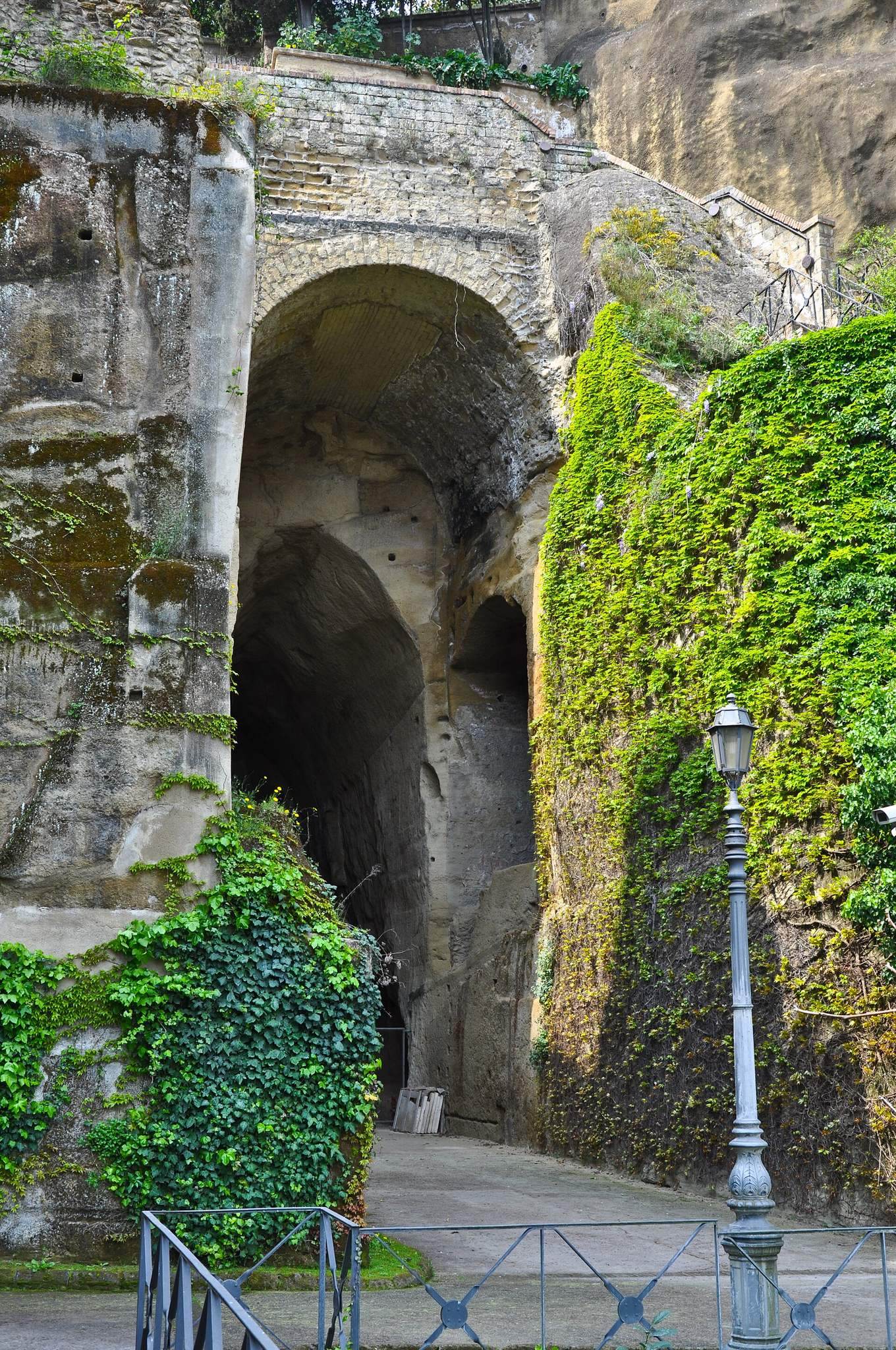
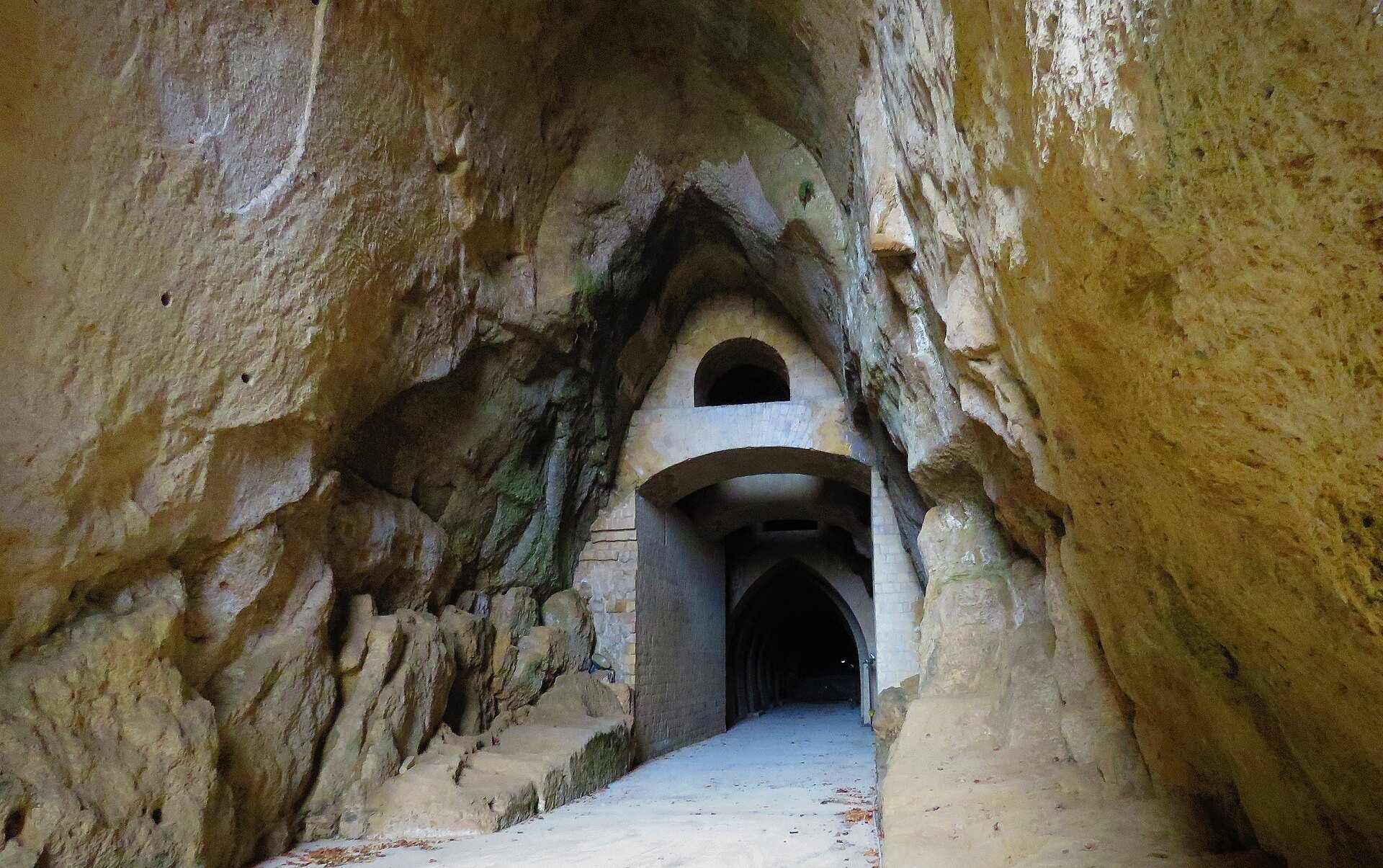
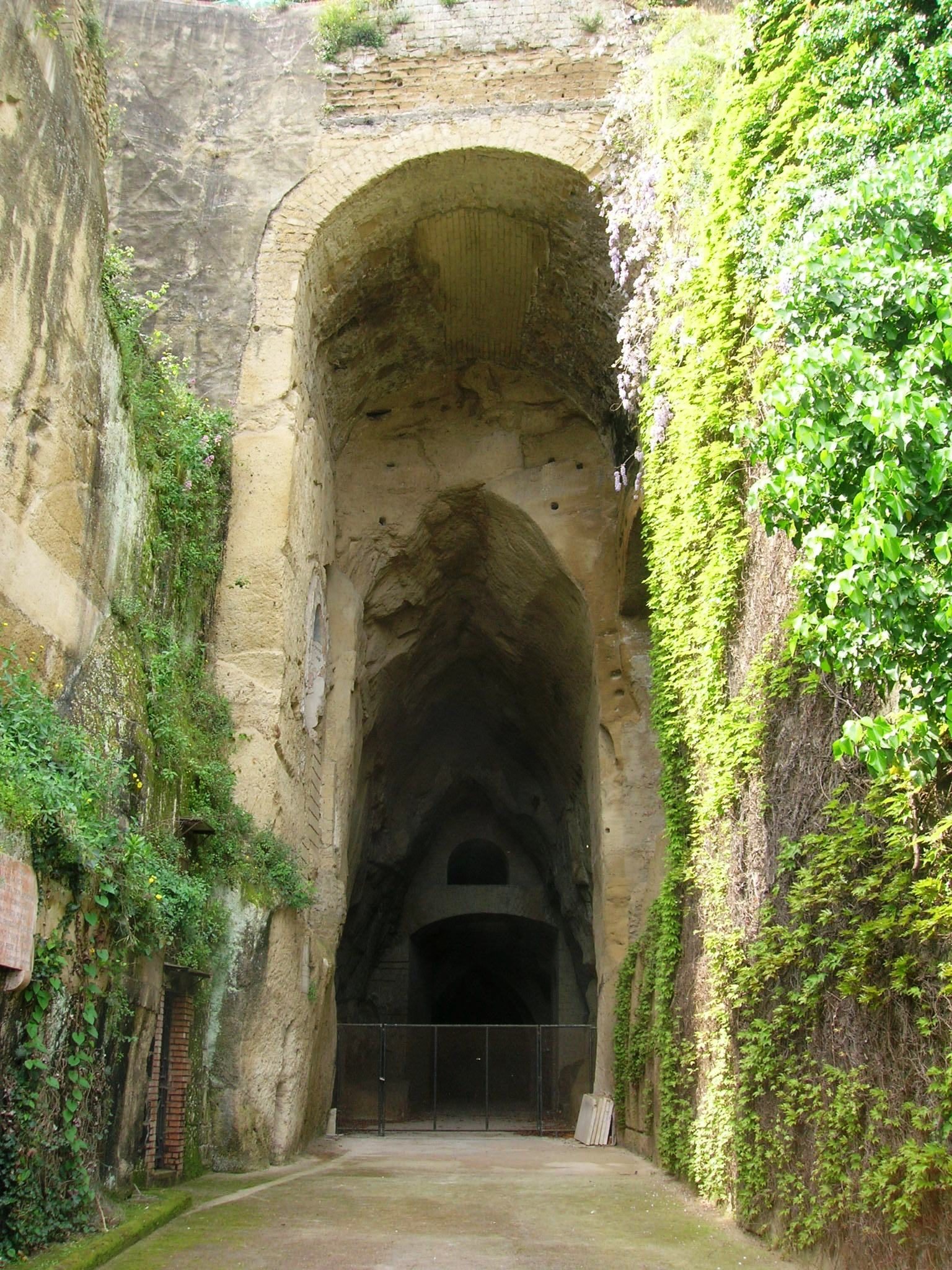
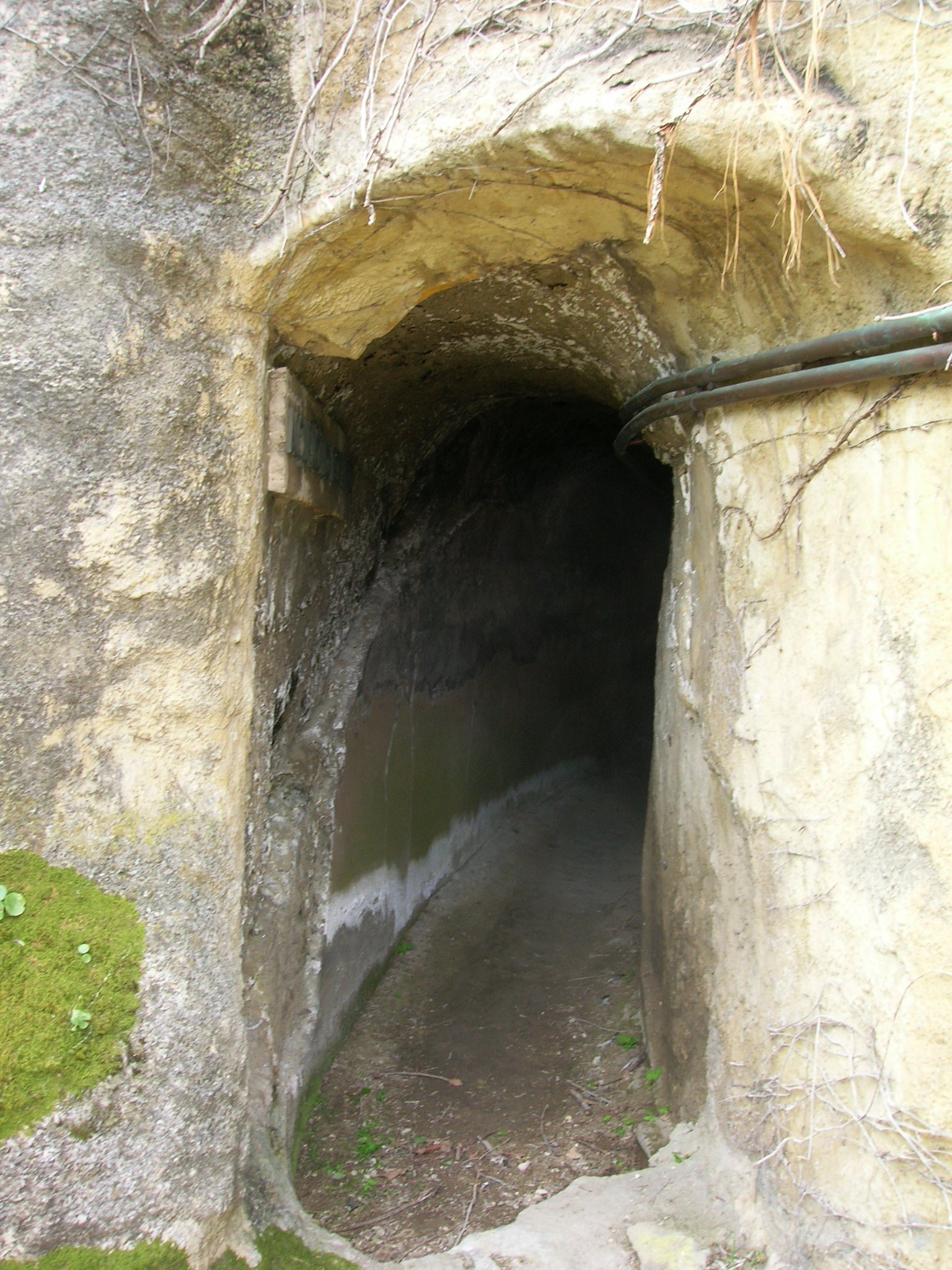
Crypta Neapolitana is a road tunnel cut through the volcanic tuff of Posillipo Hill. It runs broadly east-west between present-day Piedigrotta and Via della Grotta Vecchia, linking the Mergellina or Chiaia side of Naples with Fuorigrotta. The tunnel is approximately 711 metres long, although a measurement of 705 metres is also recorded. Its width varies from about 2.8 to 4.5 metres, while its usual height is approximately 5 to 5.6 metres and rises to as much as 16 metres near the exits.
The Roman tunnel and water gallery
Road passage
The main gallery preserves the scale of an ancient road route through the hill. Two inclined shafts, known as spiracula, connect the passage with the surface and served to provide lighting and ventilation. At the equinoxes, the setting sun can align with the two entrances and illuminate the tunnel from end to end. The passage was partly obstructed by the 1917 landslide and later affected by neglect, but it has been restored as an archaeological site.
Water gallery
A second gallery runs parallel to the road tunnel. Measuring about two square metres in section, it carried water from an aqueduct to the Phlegraean military installations and ultimately to the Piscina Mirabilis at Misenum.
Entrances and associated monuments
Eastern entrance and Vergiliano Park
The eastern entrance lies within Vergiliano Park at Piedigrotta, established in 1930. The park contains an ancient columbarium, a funerary structure with niches for cremation urns, traditionally identified as Virgil’s Tomb. It also contains the tomb of the Italian poet Giacomo Leopardi.
Chapel and religious remains
A small chapel stands near the eastern entrance. It was built on the remains of a sanctuary associated with Priapus and contains a surviving image of the Madonna Odigitria. Partially preserved wall frescoes from the fourteenth and fifteenth centuries depict the Madonna and Child and various saints.
Western entrance
The western entrance stands at the end of Via della Grotta Vecchia in Fuorigrotta. Together with the eastern entrance, it forms the opposite end of the east-west passage through Posillipo Hill.
Mithraic relief
A marble relief showing the tauroctony of Mithra, the ritual bull-slaying scene associated with his Roman cult, was found during restoration work in the fifteenth or sixteenth century. The relief includes the sun and moon and dates to around the third or fourth century AD. It is preserved in the National Archaeological Museum of Naples.