Chabot Cave: A Prehistoric Engraving Site in France
Site at a Glance
- Popularity
- Medium
- Country
- France
- Primary era
- Stone Age
- Eras represented
- Stone Age
- Civilizations
- Unclassified
- Site type
- Civic
- Remains
- Rock Art
On this page13 sections
History
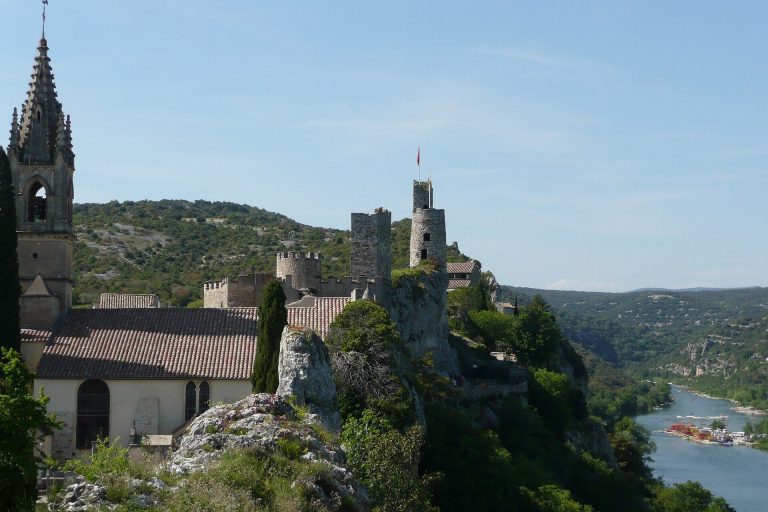
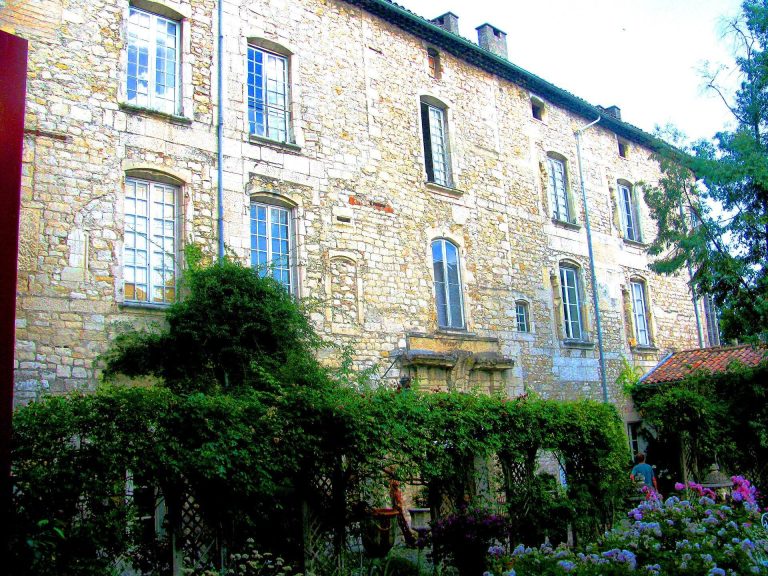
Chabot Cave is a prehistoric decorated cave on the southern bank of the Ardèche River at Aiguèze in Gard, France. Its engravings are generally attributed to the Solutrean, an Upper Paleolithic tool-making tradition, although the images have no direct date. The cave’s recognition as Ice Age art helped establish the acceptance of Upper Paleolithic cave art among scholars, before they recognized the paintings at Altamira.
Prehistoric Occupation
Excavations recovered stone and bone tools from a layer about a metre deep, estimated to be roughly 20,000 years old and assigned to the Solutrean. Bone and burned-bone samples place human occupation between 22,000 and 20,000 years before present. A separate result of 12,000 years is considered inconsistent and probably affected by the cave’s later use as a sheepfold. The earlier estimates are somewhat later than those suggested by portable finds, but fall within the locally assigned date range for the Early Solutrean.
A later Gallo-Roman layer, from the period when Roman and Gallic traditions met in Gaul, contained characteristic remains and a small bronze coin bearing the image of Constantine, a Roman emperor of the late third and early fourth centuries. After the cave’s discovery, collectors disturbed its deposits. In the 1890s, prehistorian Paul Raymond gathered flint objects and reindeer bones broken in a characteristic pattern, which he attributed to the Magdalenian, another Upper Paleolithic tool-making tradition.
Discovery and Changing Use
Teacher and prehistory researcher Léopold Chiron is usually credited with discovering the engravings in 1876, though dates of 1872, 1873, and 1878 have also been proposed. He excavated in 1878, made casts, and photographed the panels on glass plates. Chiron thought the marks on the right wall might represent birds with outstretched wings; on the left, he saw a drawn bow and five or six intertwined people. He reported the discovery in 1878 and again in an 1889 notice.
Chiron sought financial support from the National Museum of Archaeology, but its director, Gabriel de Mortillet, refused the request. Chiron consequently stopped excavating and could not complete his planned series of photographs. The cave is also known as Grotte Jean-Louis, a name associated with former owner Jean Louis Chabot. Chabot used it as a sheep and goat pen, and it remained a stable until 1940. From 1899, it was also called Grotte des Mammouths.
Recognition, Protection, and Research
In 1889, archaeologist Ernest Chantre considered the cave a Neolithic dwelling and thought the engravings might belong to that period. Their authenticity remained disputed for several years. Discoveries at La Mouthe and Pair-non-Pair in 1896 strengthened recognition of the antiquity of cave art. In 1899, prehistorian Armand Lombard-Dumas identified four stylized mammoths at Chabot. By the end of the nineteenth century, the engravings were understood as Ice Age art, and scholars accepted Chabot as a decorated cave from the Upper Paleolithic before they recognized Altamira’s paintings.
After prehistorian Louis Capitan identified horse figures on the right wall, Chabot became the first cave in Gard to receive protected historic-monument status, on 5 February 1903. Prehistorian Jean Combier carried out surveys and excavations in the 1950s and 1960s. The French state acquired the cave in 1992. Continuous monitoring of temperature and relative humidity at the walls and ventilation openings began in 2017; the temperature rises only slightly when people are present and quickly returns to its previous level.
Remains
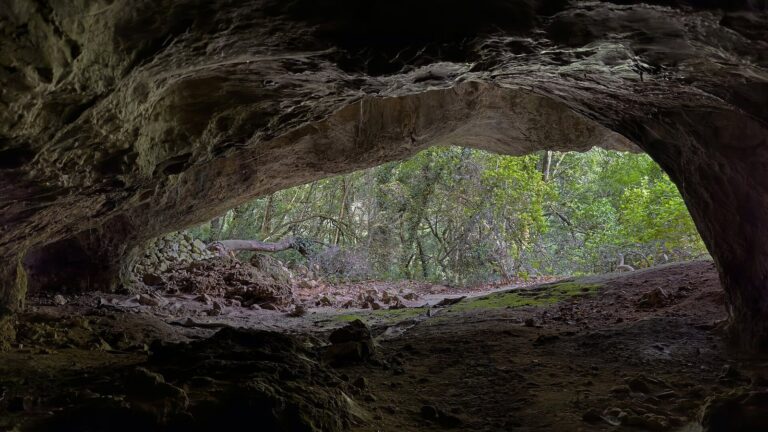
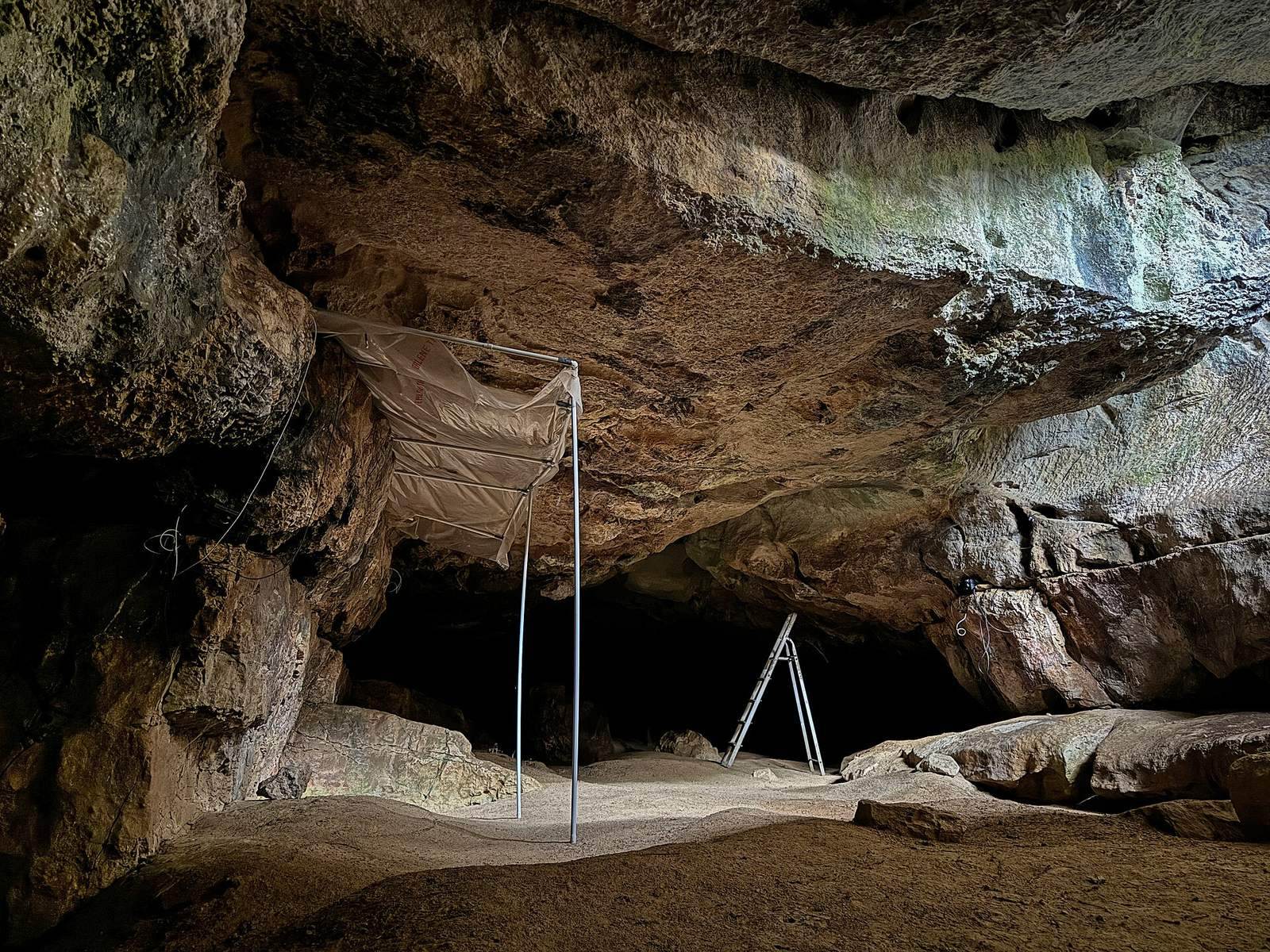
Chabot is a horizontal karst cave, formed as water dissolved limestone, with a known length of 215 metres. It developed in Urgonian limestone, a formation associated with shallow marine conditions, during the Barremian stage of the Early Cretaceous. At a bend near the exit of the Ardèche Gorge, its entrance lies 65 metres above sea level and about 15 metres above the present river.
Cave Layout
Entrance
The entrance opens generally eastward at the foot of a vertical cliff. A broad rock terrace lies in front of it, above a steep slope of debris, and shrubs and trees screen the opening. A wall closes the entrance, reflecting the cave’s former use as a livestock pen. In the late 1970s, two barred ventilation openings were added and the entrance structure was extended to the ceiling.
First Chamber and Passage
The first chamber is about 20 metres long and 5 to 6 metres wide. Its ceiling is 2 to 3 metres high and slopes slightly downward toward the back. Collapse raised the floor in the rear half, making that area difficult to reach. A tube-like passage runs southwest toward further chambers.
Engraved Panels
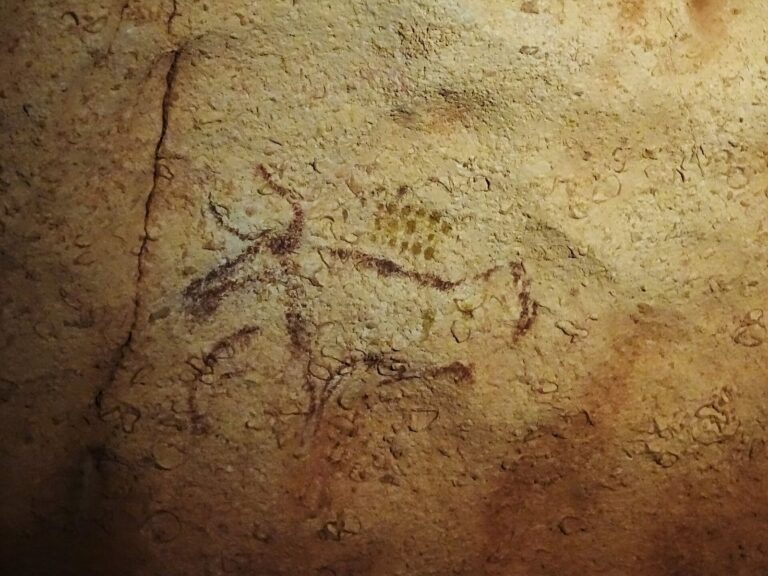
All the engravings are in the entrance area, which was once lit by daylight. They comprise 21 animal figures on two opposing horizontal panels, or friezes, and on the ceiling: 13 mammoths, three horses about 50 centimetres long, and five quadrupeds whose identities are uncertain. Suggested readings of the less clearly defined figures include bovines, a reclining deer or ibex, and a headless deer or goat. Four stylized, long-legged mammoths share a saddle-shaped head and curved belly line. This design became known as the Chabot type and was later identified at Pair-non-Pair, Chauvet, La Mouthe, and the Grand Cave of Arcy-sur-Cure. The engravings have no direct date; their Solutrean attribution is based on the tool-making tradition found in excavated deposits. During the Solutrean, the cave’s standing height was about 1.5 to 1.8 metres, allowing artists to reach the ceiling without a platform.
Left Frieze
The left panel measures about 0.7 metres high and 3 metres long. Its deeply incised lines overlap, with some cuts more than 5 millimetres deep. At the front, a mammoth faces outward from the cave; outlines of other mammoths overlap behind it. In 1968, a hammer was used to strike off several edges of the rock block carrying the panel.
Right Frieze
The right panel occupies two offset surfaces, about 3 metres and 3.5 metres long, separated by a diagonal fissure. Its figures overlap less than those on the left. A mammoth roughly 50 centimetres long faces outward, while a large bovine-like figure forms the central subject. Its hind legs cross the head of a reclining deer, shown with its legs tucked beneath it. Horses and other animals appear on either side, with another mammoth behind them. Pairs of vertical strokes are scattered across the panel.
Ceiling Engravings
The ceiling engravings cover about 3 square metres. They show two mammoths facing one another, joined by several lines.
Preservation and Conservation
Despite their exposed position near the entrance, the engravings remained exceptionally well preserved into the twentieth century. Near the end of the Laugerie Interstadial, a relatively warm interval within the last glacial period, washed-in sediment rapidly filled almost all of the cave’s front and shielded the panels. Natural processes, construction of the livestock pen, and archaeological excavation later cleared the deposits.
During conservation work in 1986, water entering above the left frieze was directed through channels and pipes into containers, so its volume and composition could be measured while the panel was kept dry. Conservators removed dirt, algae, calcite deposits, and cauliflower-like mineral growths, then reinforced unstable areas with epoxy resin. Traces of flexible casting compounds and wax point to an earlier mould made at an unknown date. A further mould made for a museum in 1990 left silicone and polyvinyl alcohol residues, which required extensive removal in subsequent years.