Dolmen D13: A Neolithic Passage Grave near Eext
Site at a Glance
- Popularity
- Low
- Country
- Netherlands
- Primary era
- Stone Age
- Eras represented
- Stone Age
- Civilizations
- Unclassified
- Site type
- Burial
- Remains
- Tomb
On this page16 sections
History
Dolmen D13 is a Neolithic passage grave near Eext in Drenthe, the Netherlands. Communities of the western group of the Funnel Beaker culture, a Neolithic society of northern and central Europe named for a characteristic pottery shape, built it between 3470 and 2760 BC. A passage grave is a burial chamber reached through an entry passage. The tomb’s unusual stairway entrance also gave it the alternative name Stairway Tomb.
Neolithic construction and later burials
The monument was built as a communal tomb during the Neolithic. A later burial was placed inside during the Renaissance, a period of cultural and intellectual renewal in Europe. It was probably the burial of a stillborn baby.
A burial excavated at the tomb in 1885 may also have contained bones. One interpretation identifies the burial as that of an unbaptized infant; another suggests an offering to the White Women, supernatural female beings in Dutch and neighboring folklore.
Discovery and eighteenth-century study
A stone seeker discovered the tomb in the mid-1730s. When stone seekers returned in 1756, they damaged the structure, removed two roof stones, and sold pottery vessels and axes they found to collectors. The antiquarian Joannes van Lier investigated the tomb that year and restored the chamber as far as he could. He reported pottery vessels containing burnt bones, as well as stone chisels and pottery.
Van Lier published a newspaper account of his investigation. Henrik Cannegieter, a school rector in Arnhem, wrote a study based on that account without visiting the tomb or contacting Van Lier. At the urging of his friend Arnout Vosmaer, Van Lier answered with five critical letters. Vosmaer published them in 1760 as the first book-length study devoted to a Dutch megalithic tomb. Cornelis van Noorde drew the tomb in 1756, Abraham Delfos made an engraving for Van Lier’s publication, and Petrus Camper produced another drawing in 1768.
Nineteenth-century recording and restoration
Johann Friedrich Heinrich Arends visited Drenthe in 1819 and described the tomb in a publication dated 1822. Leonhardt Johannes Friedrich Janssen, curator of the Dutch antiquities collection at the Rijksmuseum van Oudheden, the National Museum of Antiquities in Leiden, visited in 1847. His 1848 overview of Dutch megalithic tombs included descriptions and schematic plans.
The tomb was restored improperly in 1871. Three years later, Willem Pleyte and a photographer made a systematic photographic record of Drenthe’s megalithic tombs, and Pleyte produced lithographs from the photographs. In 1877, Rijksmuseum director Conradus Leemans made a separate visit to Drenthe, with Jan Ernst Henric Hooft van Iddekinge preparing plans for him. Leemans’s report was not published.
At the request of British antiquary and museum curator Augustus Wollaston Franks, William Collings Lukis and Henry Dryden surveyed 40 megalithic tombs in Drenthe in 1878. They made detailed plans and section drawings of D13. Their survey materials were held by several institutions and were not published as a complete work until 2015, when Drentse archaeologist Wijnand van der Sanden published them and judged their quality to be high.
Twentieth-century archaeology and protection
Willem Johannes de Wilde documented the surviving Dutch megalithic tombs between 1904 and 1906. D13 was restored in 1905 and documented by archaeologist Albert Egges van Giffen in 1918. Van Giffen excavated the tomb in 1927 and recovered little, since Van Lier’s earlier investigation had been thorough. He described its condition as excellent.
D13 has been a Dutch National Monument since 1978, a designation that protects heritage sites under the Netherlands’ national system. In 2017, photogrammetry, which uses photographs to create measured records and three-dimensional models, was used to document the tomb for an atlas of surviving Dutch megalithic tombs.
Remains
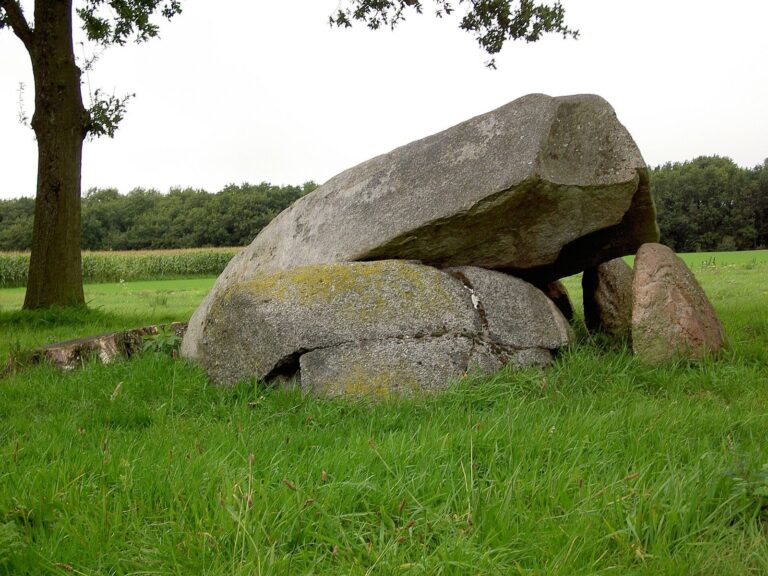
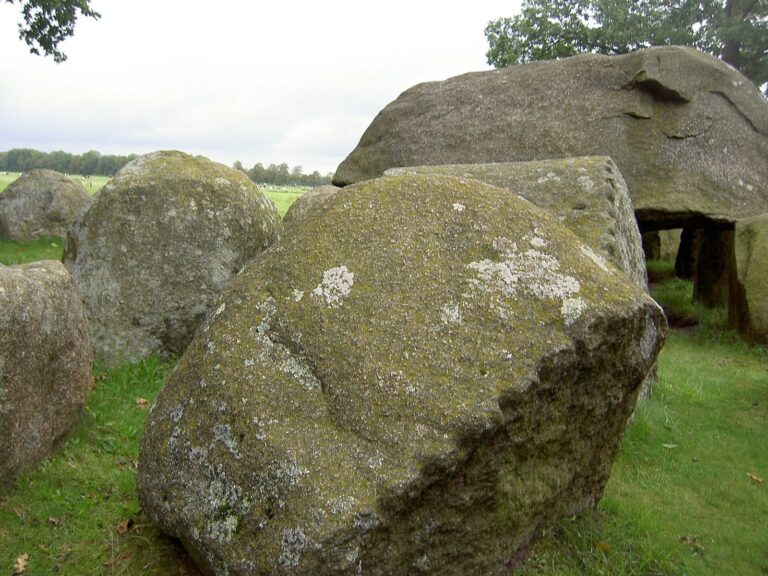
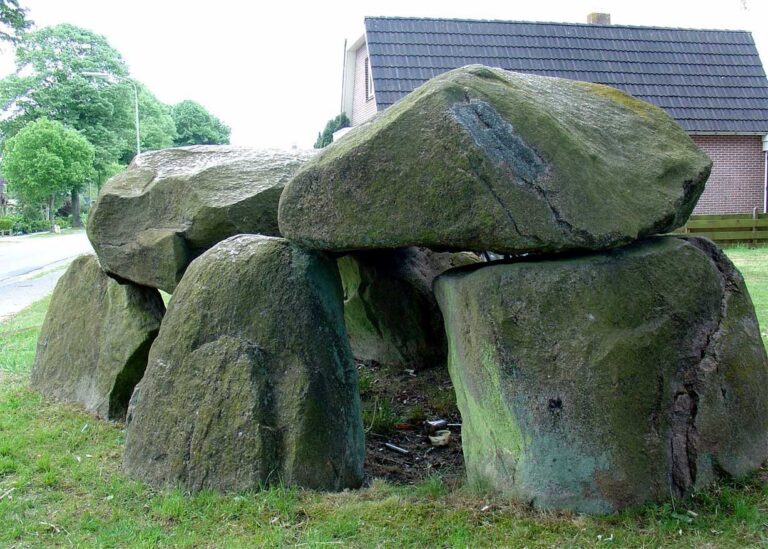
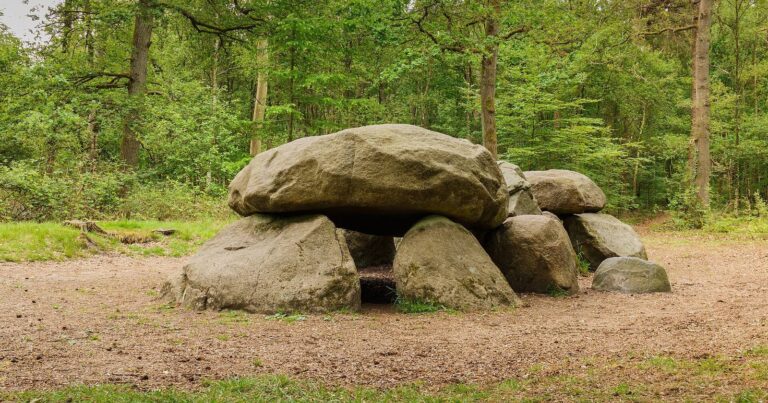
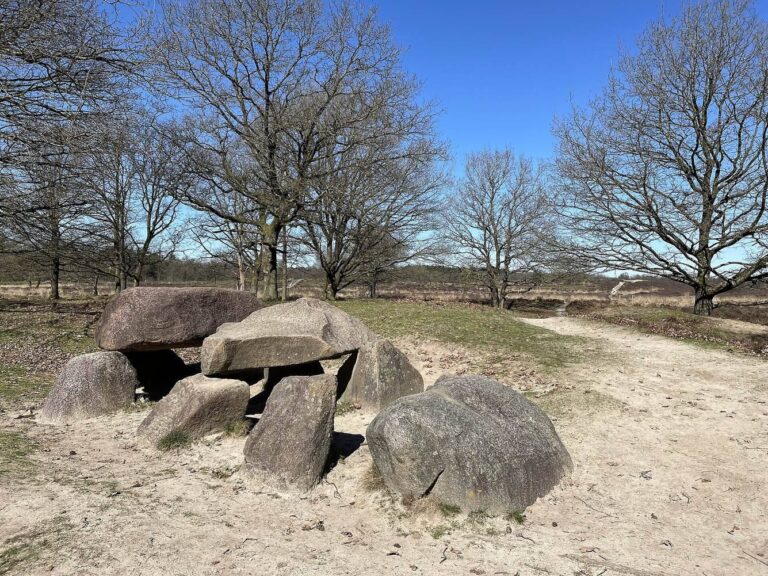
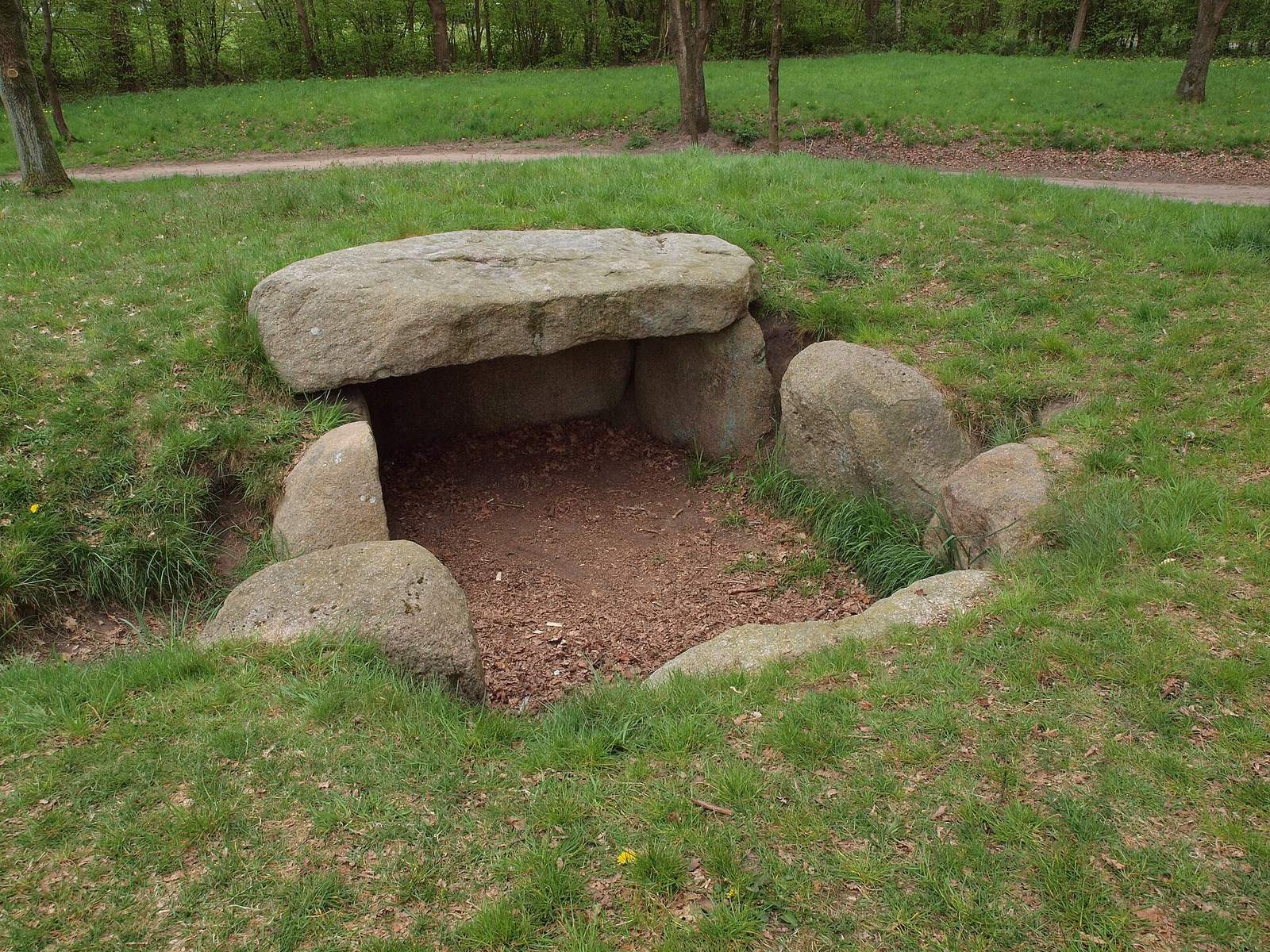
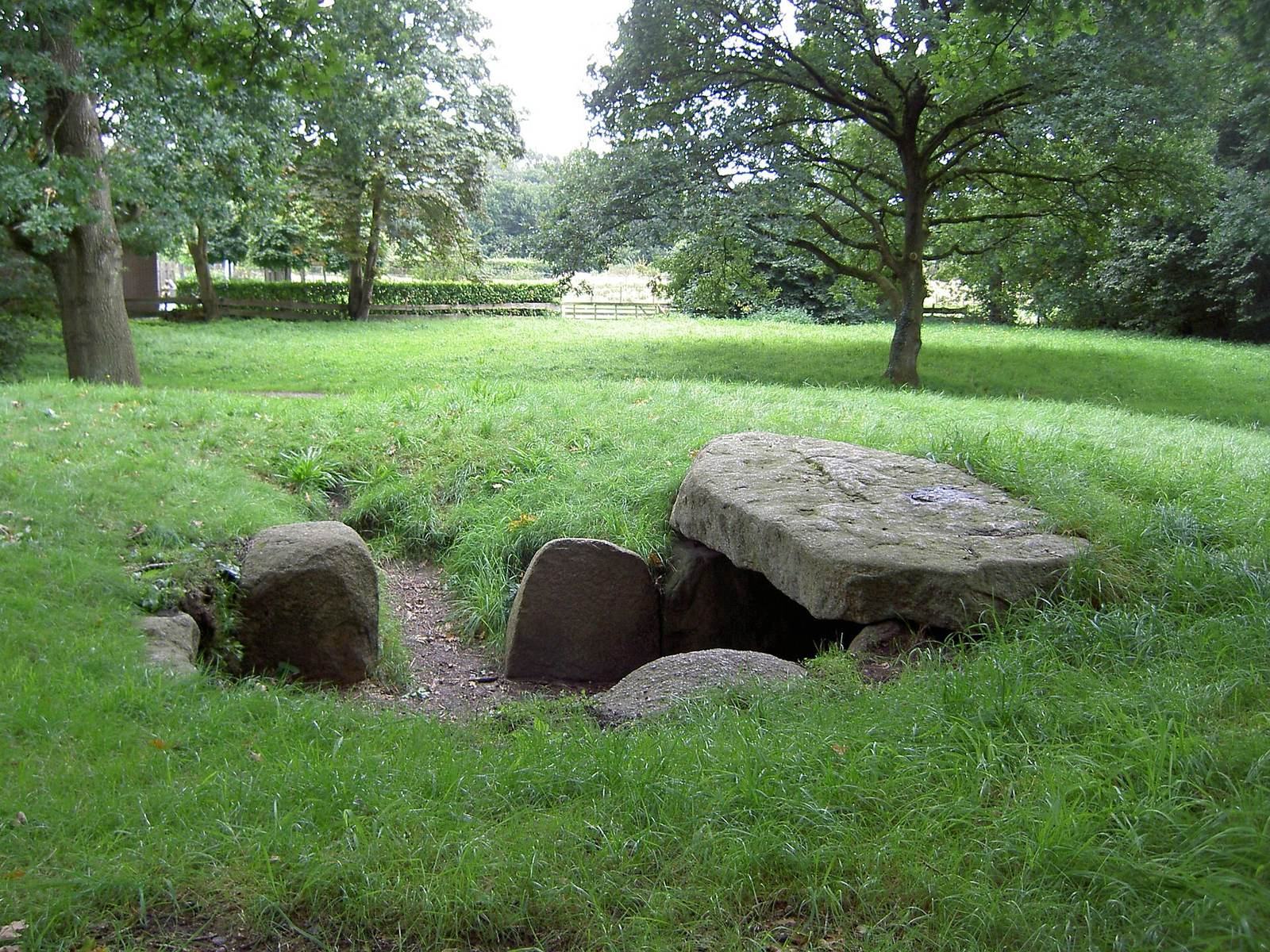
D13 is sunk into the ground, with its burial chamber still partly within the covering mound. The roughly rectangular stone chamber has a stepped entrance on its southern side. Its long axis runs from east-northeast to west-southwest.
Chamber and mound
Burial chamber
The chamber measures 4.3 metres long by 3.2 metres wide. Three pairs of upright stones form its long sides, with an end stone at each short end. The stones are unusually flat and fit closely together, so little packing masonry was used.
Covering mound
The mound was raised in three stages. The earliest reached halfway up the upright stones, the next reached the undersides of the roof stones, and the final stage covered the chamber completely. That last addition probably belongs to the End Neolithic, the final phase of the Neolithic, around 2850–2000 BC, rather than to the Funnel Beaker period.
Roof stones
A roof stone now rests on the chamber after being found displaced in Eext and reset during the 1976 restoration. Another is believed to lie underground near the village church.
Stepped entrance
The entrance lies on the southern long side, between the eastern and middle upright stones. Four steps lead down to a threshold stone at the chamber; two walls of rounded stones border the stairway. Each step consists of one or two flat stones, and entering required bending down. This arrangement is unique among Dutch megalithic tombs and rare across the wider Funnel Beaker region. Comparable stairway entrances are known at four tombs in Lower Saxony: Deinste 1, Krelingen, Sieben Steinhäuser C, and Meckelstedt 2.
Interior features and finds
Stone floor
Arends described a floor made of two layers of small field cobbles. Urns, stone wedges, and a stone arrowhead lay between the layers.
Objects attributed to the tomb
The Rijksmuseum van Oudheden in Leiden holds an old prehistoric handled vessel attributed to D13. A flint axe and a medieval pottery cup among the museum’s older finds may come from D13 or the neighboring tomb D12. A 1878 survey also listed an arrow and an urn in Leiden, and a bottle in Utrecht, as finds attributed to Van Lier.
Later pottery
A shallow, rounded Jydepot, a Danish earthenware bowl, was excavated at the tomb. It dates to the late 16th or 17th century.
Claimed inscriptions
Robert Dehon of Kadath has claimed that inscriptions are depicted on the chamber’s interior walls and ceiling.