Dolmen D14 (Eexterhalte): A Neolithic Passage Grave in the Netherlands
Site at a Glance
- Popularity
- Low
- Country
- Netherlands
- Primary era
- Stone Age
- Eras represented
- Stone Age, Modern
- Civilizations
- Dutch
- Site type
- Burial
- Remains
- Tomb
On this page12 sections
History
Dolmen D14, also known as Eexterhalte, is a Neolithic passage grave south of Eext in the Netherlands. Dated to 3470–2760 BC, it is associated with the western group of the Funnel Beaker culture, a Neolithic culture named for the shape of some of its pottery. A passage grave is a burial chamber reached through a passage.
Early records and nineteenth-century study
Stones from megalithic tombs were reused in medieval churches, to strengthen sea defenses in the eighteenth century, and as crushed granite for roads in the nineteenth century. A ban on damaging the monuments began in 1734, but stones continued to be taken afterward.
Antiquarian Johannes van Lier recorded the tomb in 1756. He also described a vessel containing a Roman coin, found outside a perimeter stone in 1750. Artist Cornelis van Noorde drew the monument in 1756, and scholar and artist Petrus Camper made another drawing in 1769.
In 1840, archaeologist Leonhardt Johannes Friedrich Janssen described seven capstones in place and reported that an eighth had been lost. After visiting in 1847, he published an overview of Dutch megalithic tombs the following year, with descriptions and schematic plans. An unsuitable restoration in 1871 removed much of the mound.
In 1874, archaeologist Willem Pleyte and photographer Jan Goedeljee made a systematic photographic record of Drenthe’s megalithic tombs; Pleyte also prepared lithographs from the images. Museum director Conrad Leemans visited Drenthe in 1877, and antiquarian draughtsman Jan Ernst Henric Hooft van Iddekinge prepared plans for him, but Leemans’s report was not published. Surveyors William Collings Lukis and Henry Dryden studied 40 tombs in 1878, including D14. Drenthe archaeologist Wijnand van der Sanden published their survey material in 2015.
Restoration and archaeological research
Physician and amateur archaeologist Willem Johannes de Wilde recorded Dutch megalithic tombs between 1904 and 1906. Although most of his records were lost, his documentation of D14 survives. Archaeologist Albert Egges van Giffen included the tomb in an atlas published in 1918 and investigated and restored it in 1927. That restoration altered the positions of some stones. Further restoration work followed in 1960, 1965, and 1996. D14 became a Dutch National Monument in 1978, a designation protecting heritage sites.
The Fries Museum identified an undated drawing of the tomb by painter Lawrence Alma-Tadema. Van der Sanden proposed that Alma-Tadema made it shortly after his second marriage on 29 July 1871, during a family visit to the Netherlands. The drawing led to a proposal to reverse changes made during the 1965 restoration.
In 2017, photographs were processed using photogrammetry, a method for deriving measurements and 3D models from images, for a digital atlas produced through a project involving the Province of Drenthe and the University of Groningen. One capstone slipped off its supporting stones in April 2019. A conservation group considered restoration options, while archaeological researchers at RAAP compared photographs, excavation plans, and written records. Their analysis showed that some stones had shifted during the 1927 restoration. Delft University of Technology also conducted a 3D-scanning pilot to help plan safe work. In 2021, ground-penetrating radar, which maps buried features using radio waves, was used to trace buried stone structures and support safer, less intrusive restoration planning.
Remains
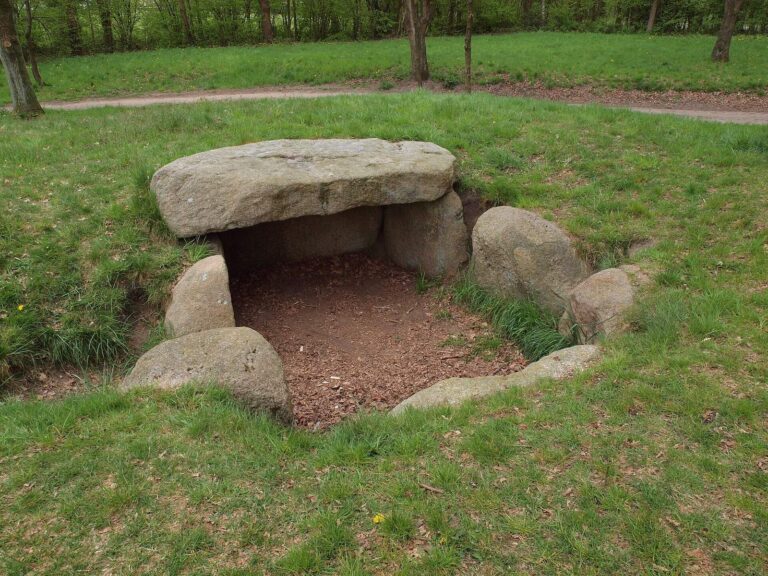
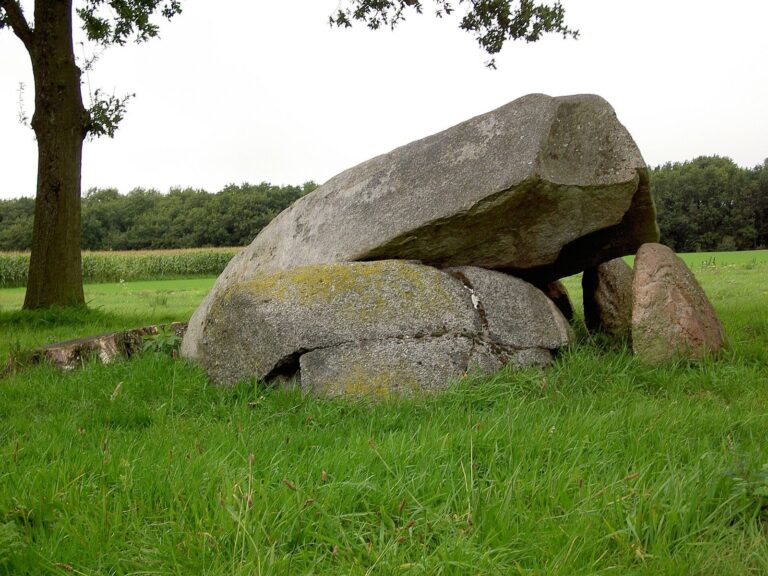
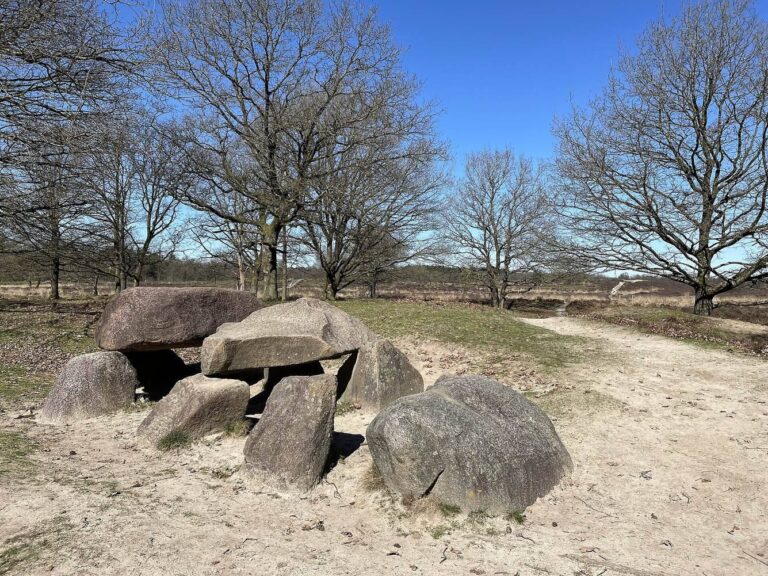
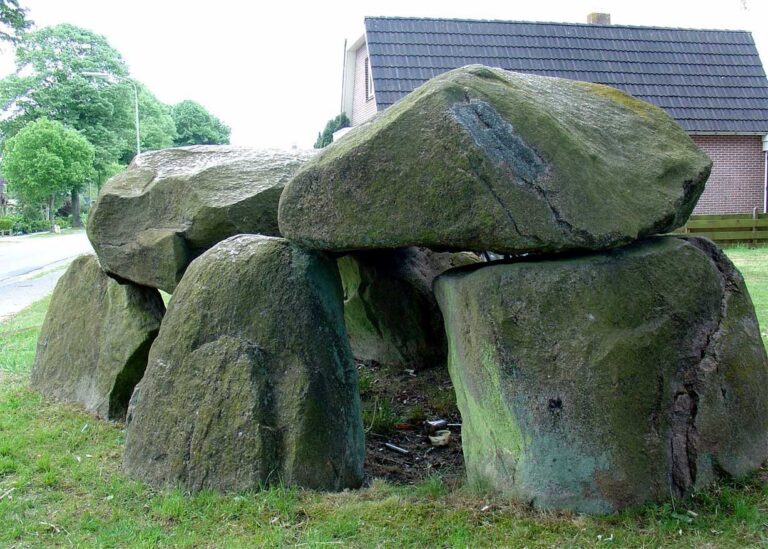
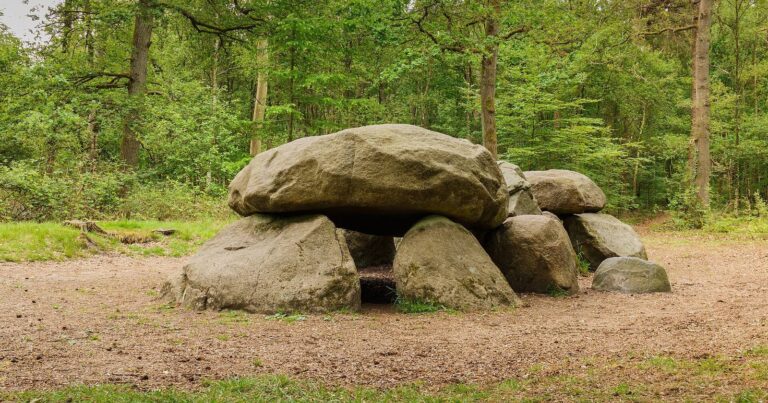
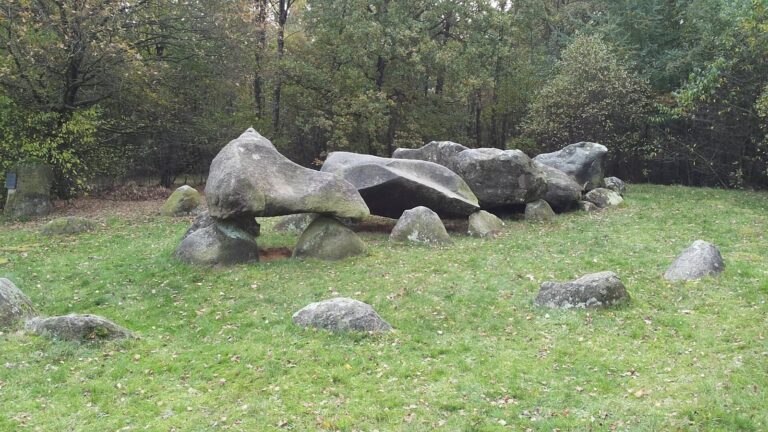
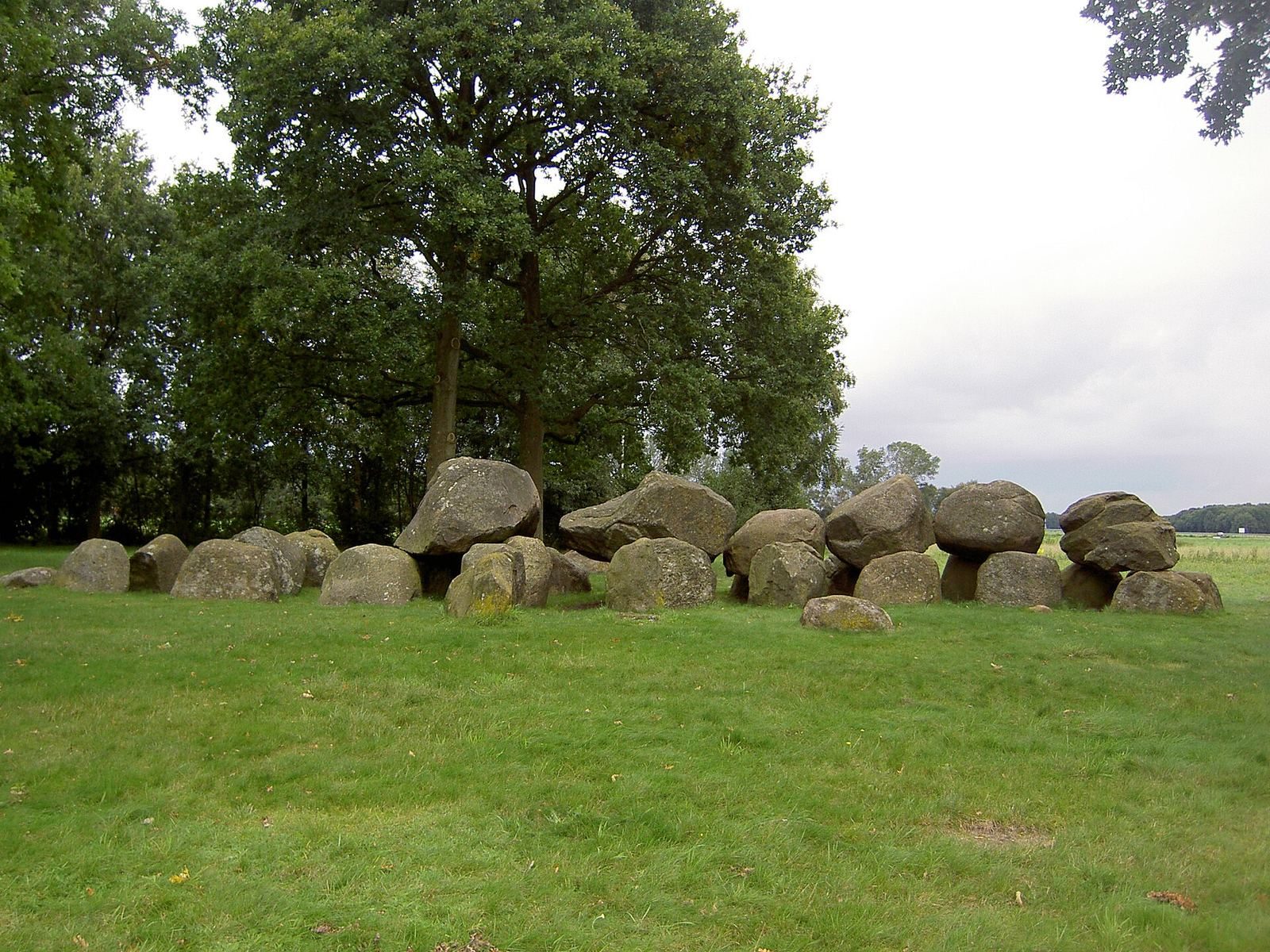
The remains form an elongated chamber of upright stones and large roof stones, set on a roughly east–west axis. A passage opens on the south side, and perimeter stones survive around the tomb. The site lies south of Eext, east of Stationsstraat, diagonally opposite the former railway station.
Layout and surviving stonework
Chamber
The slightly oval chamber measures 18 m long by 4.5 m wide. Nine pairs of supporting stones form its long sides, with a closing stone at either end, giving 18 supports and two end stones. Six capstones, the large stones spanning the chamber, remain on their supports. The original number is uncertain, with estimates of eight or nine. Two further capstone fragments lie inside the chamber, and blasting holes mark the fragments. Lukis’s 1878 Plan IX showed 20 supporting stones.
Southern passage
The entrance lies between the fourth and fifth supporting stones from the west. Its passage originally had two pairs of supporting stones. Three entrance stones survive, and concrete fills the socket associated with a passage stone.
Mound and perimeter
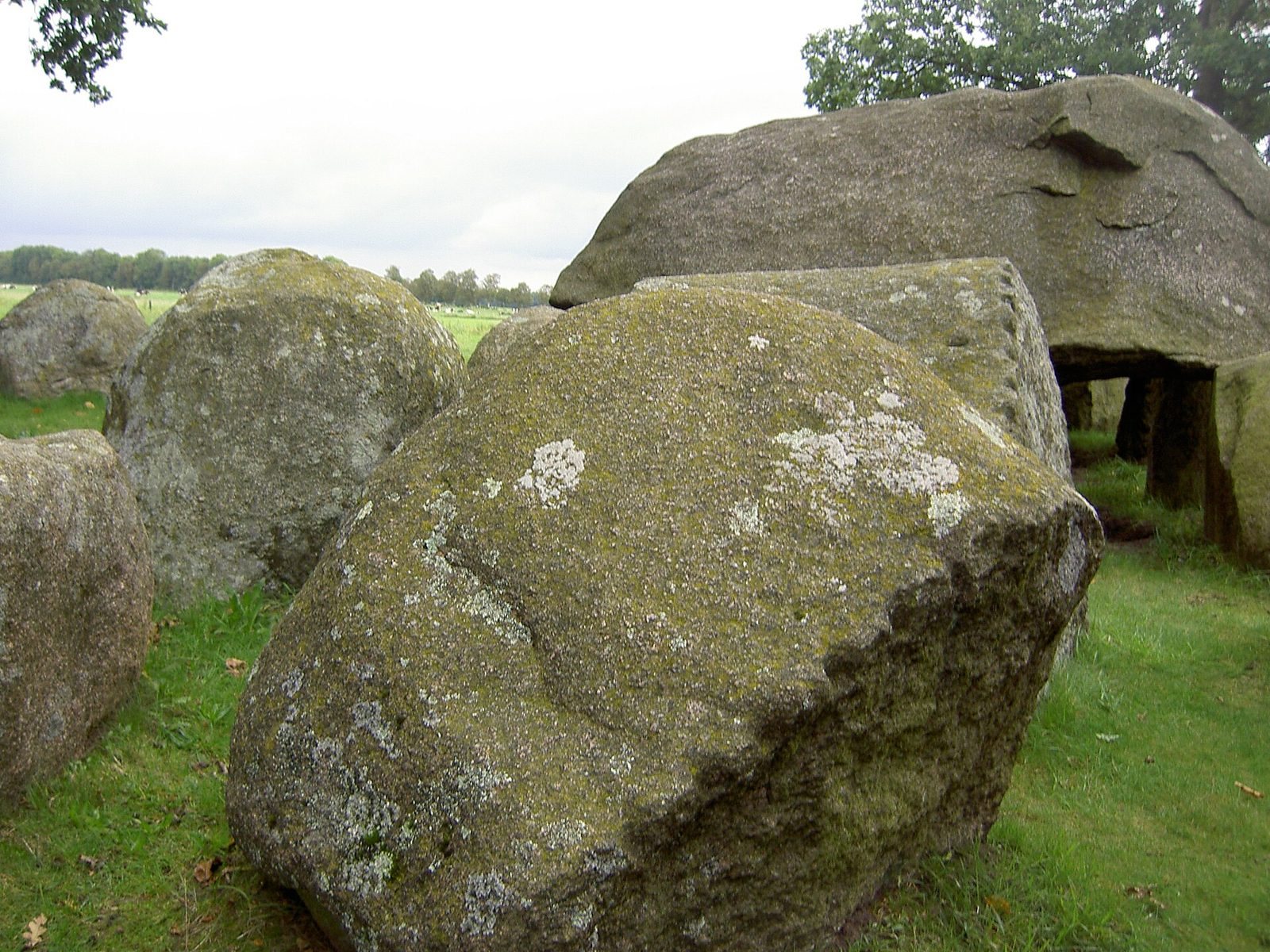
Eight perimeter stones survive. In 1878, the mound remained as traces; Lukis measured its extent as 30 m long and 18 m wide. Some stones have holes made to split them, either by using gunpowder or inserting wedges.
Excavated finds
Human remains and pottery
Excavation recovered 472 g of cremated human bone from one individual. The person’s age at death and sex could not be determined. Van Giffen’s 1927 investigation yielded more than 20,000 pottery sherds, including Funnel Beaker pottery and pieces from an end-Neolithic Bell Beaker.
Animal bone and Roman coin
Burnt animal-bone fragments from the tomb weigh 4.5 g; their possible use as tools or food offerings remains uncertain. A silver denarius, a Roman coin, is also associated with the finds. It dates to the reign of Augustus, the first Roman emperor, who ruled from 27 BC to AD 14.
Stone objects and fragments
Lukis donated numerous fragments, part of a stone axe, and an arrowhead to the Drents Museum. Pleyte held many fragments attributed to D14, including parts of four baking plates.