La Roche-aux-Fées: A Neolithic Dolmen in France
Site at a Glance
- Popularity
- High
- Country
- France
- Primary era
- Stone Age
- Eras represented
- Stone Age, Modern
- Civilizations
- Unclassified
- Site type
- Burial
- Remains
- Tomb
On this page12 sections
History
Neolithic origins and purpose
La Roche-aux-Fées is an elongated Neolithic megalithic monument in Essé, France. Its construction is generally assigned to the Late Neolithic, the later Stone Age before metal became widespread, most often around 3000-2500 BC. An earlier date of about 3500-3000 BC has also been proposed. The monument is usually classified as an Angevin-type portico dolmen, a debated category of prehistoric stone chamber with a roofed entrance, particularly associated with Anjou.
Its name means “Fairies’ Rock” and reflects local beliefs about its construction. A funerary purpose has been suggested, in part because similar stone chambers have contained human bones, but this interpretation has not been established at La Roche-aux-Fées.
Descriptions, damage, and protection
Abbé Roussel gave an early description in 1752, emphasizing the monument’s great size. Anne Claude de Caylus described and illustrated it in 1756, and the place-name later appeared on the Cassini map. Jean-Baptiste Ogée published a detailed account in 1778. Farmers dug at the monument without authorization in the late eighteenth century. In 1789, members of the Orléans Dragoons held festivities there and lit a fire inside, damaging the undersides of the roof stones.
Archaeological societies, especially the Ille-et-Vilaine Archaeological Society, made repeated visits from the first half of the nineteenth century and published reports. In 1840, La Roche-aux-Fées was classified as a historic monument. It was among the first 1,000 monuments to receive this status and one of only four in Ille-et-Vilaine at the time. Around 1855, visitors believed to be English damaged the upper stone of the entrance structure, which had apparently been unstable.
Fairy traditions and later interpretations
Local legend tells that fairies settled in Essé and built a home together. When the work was finished, the builders failed to warn the fairies still carrying stones. Those fairies dropped their loads, which the story connects with the standing stones of Runfort and the Trois-Marie heath. Other beliefs held that the monument’s stone count changed. In one marriage custom, newlyweds circled it at the new moon in opposite directions, women clockwise and men counterclockwise, and counted the stones. Matching totals were taken to promise a lasting marriage. A stone said to rock was also associated with marital fidelity.
A tradition collected in the nineteenth century described the monument as a fairy-built cave that sheltered the souls of good people. The fairies were said to have left after the trees died more than two centuries earlier, and wind passing through the stones was understood as the souls’ lament. Another belief warned that anyone who destroyed the monument would die within a year. Some people regarded it as a fairy temple; others thought it was the tomb of a Roman general. Ogée rejected the temple interpretation but recorded the belief about the general. Nearly a century later, Arthur de La Borderie criticized the confident rejection of the peasants’ poetic story in favor of what he called an educated error.
In 1904, Adolphe Orain introduced his tale The Holly Fairy with a description of the monument. In the story, a woodcutter and his wife bury a pot inside it and receive a magic purse that continually provides gold, on condition that they never open the pot. Other local tales describe a farmer thwarting a fairy’s attempt to exchange a newborn, either with a sieve or by blinding the fairy with boiling water. A yearly gathering is held at the site on the morning of the winter solstice. The Roche-aux-Fées community of communes, a French body through which municipalities cooperate, took its name from the monument.
Conservation
In 2010, the French Laboratory for Research on Historic Monuments assessed the structure and recommended conservation work. Foot traffic was loosening stones, damaging the bases of some blocks, and widening cracks. In 2018, stone and earth were laid over a permeable fabric around and inside the monument to level the ground. A low fence, 99 metres long, was also installed, and signs warn of the structure’s fragility.
Remains
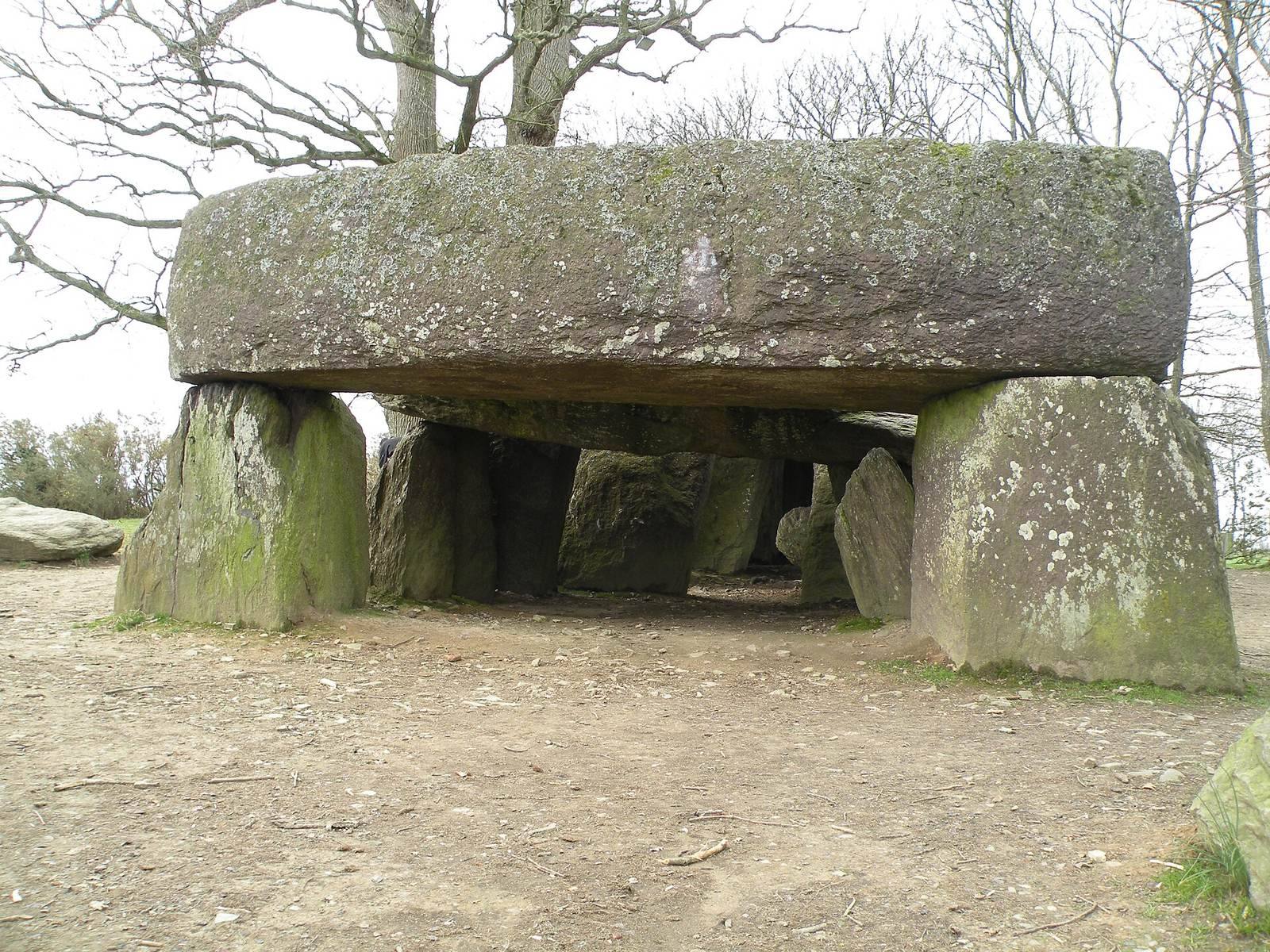
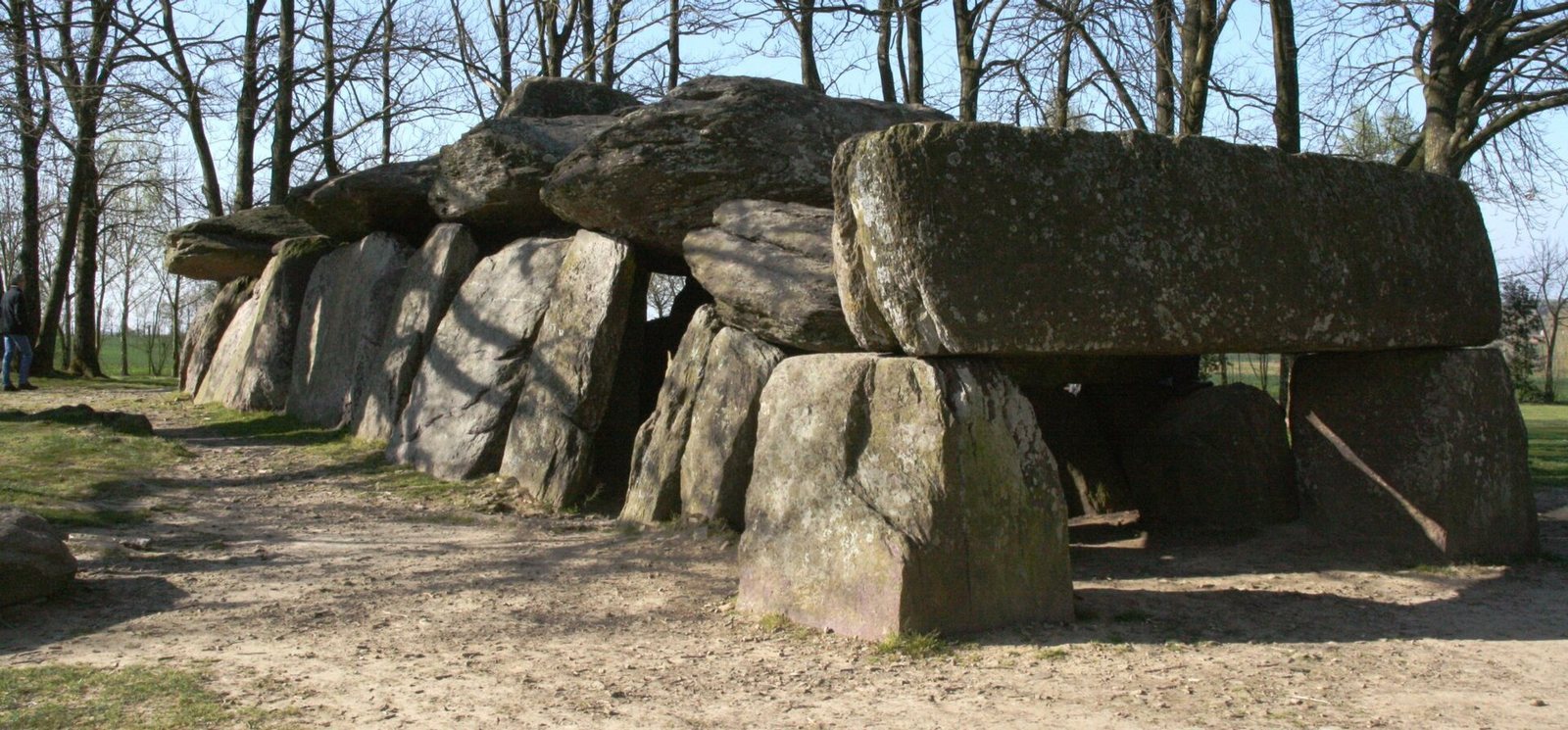
The monument forms a nearly rectangular stone structure about 19.5 metres long, 4.70 metres wide, and up to 4.10 metres high. Its elongated chamber runs roughly from north-northwest to south-southeast. It stands at about 70 metres above sea level in the Seiche valley, near the boundary with Theil-de-Bretagne and about three kilometres south-southeast of Essé village. It is the only megalith in Essé; most dolmens of this type are found in Anjou.
Chamber and stone construction
Internal layout
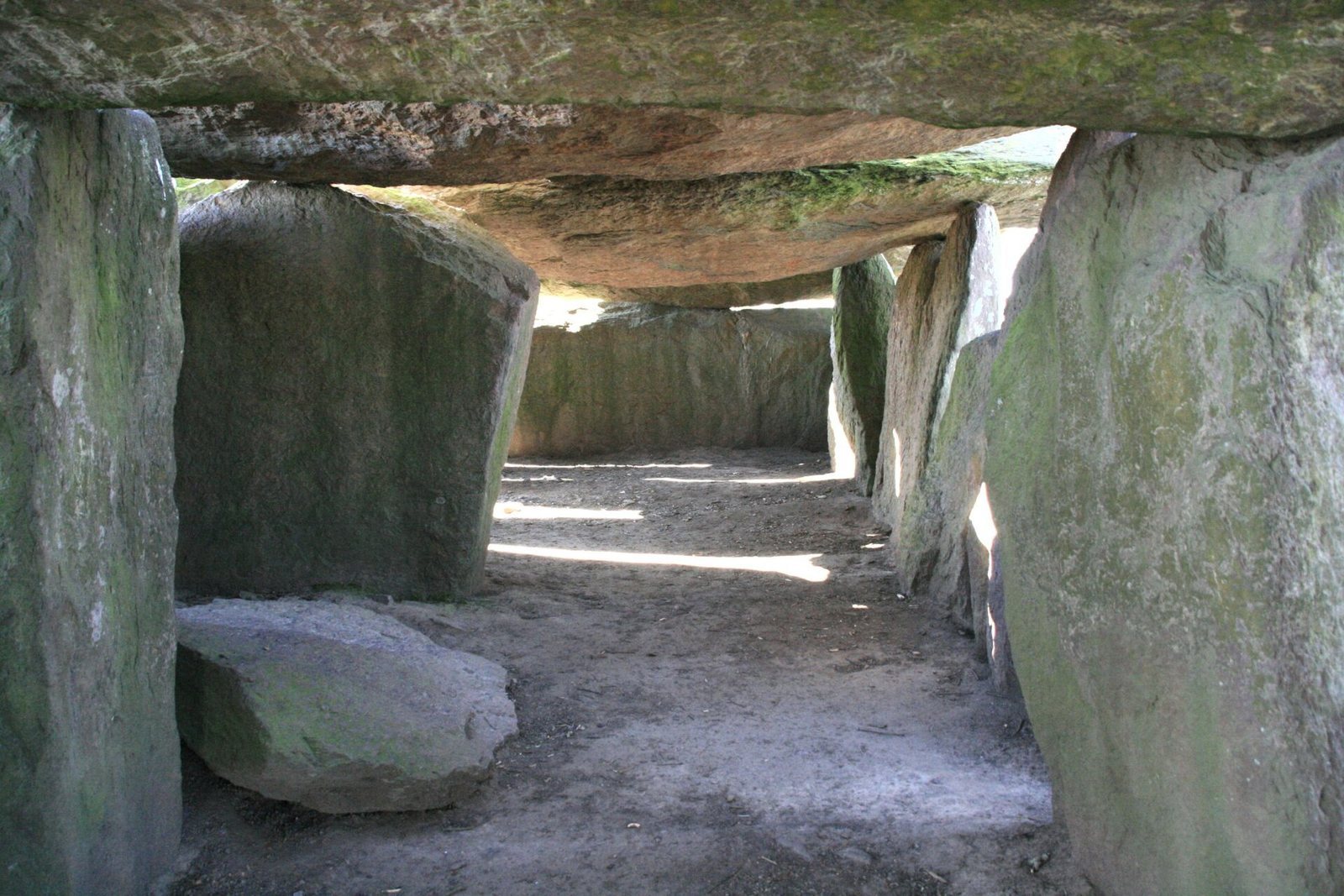
The entrance leads first to an antechamber about 3.5 metres long, set slightly lower than the main chamber. Two crosswise slabs form the doorway between them. On the south side of the main chamber, three further crosswise stones divide the space into four parts. The passage is about four times as long as it is wide.
Stone framework
Counts of the stones usually range from 40 to 42. One planned arrangement shows 41: nine horizontal roof slabs, including one much smaller slab, and 32 upright stones, among them a leaning block and a larger stone at the end. Another stone lies apart, encircled by tree roots. The six largest roof slabs are estimated to weigh 40-45 tonnes each. The stones are purple schist, and the nearest known outcrop is in the forest of Theil, about five kilometres away. Moving the heaviest slabs would have required a substantial effort.
The stony ground has led to the suggestion that a mound of rubble, or a stone cairn, once covered the monument. This interpretation has not been established through excavation.
Entrance and solar alignment
Entrance portico
The entrance structure has a lintel about 5.5 metres long, resting across two upright supports roughly one metre high. Together, the supports and lintel form a roofed porch at the entrance.
Winter-solstice light
The monument’s alignment corresponds to sunrise at the winter solstice. When the sky is clear, a small patch of sunlight appears on the end stone at dawn, moves down to the ground, lengthens, and progresses toward the exit. The effect lasts only a few minutes on the solstice and can also be seen on the days immediately before and after.