Santo Stefano del Cacco: A Roman Catholic Church in Rome
Site at a Glance
- Popularity
- Medium
- Country
- Italy
- Primary era
- Early Modern
- Eras represented
- Medieval, Early Modern, Modern
- Civilizations
- Papal States
- Site type
- Religious
- Remains
- Church
On this page20 sections
History
Santo Stefano del Cacco is a Roman Catholic church in Rome, Italy, dedicated to Saint Stephen, traditionally regarded as the first Christian martyr. It stands in the Pigna district and belongs to the parish of Santi XII Apostoli in the Diocese of Rome. The church’s foundation date is unknown, and its history includes successive medieval, monastic, and Baroque phases.
Origins and ancient setting
The church stands on the ruins of a sanctuary to Isis and Serapis, Egyptian deities, built in 43 BC. Traditions offer different dates for the church’s beginnings, associating it with Pope Honorius I in 630, Pope Hadrian I (772–795), or Pope Paschal I (817–824). It was certainly standing by Paschal I’s pontificate, when a mosaic depicting him was added to the apse, the curved recess at the end of the church.
The name del Cacco probably derives from macaco, a popular term for an Egyptian statue associated with the sanctuary. Another proposed explanation connects it with Cacus, a fire-breathing giant in Roman mythology. The church was also called Santo Stefano de Pinea. That name has been linked to a large ancient pinecone found nearby and later transferred to the Vatican; the Pigna district is likewise said to take its name from the pinecone.
Medieval records and restoration
Pope Paschal II (1099–1118) oversaw restoration of the apse. Further work followed in 1160, when the Romanesque bell tower was built and the portico rebuilt. A 1192 catalogue of Roman churches lists the church as Santo Stefano di Pinea.
In 1345, an Egyptian statue was found among the ruins of the nearby sanctuary. It is thought to show Thoth, an Egyptian god associated with writing and wisdom, in baboon form, though it has also been identified as Anubis. The statue is now in the Vatican Museums.
Sylvestrine and Baroque phases
Pope Pius IV assigned the church to Sylvestrine monks in 1563. The Sylvestrines are a Benedictine congregation associated with their founder, Silvestro Guzzolini. They made the church their Roman headquarters and soon carried out a minor restoration. A more extensive renovation began in 1607, destroying the apse mosaic and the portico.
Between 1638 and 1643, work gave the church a Baroque appearance. In 1685, the Sylvestrine abbot Giuseppe Bianchi established devotion to the Most Holy Name of Mary, a Catholic devotion to the Virgin, and founded a confraternity that fed the poor. The association received formal approval in 1688 and moved to Santissimo Nome di Maria al Foro Traiano in 1694.
Modern history
Further restorations took place in the eighteenth and nineteenth centuries. When the Italian state confiscated the monastery in 1870, the monks were allowed to keep the church. In the 1930s, the monastery became the Sylvestrine congregation’s general curia, or central administrative headquarters, under the name Santo Stefano Protomartire. The Sylvestrines later ceased to be a separate order and became a congregation within the Benedictine order.
In 1940, plans to expand the central police station in the neighboring former monastery of Santa Marta threatened the church with demolition, but the proposal was averted. The church’s interior and façade were restored in 2007.
Remains
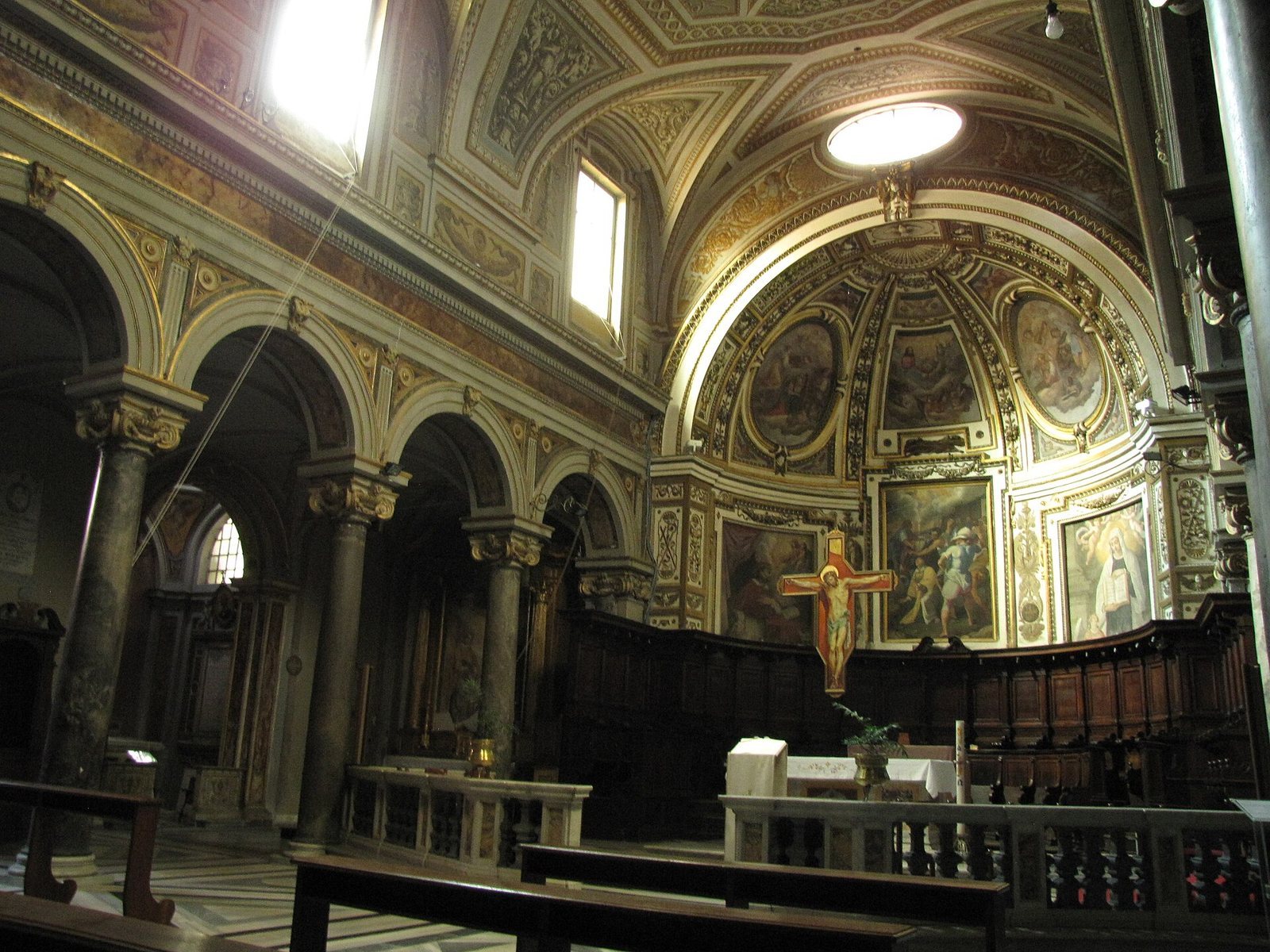
The church has a basilican plan, a long layout with a central nave and two side aisles, and no transept, or crosswise section. The aisles lead to a semicircular apse. Its present appearance combines Baroque treatment with earlier architectural features, including a Romanesque bell tower.
Plan and exterior
Ancient columns
Twelve ancient columns stand in the nave. Four are eastern granite, one is veined marble, five are gray marble, and two are green-veined marble. They probably came from the sanctuary of Isis and Serapis on whose ruins the church was built.
Façade and entrance
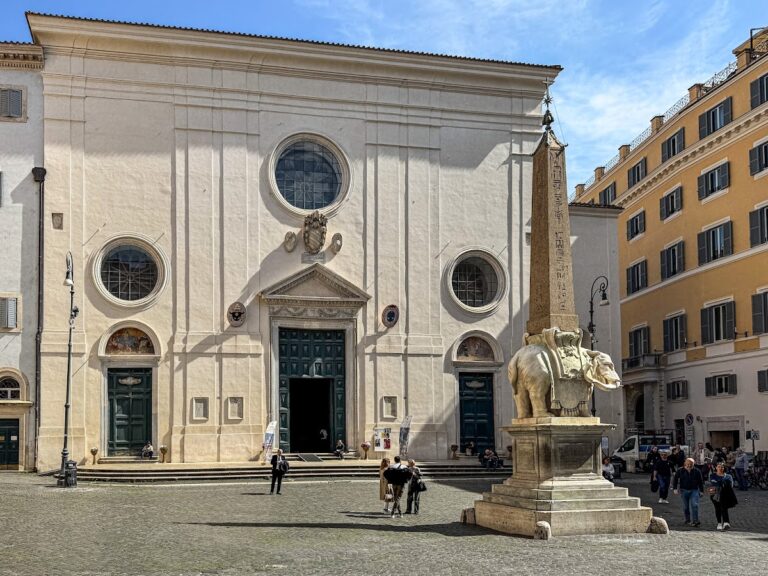
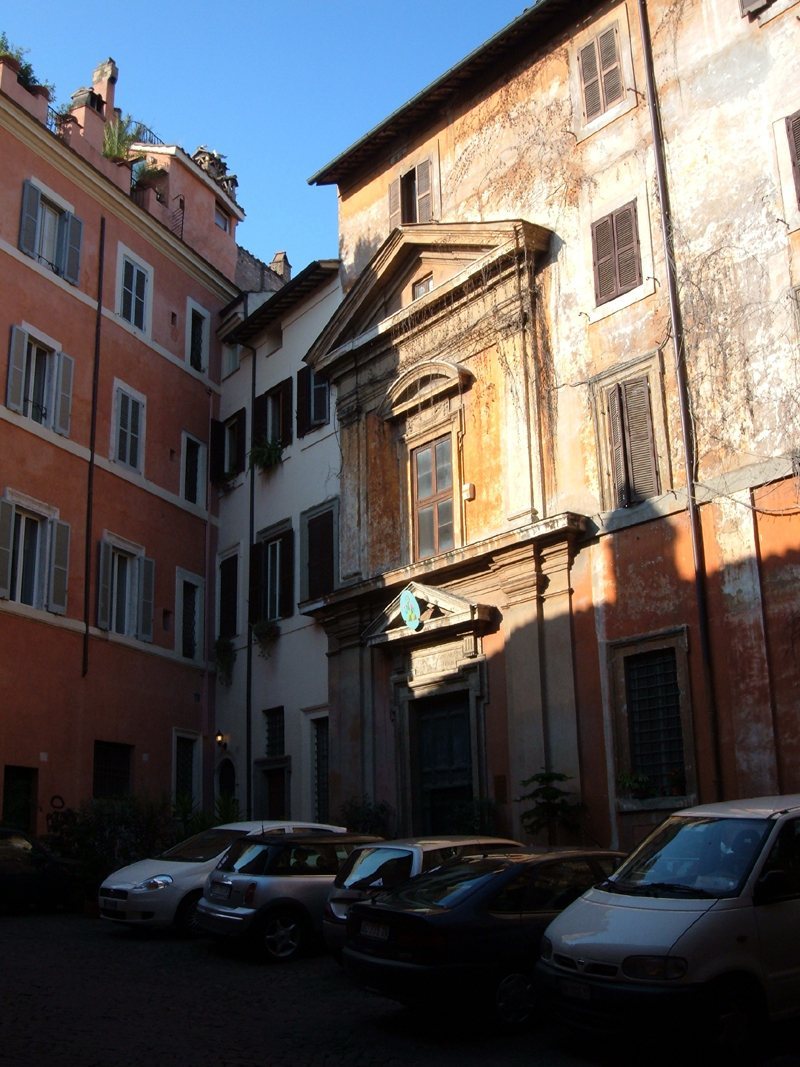
The two-storey façade is substantially obscured by adjoining buildings. Its lower storey has Doric pilasters and the upper one Ionic pilasters, classical column styles. A rectangular window on the upper level is topped by a curved pediment decorated with garlands. The triangular pediment crowning the façade contains a small window.
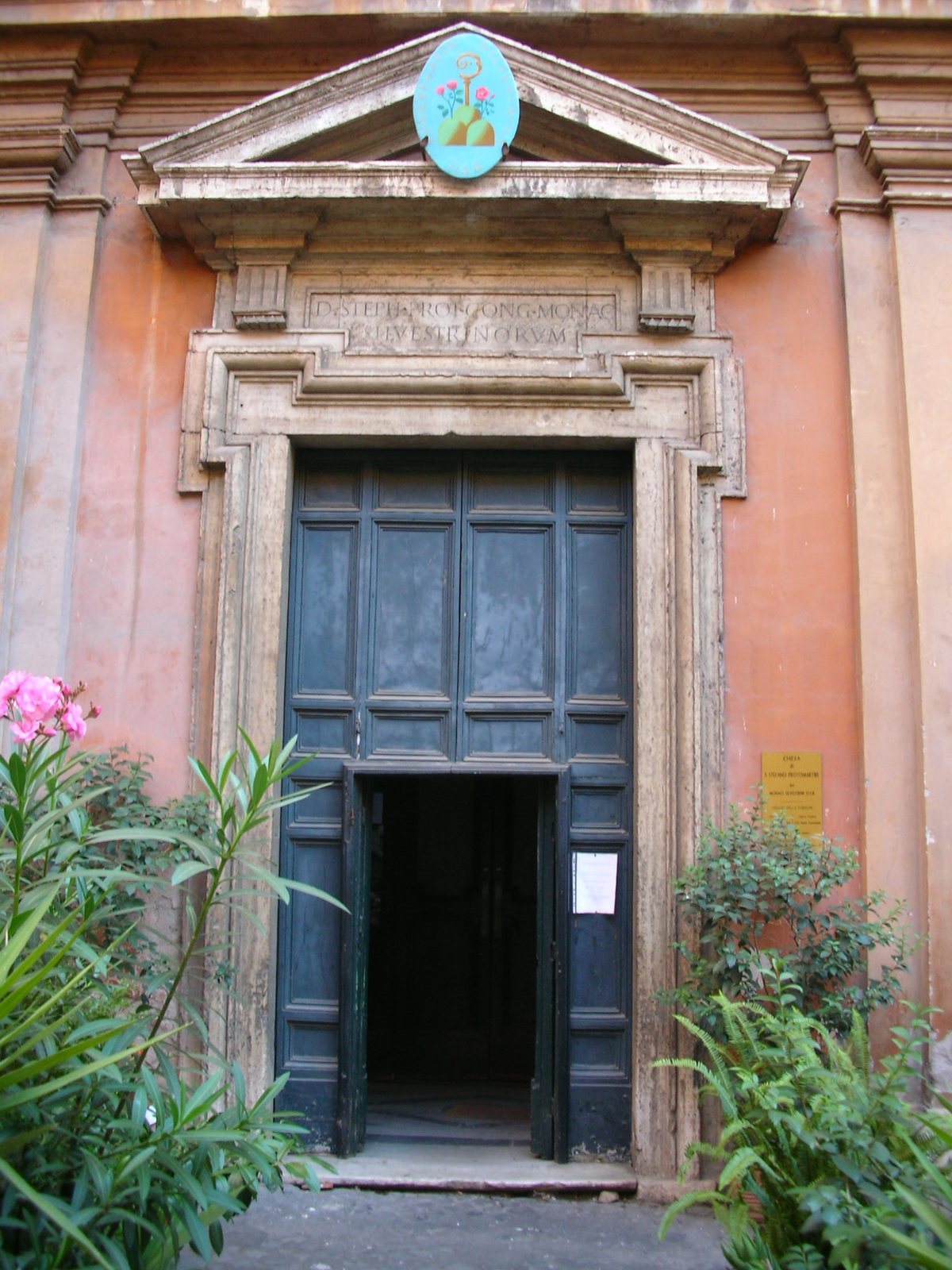
The entrance portal is made of travertine and has pilasters at either side and a triangular pediment. Its inscription dedicates the church to Saint Stephen the Protomartyr and names the Sylvestrine monastic congregation. Two basalt lions from the ancient sanctuary once stood beside the portal. Michelangelo later placed them at the base of the Cordonata, the broad ramped approach to Rome’s Capitoline Hill.
Bell tower
The Romanesque bell tower is incorporated into the adjoining monastery. Its three storeys are divided by cornices decorated with dentils, small tooth-shaped projections, and modillions, projecting architectural supports. A stylized pinecone forms its finial.
Interior decoration
Ceiling and floor
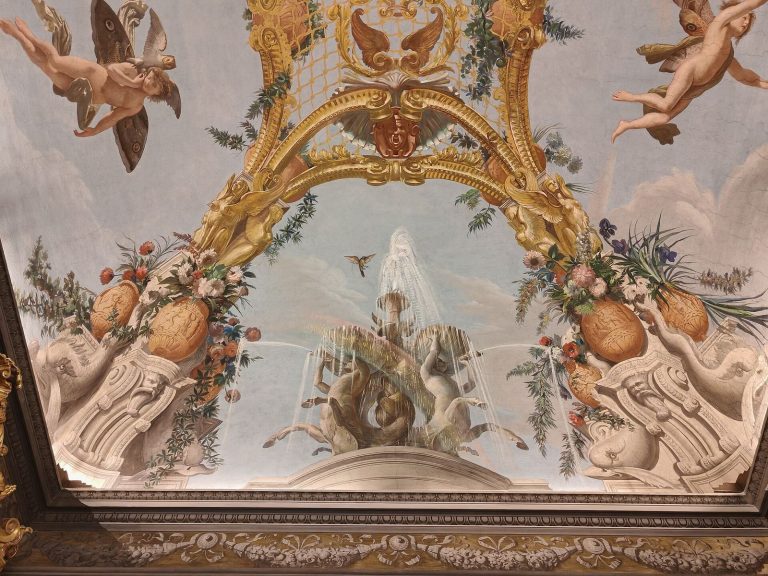
Paintings added in the mid-nineteenth century decorate the ceiling. The central fresco depicts the Apotheosis of Saint Benedict, an image of the saint’s glorification. The floor was relaid during the same period with marble salvaged from San Paolo fuori le Mura after a fire damaged that church.
Apse
The apse contains Cesare Nebbia’s central fresco of the Martyrdom of Saint Stephen. Frescoes of Saint Charles Borromeo and Saint Frances of Rome by Cristoforo Casolani flank it. Casolani also painted three scenes in the apse’s semi-dome: the Trinity between two images of angel choirs. Rocco Solari made the apse’s gilded stucco decorations.
Chapels and altars
Right-hand chapels
The first chapel on the right is dedicated to the Guardian Angel. Its painting shows the angel leading a child by the hand and is a copy of a work by Pietro da Cortona. The second chapel, now dedicated to Saint Joseph, was formerly dedicated to the Nativity. Its painting of the Death of Saint Joseph is by an anonymous eighteenth-century artist.
Pietà fresco
Beyond the second chapel on the right is an early-sixteenth-century fresco of a Pietà, a scene of Mary mourning the dead Christ, by Perino del Vaga. It is described as the artist’s first independent work. Giorgio Vasari praised its skill and beauty.
Altar of the Virgin Mary
An altar on the right is dedicated to the Virgin Mary as Comforter of the Afflicted. Its niche holds a wooden statue of Mary carrying the infant Jesus on her right arm. She wears a white silk dress and blue mantle. Tradition holds that the statue wept shortly before Napoleon’s invasion of Rome in 1796.
Left-hand chapels
The first chapel on the left is dedicated to the Holy Face of Jesus, a devotional image of Christ’s face, and was formerly dedicated to the Annunciation. Above its altar is a 1945 image of Veronica’s Veil, traditionally understood as a cloth bearing Jesus’s image, painted by Sister Zeffirina del Sacro Cuore. Two columns of red Sicilian jasper frame the altar. Giovanni Baglione painted the side-wall scenes: Saint Charles Borromeo and Saint Philip Neri on one side, Paul the First Hermit and Saint Stephen on the other.
The second chapel is dedicated to the Blessed Sacrament, the consecrated bread and wine of the Eucharist. It was formerly dedicated to the Sylvestrine founder Silvestro Guzzolini. Its painting, attributed to Carlo Maratta, shows Saint Benedict handing the monastic rule to Saint Silvestro; two circular paintings of scenes from Silvestro’s life are by Cesare Mariani. The third chapel, dedicated to Saint Matthew, was formerly dedicated to Saint Nicholas. Its painting of Saint Matthew and the Angel is also by Mariani.
Crucifixion altar
An altar on the left is dedicated to the Crucifixion. Its early-seventeenth-century fresco depicts Saints Lawrence, Anthony, and Silvestro Guzzolini worshipping the crucified Christ.
Sacristy
The sacristy contains Giovanni Odazzi’s Apotheosis of Saint Nicholas, a painting of Saint Aurea Led to Martyrdom attributed to Luigi Garzi, and Sebastiano Conca’s preparatory sketch for the Nativity of the Virgin Mary.