Prodromou Monastery: A Greek Orthodox Monastery Above the Tanos Gorge
Site at a Glance
- Popularity
- Medium
- Country
- Greece
- Primary era
- Early Modern
- Eras represented
- Medieval, Early Modern
- Civilizations
- Byzantine, Venetian
- Site type
- Religious
- Remains
- Monastery
On this page11 sections
History
Prodromou Monastery is a Greek Orthodox monastery near Perdikovrysi and Kastri in Greece, about 30 km west of Astros. Tradition places its foundation in the 8th century, although a 9th- or 10th-century foundation has also been proposed. An inscription at the entrance places the monastery’s presence by 1126, and an inscription in the church dates that building to the same year.
Origins and early traditions
A construction legend tells of a mason who fell while carrying a cut stone. When his fellow workers went down to find him, they saw him climbing back up the path with the stone on his shoulder. A cave and altar dedicated to Pan, a deity associated with wild and pastoral life, may have existed in the area in antiquity. Pausanias, a Greek travel writer of the second century AD, described a cave on the left side of the road between Ancient Tegea and Lacedaemon.
The Greek War of Independence
During the Greek War of Independence, the revolt against Ottoman rule, the monastery’s hard-to-reach position made it a base against Turkish forces, a military hospital, and a refuge for civilians. In May 1821, monks took part in the battles of Doliana and Vervena. Ibrahim Pasha, an Egyptian commander fighting on the Ottoman side, besieged the monastery twice in 1826 but failed to capture it.
Religious and civic history
The monastery was formerly a parish establishment under the Metropolis of Argos and Nafplio, a Greek Orthodox diocese led by a metropolitan bishop. It is now a men’s monastery under the Metropolis of Mantineia and Kynouria. Four monks were counted there in the 2011 census.
In 1845, the monastery was also a settlement attached to the then Municipality of Taneas. It is now part of the community of Perdikovrysi in the Municipality of North Kynouria. Its annual feast days fall on 6 September, nine days after the feast of John the Baptist, and 14 September, the feast of the Holy Cross. In the monastery’s name, Prodromos means “Forerunner,” an epithet for John the Baptist, a major Christian prophet; the Holy Cross is central to Christian tradition.
Remains
The monastic complex
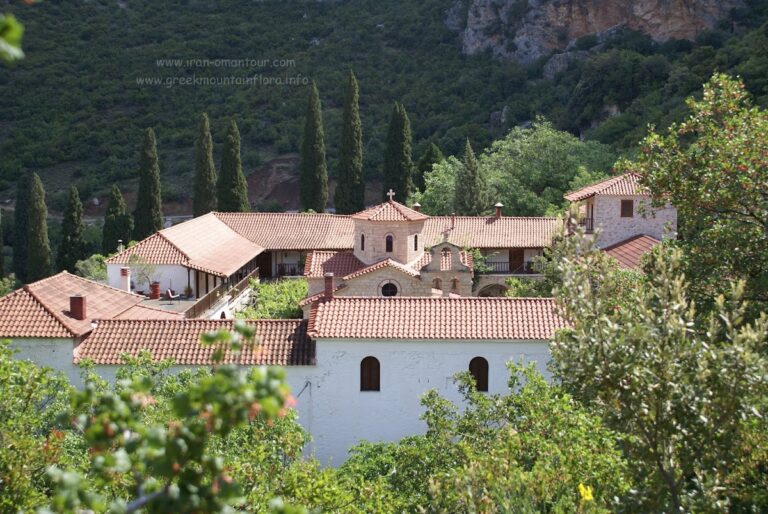
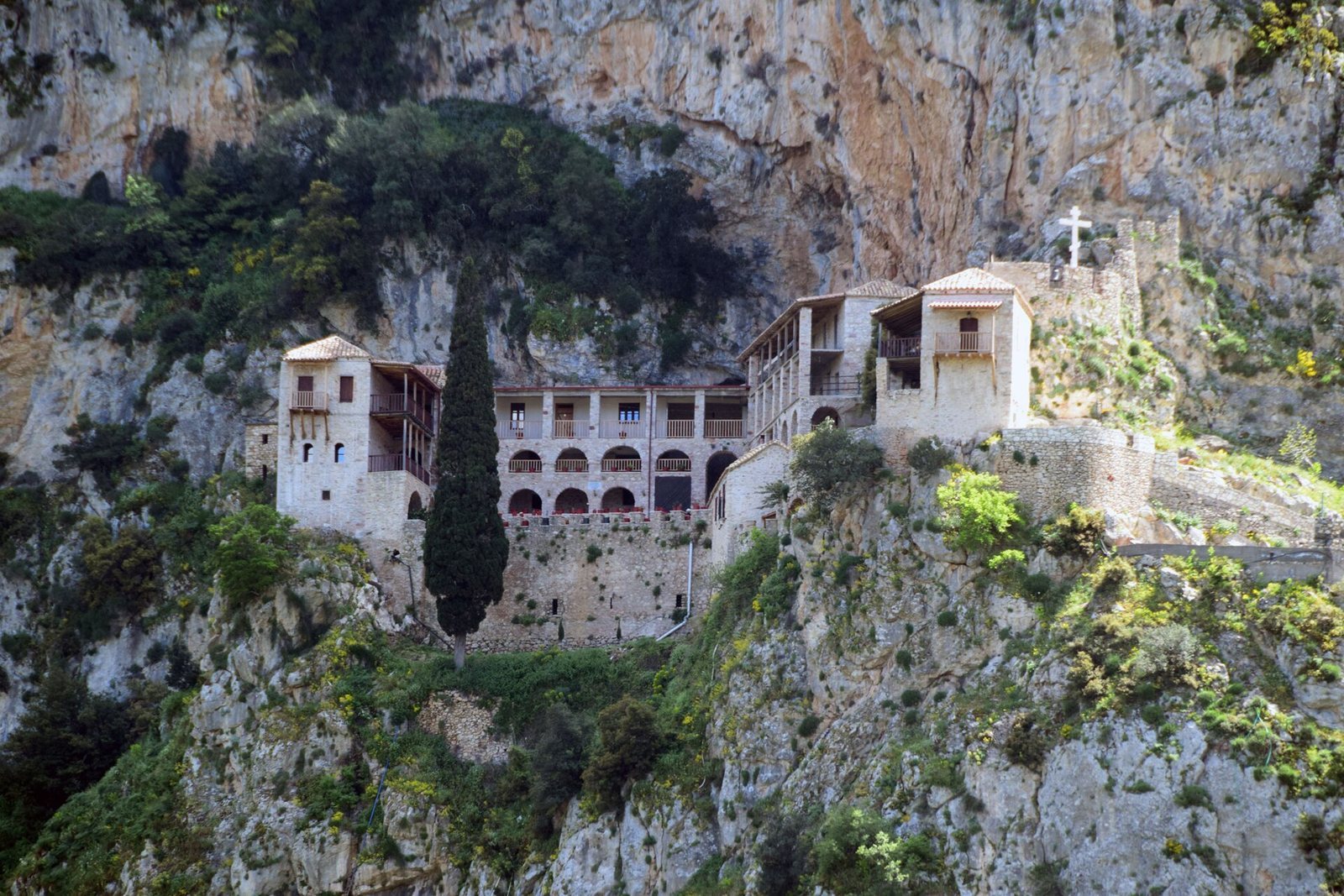
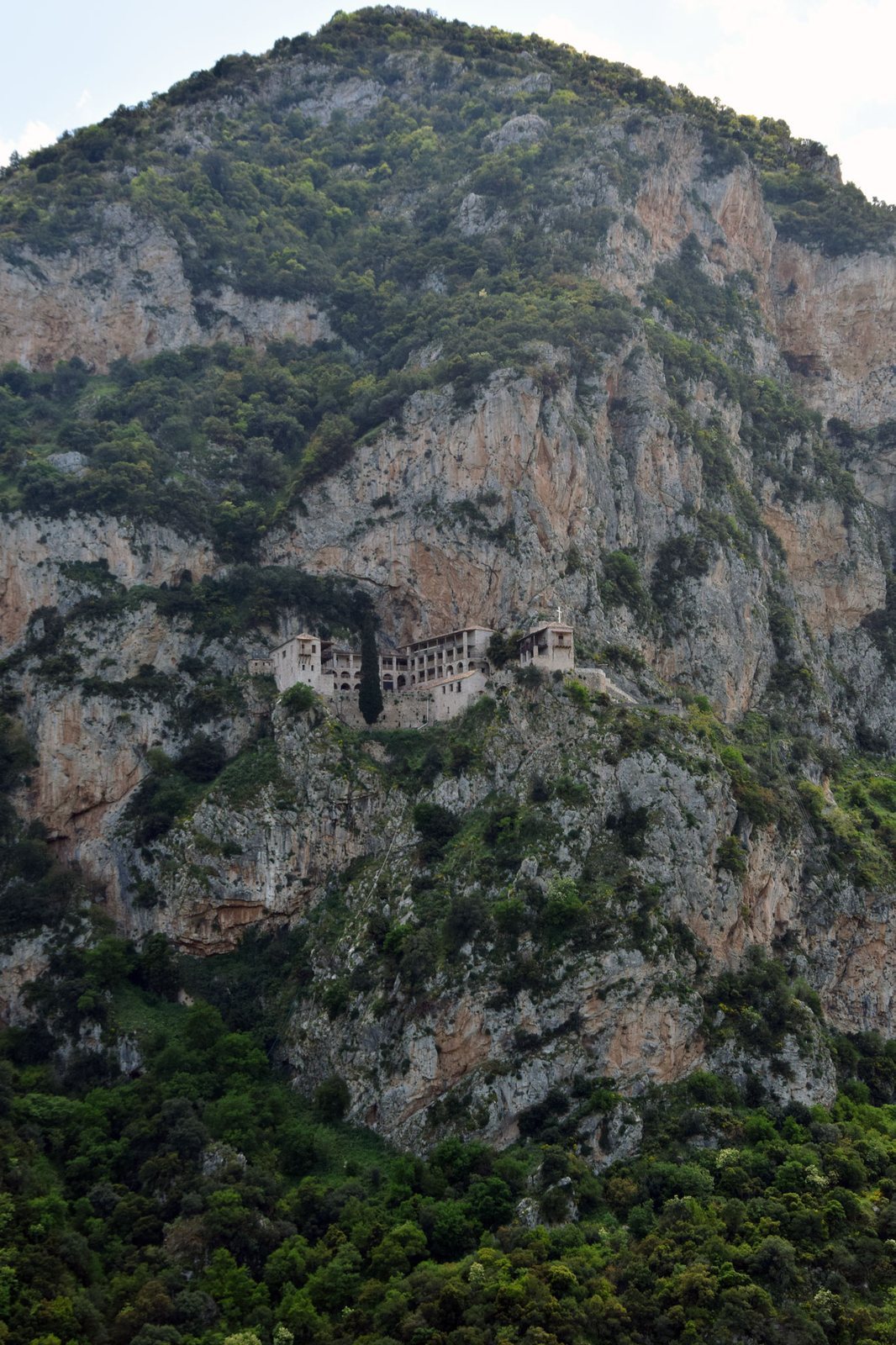
The buildings occupy a rock above the Tanos River gorge on the slopes of Mount Parnon, and their layout adapts to the terrain around a small courtyard. The complex has been fully renovated.
Cell buildings
The monastic buildings took their present form in 1704. The cell ranges follow a U-shaped plan around the courtyard. They rise three storeys on the east and south sides and two on the north, with arches, stone stairs, and galleries among their features.
Principal church
The monastery’s principal church stands on the second floor of the south wing, fitted into a hollow in the rock. Its domed, irregular L-shaped plan follows the contours of the cave. Fragments of 18th-century wall paintings survive inside and are attributed to Jeremiah, a priest-monk from Nafplio. A carved wooden screen separates the sanctuary from the main church space and carries icons made in the 18th century.
Passage and dependent churches
A narrow, elongated passage beside the church leads toward a cave. Some believe it leads to Malevi Monastery.
Church of Saint Charalambos
The monastery’s dependencies include the church of Saint Charalambos at Stolos.
Church of Saint Nicholas
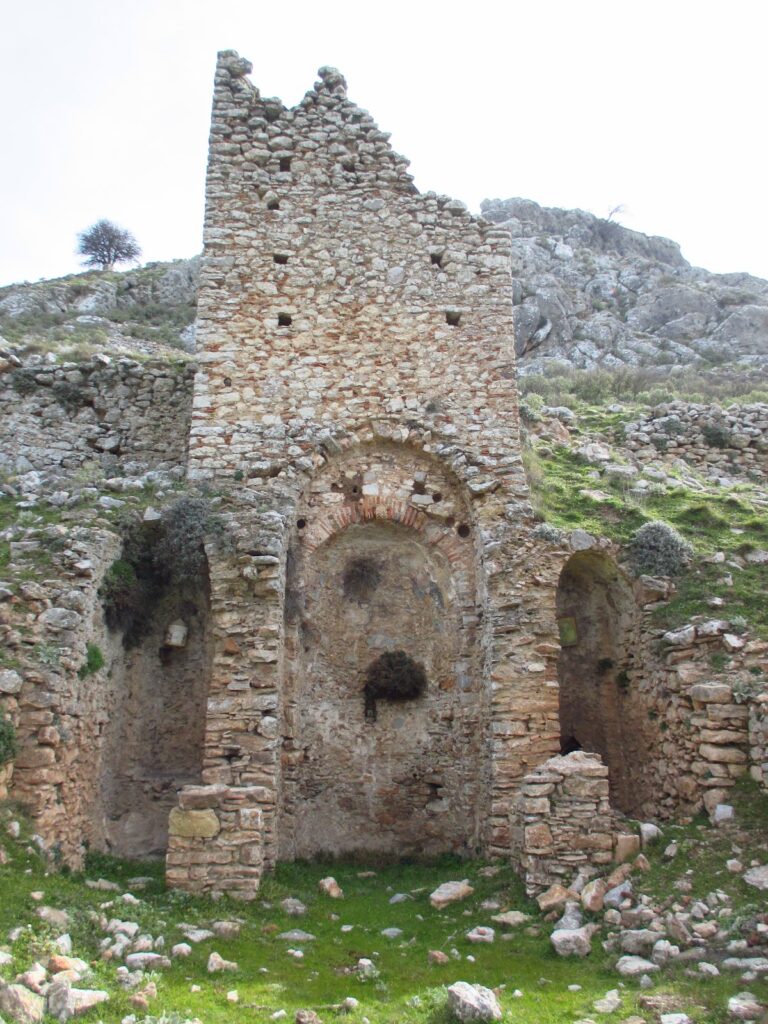
A second dependency is the ruined church of Saint Nicholas at Perdikovrysi.