Głuchy Manor House: A Classical Residence and Norwid Birthplace
Site at a Glance
- Popularity
- Very Low
- Country
- Poland
- Primary era
- Early Modern
- Eras represented
- Early Modern, Modern
- Civilizations
- Polish–Lithuanian Commonwealth, Russian
- Site type
- Domestic
- Remains
- Manor House
On this page10 sections
History
Głuchy Manor House is an eighteenth-century residence in Poland, built for the Zdzieborski family late in the century in a Classical style inspired by ancient Greek and Roman architecture. It may have been erected by Michał Zdzieborski or his son Ludwik. A member of the family serving as a regent, a legal or administrative official, held the estate from 1783.
The Zdzieborski and Norwid families
From about 1804, the hereditary estate belonged to Ludwika Zdzieborska, Michał’s daughter, who had inherited it from Ludwik. She married Jan Norwid in 1818, and the Norwids had moved to Laskowo-Głuchy by 30 July 1821. In a letter, Jan described their home as standing beside the new main road from Warsaw toward Kobyłka.
The couple’s third child, Cyprian Kamil Norwid, was born at the manor at 8 p.m. on 24 September 1821. After his great-grandmother Hilaria Sobieska died in 1830, the family moved to Warsaw. Cyprian’s brother Ludwik later completed practical training on the estate, following his studies at the Institute of Rural Economy in Marymont, an agricultural education institution.
The Norwid family held the manor until 1848, when it passed to Jan Suski and his wife Paulina, Cyprian’s sister. The place was once called Laskowo Głuche. It later became the Głuchy manorial farm within the Laskowo estate, then Laskowo-Głuchy, and is now known as Głuchy.
Later owners and wartime changes
From around 1858, the owners included Bronisław Deskur and later Antoni Winnicki. Konstanty Puget held the property from 1874 to 1881, followed by Amalia Kochowicz from 1881 to 1897 and Walenty Zieliński from 1897 until 1898 or 1899. Jerzy Jeziorański acquired the Głuchy estate in 1898, and his family retained it until 1966 or 1967. In 1912, sculptor Bolesław Jeziorański purchased a reduced estate of 16 hectares. His children Adela, Karol, and Stanisława inherited it. Stanisława was the last family member to live in the manor, and the family decided to sell because of the cost of maintaining the property.
During the Second World War, German officers were housed in the manor; refugees occupied it toward the war’s end. Soviet forces partly demolished the building and its outbuildings. The estate was not included in postwar agrarian reform. From 1945 to 1954, painter Antoni Gawiński lived there with his wife Irena and sister Jadwiga.
The manor ensemble entered the regional register of immovable monuments on 18 November 1959 and 20 January 1976. Polish film director Andrzej Wajda and actress Beata Tyszkiewicz bought the manor and park in 1966 or 1967 and owned them until 1996. The manor later underwent a general restoration. Their daughter Karolina Wajda is its owner.
Remains
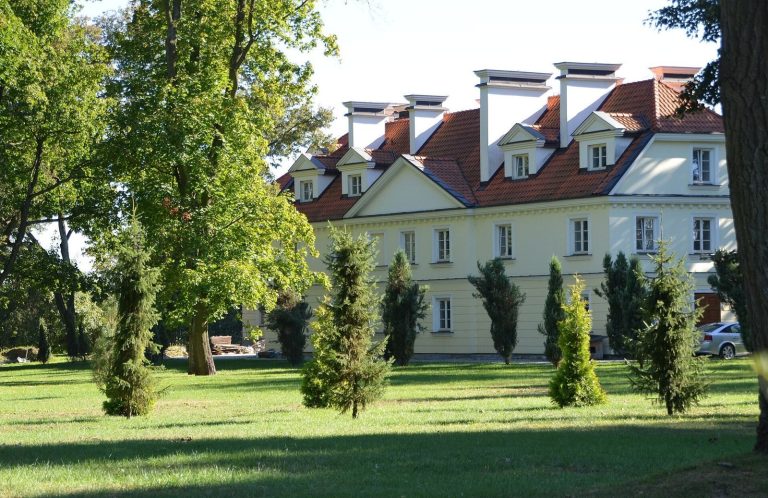
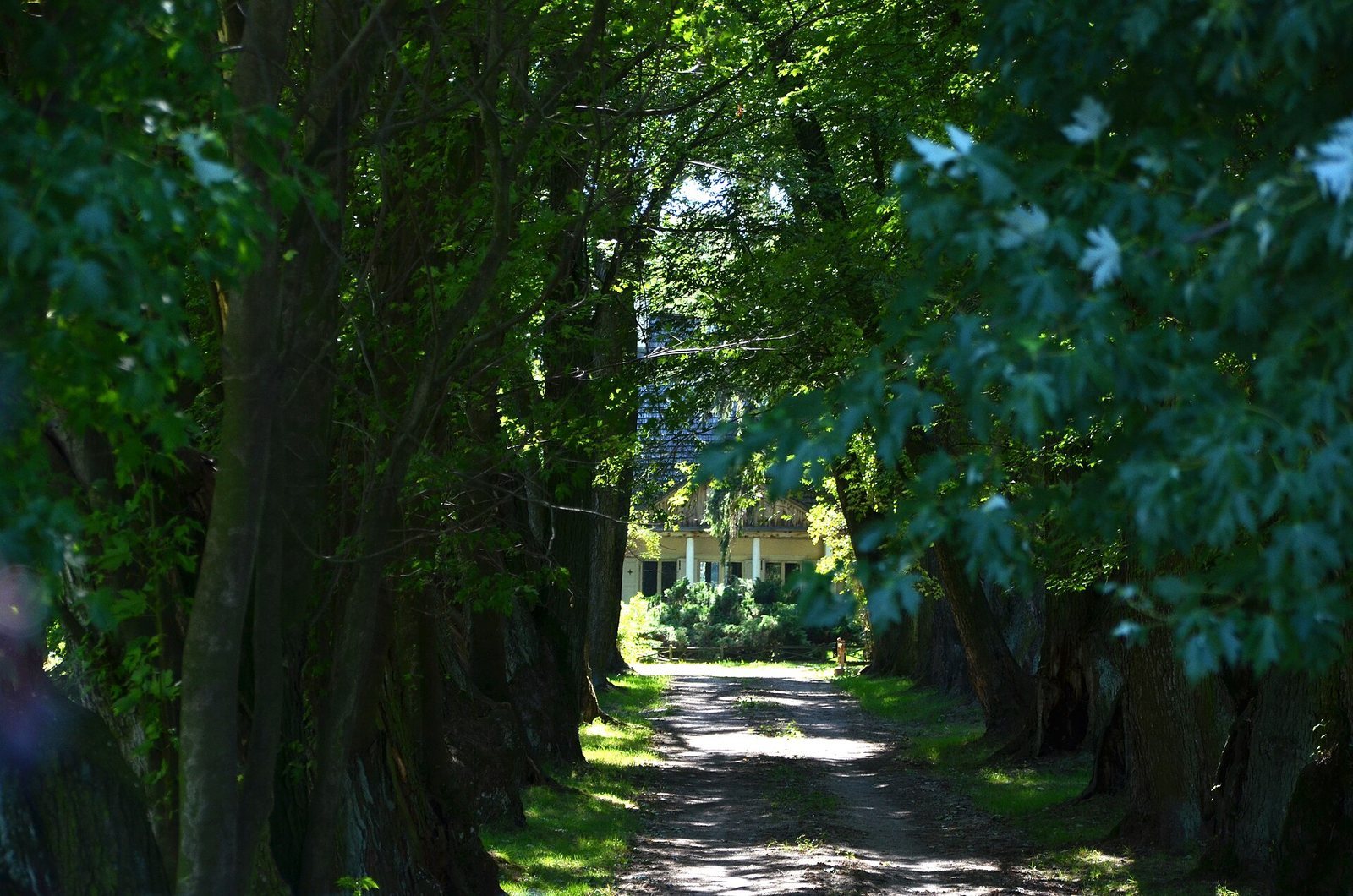
The one-storey manor has a rectangular plan and combines a plastered exterior with walls formed from horizontal larch timbers joined together. It stands on a masonry base and has a roof that slopes on all four sides, covered with wooden shingles.
The Manor House
Exterior and plan
Porches on the driveway and garden sides are supported by wooden posts and topped with triangular pediments, the decorative triangular sections above them. A plaster bust of Adam Mickiewicz, a major Polish poet, sits in the garden-side pediment; sculptor Bolesław Jeziorański made it. A watercolor dated 1839 is thought to depict the Norwid family’s manor at Laskowo-Głuchy.
Interior
The rooms occupy two parallel rows, with an entrance hall on the central axis. Some rooms have exposed beams, and the manor contains fireplaces. The room in which Cyprian Norwid was born was painted blue at the time.
Park and grounds
Park layout
The manor is surrounded by a park landscaped around the middle of the nineteenth century. Maples line the approach avenue, while a linden avenue runs east of the building; hornbeams also grow in the grounds. An ornamental lawn borders the front driveway, and the park is preserved in very good condition.
Earlier estate grounds
In Jerzy Jeziorański’s time, the estate also contained a garden, an orchard, and an arable field. The garden held a plaster cast of a sculpture showing Christ tied to a pillar.