Moulin du Bosq: A Seventeenth-Century Watermill in Normandy
Site at a Glance
- Popularity
- Very Low
- Country
- France
- Primary era
- Early Modern
- Eras represented
- Early Modern, Modern
- Civilizations
- French
- Site type
- Economic
- Remains
- Watermill
On this page9 sections
History
The Étang estate and early history
Moulin du Bosq is a seventeenth-century watermill on the Tortonne at Trévières in Normandy, France. It formed part of the Étang fief, land held under feudal obligations on a rent-paying basis. In 1262, King Louis IX, known as Saint Louis and king of France from 1226 to 1270, granted the fief to Montebourg Abbey. In 1560, the Étang estate, including the mill then called Bosc-Moulin, was leased to Pierre Gallon, a member of Bayeux’s urban social class, for 60 livres tournois, a French unit of account.
Seventeenth-century rebuilding and the Pellot family
Although 1684 is given as the mill’s foundation date, it was probably rebuilt during the first quarter of the seventeenth century to replace an earlier structure, under Claude Pellot (1619–1683). The later date may instead refer to a change in the roof’s shape. In 1684, Claude Pellot’s son, Claude-François, performed feudal homage, a formal acknowledgment of a lordly relationship, for the castellany of Trévières, a territorial lordship associated with a castle. His son, another Claude Pellot (c. 1683–1769), succeeded him as count of Trévières, lord, parish patron, and owner of the leased mill. Parish patronage involved rights connected with the presentation of clergy. The next heir was Claude-Anne-François Pellot (1728–1793).
Revolution and nineteenth-century ownership
Claude-Anne-François had no children with his wife, a cousin of the Polignac family. Her sister, Marie-Françoise de Polignac, became his sole heir. During the French Revolution, the political upheaval that began in 1789, property belonging to emigrants was confiscated. After Marie-Françoise emigrated, her property was sold on 9 March 1795, and François-Denis-Auguste de Grimoard de Beauvoir du Roure de Beaumont, Count of Brison, acquired the mill. When he died in 1810, his son Denis-Scipion succeeded him.
Louis Alexandre took the mill as a fief in 1812, and his widow, Thérèse Courteil, succeeded him in 1838. The Countess of Sacriste de Tombebeuf acquired it in November 1850 and granted it as a fief to Courteil, its former owner. In March 1855, she sold the mill to Vigor Yver for 5,250 francs. A regulation concerning the mill was issued in the middle of the nineteenth century, and the building was raised during that century.
Twentieth-century use and restoration
The Yver family retained the mill until the Second World War, after which the Mouchel family of Rubercy settled there. By 1980 it was partly abandoned. Marcel Masi, a decorator from Paris, bought it in 1988, and restoration began after his purchase. In 1993, the mill and its millrace received classification as historic monuments, a French legal heritage-protection designation. The restoration received a first prize from delegates of the heritage-preservation association Vieilles Maisons Françaises in 1999.
Remains
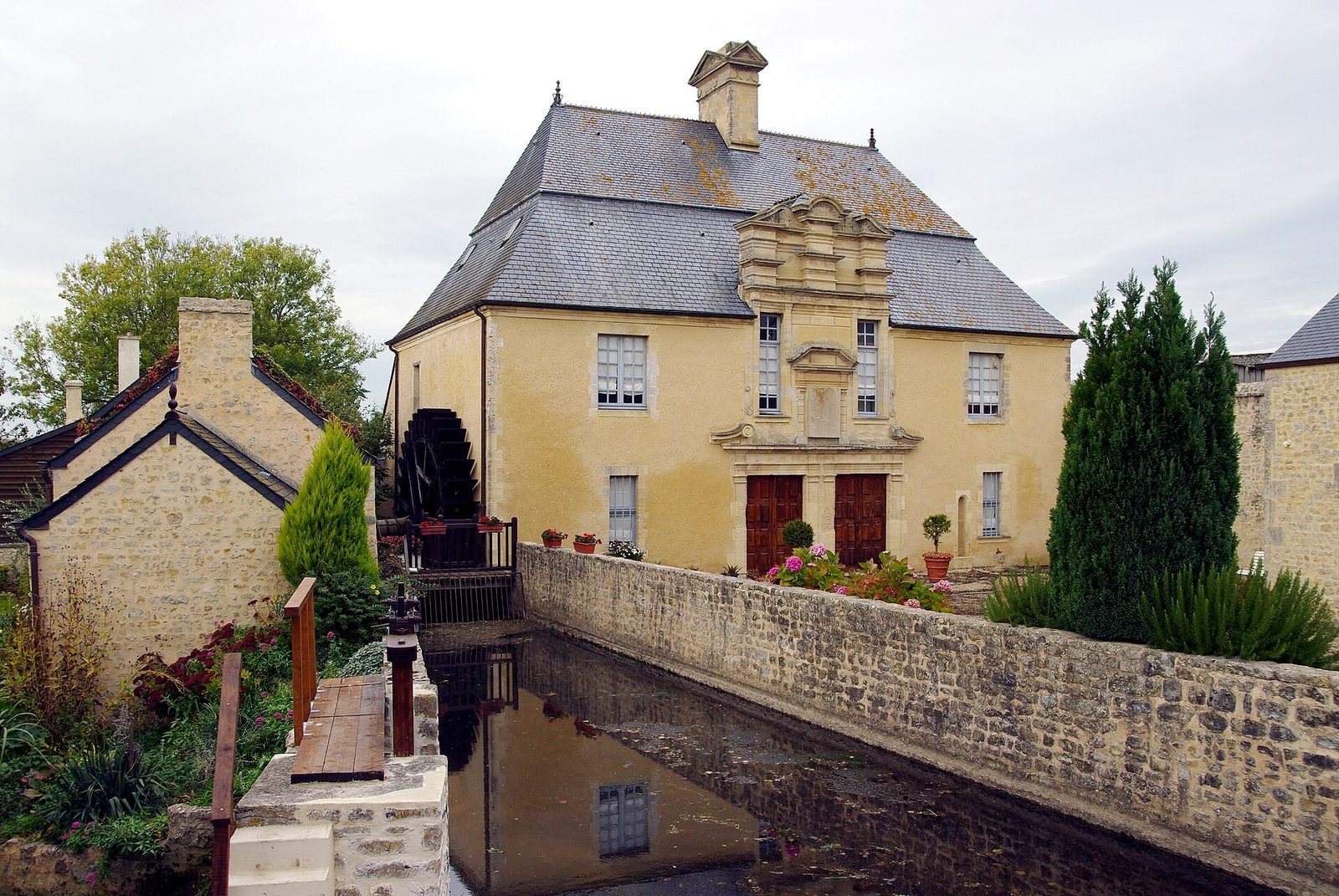
The site comprises a compact limestone watermill with a ground floor and one upper storey, together with its associated millrace, a channel that carries water to or from a mill. The building is rendered and has a prominent roof.
The mill and its water system
Mill building
The façade is arranged in three bays, or sections, with a shallow central projection rising through three levels. Its decoration draws on the Baroque, an elaborate architectural style that developed in seventeenth-century Europe. The ornamental work resembles features on the upper part of the portal at Caillerie manor in Bayeux, dated 1667, and on the principal doorway of Douville manor at Mandeville-en-Bessin.
The roof profile may have been altered in 1684. The building probably began with a high roof in the French style. The date 1684 is engraved in the central attic and also appears on the chimney.
Millrace
The millrace is associated with the watermill on the Tortonne and forms part of the classified site.