Castle of Colombières: A Medieval Fortified Residence in France


Site at a Glance
- Rating
- 4.2
- Popularity
- Low
- Country
- France
- Primary era
- Medieval
- External website
- Open
- Eras represented
- Medieval, Early Modern, Modern
- Civilizations
- French
- Site type
- Military
- Remains
- Castle
On this page13 sections
History
Castle of Colombières is a medieval fortified residence in Colombières, France, whose oldest surviving parts date from the late fourteenth century. The site developed from an earlier stronghold associated with the Colombières family and later became a more comfortable residence while retaining its defensive layout. Its position beside the Esque valley’s meadows, the Bessin marshes, and the former Bay of Isigny gave it strategic value for controlling Lower Normandy.
Early Lords and the Medieval Castle
The first references to Colombières date to the beginning of the eleventh century, when the site was probably a motte castle. This type of fortification centered on an earthen mound carrying a fortified residence or tower. The Colombières family occupied the site at this time. Guillaume, Raoul, and Baudoin de Colombières accompanied William the Conqueror, Duke of Normandy and later king of England, during the Norman conquest of England in 1066. Raoul subsequently settled in Kent, where he held several estates.
In 1147, Philippe de Colombières, a member of the Bacon du Molay family and brother of Roger III Bacon, was recorded as lord and castellan of the fief of Colombières. After the Colombières family died out, members of the Bacon du Molay family succeeded them, adopted the Colombières name, and were credited with constructing the medieval castle between the thirteenth and fourteenth centuries.
Fortification during the Hundred Years’ War
The oldest surviving sections of the present castle belong to the late fourteenth century. During the Hundred Years’ War, the prolonged conflict between the English and French crowns conventionally dated from 1337 to 1453, Charles V ordered strongholds in the Bessin and Cotentin to be fortified or renovated against possible English attacks in Normandy.
A royal survey in 1371 described Colombières as a well-organized, provisioned, and equipped fortified residence. In 1372, Henri de Colombières acknowledged possession of the site to the king. The English conquest of Norman strongholds later changed its ownership. Letters patent dated 12 February 1418 confiscated Colombières from Olivier de Colombières, chamberlain to Charles VI, because he had remained loyal to his overlord. The English king granted the castle and Olivier’s other possessions to Richard Drayton.
The fortress was ruined during the war. Olivier’s son, Jehan de Colombières, briefly recovered it, then sold it with a right of repurchase to Christophe de Castiglione. Jehan’s uncle, Roger de Briqueville, bought the castle back on 25 May 1457. Roger’s grandson, Guillaume VI, constructed the present main building at the end of the fifteenth century, and the Bricqueville family later added two Renaissance towers.
Religious Conflict and Transformation
During the Wars of Religion, François de Bricqueville, who was born at the castle in 1535 and died in 1574, became a marshal of the king’s camps and armies and one of the leading Protestant figures in Lower Normandy. The Reformed religion was a form of Protestant Christianity associated with the Reformation. François desecrated the Notre-Dame de Rougebrèque chapel on the first floor of the principal residential building and converted it into apartments. His son, Paul de Bricqueville, established a Protestant place of worship in a farm building near the castle, which was later demolished.
During the seventeenth and eighteenth centuries, the fortress was progressively adapted for comfort and use as a pleasure residence. The south side of the enclosing wall was demolished, a partly destroyed tower was rebuilt as a square keep, and the residential windows were enlarged. After converting to Catholicism in 1678, Cyrus-Antoine de Bricqueville restored the former chapel to religious use. He placed above its entrance the lintel from the former Protestant place of worship. The stone bears passages from Isaiah 55:6–7 concerning the search for the Lord, the abandonment of wickedness, and return to a merciful God.
Ownership from the Eighteenth Century
Debt forced Anne-Henriette de Bricqueville to sell the castle in 1720. Gaspard de Réal acquired it and resold it to Pierre-Jacques Delaye in 1726, but Delaye’s estate was seized in 1727. The domain was adjudicated on 2 April 1755 to Foisy the Younger, who declared on 12 August that he had acquired it for René Hatte.
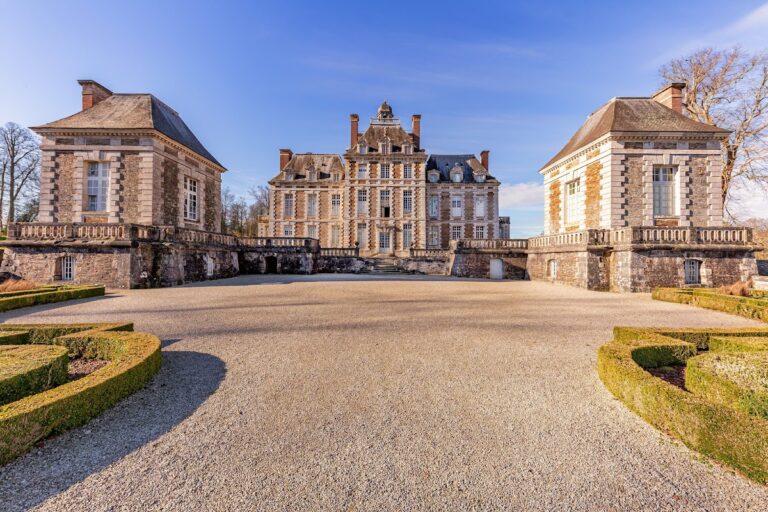
Hatte, a fermier général, or private tax farmer collecting certain royal taxes under contract with the French monarchy, acquired the lordships of Bricqueville, Bernesq, and Colombières. He continued modernizing the castle and gave it its classical appearance. In 1761, his daughter Anne-Catherine Hatte married Alexandre Girardin de Vauvré, and their descendants continued to own the property.
Sophie de Girardin inherited the castle in 1808 and left it to her stepson, Auguste Berthelot de Baye. Ownership then passed through Auguste’s son and grandson, including Jean Berthelot de Baye. Jean, who had no children, bequeathed the castle to his distant cousin Marie de Briey. Marie likewise left it to her distant cousin Jeanne de Ludre. Thérèse, Jeanne’s daughter, inherited the property, which Étienne de Maupeou acquired through his marriage to her. The castle subsequently remained in the Maupeou family.
Colombières during the Second World War
During the Second World War, the castle stood near Omaha Beach during the Normandy landings and was spared. On the morning of 6 June 1944, ten camouflaged German Sturmgeschütz III assault guns from the 2nd Company of the antitank battalion of the 352nd Division left positions beneath the elm trees along the castle avenue. They had been concealed there since March and moved toward Ryes, south of Arromanches.
German forces had flooded the surrounding marshes by destroying the floodgates at Isigny-sur-Mer. American troops nevertheless crossed the marsh on foot. Lieutenant Kermit Miller of the 115th Infantry Regiment, 29th U.S. Division, passed through Colombières on the evening of 8 June, and the village was liberated on 9 June.
The castle is privately owned and protected in its entirety as a French historic monument. The castle, apart from separately classified elements, was registered on 2 July 1927. Its facades and roofs, together with a fifteenth-century fireplace on the second floor of the tower, were classified on 20 December 1968. The hydraulic system, including the moats and irrigation canals, and the walled vegetable garden were registered on 13 October 2006. The guard post and the lintel from François de Bricqueville’s Protestant place of worship are also protected.
Remains
Colombières is arranged as a quadrangular fortified residence enclosed by moats. Its medieval military character survives within a complex later adapted for domestic comfort and leisure. The original enclosure was about 3 metres thick and surrounded a single courtyard, with buildings constructed against the curtain wall. A curtain wall is the defensive wall running between towers. Four round towers strengthened the corners, and access was provided through a fortified gate preceded by a drawbridge, a bridge that could be raised to block the entrance.
Fortified Enclosure and Residential Buildings
Towers and Main Building
The corner towers are cylindrical and crowned with machicolations, projecting openings used to defend the base of a wall. The main building was reconstructed at the end of the fifteenth century and includes an octagonal tower. Renaissance remodeling altered the complex, while the later removal of the south section of the enclosure opened part of the former defensive circuit. A partly destroyed tower was rebuilt as a square keep, or principal fortified tower, and the residential windows were enlarged.
Service Wing and Gardens
A nineteenth-century wing containing service rooms was converted to accommodate family and guests. Gardens were laid out around the inner perimeter of the medieval moats, linking the later domestic use of the residence with its earlier defensive setting. Heraldic features associated with later owners survive in the buildings. The arms of the Berthelot de Baye family appear on one fireplace, while the arms of the Ludre family are placed in the courtyard and supported by two stone lions.
Chapel and Hydraulic Works
Notre-Dame de Rougebrèque Chapel
The former Notre-Dame de Rougebrèque chapel occupies the first floor of the principal residential building. During the Wars of Religion, it was converted into apartments before being restored to religious use after Cyrus-Antoine de Bricqueville’s conversion to Catholicism in 1678. The entrance retains the lintel taken from the former Protestant place of worship established by Paul de Bricqueville. Its passages from Isaiah 55:6–7 remain part of the chapel’s architectural fabric.
Moats, Canals, and Vegetable Garden
The surviving hydraulic works include the medieval moats and irrigation canals. A vegetable garden enclosed by walls forms part of the protected complex. Together, these features preserve the relationship between the castle’s fortified enclosure, its water management, and its later landscaped residential use.
Nearby sites