Beaumont-le-Richard Castle: A Medieval Lord’s Residence in Normandy
Site at a Glance
- Popularity
- Medium
- Country
- France
- Primary era
- Medieval
- Eras represented
- Medieval
- Civilizations
- Norman
- Site type
- Domestic
- Remains
- Castle
On this page11 sections
History
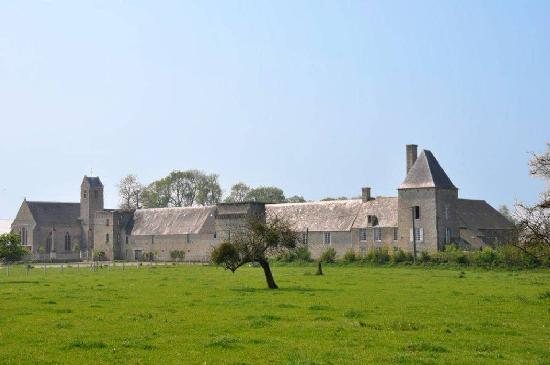
Beaumont-le-Richard Castle is a medieval lord’s residence on a hill in Englesqueville-la-Percée, France. Built in the 12th or early 13th century in the Anglo-Norman style, associated with Norman rule in England and Normandy, it is one of the last standing examples of a lord’s residence from its period.
The du Hommet lordship
The lordship existed by at least AD 1000, and its first lord may have been recorded in the late 12th century. In the second half of that century, the lordship passed to the du Hommet family through the marriage of Agnes de Say and Richard I du Hommet. Agnes inherited it as her brother’s sole heir after he died unmarried around 1151. The castle takes its name from Richard, a Norman nobleman who lived from about 1115 to 1180 and served as Constable, a senior military officer, and Grand Seneschal, a senior administrator, of Normandy.
In 1220, Enguerrand du Hommet gave the church of Beaumont-le-Richard and its tithes, revenues drawn from agricultural produce or income, to Mondaye Abbey, a monastery led by an abbot. In 1239, Guillaume du Hommet was described as castellan, the officer responsible for a castle.
War and Protestant worship
During the English occupation of Normandy from 1418 to 1450, part of the Hundred Years’ War, a prolonged conflict between the English and French crowns, Thomas de Hottot lost the lordship while fighting for the French. In 1540, a diary entry by Jehan Canivet, lord of Vaumicel, placed a Huguenot meeting in the parish of Englesqueville. Huguenots were French Protestants generally associated with Calvinism, and the meeting probably took place at the castle. A Calvinist sermon was held later in the 16th century in a village loft above a press near the chapel.
Changing use and preservation
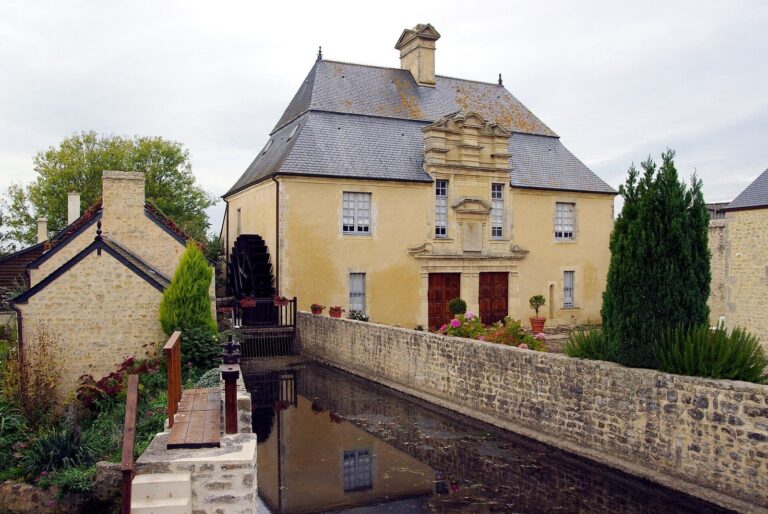
The lordship passed between families. After the castle ceased to be a residence for its lords, it was adapted for farming, and the farm continued in operation until the Second World War. In 1632, Jean, titled Count of Choisy, was lord of Beaumont-le-Richard and Balleroy. The chapel was used for religious worship around 1640.
In 1919, the former chapel and parts of the medieval fabric were classified as historic monuments. In 1997, the parcel containing standing and buried remains was registered.
Remains
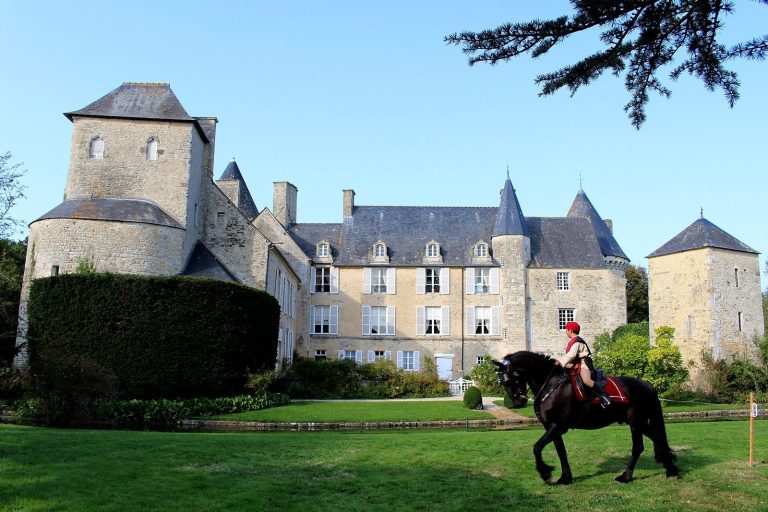
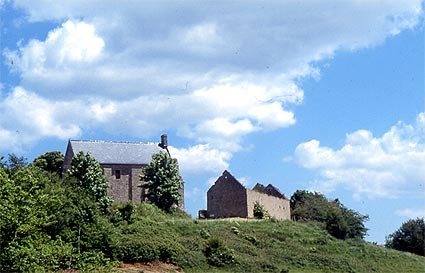
The remains occupy a hill in the Bessin, a historic region of Normandy, about 1.2 km southwest of Saint-Vigor Church in Englesqueville-la-Percée. The complex includes two round towers capped with stone domes, parts of an enclosure, a chapel, and two mid-12th-century Romanesque buildings, in a medieval architectural style. The antiquarian Arcisse de Caumont characterized the castle as more the residence of a wealthy baron than a fortress.
Castle buildings
Towers and enclosure
The two round towers retain their stone dome caps, and portions of the enclosure also survive. Together, these remains form part of the castle’s surviving layout.
Residential block and great hall
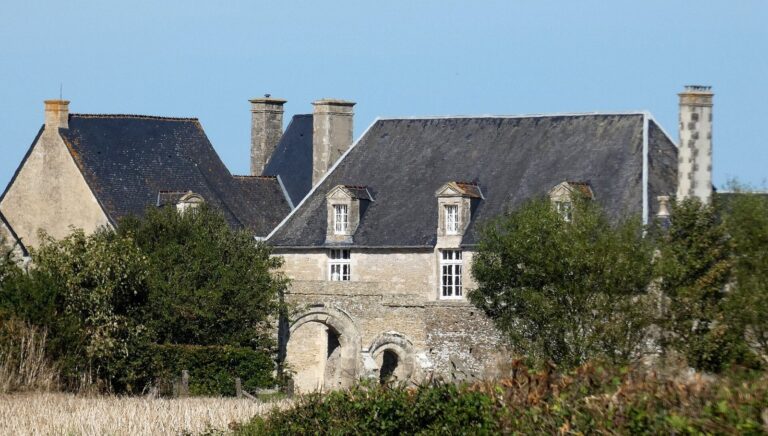
One of the Romanesque buildings is a residential block; the other is a great hall arranged with a nave, the main body of the hall, and a side aisle, a parallel space beside it. A cellar with an arched ceiling occupies the ground floor. On the residential block’s first floor, a room was refitted during the 17th-century conversion to a farm. It adjoins an entrance chamber decorated with a row of Romanesque arches.
Chapel and vaulted room
The chapel stands above a room with an arched ceiling that may have served as the former lord’s residence.
Window and cornice
A Romanesque window features chevron ornament, a repeated zigzag pattern. Part of a Romanesque cornice, a projecting architectural band, survives with the arches beneath it.
Village and cemetery
A village once stood on the site. Some of its houses predated 1600, and a loft above a press stood near the chapel. Nineteenth-century discoveries in the village cemetery included a lead coffin and other coffins made of stone.