Rothenburg Castle: A Medieval Stronghold in Thuringia
Site at a Glance
- Popularity
- Medium
- Country
- Germany
- Primary era
- Medieval
- Eras represented
- Medieval, Modern
- Civilizations
- German, Holy Roman Empire
- Site type
- Military
- Remains
- Castle
On this page13 sections
History
Rothenburg Castle is a medieval ruin on a steep spur near Steinthaleben in Thuringia, Germany. In 1103, the nobleman Christian von Rothenburg was identified as one of two men who murdered Count Kuno of Beichlingen. The castle later became a target in a dynastic struggle and passed among several aristocratic houses.
Early lords and the siege of 1212
From 1128, Christian increasingly supported Lothar III, a Holy Roman Emperor. Christian’s son founded the small County of Kirchberg in the Hainleite in 1155, while the main line of the Counts of Rothenburg ended in 1209. The Counts of Beichlingen then became lords of the castle, and a branch of their family living there adopted the name Rothenburg.
In the summer of 1212, Otto IV, another Holy Roman Emperor, campaigned in Thuringia amid a contest between the Hohenstaufen and Welf dynasties over the German throne. His forces used heavy siege engines to capture Rothenburg and Dryburg near Langensalza, but did not take the nearby Runneburg. Rothenburg was partly destroyed during the campaign. After Otto withdrew, the castle was rebuilt and modernized; the residential hall and chapel probably belong to this phase.
Later medieval and early modern use
The castle changed hands several times before the end of the sixteenth century. It became a fief, land held from a superior lord, of the Counts of Schwarzburg, who later granted it to the lords of Tütchenrode. Rothenburg was restored and enlarged in the fifteenth century. Around 1300, the poet and singer of courtly love Christian von Luppin, known as a minnesinger, stayed there.
The castle declined in the late sixteenth century. Later, the robber Loth of Frankenhausen used its ruins as a refuge. During the Romantic period, an artistic and intellectual movement that emphasized emotion, imagination, and the past, interest in Rothenburg revived. Heinrich Heine’s satirical poem Germany: A Winter’s Tale helped draw attention to the Kyffhäuser.
The inn and its visitors
In 1836, Karl Friedrich Wilhelm Beyer received a license to run an inn at Rothenburg. It opened on 1 August in a small wooden hut, which Beyer used only in summer. Donkeys carried supplies up from Kelbra, and water came from a mountain spring. Travelers on the Frankenhausen road paid a toll collected at the Rothenburg forester’s house. At that time, Kelbra was in Prussia, while Rothenburg belonged to the Principality of Schwarzburg-Rudolstadt. When beer ran out, orders were reportedly sent to a Kelbra brewery through a three-metre speaking tube. Clubs held meetings and celebrations at the inn, including a singing festival attended by about 200 people.
Revolutionaries met at the inn in 1849. An attempt was later made to implicate Beyer, but the prince continued to support him and did not withdraw his license. After the prince died in 1867, Hermann Prinz of Bad Frankenhausen received the license but could not run the inn successfully. In the late nineteenth century, a large excursion inn was built beside the castle using leftover material from the Kyffhäuser Monument. It replaced an earlier inn described as dating from 1839.
Twentieth-century use and restoration
In 1906, the Kyffhäuser League, an umbrella organization of German student fraternities, built the Bismarck Tower in the northern part of the castle to a design by architect Wilhelm Kreis. Building work by the National Socialist Reich Warrior League, a Nazi-era umbrella organization for veterans’ groups, took place at Rothenburg from 1937 to 1939 and produced archaeological and architectural observations as well as a small number of finds. The SS, a major Nazi organization, later used the castle grounds and inn as a recreation home.
During the German Democratic Republic period, the National People’s Army, the state’s armed force, used the site. After German reunification, the Bundeswehr, Germany’s armed forces, continued to use it for several years. The guesthouse accommodated officers and sergeants from the Kyffhäuser barracks. Security and renovation work took place in the 1990s. After the Bundeswehr left, the grounds were sold and passed through changes of ownership; restoration work has proceeded since 2010.
Remains
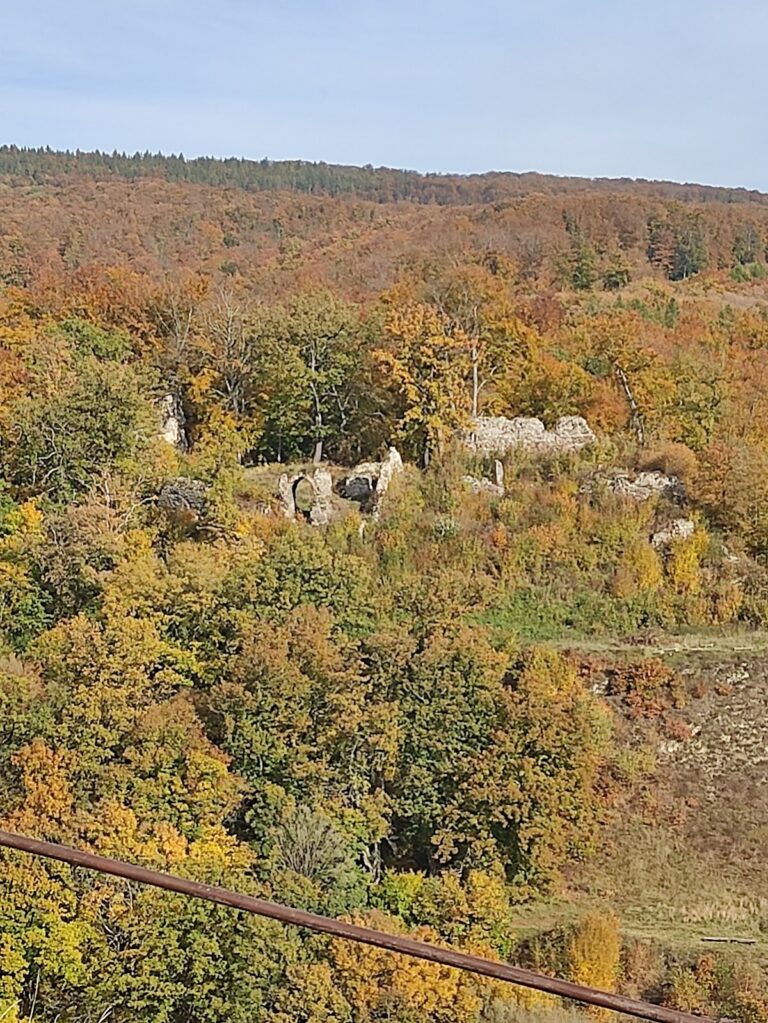
The castle stands about 350 metres above sea level on a steep spur at the northwestern edge of the Kyffhäuser Mountains. Built predominantly from red sandstone, it had an oval core and a southern outer ward, an enclosed area beyond the core, which has been removed; part of its former area is now built over. The name Rothenburg may refer to the red stone or, alternatively, to woodland clearance.
Core, entrance and defenses
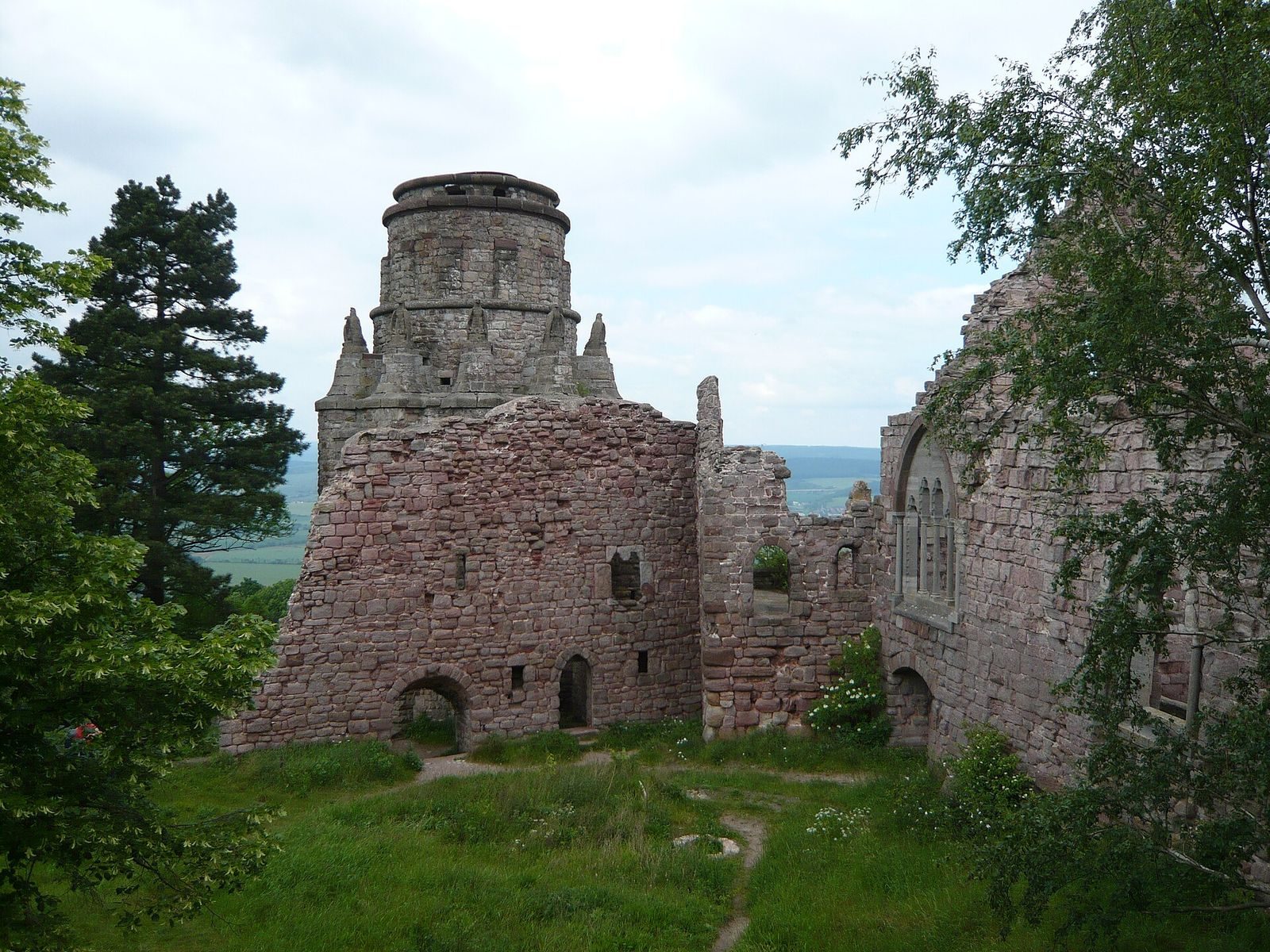
A rampart and ditch separated the core from the mountain. A round defensive tower stood on the side most exposed to attack. Its walls are almost three metres thick, its diameter is about 12 metres, and it survives to a height of 12 metres. East of the tower, the approach crossed a drawbridge to a former gate incorporated into the main building. The passage ran through the building’s ground floor into the courtyard. Another gate is identified on the north side.
Residential and religious buildings
Count’s House
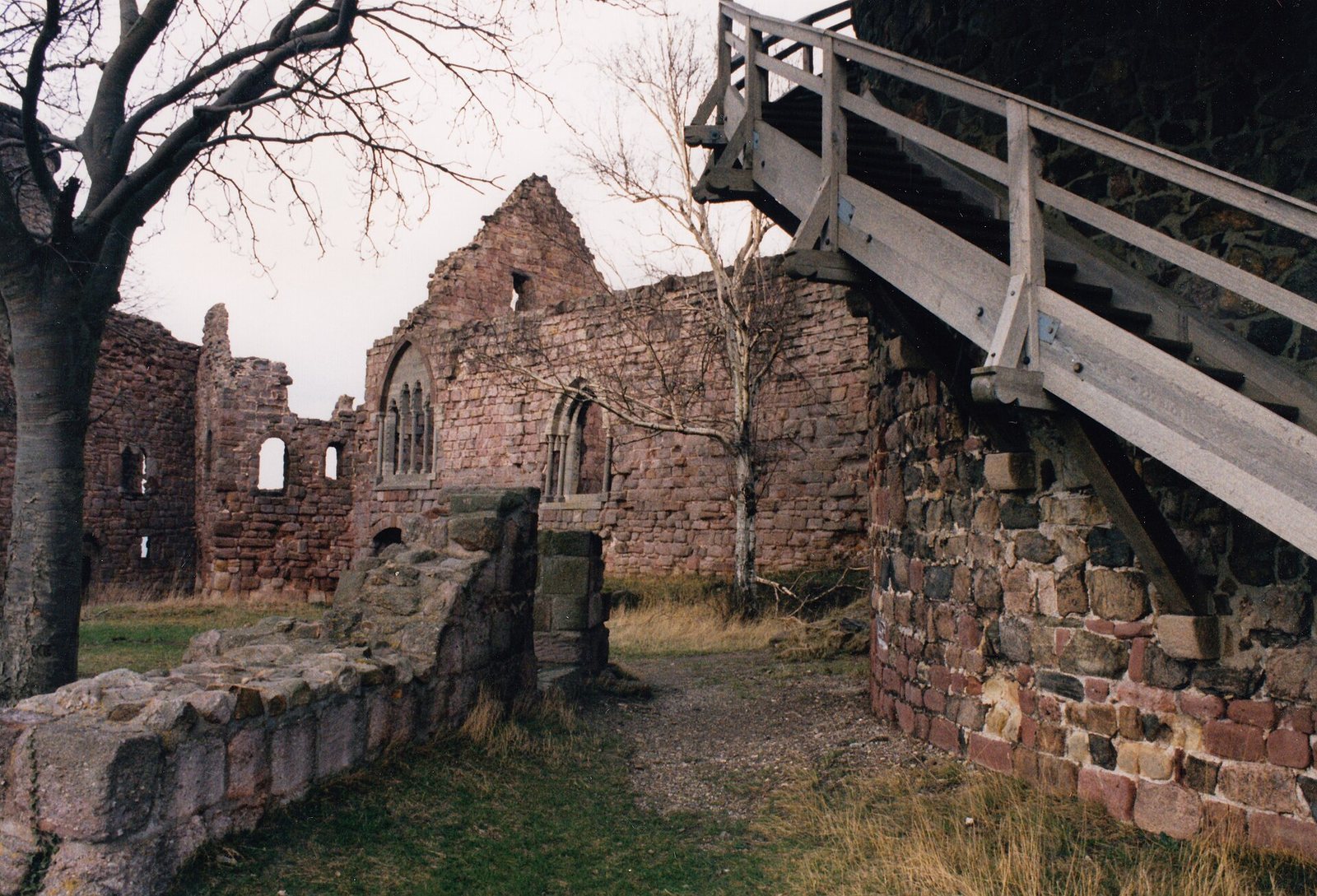
The main building, known as the Count’s House, measured 20 by 9.5 metres. An outside staircase from the courtyard gave access to its upper floor. The delicate, richly decorated four-part windows indicate that this level contained representative rooms.
Chapel
The chapel ruin lies north of the main building, and parts of the chapel and residential hall survive. During the fifteenth-century restoration, workers found a puzzling figure in the dilapidated chapel. Known as the Püstrich of Sondershausen, its identity remains uncertain. It was taken from the castle to the Schwarzburg family’s cabinet of natural-history specimens and curiosities at Sondershausen.
Western and northern structures
Western wall and adjoining buildings
Excavations exposed the largely demolished western curtain wall, a defensive wall enclosing the castle. Service and residential buildings stood against it.
Northern buildings and memorial
Residential and service buildings also occupied the northern part of the castle, where the Bismarck memorial now stands. The Bismarck Tower is located in this area, with a viewing terrace below it. Work in the 1990s cleared the terrace after it had become overgrown.