Tilleda Royal Palace: A Medieval Royal Residence in Germany


Site at a Glance
- Rating
- 4.5
- Popularity
- Low
- Country
- Germany
- Primary era
- Medieval
- External website
- Open
- Eras represented
- Medieval
- Civilizations
- Holy Roman Empire
- Site type
- Domestic
- Remains
- Palace
On this page7 sections
History
Tilleda royal palace is a medieval royal residence in Germany, beneath the Kyffhäuser on the southern edge of the Harz. The complex developed as a royal palace and administrative estate during the Middle Ages, with its earliest documentary identification as an imperial court dating to 972. It later served as a place where rulers stayed, issued charters, managed royal property, and assembled military forces.
Early settlement and royal development
The site on the Pfingstberg was occupied intermittently in prehistoric and early historical times. Settlement was especially intensive during the Late Bronze Age. Evidence for an early medieval community begins around AD 700, and the finds indicate that comparatively wealthy inhabitants lived there.
Tilleda appears for the first time in the early ninth-century Breviarium Lulli, an early medieval record associated with Lullus, the archbishop of Mainz. The place-name may derive from a word meaning “palisade,” which could point to an early fortification, although this interpretation does not establish when such a defense was built.
A marriage charter issued for Empress Theophanu identifies Tilleda in 972 as an imperial court, meaning a royal palace and estate, and grants it to her as widow’s property. From 974 to 1042, Tilleda was named as the issuing place of charters of Emperors Otto II, Otto III, Conrad II, and Henry III. During the Salian period, the era of rule by the Salian dynasty in the medieval German kingdom and Holy Roman Empire, the main castle underwent major alterations.
Changing military and political roles
In the eleventh century, Tilleda lost military importance as newer castles on the Kyffhäuser assumed that function. Its royal demesne, however, continued to expand during the twelfth century. This development included a manufacturing-scale textile workshop. The main castle was also fortified again for a short period, apparently as a provisional measure.
Tilleda remained connected with major imperial affairs. In 1174, Emperor Frederick I Barbarossa assembled an army there for his planned campaign in northern Italy against Alessandria. In 1194, his son and successor, Emperor Henry VI, reconciled at the palace with Duke Henry the Lion. Their settlement ended the long conflict between the Hohenstaufen and Welf dynasties, rival political groups that shaped imperial affairs during the twelfth century.
Abandonment and archaeological recovery
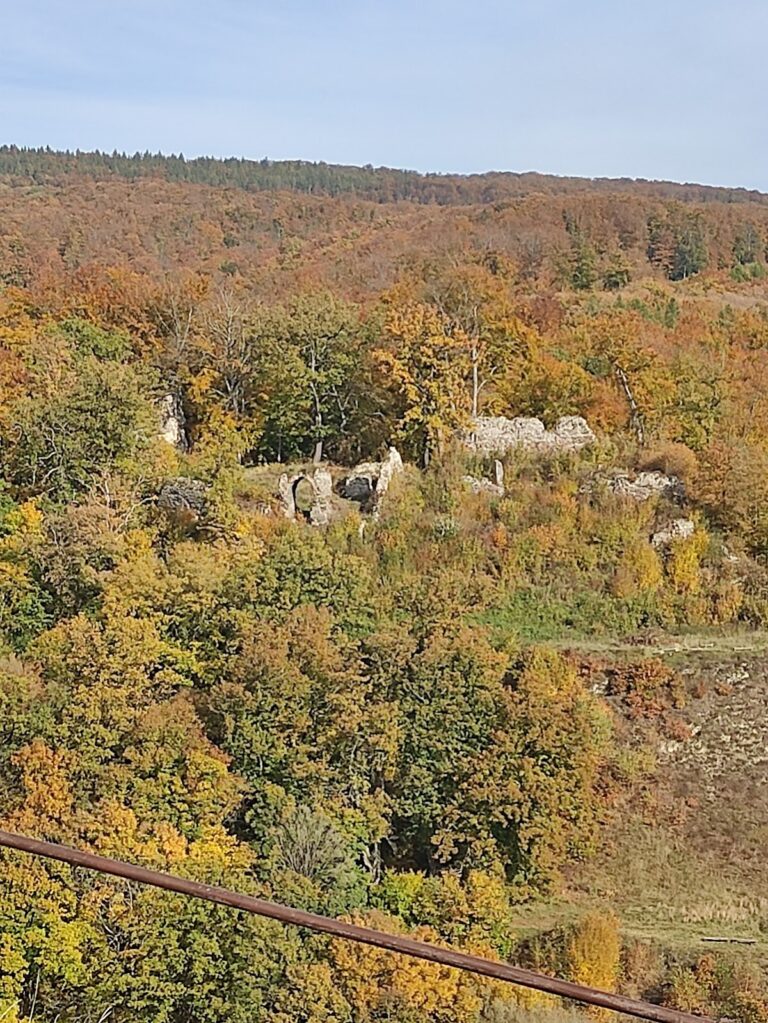
Tilleda disappears from the written record after 1194, but finds associated with a knightly milieu show that the complex continued to be used. It was completely abandoned during the thirteenth century. From the fourteenth through the twentieth century, the Pfingstberg was used for agriculture. Ruins that obstructed cultivation were gradually removed, leaving slight traces of earthworks and ditches together with two small wall fragments. These terrain features were recognized again as the remains of the palace in 1871.
Archaeological excavations began under Paul Grimm between 1935 and 1939 and resumed in 1958 under the Institute of Prehistory and Early History of the Academy of Sciences of the German Democratic Republic. Grimm directed the work and published extensively. Surveying was carried out by W. Saal of Merseburg, a builder and geodesist, with research and publication assistance from Hans Eberhardt, director of the Weimar State Archives. By 1979, the palace had been excavated almost completely, apart from a few control areas. In 2001, the municipality of Tilleda converted the excavated area into an open-air museum. Tilleda is recorded as an archaeological monument in the local monument register under registration number 428300472 and forms a station on the Romanesque Road, a cultural heritage route in Saxony-Anhalt linking monuments built in the Romanesque style.
Remains
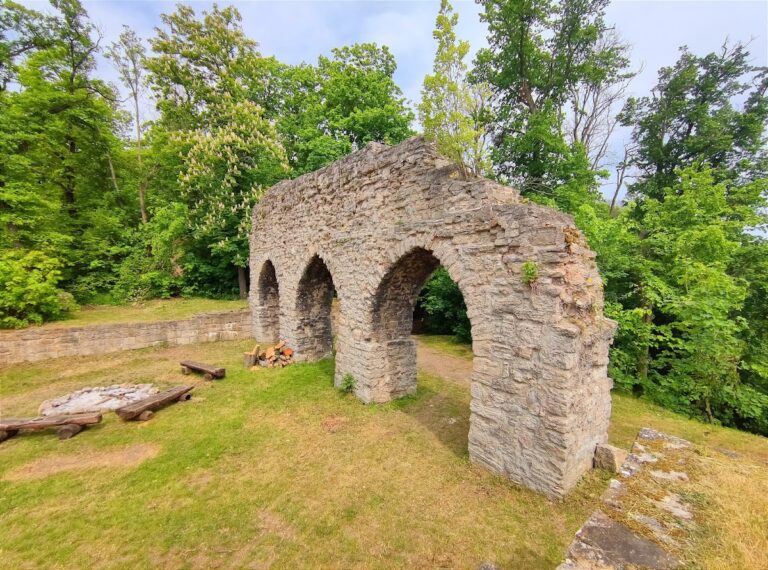
The palace occupied the Pfingstberg beneath the Kyffhäuser. Steep slopes naturally protected the main castle to the north, east, and south. Its defenses combined stone walls, palisades, earthworks, and ditches. The excavated complex includes both the main castle and an outer bailey, while a pincer gate, a fortified entrance whose projecting walls constrained approaching attackers, has been reconstructed. The site is partly reconstructed, and its surviving physical evidence consists chiefly of excavated foundations and rebuilt elements.
Castle defenses and excavated layout
Excavation revealed the foundations of 180 buildings across the palace complex. These included guardhouses, residential buildings, and numerous service and economic structures, showing the range of activities supported within the royal estate. The earthworks and ditches, together with the reconstructed gate and surviving wall fragments, express the defensive organization of the main castle and its outer bailey.
Residential and service buildings
The residential buildings included houses with ovens of the period’s baking-oven type. These ovens were built without chimneys. Two houses had underfloor heating, a system in which heat circulated beneath the floor and warmed the rooms from below. Together with the many service and economic buildings, these remains show the domestic and productive facilities that formed part of the palace complex.
Nearby sites